Визначення впливу температури аустенітизації, швидкості обертання зірочки та середовища загартування на мікроструктуру та твердість випаленої полум’ям шестеренної сталі
DOI:
https://doi.org/10.15587/1729-4061.2026.349675Ключові слова:
полум'яне гартування, середньовуглецева зубчаста сталь, мікроструктура, гартуюче середовище, поверхнева твердістьАнотація
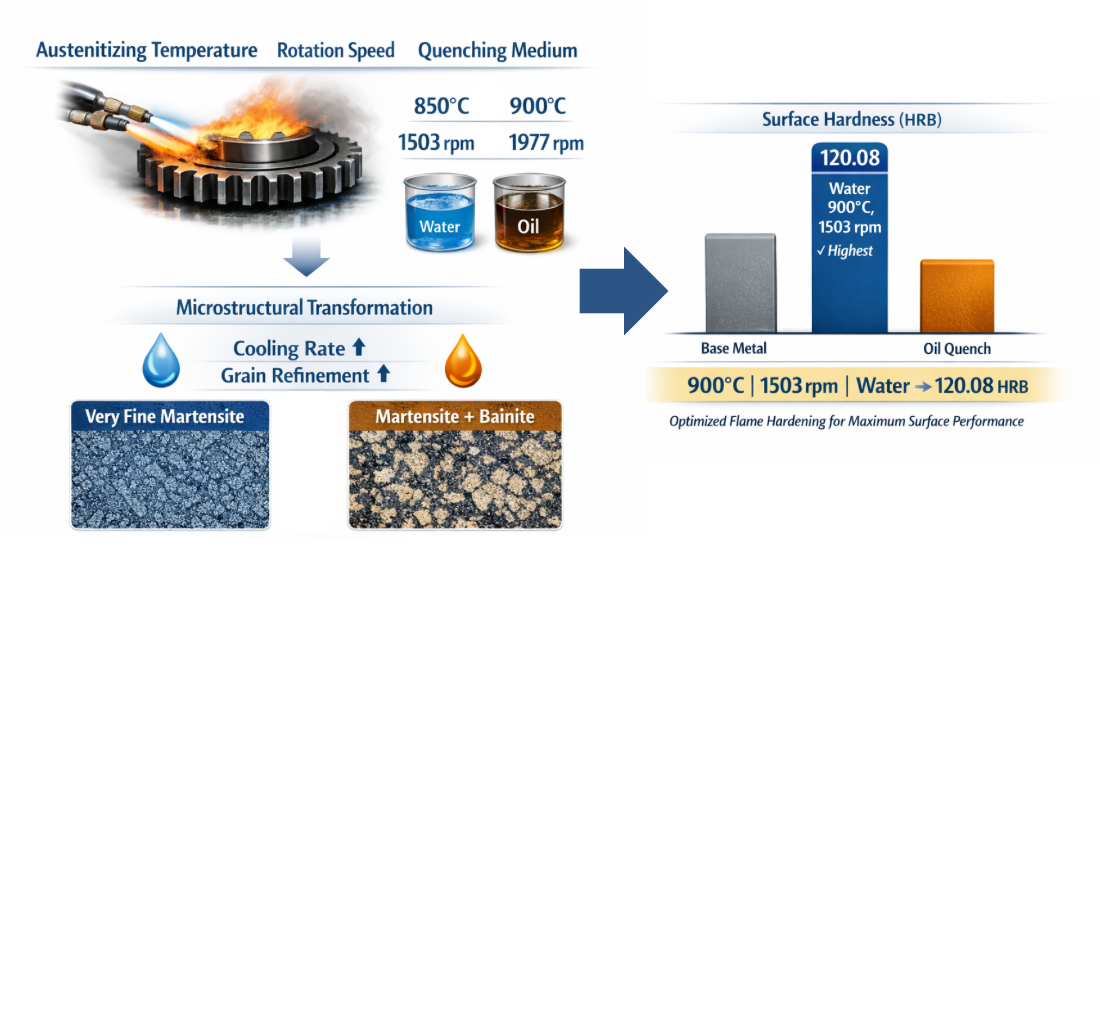
Об'єктом цього дослідження є середньовуглецева зубчаста сталь, яка зазвичай використовується для зірочок та шестерень у системах механічних приводів. Проблема, яку необхідно вирішити в цьому дослідженні, полягає в обмеженому розумінні комплексного впливу температури аустенізації, швидкості обертання зірочки та гартуючого середовища на твердість поверхні та еволюцію мікроструктури, що робить вибір параметрів полум'яного гартування в промисловості неоптимальним. Експерименти проводилися шляхом нагрівання середньовуглецевої зубчастої сталі до температур аустенізації 850°C та 900°C, швидкостей обертання 1503 об/хв та 1977 об/хв, з використанням води та олії як гартуючого середовища. Зразки оцінювали за допомогою твердоміра Роквелла (шкала B) та оптичної мікроскопії. Результат цього дослідження показує, що найвища поверхнева твердість 120,08 HRB досягається при температурі аустенізації 900°C, швидкості обертання 1503 об/хв та гартуванні водою. Це також підтверджується результатами мікроструктурних спостережень, які показують дуже дрібний мартенсит. Поверхневе зміцнення найбільше залежить від гартуючого середовища, тоді як швидкість обертання не має суттєвого впливу на підвищення твердості. При температурі аустенізації 900°C сталь перебуває в аустенітній фазі, тому збільшення швидкості обертання знижує твердість через надмірне підведення тепла та укрупнення зерен аустеніту. Відмінною особливістю цих результатів є виявлення механізмів взаємодії між часом термічної витримки та швидкістю охолодження. Отримані результати можуть бути практично застосовані до компонентів із середньовуглецевої зубчастої сталі, що піддаються контрольованому полум'яному гартуванню з безперервним обертанням зі швидкістю 1503–1977 об/хв з подальшим гартуванням у воді або олії, зокрема при термічній обробці зубчастих коліс та зірочок у малому та середньому масштабі промислового виробництва
Посилання
- Haiko, O., Pallaspuro, S., Javaheri, V., Kaikkonen, P., Ghosh, S., Valtonen, K., Kaijalainen, A., Kömi, J. (2023). High-stress abrasive wear performance of medium-carbon direct-quenched and partitioned, carbide-free bainitic, and martensitic steels. Wear, 526-527, 204925. https://doi.org/10.1016/j.wear.2023.204925
- Yu, Q., Zhao, Y., Zhao, F. (2025). Effect of austenitizing temperature on microstructure and mechanical properties of medium carbon spring steel. Materials Letters: X, 26, 100251. https://doi.org/10.1016/j.mlblux.2025.100251
- Fattah, R. N., Sugiyanto, S., Priyambodo, B. H., Nurhidayat, A., Yaqin, R. I. (2023). Rekayasa Peningkatan Kekerasan Permukaan Gear Sprocket Sepeda Motor dengan Metode Quenching Variasi Media Pendingin. Quantum Teknika: Jurnal Teknik Mesin Terapan, 5 (1), 8–13. https://doi.org/10.18196/jqt.v5i1.19418
- Gathmann, M., Tönnißen, N., Baron, C., Kostka, A., Steinbacher, M., Springer, H. (2024). Surface hardening of high modulus steels through carburizing and nitriding: First insights into microstructure property relationships. Surface and Coatings Technology, 494, 131354. https://doi.org/10.1016/j.surfcoat.2024.131354
- Thamilarasan, J., Karunagaran, N., Nanthakumar, P. (2021). Optimization of oxy-acetylene flame hardening parameters to analysis the surface structure of low carbon steel. Materials Today: Proceedings, 46, 4169–4173. https://doi.org/10.1016/j.matpr.2021.02.680
- Jeyaraj, S., Arulshri, K.P., Harshavardhan, K., Sivasakthivel, P.S. (2015). Optimization of Flame Hardening Process Parameters Using L9 Orthogonal Array of Taguchi Approach. International Journal of Engineering and Applied Sciences, 2. Available at: https://www.semanticscholar.org/paper/Optimization-of-Flame-Hardening-Process-Parameters-Jeyaraj-Arulshri/227823755df2ac8da50e005822418fa1e220d864
- Zhang, Y., Liu, W., Long, X., Liu, Z., Li, Y., Yang, Z., Zhang, Y. (2025). Combining in-situ technology to study the influence of bainite morphology on the strength and toughness properties of medium-carbon bainitic steel. Journal of Materials Research and Technology, 36, 34–44. https://doi.org/10.1016/j.jmrt.2025.03.106
- Luo, R., Chen, J., Ding, H., Zhang, P., Liao, J., Yu, Y. et al. (2025). The effect of quenching cooling rate on the microstructure and tensile/compressive behaviors of 2Cr12Ni martensitic stainless steel. Journal of Materials Research and Technology, 36, 2994–3006. https://doi.org/10.1016/j.jmrt.2025.03.227
- Ajoge, E. O., James, M. (2024). Influence of Different Quenching Media on the Mechanical Properties of Mild Steel – A Case Study of Coconut Oil, Mineral Oil, Jatropha Oil, and Water. Metall Alloy, 10, 1–8. Available at: https://journalspub.com/wp-content/uploads/2024/12/1-8Influence-of-Different-Quenching-Media.pdf
- Li, B., Bai, W., Yang, K., Hu, C., Wei, G., Liu, J. et al. (2024). Revealing the microstructural evolution and strengthening mechanism of Mg-5.5Gd-3Y-1Zn-0.5Mn alloy in centrifugal casting and subsequent hot rolling. Journal of Alloys and Compounds, 984, 173950. https://doi.org/10.1016/j.jallcom.2024.173950
- Kombayev, K., Nedobitkov, A., Gridunov, I., Kozhakhmetov, Y., Khoshnaw, F., Aibar, K. (2025). Surface crack analysis and quality enhancement of 30Х13 (AISI 420) martensitic stainless steel gate valve shutters via electrolytic plasma hardening. Results in Engineering, 26, 104966. https://doi.org/10.1016/j.rineng.2025.104966
- Oliaei, M., Jamaati, R., Jamshidi Aval, H. (2025). Optimizing microstructure and performance: The impact of pre-deformation and rotational speed on friction stir processed Cu-W composites. Journal of Advanced Joining Processes, 11, 100308. https://doi.org/10.1016/j.jajp.2025.100308
- Bararpour, S. M., Jamshidi Aval, H., Jamaati, R., Javidani, M. (2024). Effect of heat treatment before fast multiple rotation rolling on friction surfaced Al–Si–Cu alloy. Journal of Materials Research and Technology, 33, 940–953. https://doi.org/10.1016/j.jmrt.2024.09.119
- Kristiadi, S., Lesmanah, U., Raharjo, A. (2023). Pengaruh Variasi Media Pendingin Terhadap Kekerasan dan Mikrostruktur Pada Pengecoran Aluminium 6061. Ring Mechanical Engineering, 2(2), 101–112. https://doi.org/10.33474/rm.v2i2.19906
- Li, Q., Li, W., Li, M., Su, M., Hu, Z., Ma, H. et al. (2025). Improving the high stress abrasive wear resistance of medium carbon quenched and partitioned bainitic steel by controlling the phase transformation sequence. Journal of Materials Research and Technology, 38, 2808–2819. https://doi.org/10.1016/j.jmrt.2025.08.109
- Li, X., Li, Z., Dong, L., Liu, B., Wang, H., Shi, T. et al. (2025). Study of microstructure evolution and fatigue crack extension properties of 42CrMo steel strengthened by induction hardening. Journal of Materials Research and Technology, 35, 3887–3901. https://doi.org/10.1016/j.jmrt.2025.02.069
- Xin, M., Wang, Z., Lu, B., Li, Y. (2022). Effects of different process parameters on microstructure evolution and mechanical properties of 2060 Al–Li alloy during vacuum centrifugal casting. Journal of Materials Research and Technology, 21, 54–68. https://doi.org/10.1016/j.jmrt.2022.08.147
- Sundari, E., Taufikurrahman, Fahlevi, R. (2018). Analisa pengaruh pack carburizing terhadap sifat mekanis sprocket imitasi sepeda motor menggunakan arang kayu gelam dan serbuk cangkang remis sebagai katalisator. Austenit, 10 (2), 72–78. https://doi.org/10.5281/ZENODO.4547659
- ASTM E18-22. Standard Test Methods for Rockwell Hardness of Metallic Materials. https://doi.org/10.1520/e0018-22
- Ackermann, M., Iren, D., Wesselmecking, S., Shetty, D., Krupp, U. (2022). Automated segmentation of martensite-austenite islands in bainitic steel. Materials Characterization, 191, 112091. https://doi.org/10.1016/j.matchar.2022.112091
- Chakraborty, S., Björk, J., Dahlqvist, M., Rosen, J., Heintz, F. (2026). A survey of AI-supported materials informatics. Computer Science Review, 59, 100845. https://doi.org/10.1016/j.cosrev.2025.100845
- Ponhan, K., Jiandon, P., Juntaracena, K., Potisawang, C., Kongpuang, M. (2024). Enhanced microstructures, mechanical properties, and machinability of high performance ADC12/SiC composites fabricated through the integration of a master pellet feeding approach and ultrasonication-assisted stir casting. Results in Engineering, 24, 102937. https://doi.org/10.1016/j.rineng.2024.102937
- Pizetta Zordão, L. H., Oliveira, V. A., Totten, G. E., Canale, L. C. F. (2019). Quenching power of aqueous salt solution. International Journal of Heat and Mass Transfer, 140, 807–818. https://doi.org/10.1016/j.ijheatmasstransfer.2019.06.036
- Moshokoa, N. A., Makhatha, E., Raganya, L., Makoana, N. W., Mkhonto, D., Phasha, M. (2026). Study of phase constituents, microstructural evolution, tensile properties and micro-Vickers hardness of as-cast and water quenched Ti-Mo-Fe alloys. Results in Materials, 29, 100885. https://doi.org/10.1016/j.rinma.2026.100885
- dos Santos, S. L., Santos, S. F. (2024). Heat treatment of the SAE 9254 spring steel: Influence of cooling rate on the microstructure and microhardness. Next Materials, 3, 100175. https://doi.org/10.1016/j.nxmate.2024.100175
- Arabacı, U. (2024). The effects of oil-quenching and over-tempering heat treatments on the dry sliding wear behaviours of 25CrMo4 steel. Heliyon, 10 (3), e25589. https://doi.org/10.1016/j.heliyon.2024.e25589
- Zhang, L., Miao, Y., Wang, J., Zhang, M., Liu, Y., Zhou, Y. et al. (2025). Research on the microstructural differences and mechanical response mechanisms of martensitic stainless steel additive manufacturing under cross-scale heat input control. Materials & Design, 260, 115132. https://doi.org/10.1016/j.matdes.2025.115132
##submission.downloads##
Опубліковано
Як цитувати
Номер
Розділ
Ліцензія
Авторське право (c) 2026 Agus Suprapto, Jumiadi Jumiadi, Pungky Eka Setyawan, Mesti Nadya, Sergius Sadu

Ця робота ліцензується відповідно до Creative Commons Attribution 4.0 International License.
Закріплення та умови передачі авторських прав (ідентифікація авторства) здійснюється у Ліцензійному договорі. Зокрема, автори залишають за собою право на авторство свого рукопису та передають журналу право першої публікації цієї роботи на умовах ліцензії Creative Commons CC BY. При цьому вони мають право укладати самостійно додаткові угоди, що стосуються неексклюзивного поширення роботи у тому вигляді, в якому вона була опублікована цим журналом, але за умови збереження посилання на першу публікацію статті в цьому журналі.
Ліцензійний договір – це документ, в якому автор гарантує, що володіє усіма авторськими правами на твір (рукопис, статтю, тощо).
Автори, підписуючи Ліцензійний договір з ПП «ТЕХНОЛОГІЧНИЙ ЦЕНТР», мають усі права на подальше використання свого твору за умови посилання на наше видання, в якому твір опублікований. Відповідно до умов Ліцензійного договору, Видавець ПП «ТЕХНОЛОГІЧНИЙ ЦЕНТР» не забирає ваші авторські права та отримує від авторів дозвіл на використання та розповсюдження публікації через світові наукові ресурси (власні електронні ресурси, наукометричні бази даних, репозитарії, бібліотеки тощо).
За відсутності підписаного Ліцензійного договору або за відсутністю вказаних в цьому договорі ідентифікаторів, що дають змогу ідентифікувати особу автора, редакція не має права працювати з рукописом.
Важливо пам’ятати, що існує і інший тип угоди між авторами та видавцями – коли авторські права передаються від авторів до видавця. В такому разі автори втрачають права власності на свій твір та не можуть його використовувати в будь-який спосіб.