Determining the loading on the body of a covered wagon modernized for container transportation
DOI:
https://doi.org/10.15587/1729-4061.2026.360214Keywords:
railroad transport, covered wagon, modernization of car body structure, body strength, container transportationAbstract
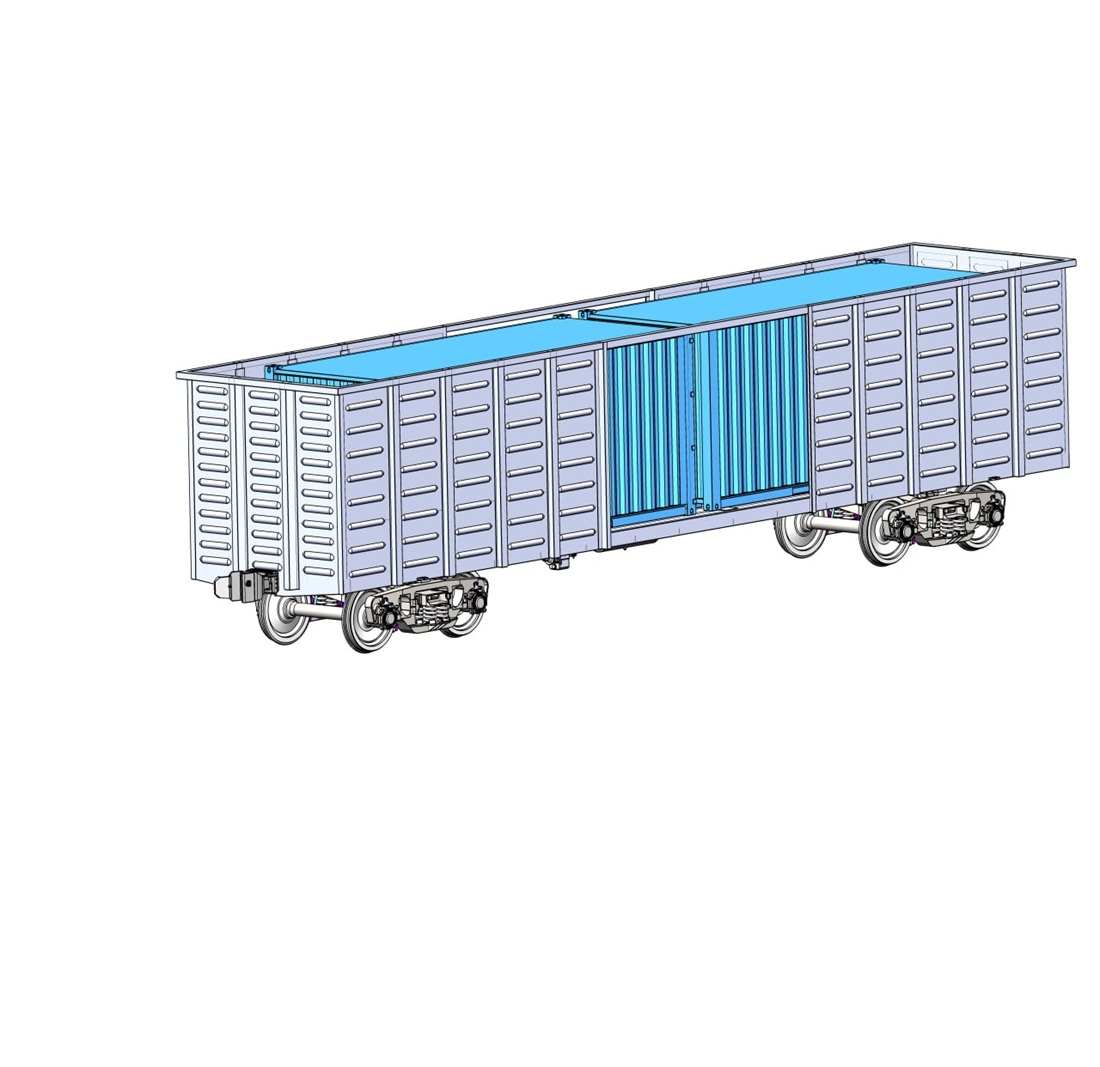
This study investigates the process of loading the body of a covered hopper railroad car, modernized for container transportation. The task addressed is to improve the efficiency of container transportation by rail. To this end, it is proposed to use covered wagons taking into account the modernization of their structure. The modernization involves dismantling the roof and placing fitting stops on the floor for fastening containers.
The study was conducted using a universal covered wagon, model 11-217, as an example. The strength of the covered wagon body was calculated when it is subjected to vertical loads from containers, as well as the simultaneous action of vertical and longitudinal loads. It was established that when the body of the covered wagon is subjected to vertical loads, the maximum stresses in its structure are 8.3% lower than the permissible ones. When vertical and longitudinal loads are simultaneously applied, the maximum stresses in the body are 4% lower than the permissible ones. The calculation results prove that the strength of the covered wagon body, taking into account the proposed modernization, is maintained.
A feature of the proposed modernization is the fact that, if necessary, the design of the covered wagon body can be returned to its original state.
The scope of practical application of the results is railroad transport.
A condition for using the findings is the symmetrical placement of the fitting stops relative to the transverse axis of the covered wagon body, which is due to the need to ensure uniform loading of both car bogies.
This study will contribute to increasing the efficiency of container transportation by rail and container transportation in general
References
- Panchenko, S., Lovska, A., Muradian, A., Pelypenko, Y., Rukavishnykov, P., Demydiukov, O. (2024). Identifying possible ways for adapting an open wagon for transporting containers. Eastern-European Journal of Enterprise Technologies, 5 (7 (131)), 6–14. https://doi.org/10.15587/1729-4061.2024.311324
- Berescu, C., Fratila, C., Axinte, T., Diaconu, M., Cojocaru, R. (2020). The mechanism’s study of fixing a container on a freight wagon type Rgs. IOP Conference Series: Materials Science and Engineering, 916 (1), 12010. https://doi.org/10.1088/1757-899x/916/1/012010
- Chandra Prakash Shukla, Bharti, P. K. (2015). Study and Analysis of Doors of BCNHL Wagons. International Journal of Engineering Research And, 4 (04). https://doi.org/10.17577/ijertv4is041031
- Lee, W. G., Kim, J.-S., Sun, S.-J., Lim, J.-Y. (2016). The next generation material for lightweight railway car body structures: Magnesium alloys. Proceedings of the Institution of Mechanical Engineers, Part F: Journal of Rail and Rapid Transit, 232 (1), 25–42. https://doi.org/10.1177/0954409716646140
- Lee, H.-A., Jung, S.-B., Jang, H.-H., Shin, D.-H., Lee, J. U., Kim, K. W., Park, G.-J. (2015). Structural-optimization-based design process for the body of a railway vehicle made from extruded aluminum panels. Proceedings of the Institution of Mechanical Engineers, Part F: Journal of Rail and Rapid Transit, 230 (4), 1283–1296. https://doi.org/10.1177/0954409715593971
- Reidemeister, O. H., Kalashnyk, V. O., Shykunov, O. A. (2016). Modernization as a way to improve the use of universal cars. Science and Transport Progress, 2 (62), 148–156. https://doi.org/10.15802/stp2016/67334
- Fomin, O., Lovska, A., Klymash, A., Keremet, M. (2021). Improvement of covered wagons of the “East-West” type by sectioning with a partition. Eastern-European Journal of Enterprise Technologies, 5 (7 (113)), 36–43. https://doi.org/10.15587/1729-4061.2021.239751
- Shaposhnyk, V., Shykunov, O., Reidemeister, A., Muradian, L., Potapenko, O. (2021). Determining the possibility of using removable equipment for transporting 20- and 40-feet-long containers on an universal platform wagon. Eastern-European Journal of Enterprise Technologies, 1 (7 (109)), 14–21. https://doi.org/10.15587/1729-4061.2021.225090
- Blatnický, M., Dižo, J., Timoščuk, M. (2016). Design of a Three-Finger Robot Manipulator. Manufacturing Technology, 16 (3), 485–489. https://doi.org/10.21062/ujep/x.2016/a/1213-2489/mt/16/3/485
- Dižo, J., Harušinec, J., Blatnický, M. (2015). Multibody System of a Rail Vehicle Bogie with a Flexible Body. Manufacturing Technology, 15 (5), 781–788. https://doi.org/10.21062/ujep/x.2015/a/1213-2489/mt/15/5/781
- Dižo, J., Blatnický, M., Melnik, R., Karľa, M. (2022). Improvement of Steerability and Driving Safety of an Electric Three-Wheeled Vehicle by a Design Modification of its Steering Mechanism. LOGI – Scientific Journal on Transport and Logistics, 13 (1), 49–60. https://doi.org/10.2478/logi-2022-0005
- Kowalski, S., Cieślikowski, B., Barta, D., Dižo, J., Dittrich, A. (2023). Analysis of the Operational Wear of the Combustion Engine Piston Pin. Lubricants, 11 (3), 100. https://doi.org/10.3390/lubricants11030100
- Goolak, S., Kyrychenko, M. (2022). Thermal Model of the Output Traction Converter of an Electric Locomotive with Induction Motors. Problems of the Regional Energetics, 3 (55), 1–16. https://doi.org/10.52254/1857-0070.2022.3-55.01
- Goolak, S., Gorobchenko, O., Petrychenko, O., Holub, H., Kulbovskyi, I. (2025). Traction Drive Control System for Railway Electric Rolling Stock Based on the Application of Power Factor as an Optimization Criterion. Problems of the Regional Energetics, 3 (67), 1–12. https://doi.org/10.52254/1857-0070.2025.3-67.01
- Kondratiev, A., Píštěk, V., Gajdachuk, V., Kharchenko, M., Nabokina, T., Kučera, P., Kučera, O. (2023). Effect of Ply Orientation on the Mechanical Performance of Carbon Fibre Honeycomb Cores. Polymers, 15 (11), 2503. https://doi.org/10.3390/polym15112503
- Dižo, J., Steišunas, S., Blatnický, M. (2017). Vibration Analysis of a Coach with the Wheel-flat Due to Suspension Parameters Changes. Procedia Engineering, 192, 107–112. https://doi.org/10.1016/j.proeng.2017.06.019
Downloads
Published
How to Cite
Issue
Section
License
Copyright (c) 2026 Sergii Panchenko, Alyona Lovska, Arsen Muradian, Yevhen Pelypenko, Valentyna Romakh

This work is licensed under a Creative Commons Attribution 4.0 International License.
The consolidation and conditions for the transfer of copyright (identification of authorship) is carried out in the License Agreement. In particular, the authors reserve the right to the authorship of their manuscript and transfer the first publication of this work to the journal under the terms of the Creative Commons CC BY license. At the same time, they have the right to conclude on their own additional agreements concerning the non-exclusive distribution of the work in the form in which it was published by this journal, but provided that the link to the first publication of the article in this journal is preserved.
A license agreement is a document in which the author warrants that he/she owns all copyright for the work (manuscript, article, etc.).
The authors, signing the License Agreement with TECHNOLOGY CENTER PC, have all rights to the further use of their work, provided that they link to our edition in which the work was published.
According to the terms of the License Agreement, the Publisher TECHNOLOGY CENTER PC does not take away your copyrights and receives permission from the authors to use and dissemination of the publication through the world's scientific resources (own electronic resources, scientometric databases, repositories, libraries, etc.).
In the absence of a signed License Agreement or in the absence of this agreement of identifiers allowing to identify the identity of the author, the editors have no right to work with the manuscript.
It is important to remember that there is another type of agreement between authors and publishers – when copyright is transferred from the authors to the publisher. In this case, the authors lose ownership of their work and may not use it in any way.








