Розробка методу визначення довжини серії артилерійського вогню на основі ймовірнісно-аналітичного моделювання та нечіткого багатокритеріального оцінювання
DOI:
https://doi.org/10.15587/1729-4061.2026.361486Ключові слова:
артилерійська стрільба, вогнева серія, ймовірнісно-аналітичне моделювання, нечітка логіка, багатокритеріальне оцінюванняАнотація
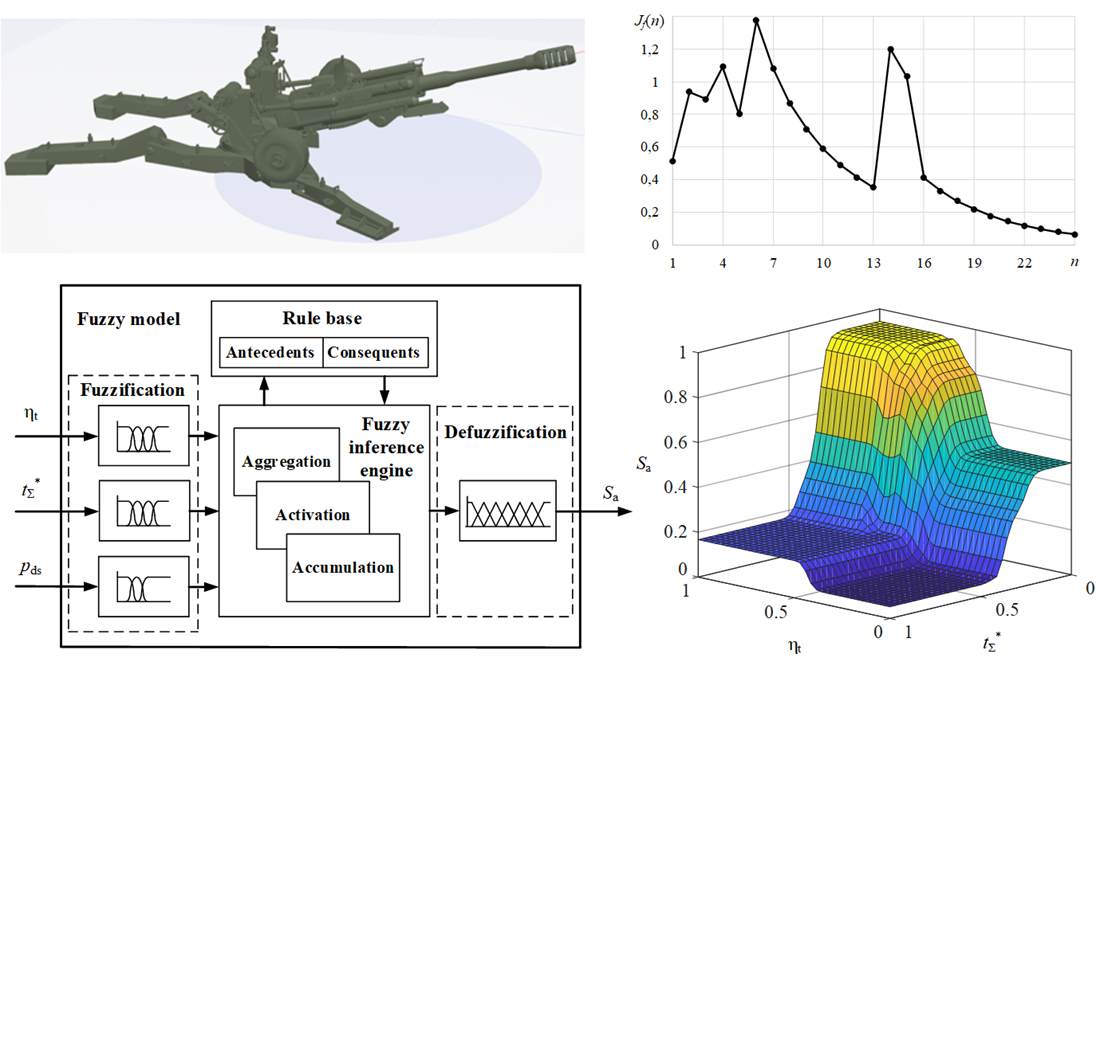
Об'єктом дослідження є процеси керування вогнем артилерійських установок в умовах невизначених збурень при застосуванні тактики «shoot-and-scoot». Вирішується проблема підвищення ефективності артилерійського вогню та скорочення часу виконання вогневих завдань шляхом оптимального вибору кількості пострілів у серії.
Для оцінки ефективності стрільби, часу виконання завдань та ризику ураження артилерійської установки за різних значень довжини вогневої серії застосовано методи ймовірнісно-аналітичного моделювання. Для вибору найкращого рішення за набором суперечливих критеріїв використовується апарат нечіткої логіки, що дозволяє формалізувати процес прийняття рішень в умовах невизначеності.
Розроблено метод визначення раціональної довжини серій стрільби, що передбачає формування узагальненого критерію, пошук множини локальних максимумів та їх подальшу оцінку за допомогою нечіткої моделі. Запропонований підхід дозволяє врахувати вплив випадкових збурень, зокрема можливе стрибкоподібне збільшення зносу ствола під час виконання серій стрільби.
Отримано результати обчислювальних експериментів, що підтверджують ефективність запропонованого методу. Було виявлено, що забезпечується підвищення ефективності стрільби на 11,6–20,8% порівняно з підходом фіксованої довжини вогневих серій, а також скорочення часу виконання вогневих завдань до 31,6%. Крім того, у більшості випадків спостерігається зменшення загального часу перебування установок на вогневих позиціях, що свідчить про зниження ризику ураження контрбатарейними засобами.
Розроблений метод може бути застосований у системах керування сучасними артилерійськими установками для підвищення ефективності їх бойового застосування в умовах невизначеності.
Посилання
- Chávez, K., Swed, O. (2023). Emulating underdogs: Tactical drones in the Russia-Ukraine war. Contemporary Security Policy, 44 (4), 592–605. https://doi.org/10.1080/13523260.2023.2257964
- Ganjiyev, S. J., Usmonov, S. R., Karimov, A. Kh. (2023). Use of artillery in modern war: a brief analysis of the Ukrainian conflict. Galaxy International Interdisciplinary Research Journal, 11 (3), 118–121. Available at: https://internationaljournals.co.in/index.php/giirj/article/view/3646
- Oprean, L.-G. (2020). Artillery from the Perspective of Firing Effects and Ensured Capabilities. Scientific Bulletin, 25 (2), 107–113. https://doi.org/10.2478/bsaft-2020-0015
- Zha, Q., Rui, X., Liu, F., Yu, H. (2017). Study On the Dynamic Modeling and the Correction Method of the Self-Propelled Artillery. Proceedings of the 2017 7th International Conference on Mechatronics, Computer and Education Informationization (MCEI 2017). Atlantis Press, 385–393. https://doi.org/10.2991/mcei-17.2017.84
- Kislitsyn, A., Dorofeev, N. (2021). Directions for the development of domestic self-propelled artillery systems based on the analysis of samples of artillery weapons from the leading countries of the world. Social Development and Security, 11 (6), 98–107. https://doi.org/10.33445/sds.2021.11.6.7
- Xiao, H., Yang, G., Ge, J. (2017). Surrogate-based multi-objective optimization of firing accuracy and firing stability for a towed artillery. Journal of Vibroengineering, 19 (1), 290–301. https://doi.org/10.21595/jve.2016.17108
- Wang, X., Li, X., Sun, Q., Xia, C., Chen, Y.-H. (2025). Improved Manta Ray Foraging Optimization for PID Control Parameter Tuning in Artillery Stabilization Systems. Biomimetics, 10 (5), 266. https://doi.org/10.3390/biomimetics10050266
- Zhuravlev, А, Orlov, S., Shuliakov, S. (2020). Mathematical model of the flight path of a projectile of a long-range artillery system. Systems of Arms and Military Equipment, 3 (63), 62–68. https://doi.org/10.30748/soivt.2020.63.09
- Khalil, M. (2022). Study on modeling and production inaccuracies for artillery firing. Archive of Mechanical Engineering, 69 (1), 165–183. https://doi.org/10.24425/ame.2021.139802
- STANAG 4355 The Lieske modified point mass and five degrees of freedom trajectory models -AOP-4355 EDITION A. (No enabled versions). (2022) Washington: United States Department of Defense. Available at: https://publishers.standardstech.com/content/military-dod-stanag-4355 Last accessed: 14.11.2023
- Bartulović, V., Trzun, Z., Hoić, M. (2023). Use of Unmanned Aerial Vehicles in Support of Artillery Operations, Strategos, 7 (1), 71–92. Available at: https://hrcak.srce.hr/305562
- Oprean, L.-G. (2023). Artillery and Drone Action Issues in the War in Ukraine. Scientific Bulletin, 28 (1), 73–78. https://doi.org/10.2478/bsaft-2023-0008
- Khudov, H., Yuzova, I., Lisohorskyi, B., Solomonenko, Y., Mykus, S., Irkha, A. et al. (2021). Development of methods for determining the coordinates of firing positions of roving mortars by a network of counter-battery radars, EUREKA: Physics and Engineering, 3, 140-150. https://doi.org/10.21303/2461-4262.2021.001821
- Świętochowski, N. (2023). Field Artillery in the defensive war of Ukraine 2022–2023. Part I. Combat potential, tasks and tactics. Scientific Journal of the Military University of Land Forces, 210 (4), 341–358. https://doi.org/10.5604/01.3001.0054.1631
- Świętochowski, N. (2024). Field Artillery in the defensive war of Ukraine 2022-2023. Part II. Methods of task implementation. Scientific Journal of the Military University of Land Forces, 211 (1), 57–76. https://doi.org/10.5604/01.3001.0054.4136
- Shen, C., Zhou, K.-D., Lu, Y., Li, J.-S. (2019). Modeling and simulation of bullet-barrel interaction process for the damaged gun barrel. Defence Technology, 15(6), 972–986. https://doi.org/10.1016/j.dt.2019.07.009
- Shim, Y., Atkinson, M. P. (2018). Analysis of artillery shoot‐and‐scoot tactics. Naval Research Logistics (NRL), 65 (3), 242–274. https://doi.org/10.1002/nav.21803
- Damgaard, T. J., Rittri, M. (2025). Optimizing Firing Position Usage for Survivability and Effectiveness in Artillery Shoot-and-Scoot Tactics. SAE Technical Paper Series, 1. https://doi.org/10.4271/2025-01-0431
- Dobrynin, Y., Maksymov, M., Boltenkov, V. (2020). Development of a method for determining the wear of artillery barrels by acoustic fields of shots. Eastern-European Journal of Enterprise Technologies, 3 (5 (105)), 6–18. https://doi.org/10.15587/1729-4061.2020.206114
- Choi, Y. B., Yun, H. Y., Kim, J. y., Jin, S. H., Kim, K. S. (2019). Robust Optimization Approach Using Scenario Concepts for Artillery Firing Scheduling Under Uncertainty. Applied Sciences, 9 (14), 2811. https://doi.org/10.3390/app9142811
- Sun, Y., Zhang, S., Lu, G., Zhao, J., Tian, J., Xue, J. (2022). Research on a Simulation Algorithm for Artillery Firepower Assignment According to Region. 2022 3rd International Conference on Computer Science and Management Technology (ICCSMT). Shanghai, 353–356. https://doi.org/10.1109/iccsmt58129.2022.00082
- Grishyn, M., Maksymova, O., Kirkopulo, K., Klymchuk, O. (2025). Development of methods of artillery control for suppression of an enemy amphibious operation in video game simulations. Technology Audit and Production Reserves, 1 (2 (81)), 26–33. https://doi.org/10.15587/2706-5448.2025.321797
- Raskin, L., Sira, O. (2020). Development of methods for extension of the conceptual and analytical framework of the fuzzy set theory. Eastern-European Journal of Enterprise Technologies, 6 (4 (108)), 14–21. https://doi.org/10.15587/1729-4061.2020.217630
- Congxiang, L., Kozlov, O., Kondratenko, G., Aleksieieva, A.; Kondratenko, Y. P., Shevchenko, A. I. (Eds.) (2024). Decision Support System for Maintenance Planning of Vortex Electrostatic Precipitators Based on IoT and AI Techniques. Research Tendencies and Prospect Domains for AI Development and Implementation. New York: River Publishers, 87–105. https://doi.org/10.1201/9788770046947-5
- Skakodub, O., Kozlov, O., Kondratenko, Y. (2021). Optimization of Linguistic Terms’ Shapes and Parameters: Fuzzy Control System of a Quadrotor Drone. 2021 11th IEEE International Conference on Intelligent Data Acquisition and Advanced Computing Systems: Technology and Applications (IDAACS), 566–571. https://doi.org/10.1109/idaacs53288.2021.9660926
- Kozlov, O. (2021). Information Technology for Designing Rule bases of Fuzzy Systems using Ant Colony Optimization. International Journal of Computing, 20 (4), 471–486. https://doi.org/10.47839/ijc.20.4.2434
- Kozlov, O., Kondratenko, G., Aleksieieva, A., Maksymov, M., Tarakhtij, O. (2024). Swarm optimization of the drone’s intelligent control system: comparative analysis of hybrid techniques, CEUR Workshop Proceedings, 3790. Available at: https://ceur-ws.org/Vol-3790/paper01.pdf
- Kumar, D., Kalra, S., Jha, M. S. (2022). A concise review on degradation of gun barrels and its health monitoring techniques. Engineering Failure Analysis, 142, 106791. https://doi.org/10.1016/j.engfailanal.2022.106791
- Litsman, A., Nesterov, D. (2020). Definitions degree of influence of individual factors on mechanical equipment failure rate during artillery operation. Collection of Scientific Works of the National Academy of the State Border Guard Service of Ukraine. Series: Military and Technical Sciences, 80 (2), 283–299. https://doi.org/10.32453/3.v80i2.204
- Boltenkov, V., Brunetkin, O., Dobrynin, Y., Maksymova, O., Kuzmenko, V., Gultsov, P. et al. (2021). Devising a method for improving the efficiency of artillery shooting based on the Markov model. Eastern-European Journal of Enterprise Technologies, 6 (3 (114)), 6–17. https://doi.org/10.15587/1729-4061.2021.245854
- Zheng, Y., Wang, J., Kozlov, O., Kondratenko, G., Aleksieieva, A.; Shevchenko, A. I., Kondratenko, Y. P. (Eds.) (2026). Optimization-oriented Synthesis of Rule Bases of Intelligent Systems: Application Features for Complex Plants’ Control. Artificial Intelligence: Achievements and Recent Developments. River Publishers, 83–111. https://doi.org/10.1201/9788743800989-4
- Rakityanska, G. B. (2015). Fuzzy classification knowledge base construction based on trend rules and inverse inference. Eastern-European Journal of Enterprise Technologies, 1 (3 (73)), 25–32. https://doi.org/10.15587/1729-4061.2015.36934
- Pujaru, K., Adak, S., Kar, T. K., Patra, S., Jana, S. (2024). A Mamdani fuzzy inference system with trapezoidal membership functions for investigating fishery production. Decision Analytics Journal, 11, 100481. https://doi.org/10.1016/j.dajour.2024.100481
- Chaudhari, T. U., Patel, V. B., Thakkar, R. G., Singh, C. (2023). Comparative analysis of Mamdani, Larsen and Tsukamoto methods of fuzzy inference system for students’ academic performance evaluation. International Journal of Science and Research Archive, 9 (1), 517–523. https://doi.org/10.30574/ijsra.2023.9.1.0443
- Maksymov, M., Kozlov, O., Shynder, A., Maksymova, O., Aleksieieva, A. (2025). Development of mathematical models for temperature control objects in thermal destruction systems based on transient process identification. EUREKA: Physics and Engineering, 3, 207–220. https://doi.org/10.21303/2461-4262.2025.003802
- Kondratenko, Y., Kozlov, O., Zheng, Y., Wang, J., Kuzmenko, V., Aleksieieva, A. (2024). Bio-inspired optimization of fuzzy control system for inspection robotic platform: comparative analysis of hybrid swarm methods. CEUR Workshop Proceedings, 3711. Available at: https://ceur-ws.org/Vol-3711/paper7.pdf
- Kozlov, O., Kondratenko, G., Aleksieieva, A. Maksymov, M. (2025). Complex Structural-Parametric Optimization of Fuzzy Control Systems Based on Bioinspired Algorithms, CEUR Workshop Proceedings, 4048. Available at: https://ceur-ws.org/Vol-4048/paper01.pdf
##submission.downloads##
Опубліковано
Як цитувати
Номер
Розділ
Ліцензія
Авторське право (c) 2026 Maksym Maksymov, Oleksiy Kozlov, Oleksiy Maksymov, Ruslan Riaboshapka

Ця робота ліцензується відповідно до Creative Commons Attribution 4.0 International License.
Закріплення та умови передачі авторських прав (ідентифікація авторства) здійснюється у Ліцензійному договорі. Зокрема, автори залишають за собою право на авторство свого рукопису та передають журналу право першої публікації цієї роботи на умовах ліцензії Creative Commons CC BY. При цьому вони мають право укладати самостійно додаткові угоди, що стосуються неексклюзивного поширення роботи у тому вигляді, в якому вона була опублікована цим журналом, але за умови збереження посилання на першу публікацію статті в цьому журналі.
Ліцензійний договір – це документ, в якому автор гарантує, що володіє усіма авторськими правами на твір (рукопис, статтю, тощо).
Автори, підписуючи Ліцензійний договір з ПП «ТЕХНОЛОГІЧНИЙ ЦЕНТР», мають усі права на подальше використання свого твору за умови посилання на наше видання, в якому твір опублікований. Відповідно до умов Ліцензійного договору, Видавець ПП «ТЕХНОЛОГІЧНИЙ ЦЕНТР» не забирає ваші авторські права та отримує від авторів дозвіл на використання та розповсюдження публікації через світові наукові ресурси (власні електронні ресурси, наукометричні бази даних, репозитарії, бібліотеки тощо).
За відсутності підписаного Ліцензійного договору або за відсутністю вказаних в цьому договорі ідентифікаторів, що дають змогу ідентифікувати особу автора, редакція не має права працювати з рукописом.
Важливо пам’ятати, що існує і інший тип угоди між авторами та видавцями – коли авторські права передаються від авторів до видавця. В такому разі автори втрачають права власності на свій твір та не можуть його використовувати в будь-який спосіб.