Development a computationally efficient method to solve direct and inverse aerodynamic problems related to turbomachines
DOI:
https://doi.org/10.15587/1729-4061.2026.365474Keywords:
inverse problem, flow function, Euler equation, quasi-three-dimensional flow, flow section, aerodynamic designAbstract
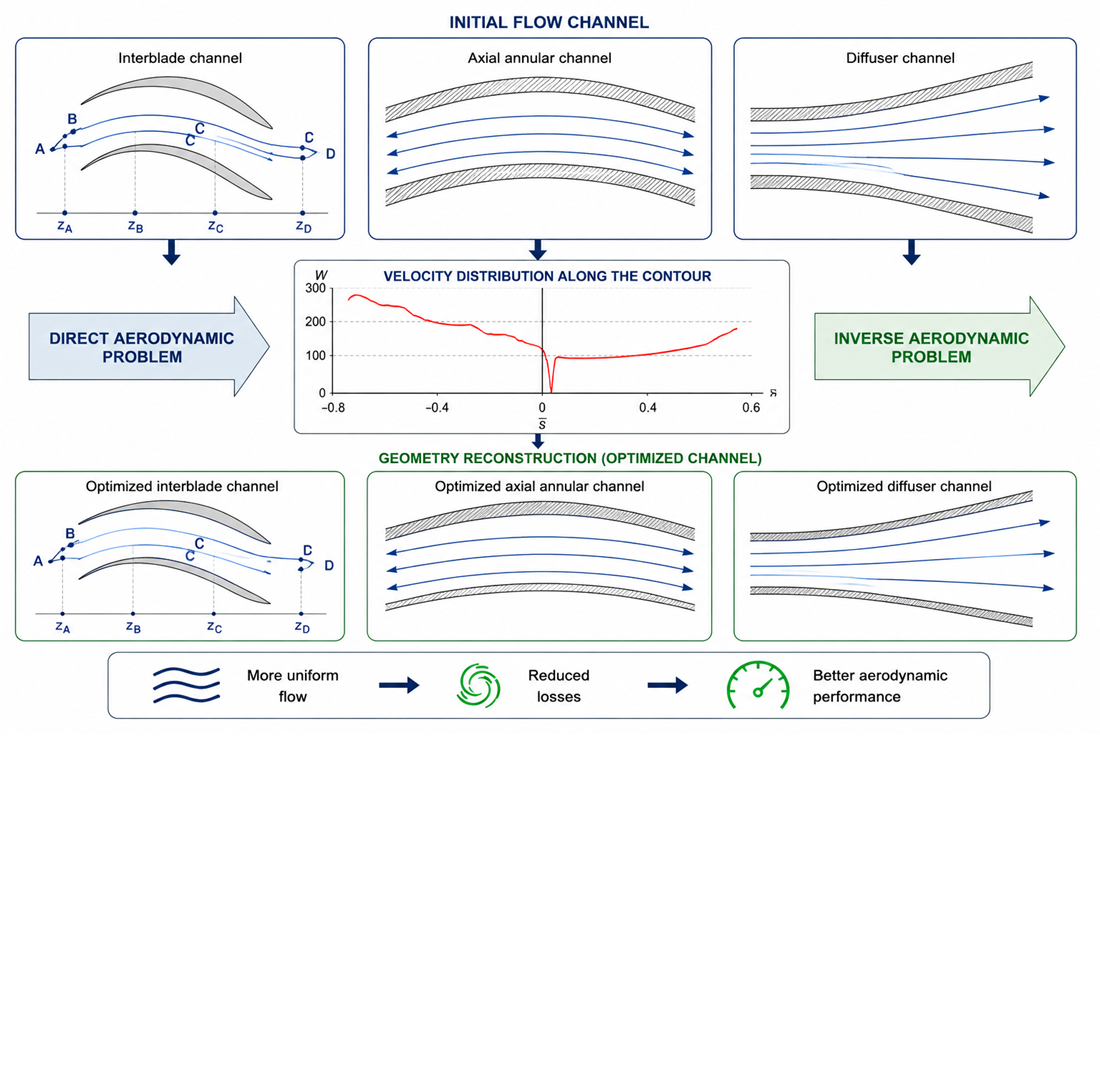
This study investigates aerodynamic processes in interblade, axial annular, and radial-axial channels in turbomachines. The task addressed relates to the need to improve the computational efficiency in solving direct and inverse aerodynamic problems when analyzing and designing flow parts of turbomachines.
A computationally efficient method for solving direct and inverse aerodynamic problems has been proposed, which provides acceptable accuracy for engineering practice at significantly lower computational costs compared to conventional CFD approaches. The results include a devised single mathematical formulation based on Euler equations for a compressible fluid, written in terms of the flow function.
The proposed method makes it possible to consider direct and inverse problems within a common mathematical structure. The system of equations is reduced to a single differential equation and a set of algebraic relations while the global flow problem is decomposed into a set of independent problems for individual cross-sections. The inverse problem is stated as a nonlinear optimization problem based on the mass flow rate agreement condition derived from the energy equation. The computational complexity is reduced by using the flow function and the decomposition of the computational domain.
The method combines the capabilities of direct analysis and reconstruction of the flow channel geometry based on the predefined aerodynamic characteristics. Verification by experimental data and direct calculation results demonstrated good agreement between the velocity distributions and the reconstructed geometry; the maximum deviations did not exceed 0.3%.
The results could be practically applied to preliminary design, parametric optimization, as well as inverse design of the flow parts in turbomachines
References
- Denton, J. D. (1983). An Improved Time-Marching Method for Turbomachinery Flow Calculation. Journal of Engineering for Power, 105 (3), 514–521. https://doi.org/10.1115/1.3227444
- Denton, J. D. (1993). The 1993 IGTI Scholar Lecture: Loss Mechanisms in Turbomachines. Journal of Turbomachinery, 115 (4), 621–656. https://doi.org/10.1115/1.2929299
- Dawes, W. N. (1993). The Extension of a Solution-Adaptive Three-Dimensional Navier–Stokes Solver Toward Geometries of Arbitrary Complexity. Journal of Turbomachinery, 115 (2), 283–295. https://doi.org/10.1115/1.2929234
- Denton, J. D., Dawes, W. N. (1998). Computational fluid dynamics for turbomachinery design. Proceedings of the Institution of Mechanical Engineers, Part C: Journal of Mechanical Engineering Science, 213 (2), 107–124. https://doi.org/10.1243/0954406991522211
- Dawes, W. N. (2007). Turbomachinery computational fluid dynamics: asymptotes and paradigm shifts. Philosophical Transactions of the Royal Society A: Mathematical, Physical and Engineering Sciences, 365 (1859), 2553–2585. https://doi.org/10.1098/rsta.2007.2021
- Sandberg, R. D., Michelassi, V. (2019). The Current State of High-Fidelity Simulations for Main Gas Path Turbomachinery Components and Their Industrial Impact. Flow, Turbulence and Combustion, 102 (4), 797–848. https://doi.org/10.1007/s10494-019-00013-3
- Sandberg, R. D., Michelassi, V. (2022). Fluid Dynamics of Axial Turbomachinery: Blade- and Stage-Level Simulations and Models. Annual Review of Fluid Mechanics, 54 (1), 255–285. https://doi.org/10.1146/annurev-fluid-031221-105530
- Slotnick, J., Khodadoust, A., Alonso, J., Darmofal, D., Gropp, W., Lurie, E., Mavriplis, D. J (2014). CFD Vision 2030 Study: A Path to Revolutionary Computational Aerosciences. NASA Technical Report. Available at: https://ntrs.nasa.gov/citations/20140003093
- Wheeler, A. P. S. (2024). High fidelity simulation of dense vapours with thermodynamic consistent modelling. Computers & Fluids, 268, 106088. https://doi.org/10.1016/j.compfluid.2023.106088
- Zhang, E., Watanabe, T., Lai, Z., Bai, B. (2024). A compressible flow solver for turbomachinery of the real gases with strongly variable properties. Energy, 290, 129915. https://doi.org/10.1016/j.energy.2023.129915
- Menter, F. R. (1994). Two-equation eddy-viscosity turbulence models for engineering applications. AIAA Journal, 32 (8), 1598–1605. https://doi.org/10.2514/3.12149
- Pope, S. B. (2000). Turbulent Flows. Cambridge University Press. https://doi.org/10.1017/cbo9780511840531
- Hammond, J., Pepper, N., Montomoli, F., Michelassi, V. (2022). Machine Learning Methods in CFD for Turbomachinery: A Review. International Journal of Turbomachinery, Propulsion and Power, 7 (2), 16. https://doi.org/10.3390/ijtpp7020016
- Waschkowski, F., Zhao, Y., Sandberg, R., Klewicki, J. (2022). Multi-objective CFD-driven development of coupled turbulence closure models. Journal of Computational Physics, 452, 110922. https://doi.org/10.1016/j.jcp.2021.110922
- Spalart, P. R. (2021). Hybrid RANS-LES Methods. Advanced Approaches in Turbulence, 133–159. https://doi.org/10.1016/b978-0-12-820774-1.00010-0
- Jameson, A. (1988). Aerodynamic design via control theory. Journal of Scientific Computing, 3 (3), 233–260. https://doi.org/10.1007/bf01061285
- Giles, M. B., Pierce, N. A. (2000). An Introduction to the Adjoint Approach to Design. Flow, Turbulence and Combustion, 65 (3-4), 393–415. https://doi.org/10.1023/a:1011430410075
- Shahpar, S. (2010). Optimisation Strategies Used in Turbomachinery Design from an Industrial Perspective. In book: INTRODUCTION TO OPTIMIZATION AND MULTIDISCIPLINARY DESIGN IN AERONAUTICS AND TURBOMACHINERY. Vol. 1. Chap. 7. Publisher: Von-Karmaan Institute (VKI). Available at: https://www.researchgate.net/publication/267763601_Optimisation_strategies_used_in_turbomachinery_design_from_an_industrial_perspective
- Li, Z., Zheng, X. (2017). Review of design optimization methods for turbomachinery aerodynamics. Progress in Aerospace Sciences, 93, 1–23. https://doi.org/10.1016/j.paerosci.2017.05.003
- Lavimi, R., Benchikh Le Hocine, A. E., Poncet, S., Marcos, B., Panneton, R. (2024). A review on aerodynamic optimization of turbomachinery using adjoint method. Proceedings of the Institution of Mechanical Engineers, Part C: Journal of Mechanical Engineering Science, 238 (13), 6405–6441. https://doi.org/10.1177/09544062231221625
- Wu, C.-H. (1952). A General Theory of Three-Dimensional Flow in Subsonic and Supersonic Turbomachines of Axial, Radial, and Mixed-Flow Types. Journal of Fluids Engineering, 74 (8), 1363–1380. https://doi.org/10.1115/1.4016114
- Novak, R. A., Hearsey, R. M. (1977). A Nearly Three-Dimensional Intrablade Computing System for Turbomachinery. Journal of Fluids Engineering, 99 (1), 154–166. https://doi.org/10.1115/1.3448517
- Davis, W. R., Millar, D. A. J. (1975). A Comparison of the Matrix and Streamline Curvature Methods of Axial Flow Turbomachinery Analysis, From a User’s Point of View. Journal of Engineering for Power, 97 (4), 549–558. https://doi.org/10.1115/1.3446059
- Denton, J. D. (1978). Throughflow Calculations for Transonic Axial Flow Turbines. Journal of Engineering for Power, 100 (2), 212–218. https://doi.org/10.1115/1.3446336
- Li, Z., Liu, Y. (2023). An Aerodynamic Loss Model for Axial Turbine Design. Journal of Turbomachinery, 145 (9). https://doi.org/10.1115/1.4062804
- Subbotovich, V. P., Yudin, A. Yu. (2004). Zadacha rascheta skorosti na poverhnosti lopatki turbomashiny kak zadacha optimizacii. Vestnik Nacionalnogo tehnicheskogo universiteta «HPI», 12, 101–106.
- Subbotovich, V. P., Yudin, A. Yu., Fan, K. T. (2008). Obtekanie trehmernym potokom reshetki profilej turbomashiny na poverhnosti vrasheniya. Vestnik Nacionalnogo tehnicheskogo universiteta «HPI», 6, 41–46. Available at: https://repository.kpi.kharkov.ua/handle/KhPI-Press/18786
- Subbotovich, V. P., Yudin, A. Yu., Temchenko, S. A. (2011). Metod rascheta techeniya v oseradialnyh kolcevyh kanalah. Visnyk Natsionalnoho tekhnichnoho universytetu «KhPI». Seriya: Enerhetychni ta teplotekhnichni protsesy y ustatkuvannia, 6, 24–27. Available at: https://library.kpi.kharkov.ua/files/Vestniki/2011_6.pdf
- Subbotovich, V. P. (2013). Potok cherez vrashayushuyusya reshetku osevoy turbomashiny na proizvolnoy poverhnosti S1. Visnyk Natsionalnoho tekhnichnoho universytetu «KhPI». Seriya: Enerhetychni ta teplotekhnichni protsesy y ustatkuvannia, 14 (987), 43–48. Available at: https://repository.kpi.kharkov.ua/handle/KhPI-Press/3813
- Subbotovich, V. P. (2013). Kompleksnoe teoreticheskoe i eksperimentalnoe reshenie zadach aerodinamiki protochnyh chastey turbin. Kharkiv: NTU «KhPI», 355.
- Kopelev, S. Z., Slitenko, A. F. (1994). Konstrukcii i raschet sistem ohlazhdeniya GTD. Kharkiv: Osnova, 240.
- Tarasov, A. I., Gurinov, A. A., Rassohin, E. V. (2005). O modelirovanii teploobmena na profilyah turbiny lopatok s pomoshyu CFD programm. Vestnik Nacionalnogo tehnicheskogo universiteta «HPI», 6, 81–84.
- Temchenko, S. A. (2015). Obratnaya aerodinamicheskaya zadacha dlya optimalnogo proektirovaniya kolcevyh diffuzornyh kanalov turbomashin. Kharkiv: NTU «KhPI», 147.
- Subbotovich, V. P., Yudin, A. Yu., Temchenko, S. A. (2014). Raschet turbinnoy stupeni po zazoram kak reshenie obratnyh aerodinamicheskih zadach v svobodnyh kolcevyh kanalah. Vestnik Nacionalnogo tehnicheskogo universiteta «HPI», 13, 35–38. Available at: https://repository.kpi.kharkov.ua/items/88c0b411-ad9f-4a63-b64f-2d8cf0208ae7
Downloads
Published
How to Cite
Issue
Section
License
Copyright (c) 2026 Valery Subotovich, Oleksandr Yudin, Artem Babaiev, Valentyn Barannik, Olena Avdieieva

This work is licensed under a Creative Commons Attribution 4.0 International License.
The consolidation and conditions for the transfer of copyright (identification of authorship) is carried out in the License Agreement. In particular, the authors reserve the right to the authorship of their manuscript and transfer the first publication of this work to the journal under the terms of the Creative Commons CC BY license. At the same time, they have the right to conclude on their own additional agreements concerning the non-exclusive distribution of the work in the form in which it was published by this journal, but provided that the link to the first publication of the article in this journal is preserved.
A license agreement is a document in which the author warrants that he/she owns all copyright for the work (manuscript, article, etc.).
The authors, signing the License Agreement with TECHNOLOGY CENTER PC, have all rights to the further use of their work, provided that they link to our edition in which the work was published.
According to the terms of the License Agreement, the Publisher TECHNOLOGY CENTER PC does not take away your copyrights and receives permission from the authors to use and dissemination of the publication through the world's scientific resources (own electronic resources, scientometric databases, repositories, libraries, etc.).
In the absence of a signed License Agreement or in the absence of this agreement of identifiers allowing to identify the identity of the author, the editors have no right to work with the manuscript.
It is important to remember that there is another type of agreement between authors and publishers – when copyright is transferred from the authors to the publisher. In this case, the authors lose ownership of their work and may not use it in any way.








