Прилад просторової навігації для людей з обмеженими можливостями
DOI:
https://doi.org/10.31498/2225-6733.49.2.2024.321352Ключові слова:
порушення зору, допоміжні пристрої, просторова навігація, Arduino UNO, далекомір, APDS-9960, TinkerCAD, Arduino IDE, CАнотація
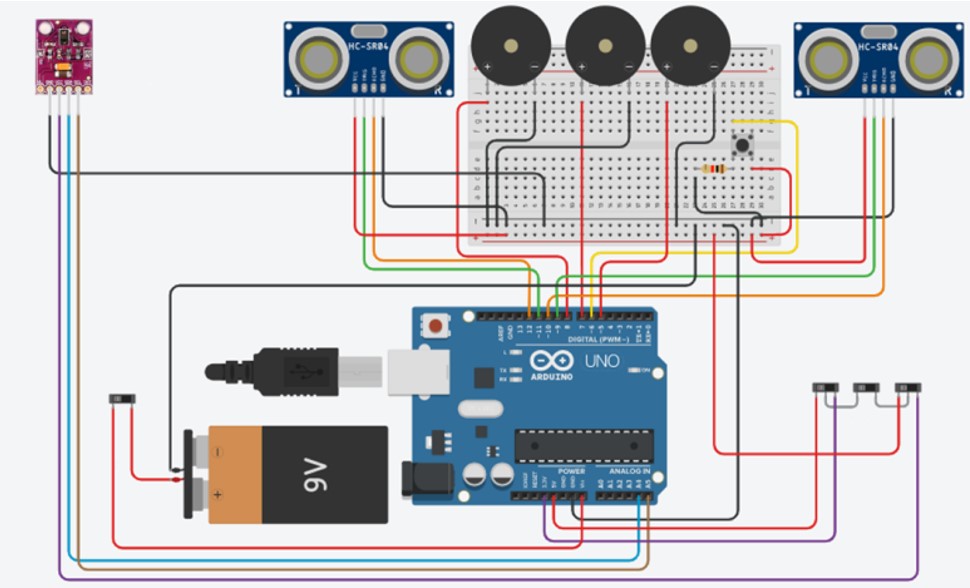
У статті представлено прототип приладу для просторової навігації, розроблений для людей із важкими порушеннями зору або сліпотою. Апаратна реалізація здійснена за допомогою сервісу TinkerCAD, а програмне забезпечення розроблено в середовищі Arduino IDE. Прилад забезпечує визначення безпечних дистанцій до перешкод та розпізнавання кольорів. Основними компонентами є Arduino UNO, ультразвукові далекоміри HC-SR04, датчик APDS-9960 і п’єзоелементи. Система враховує анатомічні особливості користувача завдяки функції калібрування. Інтеграція сучасних технологій сприяє підвищенню мобільності, впевненості та соціальної активності осіб із вадами зору
Посилання
- Vision impairment and blindness. World Health Organization (WHO). URL: https://www.who.int/news-room/fact-sheets/detail/blindness-and-visual-impairment (дата звернення: 10.08.2024).
- Magnitude, temporal trends, and projections of the global prevalence of blindness and distance and near vision impairment: a systematic review and meta-analysis / R. R. A. Bourne et al. The Lancet Global Health. 2017. Vol. 5. Iss. 9. Pp. e888-e897. DOI: https://doi.org/10.1016/s2214-109x(17)30293-0.
- Trends in prevalence of blindness and distance and near vision impairment over 30 years: an analysis for the Global Burden of Disease Study / R. Bourne et al. The Lancet Global Health. 2020. Vol. 9. Iss. 2. Pp. e130-e143. DOI: https://doi.org/10.1016/s2214-109x(20)30425-3.
- Understanding Challenges and Opportunities in Body Movement Education of People who are Blind or have Low Vision / M. De Silva et al. ASSETS '23 : Proceedings of the 25th International ACM SIGACCESS Conference on Computers and Accessibility, New York, USA, 22-25 October 2023. Pp. 1-19. DOI: https://doi.org/10.1145/3597638.3608409.
- Visual challenges in the everyday lives of blind people / E. Brady et al. CHI'13: Proceedings of the SIGCHI Conference on Human Factors in Computing Systems, Paris, France, 27 April - 2 May 2013. Pp. 2117-2126. DOI: https://doi.org/10.1145/2470654.2481291.
- Кількість людей з порушенням зору в Україні зростає: як ініціативи UNDP сприяють якісній реабілітації. UNDP. URL: https://www.undp.org/uk/ukraine/news/kilkist-lyudey-z-porushennyam-zoru-v-ukrayini-zrostaye-yak-initsiatyvy-undp-spryyayut-yakisniy-reabilitatsiyi?utm_source=chatgpt.com (дата звернення: 25.06.2024).
- Mixture reality-based assistive system for visually impaired people / J. Song et al. Displays. 2023. Vol. 78. Article 102449. DOI: https://doi.org/10.1016/j.displa.2023.102449.
- Towards assisting visually impaired individuals: A review on current status and future prospects / M. Mashiata et al. Biosensors and Bioelectronics: X. 2022. Vol. 12. Article 100265. DOI: https://doi.org/10.1016/j.biosx.2022.100265.
- Detect and Approach: Close-Range Navigation Support for People with Blindness and Low Vision / Y. Hao et al. Computer Vision – ECCV 2022 Workshops. Lecture Notes in Computer Science. 2023. Vol. 13806. Pp. 607-622. DOI: https://doi.org/10.1007/978-3-031-25075-0_41.
- Roy M., Shah P. Internet of Things (IoT) Enabled Smart Navigation Aid for Visually Impaired. Advanced Information Networking and Applications. 2022. Pp. 232-244. DOI: https://doi.org/10.1007/978-3-030-99619-2_23.
- Commute Booster: A Mobile Application for First/Last Mile and Middle Mile Navigation Support for People with Blindness and Low Vision / J. Feng et al. IEEE Journal of Translational Engineering in Health and Medicine. 2023. Vol. 11. Pp. 523-535. DOI: https://doi.org/10.1109/jtehm.2023.3293450.
- Floor Plan Based Active Global Localization and Navigation Aid for Persons with Blindness and Low Vision / R. G. Goswami et al. IEEE Robotics and Automation Letters. 2024. Vol. 9, Iss. 12. Pp. 11058-11065. DOI: https://doi.org/10.1109/lra.2024.3486208.
- UNav: An Infrastructure-Independent Vision-Based Navigation System for People with Blindness and Low Vision / A. Yang et al. Sensors. 2022. Vol. 22. Iss. 22. Article 8894. DOI: https://doi.org/10.3390/s22228894.
- Use of ToF sensors to develop Assistive Technology for visually impaired people / A. A. Ferreira et al. ENSUS 2024 - XII Encontro de Sustentabilidade em Projeto. 2024. Pp. 1004-1011. DOI: https://doi.org/10.29183/2596-237x.ensus2024.v12.n1.p1004-1011.
- IoT-Driven Accessibility: A Refreshable OCR-Braille Solution for Visually Impaired and Deaf-Blind Users through WSN / K. K. Reddy et al. Journal of Economy and Technology. 2024. Vol. 2. Pp. 128-137. DOI: https://doi.org/10.1016/j.ject.2024.04.007.
- Real-Time Object Detection and Face Recognition Application for the Visually Impaired / K. Sanjar et al. Computers, Materials & Continua. 2024. Vol. 79(3). Pp. 1-10. DOI: https://doi.org/10.32604/cmc.2024.048312.
- Sivan Sh., Darsan G. Computer Vision based Assistive Technology for Blind and Visually Impaired People. ICCCNT'16: Proceedings of the 7th International Conference on Computing Communication and Networking Technologies, Dallas TX, USA, 6-8 July 2016. Pp. 1-8. DOI: https://doi.org/10.1145/2967878.2967923.
- Mohammed Fayiz Ferosh. Assistive Technology for Navigation of Visually Impaired People. Journal of Electrical Systems. 2024. Vol. 20. Iss. 7s. Pp. 989-996. DOI: https://doi.org/10.52783/jes.3479.
- Kiruthika Devi S., Subalalitha C. Deep Learning Based Audio Assistive System for Visually Impaired People. Computers, Materials & Continua. 2021. Vol. 71. Iss. 1. Pp. 1205-1219. DOI: https://doi.org/10.32604/cmc.2022.020827.
- Сілі І. І., Азархов О. Ю., Єфременко Б. В. Тензосенсорна рукавиця для людей з порушенням мовлення. Наука та виробництво. 2023. Вип. 25. Pp. 159-167. DOI: https://doi.org/10.31498/2522-9990252023286737.
- Євсеєнко О. Синтез системи виміру параметрів повітря у приміщеннях торговельного центру. Вісник Національного технічного університету «ХПІ». Серія: Системний аналiз, управління та iнформацiйнi технологiї. 2022. Вип. 1(7). C. 28-34. DOI: https://doi.org/10.20998/2079-0023.2022.01.05.
- Tinkercad: From mind to design in minutes. Tinkercad. URL: https://www.tinkercad.com/ (дата звернення: 10.08.2024).
- Autodesk Fusion: More than CAD, it's the future of design and manufacturing. URL: https://www.autodesk.com/products/fusion-360/overview (дата звернення: 12.08.2024).
##submission.downloads##
Опубліковано
Як цитувати
Номер
Розділ
Ліцензія

Ця робота ліцензується відповідно до Creative Commons Attribution 4.0 International License.
Журнал "Вісник Приазовського державного технічного університету. Серія: Технічні науки" видається під ліцензією СС-BY (Ліцензія «Із зазначенням авторства»).
Дана ліцензія дозволяє поширювати, редагувати, поправляти і брати твір за основу для похідних навіть на комерційній основі із зазначенням авторства. Це найзручніша з усіх пропонованих ліцензій. Рекомендується для максимального поширення і використання неліцензійних матеріалів.

Автори, які публікуються в цьому журналі, погоджуються з наступними умовами:
1. Автори залишають за собою право на авторство своєї роботи та передають журналу право першої публікації цієї роботи на умовах ліцензії Creative Commons Attribution License, яка дозволяє іншим особам вільно розповсюджувати опубліковану роботу з обов'язковим посиланням на авторів оригінальної роботи та першу публікацію роботи в цьому журналі.
2. Автори мають право укладати самостійні додаткові угоди, які стосуються неексклюзивного поширення роботи в тому вигляді, в якому вона була опублікована цим журналом (наприклад, розміщувати роботу в електронному сховищі установи або публікувати у складі монографії), за умови збереження посилання на першу публікацію роботи в цьому журналі.