Determination of the effect of chitosan treatment before storage on the storage of mulberry fruits
DOI:
https://doi.org/10.15587/1729-4061.2025.323334Keywords:
mulberry fruit, natural losses, microbiological diseases, physiological disorders, chitosanAbstract
The study of the preservation of the quality of berry raw materials is becoming relevant due to the value of berries as a food product for dessert and technological purposes in the processing industry. The solution to this issue is the use of edible films and coatings. The problem being solved is to determine safer and more effective technologies for post-harvest treatment of mulberry fruit with chitosan solutions, which will reduce product losses during storage and extend the duration of its consumption.
The object of the study is the technology of pre-treatment of mulberry fruit using edible coatings based on chitosan.
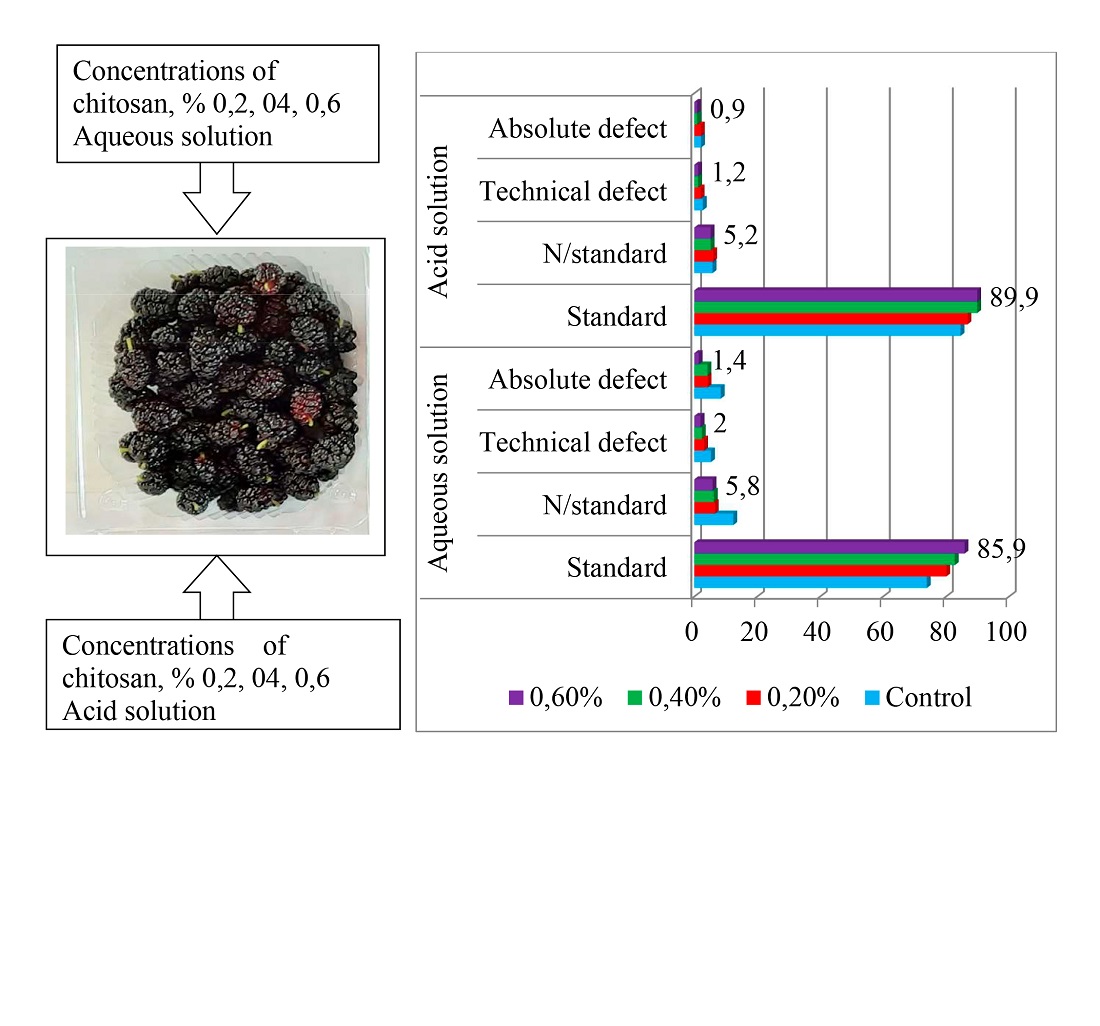
The subject of the study is mulberry fruit and protective coatings with 0.2 % 0.4 % 0.6 % concentration of chitosan and 0.5 % ascorbic acid. The minimum weight loss of mulberry fruit (2.72 %) and daily losses (0.84 %) during storage were observed after pretreatment with 0.6 % chitosan dissolved in 0.5 % ascorbic acid. The addition of ascorbic acid inhibited the development of Botrytis cinerea by 1.5–2.1 times. There is a close inverse relationship between the yield of marketable products and the concentration of the chitosan solution. An increase in the concentration of chitosan from 0.2 % to 0.6 % reduces natural weight loss, physiological disorders of fruit, and absolute shortage of products. The yield of marketable products increases from 91.7 to 95.1 %. The dry matter content during the storage period decreased by 3.0–6.6 % when treated with an aqueous solution of chitosan and a 2.0–3.5 % solution with ascorbic acid. The lowest losses were observed when treated with 0.6 % chitosan solution and 0.5 % ascorbic acid. A similar pattern was observed for the content of dry soluble substances
References
- Galat, L. (2021). World berries market: current trends and prospects for Ukraine. Efektyvna Ekonomika, 2. https://doi.org/10.32702/2307-2105-2021.2.76
- Jan, B., Parveen, R., Zahiruddin, S., Khan, M. U., Mohapatra, S., Ahmad, S. (2021). Nutritional constituents of mulberry and their potential applications in food and pharmaceuticals: A review. Saudi Journal of Biological Sciences, 28 (7), 3909–3921. https://doi.org/10.1016/j.sjbs.2021.03.056
- Maunula, L., Kaupke, A., Vasickova, P., Söderberg, K., Kozyra, I., Lazic, S. et al. (2013). Tracing enteric viruses in the European berry fruit supply chain. International Journal of Food Microbiology, 167 (2), 177–185. https://doi.org/10.1016/j.ijfoodmicro.2013.09.003
- Hussein, Z., Fawole, O. A., Opara, U. L. (2020). Harvest and Postharvest Factors Affecting Bruise Damage of Fresh Fruits. Horticultural Plant Journal, 6 (1), 1–13. https://doi.org/10.1016/j.hpj.2019.07.006
- Herman, R. A., Ayepa, E., Fometu, S. S., Shittu, S., Davids, J. S., Wang, J. (2022). Mulberry fruit post-harvest management: Techniques, composition and influence on quality traits -A review. Food Control, 140, 109126. https://doi.org/10.1016/j.foodcont.2022.109126
- Yousuf, B., Qadri, O. S., Srivastava, A. K. (2018). Recent developments in shelf-life extension of fresh-cut fruits and vegetables by application of different edible coatings: A review. LWT, 89, 198–209. https://doi.org/10.1016/j.lwt.2017.10.051
- Kumar, P., Sethi, S., Sharma, R. R., Srivastav, M., Varghese, E. (2017). Effect of chitosan coating on postharvest life and quality of plum during storage at low temperature. Scientia Horticulturae, 226, 104–109. https://doi.org/10.1016/j.scienta.2017.08.037
- Rajestary, R., Xylia, P., Chrysargyris, A., Romanazzi, G., Tzortzakis, N. (2022). Preharvest Application of Commercial Products Based on Chitosan, Phosphoric Acid Plus Micronutrients, and Orange Essential Oil on Postharvest Quality and Gray Mold Infections of Strawberry. International Journal of Molecular Sciences, 23 (24), 15472. https://doi.org/10.3390/ijms232415472
- Vasylyshyna, O. (2019). Optimization of storage fruit foods with preparing processing by hytosan solution. Ukrainian Black Sea Region Agrarian Science, 3 (103), 80–87. https://doi.org/10.31521/2313-092x/2019-3(103)-10
- Blahopoluchna, A., Liakhovska, N. (2021). Effect of chitosan pretreatment on the quality of strawberries during cold storage. Food Science and Technology, 15 (3). https://doi.org/10.15673/fst.v15i3.2151
- Ibrahim, M. A., Sharoba, A. M., El Waseif, K. H., El Mansy, H. A., El Tanahy, H. H. (2017). Effect of Edible Coating by Chitosan with Lemongrass and Thyme Oils on Strawberry Quality and Shelf Life during Storage. ournal of Food Technology and Nutritional Sciences, 3 (1). Available at: https://www.researchgate.net/publication/313388867_Effect_of_Edible_Coating_by_Chitosan_with_Lemongrass_and_Thyme_Oils_on_Strawberry_Quality_and_Shelf_Life_during_Storage
- Kerch, G., Sabovics, M., Kruma, Z., Kampuse, S., Straumite, E. (2011). Effect of chitosan and chitooligosaccharide on vitamin C and polyphenols contents in cherries and strawberries during refrigerated storage. European Food Research and Technology, 233 (2), 351–358. https://doi.org/10.1007/s00217-011-1525-6
- Kawhena, T. G., Opara, U. L., Fawole, O. A. (2021). Optimization of Gum Arabic and Starch-Based Edible Coatings with Lemongrass Oil Using Response Surface Methodology for Improving Postharvest Quality of Whole “Wonderful” Pomegranate Fruit. Coatings, 11 (4), 442. https://doi.org/10.3390/coatings11040442
- Bansal, H., Singh, S., Sharma, A., Kaur, K., Yadav, K., Bishnoi, M. et al. (2025). Enhancing grape preservation: The synergistic effect of curry leaf essential oil in buckwheat starch-chitosan composite coatings. Food Control, 169, 111001. https://doi.org/10.1016/j.foodcont.2024.111001
- Parvin, N., Rahman, A., Roy, J., Rashid, M. H., Paul, N. C., Mahamud, Md. A. et al. (2023). Chitosan Coating Improves Postharvest Shelf-Life of Mango (Mangifera indica L.). Horticulturae, 9 (1), 64. https://doi.org/10.3390/horticulturae9010064
- Petriccione, M., Mastrobuoni, F., Pasquariello, M., Zampella, L., Nobis, E., Capriolo, G., Scortichini, M. (2015). Effect of Chitosan Coating on the Postharvest Quality and Antioxidant Enzyme System Response of Strawberry Fruit during Cold Storage. Foods, 4 (4), 501–523. https://doi.org/10.3390/foods4040501
- Wang, S. Y., Gao, H. (2013). Effect of chitosan-based edible coating on antioxidants, antioxidant enzyme system, and postharvest fruit quality of strawberries (Fragaria x aranassa Duch.). LWT - Food Science and Technology, 52 (2), 71–79. https://doi.org/10.1016/j.lwt.2012.05.003
- Suriati, L., Suardani, N. M. A. (2021). Application Ecogel Incorporation additive for maintain freshness of Strawberry fruit during storage. IOP Conference Series: Materials Science and Engineering, 1098 (6), 062055. https://doi.org/10.1088/1757-899x/1098/6/062055
- Blahopoluchna, A., Mushtruk, M., Slobodyanyuk, N., Liakhovska, N., Parakhnenko, V., Udodov, S. et al. (2023). The influence of chitosan on the raspberry quality during the storage process. Potravinarstvo Slovak Journal of Food Sciences, 17, 529–549. https://doi.org/10.5219/1875
- Tezotto-Uliana, J. V., Fargoni, G. P., Geerdink, G. M., Kluge, R. A. (2014). Chitosan applications pre- or postharvest prolong raspberry shelf-life quality. Postharvest Biology and Technology, 91, 72–77. https://doi.org/10.1016/j.postharvbio.2013.12.023
- Hernández-Muñoz, P., Almenar, E., Valle, V. D., Velez, D., Gavara, R. (2008). Effect of chitosan coating combined with postharvest calcium treatment on strawberry (Fragaria×ananassa) quality during refrigerated storage. Food Chemistry, 110 (2), 428–435. https://doi.org/10.1016/j.foodchem.2008.02.020
- Romanazzi, G., Feliziani, E., Santini, M., Landi, L. (2013). Effectiveness of postharvest treatment with chitosan and other resistance inducers in the control of storage decay of strawberry. Postharvest Biology and Technology, 75, 24–27. https://doi.org/10.1016/j.postharvbio.2012.07.007
- Romanazzi, G., Feliziani, E., Sivakumar, D. (2018). Chitosan, a Biopolymer With Triple Action on Postharvest Decay of Fruit and Vegetables: Eliciting, Antimicrobial and Film-Forming Properties. Frontiers in Microbiology, 9. https://doi.org/10.3389/fmicb.2018.02745
- Martínez-González, M. del C., Bautista-Baños, S., Correa-Pacheco, Z. N., Corona-Rangel, M. L., Ventura-Aguilar, R. I., Del Río-García, J. C., Ramos-García, M. de L. (2020). Effect of Nanostructured Chitosan/Propolis Coatings on the Quality and Antioxidant Capacity of Strawberries During Storage. Coatings, 10 (2), 90. https://doi.org/10.3390/coatings10020090
- Smilanick, J. L., Aiyabei, J., Gabler, F. M., Doctor, J., Sorenson, D., Mackey, B. (2002). Quantification of the Toxicity of Aqueous Chlorine to Spores of Penicillium digitatum and Geotrichum citri-aurantii. Plant Disease, 86 (5), 509–514. https://doi.org/10.1094/pdis.2002.86.5.509
- Sinha, A., Gill, P. P. S., Jawandha, S. K., Grewal, S. K. (2022). Composite coating of chitosan with salicylic acid retards pear fruit softening under cold and supermarket storage. Food Research International, 160, 111724. https://doi.org/10.1016/j.foodres.2022.111724
- Ennab, H. A., El-Shemy, M. A., Alam-Eldein, S. M. (2020). Salicylic Acid and Putrescine to Reduce Post-Harvest Storage Problems and Maintain Quality of Murcott Mandarin Fruit. Agronomy, 10 (1), 115. https://doi.org/10.3390/agronomy10010115
- Perdones, A., Sánchez-González, L., Chiralt, A., Vargas, M. (2012). Effect of chitosan-lemon essential oil coatings on storage-keeping quality of strawberry. Postharvest Biology and Technology, 70, 32–41. https://doi.org/10.1016/j.postharvbio.2012.04.002
- Shahbazi, Y. (2018). Application of carboxymethyl cellulose and chitosan coatings containing Mentha spicata essential oil in fresh strawberries. International Journal of Biological Macromolecules, 112, 264–272. https://doi.org/10.1016/j.ijbiomac.2018.01.186
- Priyadarshi, R., El-Araby, A., Rhim, J.-W. (2024). Chitosan-based sustainable packaging and coating technologies for strawberry preservation: A review. International Journal of Biological Macromolecules, 278, 134859. https://doi.org/10.1016/j.ijbiomac.2024.134859
- Blahopoluchna, A. H., Liakhovska, N. O. (2021). Effect of preliminary treatment of strawberries with chitosane solution on storage duration and yield of marketable products. Bulletin of Uman National University of Horticulture, 2, 42–44. https://doi.org/10.31395/2310-0478-2021-2-42-44
- Blahopoluchna, A. H., Liakhovska, N. O. (2024). Preservation of blackberry fruits after post-harvest treatment with chitosan. Bulletin of Uman National University of Horticulture, 1, 60–64. https://doi.org/10.32782/2310-0478-2024-1-60-64
Downloads
Published
How to Cite
Issue
Section
License
Copyright (c) 2025 Ludmila Pusik, Vlаdimir Pusik, Veronika Bondarenko, Yana Mulienok, Lidiia Shubenko, Oksana Muliarchuk, Andrii Cherneha, Volodymyr Novikov, Volodymyr Voitsekhivskyi

This work is licensed under a Creative Commons Attribution 4.0 International License.
The consolidation and conditions for the transfer of copyright (identification of authorship) is carried out in the License Agreement. In particular, the authors reserve the right to the authorship of their manuscript and transfer the first publication of this work to the journal under the terms of the Creative Commons CC BY license. At the same time, they have the right to conclude on their own additional agreements concerning the non-exclusive distribution of the work in the form in which it was published by this journal, but provided that the link to the first publication of the article in this journal is preserved.
A license agreement is a document in which the author warrants that he/she owns all copyright for the work (manuscript, article, etc.).
The authors, signing the License Agreement with TECHNOLOGY CENTER PC, have all rights to the further use of their work, provided that they link to our edition in which the work was published.
According to the terms of the License Agreement, the Publisher TECHNOLOGY CENTER PC does not take away your copyrights and receives permission from the authors to use and dissemination of the publication through the world's scientific resources (own electronic resources, scientometric databases, repositories, libraries, etc.).
In the absence of a signed License Agreement or in the absence of this agreement of identifiers allowing to identify the identity of the author, the editors have no right to work with the manuscript.
It is important to remember that there is another type of agreement between authors and publishers – when copyright is transferred from the authors to the publisher. In this case, the authors lose ownership of their work and may not use it in any way.








