Development of technology for functional combined meat cutlets “Turkestan” enriched with tomato pomace powder
DOI:
https://doi.org/10.15587/1729-4061.2025.323381Keywords:
combined meat product, functional cutlet, tomato pomace powder, antioxidants, carotenoidsAbstract
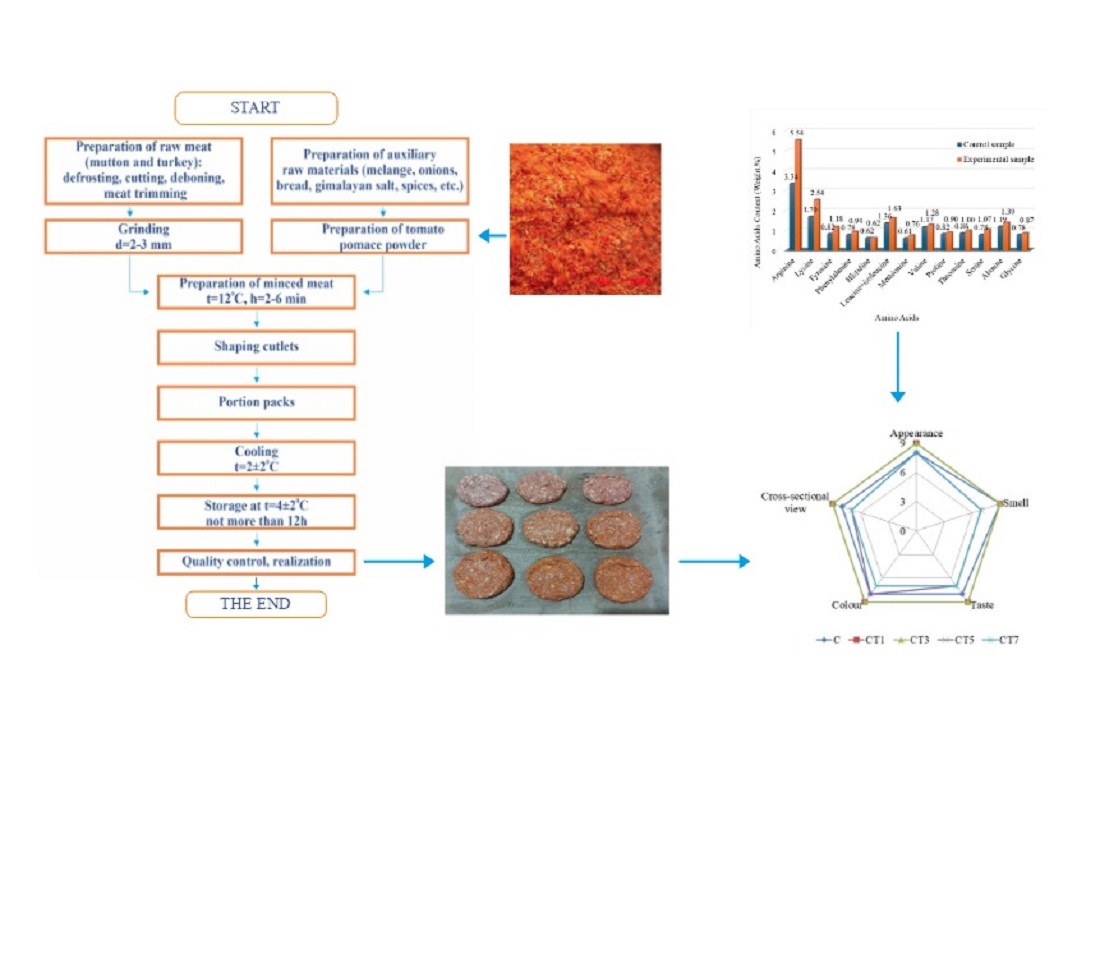
This study investigates the development of technology for functional combined meat cutlets “Turkestan”, enriched with tomato pomace powder, aiming to enhance their nutritional value, oxidative stability, and safety while maintaining sensory appeal. The research addresses the challenge of improving the nutritional profile of meat products by incorporating tomato pomace, a byproduct of tomato processing rich in bioactive compounds such as β-carotene, lycopene, pectin, and vitamin C. These compounds contribute to the product's antioxidant and functional properties.
The study examines the effects of incorporating different concentrations of tomato pomace powder (1 %, 3 %, 5 %, and 7 %) into a mutton-turkey meat blend (50:50) on the physicochemical, microbiological, and organoleptic characteristics of the final product.
The results indicate a significant increase in essential minerals, amino acids, and antioxidant capacity. Sensory evaluation determined that cutlets containing 1 % and 3 % tomato pomace powder exhibited the best flavor, texture, and overall acceptability. The amino acid profile of “Turkestan” cutlets improved notably, with arginine increasing by 56.6 %, lysine by 49.7 %, and threonine by 17.3 %. Additionally, the mineral content was enriched, particularly in potassium, magnesium, and calcium. Microbiological analysis confirmed the product's safety, meeting food safety standards and ensuring the absence of harmful pathogens, including Salmonella and Listeria monocytogenes.
The developed formulation sustainably enhances the nutritional and functional properties of meat cutlets using a plant-based byproduct. These findings demonstrate the potential for practical application in developing functional meat products for health-conscious consumers
References
- Borycka, B. (2017). Tomato fibre as potential functional food ingredients. Polish Journal of Natural Sciences, 32 (1), 121–130. Available at: http://www.uwm.edu.pl/polish-journal/sites/default/files/issues/articles/borycka_2017.pdf
- Chabi, I. B., Zannou, O., Dedehou, E. S. C. A., Ayegnon, B. P., Oscar Odouaro, O. B., Maqsood, S. et al. (2024). Tomato pomace as a source of valuable functional ingredients for improving physicochemical and sensory properties and extending the shelf life of foods: A review. Heliyon, 10 (3), e25261. https://doi.org/10.1016/j.heliyon.2024.e25261
- Mehta, D., Prasad, P., Sangwan, R. S., Yadav, S. K. (2018). Tomato processing byproduct valorization in bread and muffin: improvement in physicochemical properties and shelf life stability. Journal of Food Science and Technology, 55 (7), 2560–2568. https://doi.org/10.1007/s13197-018-3176-0
- Nour, V., Ionica, M. E., Trandafir, I. (2015). Bread enriched in lycopene and other bioactive compounds by addition of dry tomato waste. Journal of Food Science and Technology, 52 (12), 8260–8267. https://doi.org/10.1007/s13197-015-1934-9
- Belović, M., Torbica, A., Pajić Lijaković, I., Tomić, J., Lončarević, I., Petrović, J. (2018). Tomato pomace powder as a raw material for ketchup production. Food Bioscience, 26, 193–199. https://doi.org/10.1016/j.fbio.2018.10.013
- Yadav, S., Malik, A., Pathera, A., Islam, R. U., Sharma, D. (2016). Development of dietary fibre enriched chicken sausages by incorporating corn bran, dried apple pomace and dried tomato pomace. Nutrition & Food Science, 46 (1), 16–29. https://doi.org/10.1108/nfs-05-2015-0049
- Colucci Cante, R., Gallo, M., Varriale, L., Garella, I., Nigro, R. (2022). Recovery of Carotenoids from Tomato Pomace Using a Hydrofluorocarbon Solvent in Sub-Critical Conditions. Applied Sciences, 12 (6), 2822. https://doi.org/10.3390/app12062822
- Bohrer, B. M. (2019). An investigation of the formulation and nutritional composition of modern meat analogue products. Food Science and Human Wellness, 8 (4), 320–329. https://doi.org/10.1016/j.fshw.2019.11.006
- Kadam, A. N., Mane, K. A. (2022). Enrichment of multigrain cookies with tomato pomace powder. International Journal of Advanced Engineering Research and Science, 9 (5), 392–397. https://doi.org/10.22161/ijaers.95.40
- Lu, S., Chen, S., Li, H., Paengkoum, S., Taethaisong, N., Meethip, W. et al. (2022). Sustainable Valorization of Tomato Pomace (Lycopersicon esculentum) in Animal Nutrition: A Review. Animals, 12 (23), 3294. https://doi.org/10.3390/ani12233294
- Knoblich, M., Anderson, B., Latshaw, D. (2005). Analyses of tomato peel and seed byproducts and their use as a source of carotenoids. Journal of the Science of Food and Agriculture, 85 (7), 1166–1170. https://doi.org/10.1002/jsfa.2091
- Luengo, E., Ãlvarez, I., Raso, J. (2014). Improving Carotenoid Extraction from Tomato Waste by Pulsed Electric Fields. Frontiers in Nutrition, 1. https://doi.org/10.3389/fnut.2014.00012
- Torbica, A., Belović, M., Mastilović, J., Kevrešan, Ž., Pestorić, M., Škrobot, D., Dapčević Hadnađev, T. (2016). Nutritional, rheological, and sensory evaluation of tomato ketchup with increased content of natural fibres made from fresh tomato pomace. Food and Bioproducts Processing, 98, 299–309. https://doi.org/10.1016/j.fbp.2016.02.007
- Islamova, G. E., Utebayeva, A. A. (2024). Development of technology and studying the quality of combined meat bread with the added powder from tomato pomace. The Journal of Almaty Technological University, 146 (4), 12–20. https://doi.org/10.48184/2304-568x-2024-4-12-20
- Kumar, S., Yadav, S., Rani, R., Pathera, A. K. (2024). Effects of plum powder and apple pomace powder addition on the physico-chemical, sensory, and textural properties of buffalo meat emulsion. Nutrition & Food Science, 54 (2), 421–432. https://doi.org/10.1108/nfs-09-2023-0223
- Hussain, A., Kauser, T., Aslam, J., Quddoos, M. Y., Ali, A., Kauser, S. et al. (2023). Comparison of Different Techno-Functional Properties of Raw Lemon Pomace and Lemon Pomace Powder, and Development of Nutritional Biscuits by Incorporation of Lemon Pomace Powder. Caraka Tani: Journal of Sustainable Agriculture, 38 (1), 176. https://doi.org/10.20961/carakatani.v38i1.67769
- Teixeira, A., Silva, S., Guedes, C., Rodrigues, S. (2020). Sheep and Goat Meat Processed Products Quality: A Review. Foods, 9 (7), 960. https://doi.org/10.3390/foods9070960
- Ferreira, M. (2000). Relationships of the minerals and fatty acid contents in processed turkey meat products. Food Chemistry, 69 (3), 259–265. https://doi.org/10.1016/s0308-8146(99)00259-9
- Kupina, S., Fields, C., Roman, M. C., Brunelle, S. L. (2018). Determination of Total Phenolic Content Using the Folin-C Assay: Single-Laboratory Validation, First Action 2017.13. Journal of AOAC INTERNATIONAL, 101 (5), 1466–1472. https://doi.org/10.5740/jaoacint.18-0031
- Utebaeva, A., Gabrilyants, E., Abish, Z. (2024). Developing a Symbiotic Fermented Milk Product with Microwave-Treated Hawthorn Extract. Fermentation, 10 (8), 377. https://doi.org/10.3390/fermentation10080377
- Utebaeva, A., Yevlash, V., Gabrilyants, E., Abish, Z., Aitbayeva, A. (2024). Development of kefir product with Bifidobacterium animalis subsp. Lactis (BB-12) activated by Sanguisorba officinalis L. extract. Eastern-European Journal of Enterprise Technologies, 5 (11 (131)), 6–15. https://doi.org/10.15587/1729-4061.2024.312708
- Zhang, J., Chen, J., Lan, J., Liu, B., Wang, X., Zhang, S., Zuo, Y. (2024). Effect of Different Drying Techniques on the Bioactive Compounds, Antioxidant Ability, Sensory and Volatile Flavor Compounds of Mulberry. Foods, 13 (16), 2492. https://doi.org/10.3390/foods13162492
- Pérez-Gálvez, A., Hornero-Méndez, D., Mínguez-Mosquera, M. I. (2005). Dependence of carotenoid content and temperature-time regimes during the traditional slow drying of red pepper for paprika production at La Vera county. European Food Research and Technology, 221 (5), 645–652. https://doi.org/10.1007/s00217-005-0074-2
- Núñez-Gómez, V., González-Barrio, R., Periago, M. J. (2023). Interaction between Dietary Fibre and Bioactive Compounds in Plant By-Products: Impact on Bioaccessibility and Bioavailability. Antioxidants, 12 (4), 976. https://doi.org/10.3390/antiox12040976
- Serna, J., Bergwitz, C. (2020). Importance of Dietary Phosphorus for Bone Metabolism and Healthy Aging. Nutrients, 12 (10), 3001. https://doi.org/10.3390/nu12103001
- Lau, K. Q., Sabran, M. R., Shafie, S. R. (2021). Utilization of Vegetable and Fruit By-products as Functional Ingredient and Food. Frontiers in Nutrition, 8. https://doi.org/10.3389/fnut.2021.661693
Downloads
Published
How to Cite
Issue
Section
License
Copyright (c) 2025 Gulnur Islamova, Aidana Utebaeva, Viktoriia Yevlash, Azret Shingisov, Elmira Kanseitova

This work is licensed under a Creative Commons Attribution 4.0 International License.
The consolidation and conditions for the transfer of copyright (identification of authorship) is carried out in the License Agreement. In particular, the authors reserve the right to the authorship of their manuscript and transfer the first publication of this work to the journal under the terms of the Creative Commons CC BY license. At the same time, they have the right to conclude on their own additional agreements concerning the non-exclusive distribution of the work in the form in which it was published by this journal, but provided that the link to the first publication of the article in this journal is preserved.
A license agreement is a document in which the author warrants that he/she owns all copyright for the work (manuscript, article, etc.).
The authors, signing the License Agreement with TECHNOLOGY CENTER PC, have all rights to the further use of their work, provided that they link to our edition in which the work was published.
According to the terms of the License Agreement, the Publisher TECHNOLOGY CENTER PC does not take away your copyrights and receives permission from the authors to use and dissemination of the publication through the world's scientific resources (own electronic resources, scientometric databases, repositories, libraries, etc.).
In the absence of a signed License Agreement or in the absence of this agreement of identifiers allowing to identify the identity of the author, the editors have no right to work with the manuscript.
It is important to remember that there is another type of agreement between authors and publishers – when copyright is transferred from the authors to the publisher. In this case, the authors lose ownership of their work and may not use it in any way.








