Identifying the factors affecting the production of juice and wine from the autochthonous Bayanshira grape variety
DOI:
https://doi.org/10.15587/1729-4061.2025.323382Keywords:
phenolic compounds, amino nitrogen, ultraviolet rays, solid residue, mass exchangeAbstract
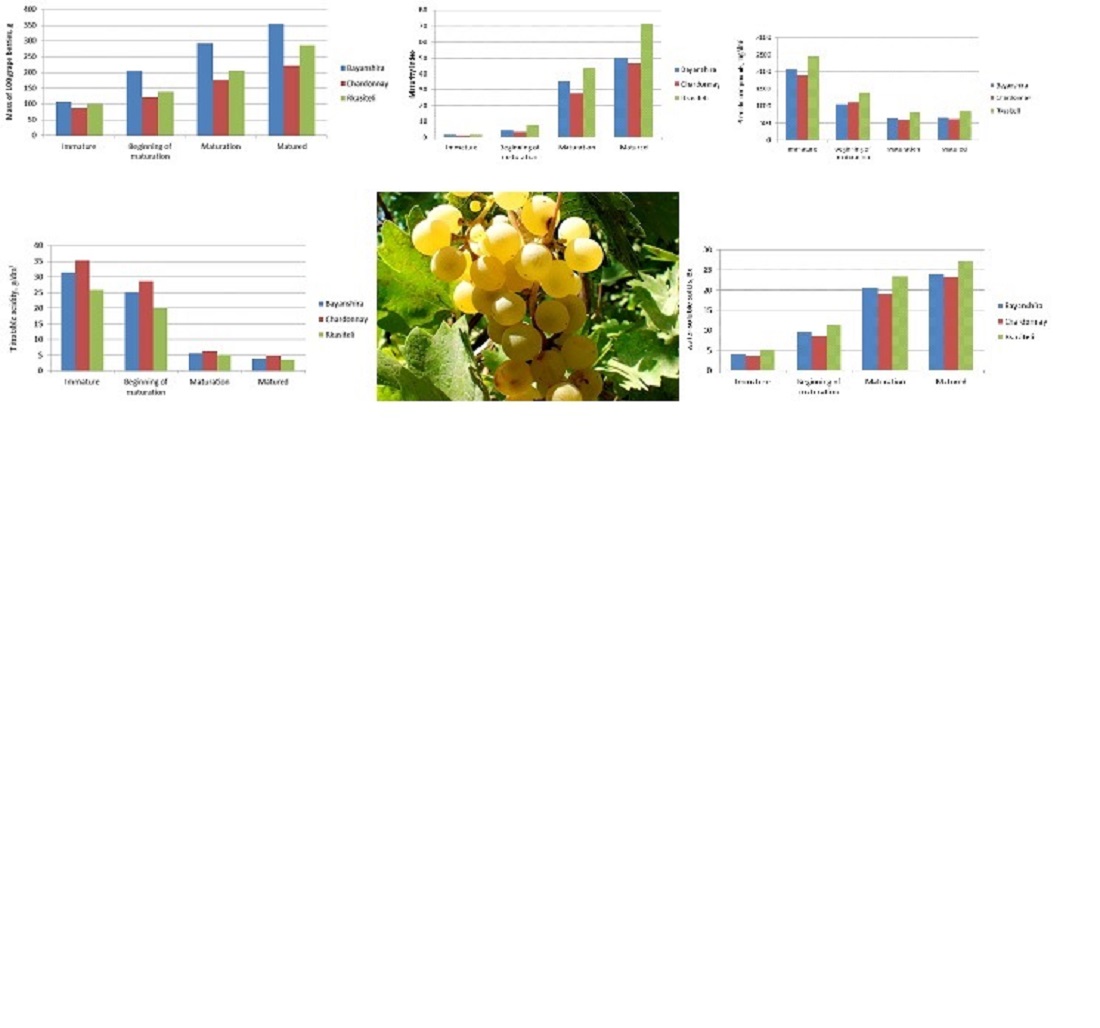
The object of the study is juice and wine samples obtained from the Bayanshira grape variety. A number of studies were conducted on the Bayanshira grape variety, but the dynamics of berry ripening and the mechanical composition of the bunch, the effect of applied technological methods on the juice and wine indices have not been sufficiently studied. The study of the dynamics of berry ripening that the ripening index increased by the time of ripening and fluctuated within 27.46–43.92 The average length of a bunch is 21.93 cm, width is 9.70 cm, mass 172.11 g, the average number of berries in a bunch is 61.46 pieces, the weight of the comb in a bunch is 6.54 g. The average length of the berry was 18.46 mm, and the width was 18.40 mm, the average mass of the berry was 3.67 g.
During the processing and storage of grape juice processed by the white method in different ways, it was found that the physicochemical composition of hot pasteurized samples was more susceptible to changes, compared to the control, and the samples treated with ultraviolet rays practically did not change their natural color and composition.
The flow of nitrogenous substances into wine increased during their in yeast sediment from 30 to 90 days. An increase in temperature from 8–11 °C to 25–30 °C significantly increased the flow of nitrogenous substances from yeast sediment into wine compared to other options.
These studies are important for production in terms of determining the dynamics of grape ripening at different stages of growth, the transformations that occur in the physicochemical composition during the storage of juice processed by different methods, and the regulation of the processes occurring during the stages of wine preparation. The results obtained can be used in family farms and wineries
References
- Ivanova, V., Stefova, M., Vojnoski, B., Dörnyei, Á., Márk, L., Dimovska, V. et al. (2011). Identification of polyphenolic compounds in red and white grape varieties grown in R. Macedonia and changes of their content during ripening. Food Research International, 44 (9), 2851–2860. https://doi.org/10.1016/j.foodres.2011.06.046
- Arana, I., Jarén, C., Arazuri, S. (2005). Maturity, Variety and Origin Determination in White Grapes (Vitis Vinifera L.) Using near Infrared Reflectance Technology. Journal of Near Infrared Spectroscopy, 13 (6), 349–357. https://doi.org/10.1255/jnirs.566
- Fataliyev, H., Malikov, A., Lezgiyev, Y., Gadimova, N., Musayev, T., Aliyeva, G. (2024). Identifying of the wine-making potential of the autochthon madrasa grape variety of different colors and quality. Eastern-European Journal of Enterprise Technologies, 2 (11 (128)), 56–63. https://doi.org/10.15587/1729-4061.2024.302971
- Fataliyev, H., Malikov, A., Lazgiyev, Y., Haydarov, E., Agayeva, S., Baloghlanova, K. et al. (2023). Effect of maceration regime on phenolic compound quantity and color quality of madrasa wine samples. Food Science and Technology, 17 (4). https://doi.org/10.15673/fst.v17i4.2784
- Fataliyev, H., Gadimova, N., Huseynova, S., Isgandarova, S., Heydarov, E., Mammadova, S. (2024). Enrichment of functional drinks using grape pomace extracts, analysis of physicochemical indicators. Eastern-European Journal of Enterprise Technologies, 3 (11 (129)), 37–45. https://doi.org/10.15587/1729-4061.2024.307039
- Silva-Barbieri, D., Salazar, F. N., López, F., Brossard, N., Escalona, N., Pérez-Correa, J. R. (2022). Advances in White Wine Protein Stabilization Technologies. Molecules, 27 (4), 1251. https://doi.org/10.3390/molecules27041251
- Liu, Z., Xu, L., Wang, J., Duan, C., Sun, Y., Kong, Q., He, F. (2023). Research progress of protein haze in white wines. Food Science and Human Wellness, 12 (5), 1427–1438. https://doi.org/10.1016/j.fshw.2023.02.004
- Kamaladdin, F. H., Galib, A. S., Elman, H. E., Elxan, A. S., Mammadtagi, A. I., Abbasgulu, H. A., Tofig, C. K. (2022). The research of effect of diluents to the amount of pesticide residues in wine. Food Science and Technology, 42. https://doi.org/10.1590/fst.39322
- Kamaladdin, F. H., Razim, A. G., Elman, H. E., Tofiq, C. K., Galib, A. S., Hasil, F. S. et al. (2023). The research of factors affecting the amount of aromatic compounds in white muscat wine samples. Food Science and Technology, 43. https://doi.org/10.1590/fst.70222
- Prakash, O., A., S., Kudachikar, V. B. (2020). Physicochemical Changes, Phenolic Profile and Antioxidant Capacities of Colored and White Grape (Vitis Vinifera L.) Varieties during Berry Development and Maturity. International Journal of Fruit Science, 20, S1773–S1783. https://doi.org/10.1080/15538362.2020.1833809
- Xiao, H., Li, A., Li, M., Sun, Y., Tu, K., Wang, S., Pan, L. (2018). Quality assessment and discrimination of intact white and red grapes from Vitis vinifera L. at five ripening stages by visible and near-infrared spectroscopy. Scientia Horticulturae, 233, 99–107. https://doi.org/10.1016/j.scienta.2018.01.041
- Mammadova, S. M., Fataliyev, H. K., Gadimova, N. S., Aliyeva, G. R., Tagiyev, A. T., Baloglanova, K. V. (2020). Production of functional products using grape processing residuals. Food Science and Technology, 40, 422–428. https://doi.org/10.1590/fst.30419
- Savoi, S., Wong, D. C. J., Arapitsas, P., Miculan, M., Bucchetti, B., Peterlunger, E. et al. (2016). Transcriptome and metabolite profiling reveals that prolonged drought modulates the phenylpropanoid and terpenoid pathway in white grapes (Vitis vinifera L.). BMC Plant Biology, 16 (1). https://doi.org/10.1186/s12870-016-0760-1
- Garrido, A., Engel, J., Mumm, R., Conde, A., Cunha, A., De Vos, R. C. H. (2021). Metabolomics of Photosynthetically Active Tissues in White Grapes: Effects of Light Microclimate and Stress Mitigation Strategies. Metabolites, 11 (4), 205. https://doi.org/10.3390/metabo11040205
- Odinayev, M., Buriev, K., Sultonov, K., Eralieva, S. (2021). Analysis of mechanical properties, biochemical composition and technological parameters of grape (Vitis) raisin varieties in conditions of Uzbekistan. E3S Web of Conferences, 284, 03023. https://doi.org/10.1051/e3sconf/202128403023
- Nabiyev, A., Kazimova, İ., Mammadaliyeva, M., Maharramova, S., Nasrullayeva, G., Yusifova, M. (2024). Determining biochemical qualitative indicators of grapes during long-term storage. Eastern-European Journal of Enterprise Technologies, 2 (11 (128)), 64–75. https://doi.org/10.15587/1729-4061.2024.302794
- Delić, M., Behmen, F., Sefo, S., Drkenda, P., Matijašević, S., Mandić, A. (2023). Effect of Pruning on Mechanical Composition of Bunch of Table Grape Varieties (Vitis Vinifera L.). 32nd Scientific-Expert Conference of Agriculture and Food Industry, 72–81. https://doi.org/10.1007/978-3-031-47467-5_8
- Prculovski, Z., Petkov, M., Boskov, K., Popović, T., Korunovska, B. (2024). Bunch load as a factor on the quality of the grapevine varieties'ribier'and'italia'. Poljoprivreda i Sumarstvo, 70 (2), 159–169. https://doi.org/10.17707/agricultforest.70.2.12
- Makuev, G. A., Isrigova, T. A., Mukailov, M. D., Salmanov, M. M., Magomedov, M. G. (2022). Technological assessment of native grapes varieties for winemaking in the conditions of Southern Dagestan. IOP Conference Series: Earth and Environmental Science, 979 (1), 012018. https://doi.org/10.1088/1755-1315/979/1/012018
- Khosrov, M. U. (2024). Mechanical and enocarpological characteristics of a number of technical and table grape varieties planted and cultivated in Azerbaijan. In The World Of Science and Education.
- Milanović, V., Cardinali, F., Ferrocino, I., Boban, A., Franciosa, I., Gajdoš Kljusurić, J. et al. (2022). Croatian white grape variety Maraština: First taste of its indigenous mycobiota. Food Research International, 162, 111917. https://doi.org/10.1016/j.foodres.2022.111917
- Cataldo, E., Salvi, L., Paoli, F., Fucile, M., Mattii, G. B. (2021). Effect of Agronomic Techniques on Aroma Composition of White Grapevines: A Review. Agronomy, 11 (10), 2027. https://doi.org/10.3390/agronomy11102027
- Liu, X., Liu, C., Fan, X., Zhang, Y., Sun, L., Lin, M. et al. (2024). Aroma profiling analysis of grape berries based on electronic nose detection. Scientia Horticulturae, 336, 113425. https://doi.org/10.1016/j.scienta.2024.113425
- Fataliyev, H. K. (2013). Winemaking practicum. Baku: Elm, 328.
- Sheskin, D. J. (2020). Handbook of Parametric and Nonparametric Statistical Procedures. Chapman and Hall/CRC, 1928. https://doi.org/10.1201/9780429186196
- Gadimova, N., Fataliyev, H., Heydarov, E., Lezgiyev, Y., Isgandarova, S. (2023). Development of a model and optimization of the interaction of factors in the grain malting process and its application in the production of functional beverages. Eastern-European Journal of Enterprise Technologies, 5 (11 (125)), 43–56. https://doi.org/10.15587/1729-4061.2023.289421
- de Souza, V. R., Popović, V., Bissonnette, S., Ros, I., Mats, L., Duizer, L. et al. (2020). Quality changes in cold pressed juices after processing by high hydrostatic pressure, ultraviolet-c light and thermal treatment at commercial regimes. Innovative Food Science & Emerging Technologies, 64, 102398. https://doi.org/10.1016/j.ifset.2020.102398
Downloads
Published
How to Cite
Issue
Section
License
Copyright (c) 2025 Hasil Fataliyev, Yahya Aghazade, Elnur Heydarov, Natavan Gadimova, Mehman Ismailov, Konul Imanova

This work is licensed under a Creative Commons Attribution 4.0 International License.
The consolidation and conditions for the transfer of copyright (identification of authorship) is carried out in the License Agreement. In particular, the authors reserve the right to the authorship of their manuscript and transfer the first publication of this work to the journal under the terms of the Creative Commons CC BY license. At the same time, they have the right to conclude on their own additional agreements concerning the non-exclusive distribution of the work in the form in which it was published by this journal, but provided that the link to the first publication of the article in this journal is preserved.
A license agreement is a document in which the author warrants that he/she owns all copyright for the work (manuscript, article, etc.).
The authors, signing the License Agreement with TECHNOLOGY CENTER PC, have all rights to the further use of their work, provided that they link to our edition in which the work was published.
According to the terms of the License Agreement, the Publisher TECHNOLOGY CENTER PC does not take away your copyrights and receives permission from the authors to use and dissemination of the publication through the world's scientific resources (own electronic resources, scientometric databases, repositories, libraries, etc.).
In the absence of a signed License Agreement or in the absence of this agreement of identifiers allowing to identify the identity of the author, the editors have no right to work with the manuscript.
It is important to remember that there is another type of agreement between authors and publishers – when copyright is transferred from the authors to the publisher. In this case, the authors lose ownership of their work and may not use it in any way.








