Breakthrough technologies of social transformations: devising an identification methodology
DOI:
https://doi.org/10.15587/1729-4061.2025.326555Keywords:
digital transformation, Industry 4.0, breakthrough technologies, bibliographic databases of citation systemsAbstract
The object of this study is the breakthrough technologies of Industry 4.0, which are driving social transformations. Such a focus of research is due to the fact that under current conditions, all domains of society are undergoing transformation, the source of which is the accelerated development of equipment and technology. Innovation cycles generate inventions and open up new possibilities, but this is not always obvious to economic actors. The need arises to design a toolkit that would allow early identification of new trends in social transformations and form appropriate business models and economic policy directions for them.
This paper reports a methodological approach to identifying breakthrough technologies that drive the development of social transformations. It is based on the use of special indicators of bibliographic databases and information from social networks – platforms where the communication among researchers takes place. The specificity of the approach is the combination of bibliometric monitoring on a new, expanded database of sources with statistical analysis. The latter involved assessing the time series using the growth rate of publications and establishing a threshold value using the standard deviation method.
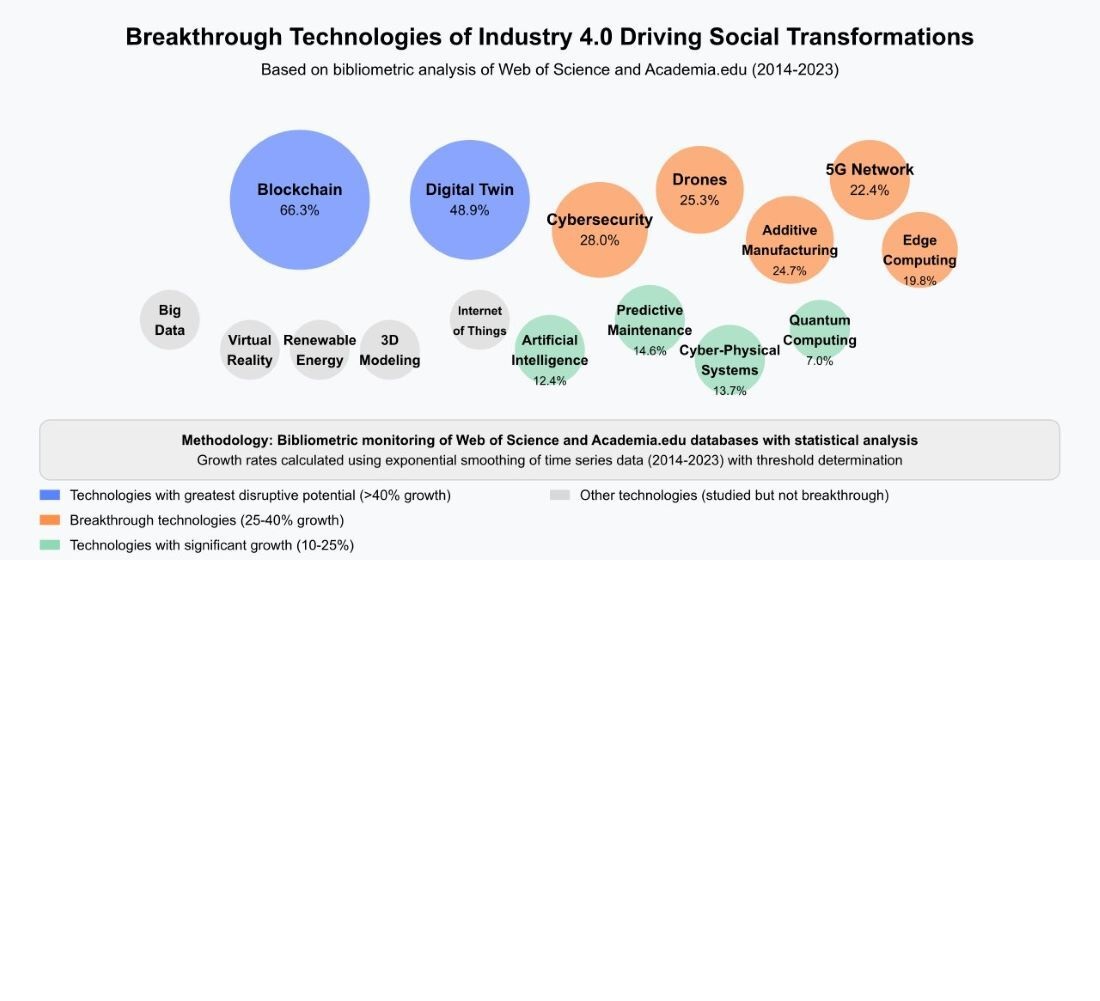
The prognostic capabilities of such an approach have been demonstrated on the example of identifying breakthrough technologies within Industry 4.0, which enabled the formation of a cluster of 7 technologies, which drive the deployment of a new technological paradigm. Focusing on these technologies could allow firms to improve business models and the state to concentrate resources on points of technological growth, thereby increasing the effectiveness of innovation policy
References
- Schwab, K. (2016). The Fourth Industrial Revolution. World Economic Forum, 172. Available at: https://law.unimelb.edu.au/__data/assets/pdf_file/0005/3385454/Schwab-The_Fourth_Industrial_Revolution_Klaus_S.pdf
- Rada, M. (2018). Industry 5.0 definition. Medium. Available at: https://michael-rada.medium.com/industry-5-0-definition-6a2f9922dc48
- Pylypenko, Y., Pylypenko, H., Prokhorova, V. V., Mnykh, O. B., Dubiei, Yu. V. (2021). Transition to a new paradigm of human capital development in the dynamic environment of the knowledge economy. Naukovyi Visnyk Natsionalnoho Hirnychoho Universytetu, 6, 170–176. https://doi.org/10.33271/nvngu/2021-6/170
- Pylypenko, Yu., Pylypenko, H., Lytvynenko, N., Tryfonova, O., Prushkivska, E. (2019). Institutional components of socio-economic development. Naukovyi Visnyk Natsionalnoho Hirnychoho Universytetu, 3. https://doi.org/10.29202/nvngu/2019-3/21
- Pilipenko, G. M. (2013). Cultural impact on the ratio of public and market coordination in Ukraine. Naukovyi Visnyk Natsionalnoho Hirnychoho Universytetu, 3, 118–125. Available at: https://nvngu.in.ua/index.php/en/archive/on-divisions-of-science/economy/2201-cultural-impact-on-the-ratio-of-public-and-market-coordination-in-ukraine
- Pylypenko, H. M., Pylypenko, Yu. I., Dubiei, Yu. V., Solianyk, L. G., Pazynich, Yu. M., Buketov, V. et al. (2023). Social capital as a factor of innovative development. Journal of Open Innovation: Technology, Market, and Complexity, 9 (3), 100118. https://doi.org/10.1016/j.joitmc.2023.100118
- Rüßmann, M., Lorenz, M., Gerbert, P., Waldner, M., Engel, P., Harnisch, M., Justus, J. (2015). Industry 4.0: The Future of Productivity and Growth in Manufacturing Industries. Boston Consulting Group. Available at: https://www.bcg.com/publications/2015/engineered_products_project_business_industry_4_future_productivity_growth_manufacturing_industries
- Industry 4.0 Challenges and solutions for the digital transformation and use of exponential technologies. Audit. Tax. Consulting. Corporate Finance (2015). Deloitte, 32. Available at: https://www.pac.gr/bcm/uploads/industry-4-0-deloitte-study.pdf
- Prokhorova, V., Protsenko, V., Bezuglaya, Y., Us, J. (2018). The optimization algorithm for the directions of influence of risk factors on the system that manages the potential of machine-building enterprises. Eastern-European Journal of Enterprise Technologies, 4 (1 (94)), 6–13. https://doi.org/10.15587/1729-4061.2018.139513
- Prokhorova, V., Protsenko, V., Abuselidze, G., Mushnykova, S., Us, Yu. (2019). Safety of industrial enterprises development: evaluation of innovative and investment component. Naukovyi Visnyk Natsionalnoho Hirnychoho Universytetu, 5. https://doi.org/10.29202/nvngu/2019-5/24
- Pylypenko, H. M., Prokhorova, V. V., Mrykhina, O. B., Koleshchuk, O. Y., Mushnykova, S. A. (2020). Cost evaluation models of R&D products of industrial enterprises. Naukovyi Visnyk Natsionalnoho Hirnychoho Universytetu, 5, 163–170. https://doi.org/10.33271/nvngu/2020-5/163
- Barreto, L., Amaral, A., Pereira, T. (2017). Industry 4.0 implications in logistics: an overview. Procedia Manufacturing, 13, 1245–1252. https://doi.org/10.1016/j.promfg.2017.09.045
- Smiesova, V., Pylypenko, A., Ivanova, M., Karpenko, R. (2019). Economic and Institutional Conditions for Implementation of Economic Interests in the Countries of the World. Montenegrin Journal of Economics, 15 (4), 75–86. https://doi.org/10.14254/1800-5845/2019.15-4.6
- Pylypenko, Y., Prokhorova, V., Halkiv, L., Koleshchuk, O., Dubiei, Y. (2022). Innovative intellectual capital in the system of factors of technical and technological development. Naukovyi Visnyk Natsionalnoho Hirnychoho Universytetu, 6, 181–186. https://doi.org/10.33271/nvngu/2022-6/181
- Bai, C., Dallasega, P., Orzes, G., Sarkis, J. (2020). Industry 4.0 technologies assessment: A sustainability perspective. International Journal of Production Economics, 229, 107776. https://doi.org/10.1016/j.ijpe.2020.107776
- Sanchez, M., Exposito, E., Aguilar, J. (2020). Industry 4.0: survey from a system integration perspective. International Journal of Computer Integrated Manufacturing, 33 (10-11), 1017–1041. https://doi.org/10.1080/0951192x.2020.1775295
- Dalenogare, L. S., Benitez, G. B., Ayala, N. F., Frank, A. G. (2018). The expected contribution of Industry 4.0 technologies for industrial performance. International Journal of Production Economics, 204, 383–394. https://doi.org/10.1016/j.ijpe.2018.08.019
- Kagermann, H., Anderl, R., Gausemeier, J., Schuh, G., Wahlster, W. (Eds.) (2016). Industrie 4.0 in a Global Context: Strategies for Cooperating with International Partners (acatech STUDY). Herbert Utz Verlag. Available at: https://www.researchgate.net/publication/315739153
- Manyika, J., Chui, M., Bughin, J., Dobbs, R., Bisson, P., Marrs, A. (2013). Disruptive Technologies: Advances that Will Transform Life, Business, and the Global Economy. McKinsey Global Institute. Available at: https://www.mckinsey.com/capabilities/mckinsey-digital/our-insights/disruptive-technologies
- Tu, H., Sun, Z., Yao, Y., Xu, Y. (2017). Analysis and Insights from the MIT Technology Review “Top 10 Breakthrough Technologies” in the Past Six Years. Chinese Journal of Engineering Science, 19 (5), 85‒91. https://doi.org/10.15302/j-sscae-2017.05.015
- Elnadi, M., Abdallah, Y. O. (2023). Industry 4.0: critical investigations and synthesis of key findings. Management Review Quarterly, 74 (2), 711–744. https://doi.org/10.1007/s11301-022-00314-4
- Oztemel, E., Gursev, S. (2018). Literature review of Industry 4.0 and related technologies. Journal of Intelligent Manufacturing, 31 (1), 127–182. https://doi.org/10.1007/s10845-018-1433-8
- Figliè, R., Amadio, R., Tyrovolas, M., Stylios, C., Paśko, Ł., Stadnicka, D. et al. (2024). Towards a Taxonomy of Industrial Challenges and Enabling Technologies in Industry 4.0. IEEE Access, 12, 19355–19374. https://doi.org/10.1109/access.2024.3356349
- Oesterreich, T. D., Teuteberg, F. (2016). Understanding the implications of digitisation and automation in the context of Industry 4.0: A triangulation approach and elements of a research agenda for the construction industry. Computers in Industry, 83, 121–139. https://doi.org/10.1016/j.compind.2016.09.006
- Perales, D. P., Valero, F. A., García, A. B. (2017). Industry 4.0: A Classification Scheme. Closing the Gap Between Practice and Research in Industrial Engineering, 343–350. https://doi.org/10.1007/978-3-319-58409-6_38
- Pylypenko, H., Fedorova, N., Huzenko, I., Naumenko, N. (2020). Paradoxes of economic development: science and innovation in the modern world. Naukovyi Visnyk Natsionalnoho Hirnychoho Universytetu, 2, 153–159. https://doi.org/10.33271/nvngu/2020-2/153
- Davis, A., Parikh, J., Weihl, W. E. (2004). Edgecomputing: extending enterprise applications to the edge of the internet. WWW Alt. '04: Proceedings of the 13th international World Wide Web conference on Alternate track papers & posters, 180. https://doi.org/10.1145/1013367.1013397
- Ehls, D., Polier, S., Herstatt, C. (2020). Reviewing the Field of External Knowledge Search for Innovation: Theoretical Underpinnings and Future (Re‐)search Directions. Journal of Product Innovation Management, 37 (5), 405–430. https://doi.org/10.1111/jpim.12549
- Laurell, C., Sandstrom, C. (2022). Social Media Analytics as an Enabler for External Search and Open Foresight - The Case of Tesla’s Autopilot and Regulatory Scrutiny of Autonomous Driving. IEEE Transactions on Engineering Management, 69 (2), 564–571. https://doi.org/10.1109/tem.2021.3072677
Downloads
Published
How to Cite
Issue
Section
License
Copyright (c) 2025 Hanna Pylypenko, Natalia Fedorova, Nataliia Lytvynenko, Yuriy Pylypenko

This work is licensed under a Creative Commons Attribution 4.0 International License.
The consolidation and conditions for the transfer of copyright (identification of authorship) is carried out in the License Agreement. In particular, the authors reserve the right to the authorship of their manuscript and transfer the first publication of this work to the journal under the terms of the Creative Commons CC BY license. At the same time, they have the right to conclude on their own additional agreements concerning the non-exclusive distribution of the work in the form in which it was published by this journal, but provided that the link to the first publication of the article in this journal is preserved.
A license agreement is a document in which the author warrants that he/she owns all copyright for the work (manuscript, article, etc.).
The authors, signing the License Agreement with TECHNOLOGY CENTER PC, have all rights to the further use of their work, provided that they link to our edition in which the work was published.
According to the terms of the License Agreement, the Publisher TECHNOLOGY CENTER PC does not take away your copyrights and receives permission from the authors to use and dissemination of the publication through the world's scientific resources (own electronic resources, scientometric databases, repositories, libraries, etc.).
In the absence of a signed License Agreement or in the absence of this agreement of identifiers allowing to identify the identity of the author, the editors have no right to work with the manuscript.
It is important to remember that there is another type of agreement between authors and publishers – when copyright is transferred from the authors to the publisher. In this case, the authors lose ownership of their work and may not use it in any way.








