Проривні технології суспільних трансформацій: розробка методологічного підходу до ідентифікації
DOI:
https://doi.org/10.15587/1729-4061.2025.326555Ключові слова:
цифрова трансформація, Індустрія 4.0, проривні технології, бібліографічні бази систем цитуванняАнотація
Об’єктом дослідження є проривні технології Індустрії 4,0, які зумовлюють суспільні трансформації. Такий фокус дослідження зумовлений тим, що в сучасних умовах відбувається трансформація усіх сфер функціонування суспільства, джерелом якої є прискорений розвиток техніки і технологій. Інноваційні цикли породжують винаходи і відкривають нові можливості, але це не завжди є очевидним для економічних суб’єктів. Виникає потреба розробки інструментарію, який би дозволив завчасно ідентифікувати нові тренди суспільних трансформацій і формувати відповідні їм бізнес-моделі та напрями економічної політики держави.
У даному дослідженні представлено методологічний підхід ідентифікації проривних технологій, які дають поштовх для розгортання суспільних трансформацій. Він базується на використанні розширеного кола спеціальних показників бібліографічних баз, а також інформації соціальних мереж – платформ, на яких відбувається комунікація дослідників. Специфікою підходу є поєднання бібліометричного моніторингу на розширеній джерельній базі, із статистичним аналізом. Останній передбачає оцінку рядів динаміки за допомогою темпів приросту публікацій, встановлення порогового значення методом стандартних відхилень.
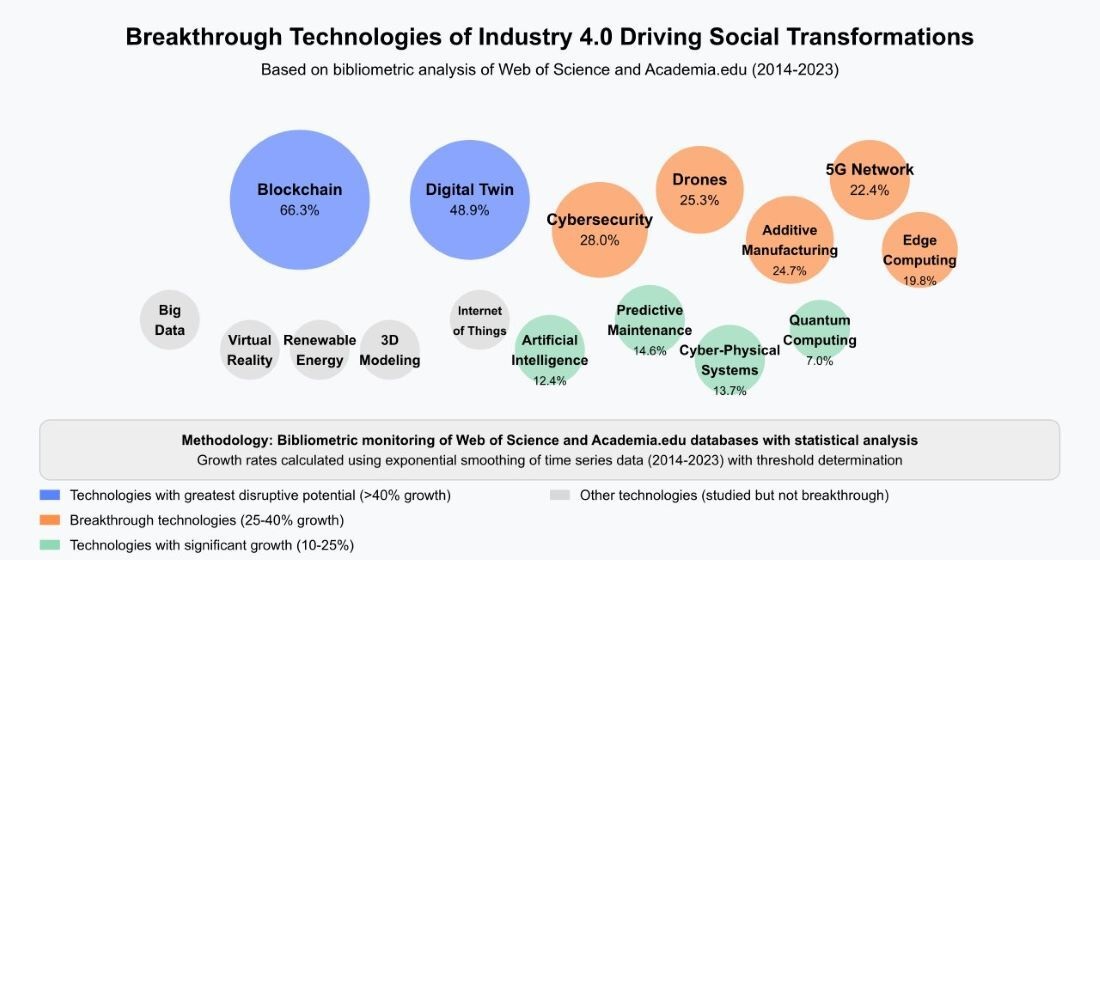
Прогностичні можливості такого підходу продемонстровано на прикладі виокремлення проривних технологій у межах Індустрії 4.0, що дозволило сформувати кластер із 7 технологій, які дають імпульс розгортанню нової технологічної парадигми. Концентрація уваги саме на цих технологіях дозволить фірмам удосконалити бізнес-моделі, а державі сконцентрувати ресурси на точках технологічного зростання і у такий спосіб підвищити ефективність інноваційної політики
Посилання
- Schwab, K. (2016). The Fourth Industrial Revolution. World Economic Forum, 172. Available at: https://law.unimelb.edu.au/__data/assets/pdf_file/0005/3385454/Schwab-The_Fourth_Industrial_Revolution_Klaus_S.pdf
- Rada, M. (2018). Industry 5.0 definition. Medium. Available at: https://michael-rada.medium.com/industry-5-0-definition-6a2f9922dc48
- Pylypenko, Y., Pylypenko, H., Prokhorova, V. V., Mnykh, O. B., Dubiei, Yu. V. (2021). Transition to a new paradigm of human capital development in the dynamic environment of the knowledge economy. Naukovyi Visnyk Natsionalnoho Hirnychoho Universytetu, 6, 170–176. https://doi.org/10.33271/nvngu/2021-6/170
- Pylypenko, Yu., Pylypenko, H., Lytvynenko, N., Tryfonova, O., Prushkivska, E. (2019). Institutional components of socio-economic development. Naukovyi Visnyk Natsionalnoho Hirnychoho Universytetu, 3. https://doi.org/10.29202/nvngu/2019-3/21
- Pilipenko, G. M. (2013). Cultural impact on the ratio of public and market coordination in Ukraine. Naukovyi Visnyk Natsionalnoho Hirnychoho Universytetu, 3, 118–125. Available at: https://nvngu.in.ua/index.php/en/archive/on-divisions-of-science/economy/2201-cultural-impact-on-the-ratio-of-public-and-market-coordination-in-ukraine
- Pylypenko, H. M., Pylypenko, Yu. I., Dubiei, Yu. V., Solianyk, L. G., Pazynich, Yu. M., Buketov, V. et al. (2023). Social capital as a factor of innovative development. Journal of Open Innovation: Technology, Market, and Complexity, 9 (3), 100118. https://doi.org/10.1016/j.joitmc.2023.100118
- Rüßmann, M., Lorenz, M., Gerbert, P., Waldner, M., Engel, P., Harnisch, M., Justus, J. (2015). Industry 4.0: The Future of Productivity and Growth in Manufacturing Industries. Boston Consulting Group. Available at: https://www.bcg.com/publications/2015/engineered_products_project_business_industry_4_future_productivity_growth_manufacturing_industries
- Industry 4.0 Challenges and solutions for the digital transformation and use of exponential technologies. Audit. Tax. Consulting. Corporate Finance (2015). Deloitte, 32. Available at: https://www.pac.gr/bcm/uploads/industry-4-0-deloitte-study.pdf
- Prokhorova, V., Protsenko, V., Bezuglaya, Y., Us, J. (2018). The optimization algorithm for the directions of influence of risk factors on the system that manages the potential of machine-building enterprises. Eastern-European Journal of Enterprise Technologies, 4 (1 (94)), 6–13. https://doi.org/10.15587/1729-4061.2018.139513
- Prokhorova, V., Protsenko, V., Abuselidze, G., Mushnykova, S., Us, Yu. (2019). Safety of industrial enterprises development: evaluation of innovative and investment component. Naukovyi Visnyk Natsionalnoho Hirnychoho Universytetu, 5. https://doi.org/10.29202/nvngu/2019-5/24
- Pylypenko, H. M., Prokhorova, V. V., Mrykhina, O. B., Koleshchuk, O. Y., Mushnykova, S. A. (2020). Cost evaluation models of R&D products of industrial enterprises. Naukovyi Visnyk Natsionalnoho Hirnychoho Universytetu, 5, 163–170. https://doi.org/10.33271/nvngu/2020-5/163
- Barreto, L., Amaral, A., Pereira, T. (2017). Industry 4.0 implications in logistics: an overview. Procedia Manufacturing, 13, 1245–1252. https://doi.org/10.1016/j.promfg.2017.09.045
- Smiesova, V., Pylypenko, A., Ivanova, M., Karpenko, R. (2019). Economic and Institutional Conditions for Implementation of Economic Interests in the Countries of the World. Montenegrin Journal of Economics, 15 (4), 75–86. https://doi.org/10.14254/1800-5845/2019.15-4.6
- Pylypenko, Y., Prokhorova, V., Halkiv, L., Koleshchuk, O., Dubiei, Y. (2022). Innovative intellectual capital in the system of factors of technical and technological development. Naukovyi Visnyk Natsionalnoho Hirnychoho Universytetu, 6, 181–186. https://doi.org/10.33271/nvngu/2022-6/181
- Bai, C., Dallasega, P., Orzes, G., Sarkis, J. (2020). Industry 4.0 technologies assessment: A sustainability perspective. International Journal of Production Economics, 229, 107776. https://doi.org/10.1016/j.ijpe.2020.107776
- Sanchez, M., Exposito, E., Aguilar, J. (2020). Industry 4.0: survey from a system integration perspective. International Journal of Computer Integrated Manufacturing, 33 (10-11), 1017–1041. https://doi.org/10.1080/0951192x.2020.1775295
- Dalenogare, L. S., Benitez, G. B., Ayala, N. F., Frank, A. G. (2018). The expected contribution of Industry 4.0 technologies for industrial performance. International Journal of Production Economics, 204, 383–394. https://doi.org/10.1016/j.ijpe.2018.08.019
- Kagermann, H., Anderl, R., Gausemeier, J., Schuh, G., Wahlster, W. (Eds.) (2016). Industrie 4.0 in a Global Context: Strategies for Cooperating with International Partners (acatech STUDY). Herbert Utz Verlag. Available at: https://www.researchgate.net/publication/315739153
- Manyika, J., Chui, M., Bughin, J., Dobbs, R., Bisson, P., Marrs, A. (2013). Disruptive Technologies: Advances that Will Transform Life, Business, and the Global Economy. McKinsey Global Institute. Available at: https://www.mckinsey.com/capabilities/mckinsey-digital/our-insights/disruptive-technologies
- Tu, H., Sun, Z., Yao, Y., Xu, Y. (2017). Analysis and Insights from the MIT Technology Review “Top 10 Breakthrough Technologies” in the Past Six Years. Chinese Journal of Engineering Science, 19 (5), 85‒91. https://doi.org/10.15302/j-sscae-2017.05.015
- Elnadi, M., Abdallah, Y. O. (2023). Industry 4.0: critical investigations and synthesis of key findings. Management Review Quarterly, 74 (2), 711–744. https://doi.org/10.1007/s11301-022-00314-4
- Oztemel, E., Gursev, S. (2018). Literature review of Industry 4.0 and related technologies. Journal of Intelligent Manufacturing, 31 (1), 127–182. https://doi.org/10.1007/s10845-018-1433-8
- Figliè, R., Amadio, R., Tyrovolas, M., Stylios, C., Paśko, Ł., Stadnicka, D. et al. (2024). Towards a Taxonomy of Industrial Challenges and Enabling Technologies in Industry 4.0. IEEE Access, 12, 19355–19374. https://doi.org/10.1109/access.2024.3356349
- Oesterreich, T. D., Teuteberg, F. (2016). Understanding the implications of digitisation and automation in the context of Industry 4.0: A triangulation approach and elements of a research agenda for the construction industry. Computers in Industry, 83, 121–139. https://doi.org/10.1016/j.compind.2016.09.006
- Perales, D. P., Valero, F. A., García, A. B. (2017). Industry 4.0: A Classification Scheme. Closing the Gap Between Practice and Research in Industrial Engineering, 343–350. https://doi.org/10.1007/978-3-319-58409-6_38
- Pylypenko, H., Fedorova, N., Huzenko, I., Naumenko, N. (2020). Paradoxes of economic development: science and innovation in the modern world. Naukovyi Visnyk Natsionalnoho Hirnychoho Universytetu, 2, 153–159. https://doi.org/10.33271/nvngu/2020-2/153
- Davis, A., Parikh, J., Weihl, W. E. (2004). Edgecomputing: extending enterprise applications to the edge of the internet. WWW Alt. '04: Proceedings of the 13th international World Wide Web conference on Alternate track papers & posters, 180. https://doi.org/10.1145/1013367.1013397
- Ehls, D., Polier, S., Herstatt, C. (2020). Reviewing the Field of External Knowledge Search for Innovation: Theoretical Underpinnings and Future (Re‐)search Directions. Journal of Product Innovation Management, 37 (5), 405–430. https://doi.org/10.1111/jpim.12549
- Laurell, C., Sandstrom, C. (2022). Social Media Analytics as an Enabler for External Search and Open Foresight - The Case of Tesla’s Autopilot and Regulatory Scrutiny of Autonomous Driving. IEEE Transactions on Engineering Management, 69 (2), 564–571. https://doi.org/10.1109/tem.2021.3072677
##submission.downloads##
Опубліковано
Як цитувати
Номер
Розділ
Ліцензія
Авторське право (c) 2025 Hanna Pylypenko, Natalia Fedorova, Nataliia Lytvynenko, Yuriy Pylypenko

Ця робота ліцензується відповідно до Creative Commons Attribution 4.0 International License.
Закріплення та умови передачі авторських прав (ідентифікація авторства) здійснюється у Ліцензійному договорі. Зокрема, автори залишають за собою право на авторство свого рукопису та передають журналу право першої публікації цієї роботи на умовах ліцензії Creative Commons CC BY. При цьому вони мають право укладати самостійно додаткові угоди, що стосуються неексклюзивного поширення роботи у тому вигляді, в якому вона була опублікована цим журналом, але за умови збереження посилання на першу публікацію статті в цьому журналі.
Ліцензійний договір – це документ, в якому автор гарантує, що володіє усіма авторськими правами на твір (рукопис, статтю, тощо).
Автори, підписуючи Ліцензійний договір з ПП «ТЕХНОЛОГІЧНИЙ ЦЕНТР», мають усі права на подальше використання свого твору за умови посилання на наше видання, в якому твір опублікований. Відповідно до умов Ліцензійного договору, Видавець ПП «ТЕХНОЛОГІЧНИЙ ЦЕНТР» не забирає ваші авторські права та отримує від авторів дозвіл на використання та розповсюдження публікації через світові наукові ресурси (власні електронні ресурси, наукометричні бази даних, репозитарії, бібліотеки тощо).
За відсутності підписаного Ліцензійного договору або за відсутністю вказаних в цьому договорі ідентифікаторів, що дають змогу ідентифікувати особу автора, редакція не має права працювати з рукописом.
Важливо пам’ятати, що існує і інший тип угоди між авторами та видавцями – коли авторські права передаються від авторів до видавця. В такому разі автори втрачають права власності на свій твір та не можуть його використовувати в будь-який спосіб.