Developing functional fish-plant snacks with improved lipid composition and physicochemical properties
DOI:
https://doi.org/10.15587/1729-4061.2025.337833Keywords:
fish-plant snacks, mullet mince, Jerusalem artichoke powder, sodium alginate, rheological properties, oxidative stability of lipids, conjugated dienes and trienes, peroxide value, functional nutritionAbstract
This paper reports the results of a study aimed at devising a technology for producing fish-plant functional snacks. The research focuses on improving the product recipe in order to enhance its organoleptic, physicochemical, and rheological properties, as well as to increase its biological value.
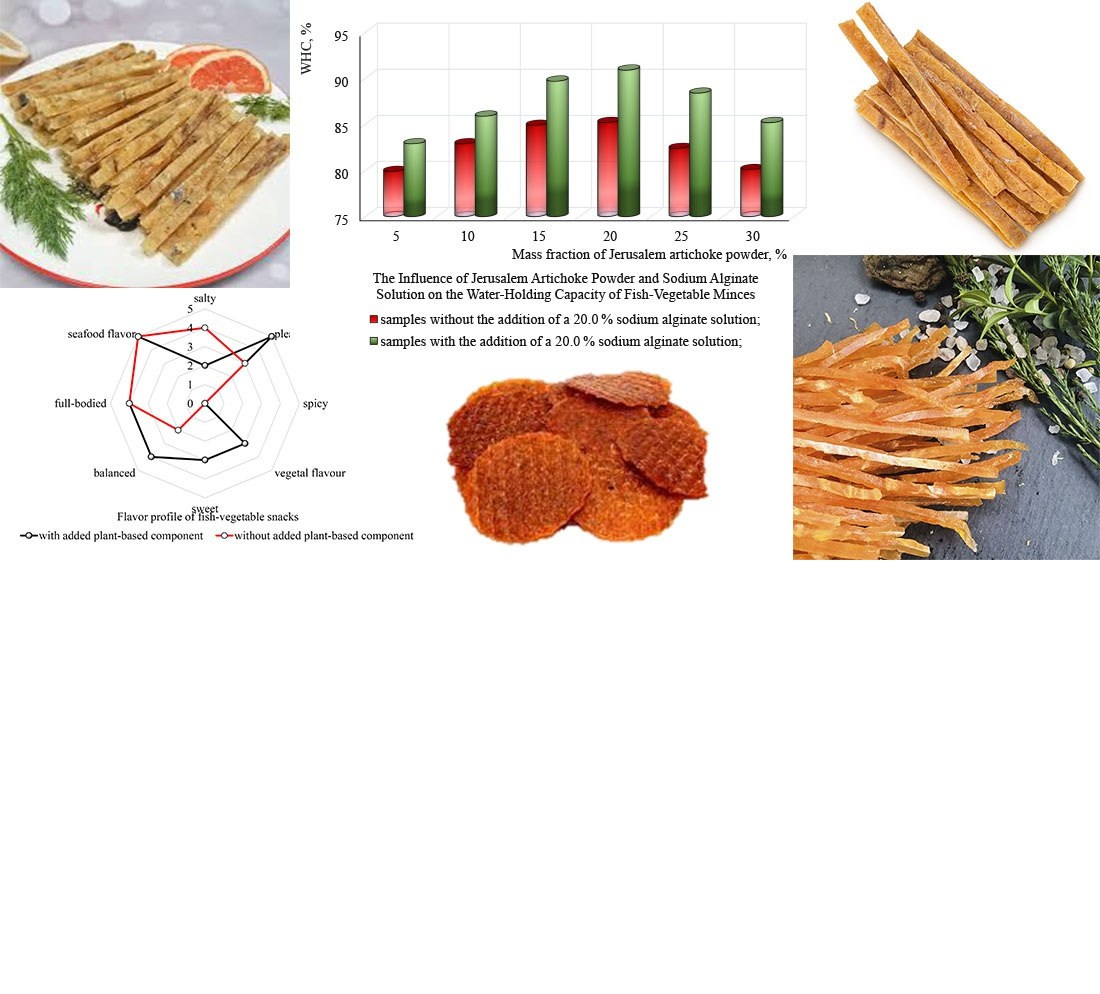
The raw material includes minced mullet (Planiliza haematocheila), fortified with 20% Jerusalem artichoke powder, 0.5% of a 20% sodium alginate solution, and prophylactic salt with reduced sodium content. The effects of these additives on water-holding capacity, physicochemical characteristics, structural and mechanical properties, microbiological stability, and sensory attributes were evaluated. It was found that the addition of Jerusalem artichoke increased the water-holding capacity by 11.7%, while the incorporation of 0.5% sodium alginate solution decreased the yield stress to 8.1 kPa and increased stickiness to 3.2 kPa.
During production and storage, lipid modification processes were observed. The dynamics in accumulating the conjugated dienes and trienes, products of PUFA conjugation, which leads to the formation of additional functional properties, were studied. The peroxide value did not exceed 0.043% I2/100 g of fat, demonstrating high oxidative stability. The shelf life of the dried fish-plant snacks was determined to be up to 25 days when stored at 2–6°C.
The formulation devised demonstrates a strong potential for practical application in the field of functional nutrition, particularly in the production of health-oriented food products and could be implemented in large-scale manufacturing to meet daily physiological nutrient requirements
References
- Yaroslavska, L., Zahorodnii, V. (2020). Problems of healthy eating of the youth. Innovations and Technologies in the Service Sphere and Food Industry, 1, 73–81. Available at: https://www.journals.chdtu.ck.ua/index.php/itsf/article/view/30
- Sels, B., Philippaerts, A. (Eds.) (2014). Conjugated Linoleic Acids and Conjugated Vegetable Oils. Catalysis Series. https://doi.org/10.1039/9781782620211
- den Hartigh, L. (2019). Conjugated Linoleic Acid Effects on Cancer, Obesity, and Atherosclerosis: A Review of Pre-Clinical and Human Trials with Current Perspectives. Nutrients, 11 (2), 370. https://doi.org/10.3390/nu11020370
- Fitri, N., Chan, S. X. Y., Che Lah, N. H., Jam, F. A., Misnan, N. M., Kamal, N. et al. (2022). A Comprehensive Review on the Processing of Dried Fish and the Associated Chemical and Nutritional Changes. Foods, 11 (19), 2938. https://doi.org/10.3390/foods11192938
- Wang, J., Han, L., Wang, D., Li, P., Shahidi, F. (2020). Conjugated Fatty Acids in Muscle Food Products and Their Potential Health Benefits: A Review. Journal of Agricultural and Food Chemistry, 68 (47), 13530–13540. https://doi.org/10.1021/acs.jafc.0c05759
- Dorozhko, V. V. (2020). Suchasni tekhnolohiyi vyrobnytstva rybnykh snekiv. The XII International Scientific and Practical Conference «Goal and the role of world science in life». Stockholm, 227–228.
- Burcu, O., Meltem, S. (2018). Effects of Jerusalem Artichoke Powder and Sodium Carbonate as Phosphate Replacers on the Quality Characteristics of Emulsified Chicken Meatballs. Korean Journal for Food Science of Animal Resources, 38 (1), 26–42. https://doi.org/10.5851/kosfa.2018.38.1.026
- Nowacka, M., Trusinska, M., Chraniuk, P., Piatkowska, J., Pakulska, A., Wisniewska, K. et al. (2023). Plant-Based Fish Analogs – A Review. Applied Sciences, 13 (7), 4509. https://doi.org/10.3390/app13074509
- Zhou, X., Zhang, C., Zhao, L., Zhou, X., Cao, W., Zhou, C. (2022). Effect of Pre-Emulsion of Pea-Grass Carp Co-Precipitation Dual Protein on the Gel Quality of Fish Sausage. Foods, 11 (20), 3192. https://doi.org/10.3390/foods11203192
- Kim, J. H., Kim, Y., Kim, Y. J., Park, Y. (2016). Conjugated Linoleic Acid: Potential Health Benefits as a Functional Food Ingredient. Annual Review of Food Science and Technology, 7 (1), 221–244. https://doi.org/10.1146/annurev-food-041715-033028
- Pariza, M. W., Hargraves, W. A. (1985). A beef-derived mutagenesis modulator inhibits initiation of mouse epidermal tumors by 7,12-dimethylbenz[a]anthracene. Carcinogenesis, 6 (4), 591–593. https://doi.org/10.1093/carcin/6.4.591
- Chauhan, D. S., Vashisht, P., Bebartta, R. P., Thakur, D., Chaudhary, V. (2025). Jerusalem artichoke: A comprehensive review of nutritional composition, health benefits and emerging trends in food applications. Comprehensive Reviews in Food Science and Food Safety, 24 (1). https://doi.org/10.1111/1541-4337.70114
- Abka-khajouei, R., Tounsi, L., Shahabi, N., Patel, A. K., Abdelkafi, S., Michaud, P. (2022). Structures, Properties and Applications of Alginates. Marine Drugs, 20 (6), 364. https://doi.org/10.3390/md20060364
- Kang, Z.-L., Wang, T., Li, Y., Li, K., Ma, H. (2020). Effect of sodium alginate on physical-chemical, protein conformation and sensory of low-fat frankfurters. Meat Science, 162, 108043. https://doi.org/10.1016/j.meatsci.2019.108043
- Simonovska, B. (2000). Determination of Inulin in Foods. Journal of AOAC INTERNATIONAL, 83 (3), 675–678. https://doi.org/10.1093/jaoac/83.3.675
- Abbey, L., Glover‐Amengor, M., Atikpo, M. O., Atter, A., Toppe, J. (2016). Nutrient content of fish powder from low value fish and fish byproducts. Food Science & Nutrition, 5 (3), 374–379. https://doi.org/10.1002/fsn3.402
- Tomčík, P., Bustin, D. (2001). Voltammetric determination of iodide by use of an interdigitated microelectrode array. Fresenius’ Journal of Analytical Chemistry, 371 (4), 562–564. https://doi.org/10.1007/s002160101010
- Vinnikova, L. G., Pronkina, K., Kyshenya, A. (2015). Improving efficiency of the dry protein preparations hydrated with the electro activated water. Ukrainian journal of food science, 3 (2), 216–224.
- Tsykhanovska, I., Skurikhina, L., Evlash, V., Pavlotska, L. (2018). Formation of the functional and technological properties of the beef minced meat by using the food additive on the nanopowder basis of double oxide of two- and trivalent iron. Ukrainian Food Journal, 7 (3), 379–396. https://doi.org/10.24263/2304-974x-2018-7-3-4
- Mahato, A., Chatterjee, P. N., Sarkar, S., Sen, A. R., Pal, A., Roy, S., Patra, A. K. (2024). Effects of Chemically and Green Synthesized Zinc Oxide Nanoparticles on Shelf Life and Sensory Quality of Minced Fish (Pangasius hypophthalmus). Foods, 13 (17), 2810. https://doi.org/10.3390/foods13172810
- Qiao, M., Zhang, T., Miao, M. (2024). Minced Beef Meat Paste Characteristics: Gel Properties, Water Distribution, and Microstructures Regulated by Medium Molecular Mass of γ-Poly-Glutamic Acid. Foods, 13 (4), 510. https://doi.org/10.3390/foods13040510
- Nykyforov, R., Korenets, Y., Frolova, N., Kuzmin, O. (2019). Determination of the effect of calcium chloride on sodium alginate on the restructuring of fish products. Ukrainian Food Journal, 8 (3), 584–596. https://doi.org/10.24263/2304-974x-2019-8-3-14
- Sow, L. C., Toh, N. Z. Y., Wong, C. W., Yang, H. (2019). Combination of sodium alginate with tilapia fish gelatin for improved texture properties and nanostructure modification. Food Hydrocolloids, 94, 459–467. https://doi.org/10.1016/j.foodhyd.2019.03.041
- Cevik, M., Icier, F. (2019). Characterization of viscoelastic properties of minced beef meat thawed by ohmic and conventional methods. Food Science and Technology International, 26 (4), 277–290. https://doi.org/10.1177/1082013219888300
- Zhu, Y., Guo, L., Tang, W., Yang, Q. (2020). Beneficial effects of Jerusalem artichoke powder and olive oil as animal fat replacers and natural healthy compound sources in Harbin dry sausages. Poultry Science, 99 (12), 7147–7158. https://doi.org/10.1016/j.psj.2020.08.058
- Merenkova, S. P., Zinina, O. V., Khayrullin, M. F., Bychkova, T. S., Moskvina, L. A. (2020). Study of the rheological properties of meat-vegetable minces. IOP Conference Series: Earth and Environmental Science, 613 (1), 012078. https://doi.org/10.1088/1755-1315/613/1/012078
- Qin, Y., Zhang, G., Chen, H. (2020). The applications of alginate in functional food products. J. Nutr. Food Sci, 3 (1), 100013. Available at: https://www.henrypublishers.com/henry-journal-of-nutrition-and-food-science/jnfs-10011.pdf
- Qin, Y., Jiang, J., Zhao, L., Zhang, J., Wang, F. (2018). Applications of Alginate as a Functional Food Ingredient. Biopolymers for Food Design, 409–429. https://doi.org/10.1016/b978-0-12-811449-0.00013-x
- Anderson-Dekkers, I., Nouwens-Roest, M., Peters, B., Vaughan, E. (2021). Inulin. Handbook of Hydrocolloids, 537–562. https://doi.org/10.1016/b978-0-12-820104-6.00015-2
- Laurberg, P., Nøhr, S. B. (2002). Iodine intake and prevention of thyroid disorders: surveillance is needed. Medical Journal of Australia, 176 (7), 306–307. https://doi.org/10.5694/j.1326-5377.2002.tb04424.x
Downloads
Published
How to Cite
Issue
Section
License
Copyright (c) 2025 Anna Palamarchuk, Sergey Patyukov, Olha Synytsia, Volodymyr Nienov

This work is licensed under a Creative Commons Attribution 4.0 International License.
The consolidation and conditions for the transfer of copyright (identification of authorship) is carried out in the License Agreement. In particular, the authors reserve the right to the authorship of their manuscript and transfer the first publication of this work to the journal under the terms of the Creative Commons CC BY license. At the same time, they have the right to conclude on their own additional agreements concerning the non-exclusive distribution of the work in the form in which it was published by this journal, but provided that the link to the first publication of the article in this journal is preserved.
A license agreement is a document in which the author warrants that he/she owns all copyright for the work (manuscript, article, etc.).
The authors, signing the License Agreement with TECHNOLOGY CENTER PC, have all rights to the further use of their work, provided that they link to our edition in which the work was published.
According to the terms of the License Agreement, the Publisher TECHNOLOGY CENTER PC does not take away your copyrights and receives permission from the authors to use and dissemination of the publication through the world's scientific resources (own electronic resources, scientometric databases, repositories, libraries, etc.).
In the absence of a signed License Agreement or in the absence of this agreement of identifiers allowing to identify the identity of the author, the editors have no right to work with the manuscript.
It is important to remember that there is another type of agreement between authors and publishers – when copyright is transferred from the authors to the publisher. In this case, the authors lose ownership of their work and may not use it in any way.








