Substantiating the turkish delight technology based on fruit and berry paste from apples, apricots, and honeysuckle
DOI:
https://doi.org/10.15587/1729-4061.2025.343276Keywords:
Turkish delight, fruit and berry paste, structure formation, rheological properties, organoleptic properties, functional ingredientsAbstract
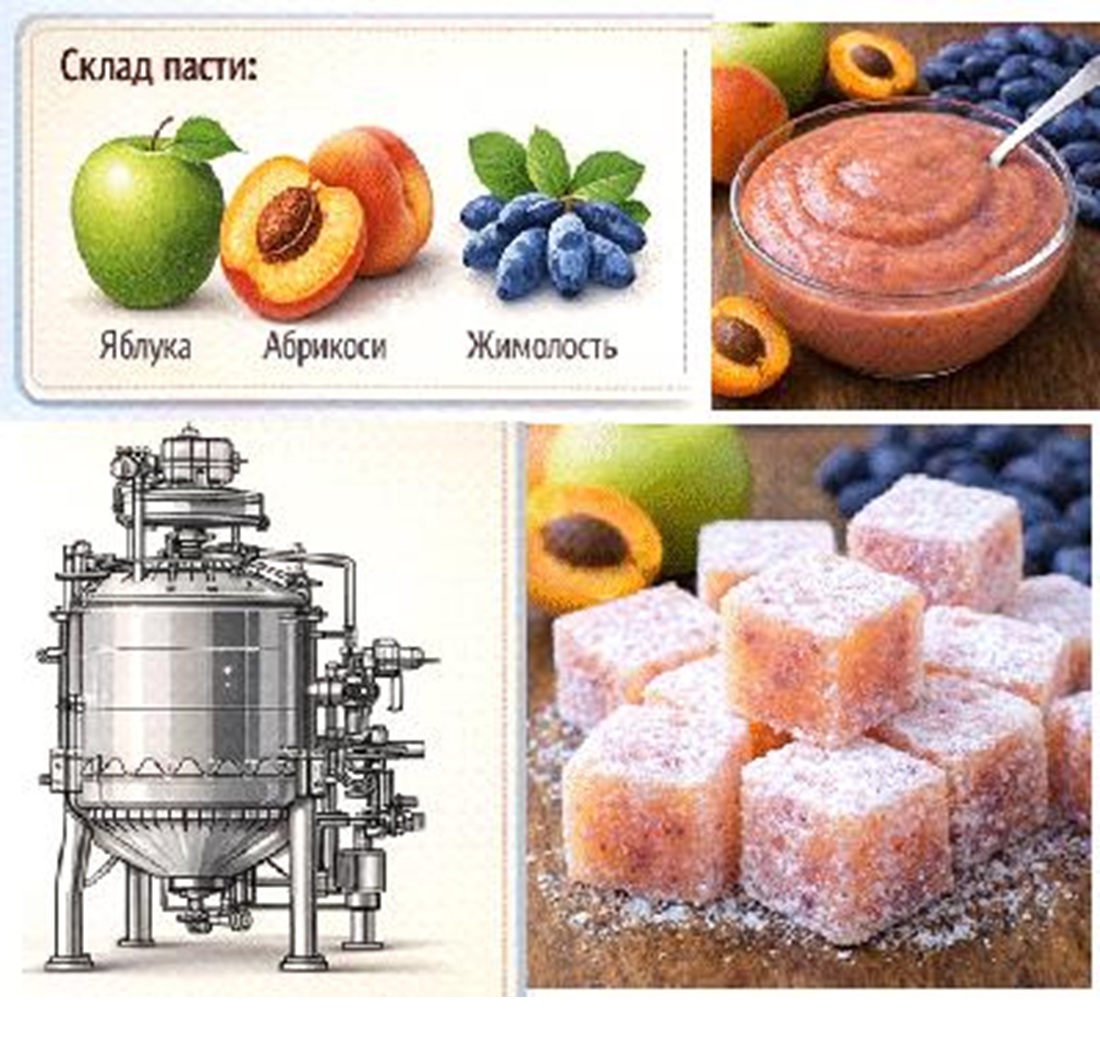
This study considers the technological process of Turkish delight production using fruit and berry paste made from apples, apricots, and honeysuckle. The task addressed is to form the structure, preserve traditional organoleptic quality indicators of Turkish delight without the use of various additives, as well as increase the nutritional value, by using natural fruit and berry paste. Exploiting the natural properties of the specified raw material makes it possible to substantiate the production of a plant-based paste and introduce it into the Turkish delight technology.
The study's results established that the introduction of short-term concentration at a temperature of 62…65°C enables the preservation of functional components in the paste, which is characterized by a dynamic viscosity of 320 Pa∙s, a content of non-starch polysaccharides of 3.3 g, vitamin C – 19 mg, and vitamin A – 210 mg.
The introduction of fruit and berry paste into the Turkish delight recipe helps improve its quality. A decrease in humidity from 17.2% to 16.8%, an increase in titrated acidity from 1.5° to 1.7°, as well as an increase in the content of reducing substances from 22.1% to 22.6%, were noted. Structural and mechanical studies showed that the strength of the experimental sample on 1, 12, and 24 h was 21; 38; and 42 kPa, respectively, which exceeds control values (14; 32; and 38 kPa), while adhesion decreased from 1.7 to 1.5 kPa. The results confirm the effectiveness of using fruit and berry paste to produce Turkish delight with improved texture and increased nutritional value.
The proposed technology opens up opportunities for making a wide range of natural confectionery products with enhanced functionality. The introduction of this technology could expand the market for environmentally friendly sweets and might contribute to integrating products with high competitiveness into production.
References
- de Oliveira, Z. B., Silva da Costa, D. V., da Silva dos Santos, A. C., da Silva Júnior, A. Q., de Lima Silva, A., de Santana, R. C. F. et al. (2024). Synthetic Colors in Food: A Warning for Children’s Health. International Journal of Environmental Research and Public Health, 21 (6), 682. https://doi.org/10.3390/ijerph21060682
- Lam, H.-P., Arli, D., Nguyen, T. H., Nguyen, T. Q. (2025). Homestay experience and eWOM among Generation Z tourists: The role of guest delight, guest satisfaction, and the need for uniqueness. Acta Psychologica, 255, 104980. https://doi.org/10.1016/j.actpsy.2025.104980
- Yuan, Y., Wei, X., Mao, Y., Zheng, Y., He, N., Guo, Y. et al. (2025). Innovative Food Processing Technologies Promoting Efficient Utilization of Nutrients in Staple Food Crops. Engineering, 50, 229–244. https://doi.org/10.1016/j.eng.2025.04.014
- Zagorulko, A., Zahorulko, A., Kasabova, K., Chuiko, L., Yakovets, L., Pugach, A. et al. (2022). Improving the production technology of functional paste-like fruit-and-berry semi-finished products. Eastern-European Journal of Enterprise Technologies, 4 (11 (118)), 43–52. https://doi.org/10.15587/1729-4061.2022.262924
- Zahorulko, A., Zagorulko, A., Kasabova, K., Liashenko, B., Postadzhiev, A., Sashnova, M. (2022). Improving a tempering machine for confectionery masses. Eastern-European Journal of Enterprise Technologies, 2 (11 (116)), 6–11. https://doi.org/10.15587/1729-4061.2022.254873
- Zagorulko, A., Shydakova-Kameniuka, O., Kasabova, K., Zahorulko, A., Budnyk, N., Kholobtseva, I. et al. (2023). Substantiating the technology of cream-whipped candy masses with the addition of berry and fruit paste. Eastern-European Journal of Enterprise Technologies, 3 (11 (123)), 50–59. https://doi.org/10.15587/1729-4061.2023.279287
- Zahorulko, A., Zagorulko, A., Kasabova, K., Shmatchenko, N. (2020). Improvement of zefir production by addition of the developed blended fruit and vegetable pasteinto its recipe. Eastern-European Journal of Enterprise Technologies, 2 (11 (104)), 39–45. https://doi.org/10.15587/1729-4061.2020.185684
- Samokhvalova, O., Kasabova, K., Shmatchenko, N., Zagorulko, A., Zahorulko, A. (2021). Improving the marmalade technology by adding a multicomponent fruit-and-berry paste. Eastern-European Journal of Enterprise Technologies, 6 (11 (114)), 6–14. https://doi.org/10.15587/1729-4061.2021.245986
- Batu, A., Kirmaci, B. (2009). Production of Turkish delight (lokum). Food Research International, 42 (1), 1–7. https://doi.org/10.1016/j.foodres.2008.08.007
- Batu, A., Arslan, A. (2014). Effects of Black Grape Syrup on Texture, Colour and Sensory Qualies of Value Added Turkish Delight (Lokum). Journal of Nutrition & Food Sciences, s8. https://doi.org/10.4172/2155-9600.s8-005
- Samokhvalova, O., Chernikova, Y., Oliinyk, S., Kasabova, K. (2015). The effect of microbial polysaccharides on the properties of wheat flour. Eastern-European Journal of Enterprise Technologies, 6 (10 (77)), 11. https://doi.org/10.15587/1729-4061.2015.56177
- Mykhaylov, V., Samokhvalova, O., Kucheruk, Z., Kasabova, K., Simakova, O., Goriainova, I. et al. (2019). Influence of microbial polysaccharides on the formation of structure of protein-free and gluten-free flour-based products. Eastern-European Journal of Enterprise Technologies, 6 (11 (102)), 23–32. https://doi.org/10.15587/1729-4061.2019.184464
- Karakaş Budak, B. (2019). Şekerleme ürününde nişastanın pullulan ile ikame edilmesinin lokumda nişasta jel yapısı üzerine etkisi. Mediterranean Agricultural Sciences, 32 (3), 323–327. https://doi.org/10.29136/mediterranean.609017
- Kasabova, K., Samokhvalova, O., Zagorulko, A., Zahorulko, A., Babaiev, S., Bereza, O. et al. (2022). Improvement of Turkish delight production technology using a developed multi-component fruit and vegetable paste. Eastern-European Journal of Enterprise Technologies, 6 (11 (120)), 51–59. https://doi.org/10.15587/1729-4061.2022.269393
- Kavak, D. D., Ogun, S. (2025). Use of quince (Cydonia oblonga mill.) as artificial coloring and flavoring substitute in functional soft candy (lokum) production. LWT, 225, 117831. https://doi.org/10.1016/j.lwt.2025.117831
- Çoban, B., Bilgin, B., Yurt, B., Kopuk, B., Atik, D. S., Palabiyik, I. (2021). Utilization of the barberry extract in the confectionery products. LWT, 145, 111362. https://doi.org/10.1016/j.lwt.2021.111362
- Özen, G., Akbulut, M., Artik, N. (2011). Stability Of Black Carrot Anthocyanins In The Turkish Delight (Lokum) During Storage. Journal of Food Process Engineering, 34 (4), 1282–1297. https://doi.org/10.1111/j.1745-4530.2009.00412.x
- Lapytska, N., Syza, O., Gorodyska, O., Savchenko, O., Rebenok, E. (2023). Improving the jelly plum juice technology by using secondary products of oil production. Eastern-European Journal of Enterprise Technologies, 3 (11 (123)), 68–77. https://doi.org/10.15587/1729-4061.2023.281929
- Kavak, D. D., Akpunar, E. B. (2018). Quality characteristics of Turkish delight (lokum) as influenced by different concentrations of cornelian cherry pulp. Journal of Food Processing and Preservation, 42 (7), e13656. https://doi.org/10.1111/jfpp.13656
- Hayoğlu, İ., Başyiğit, B., Dirik, A. (2017). Tane Nar İlaveli Lokum Üretimi Ve Vakum Ambalajlamanin Raf Ömrü Üzerine Etkisi. Gida / The Journal Of Food, 42 (5), 553–560. https://doi.org/10.15237/gida.gd17023
- Akinlolu-Ojo, T., Nwanna, E. E., Badejo, A. A. (2022). Physicochemical constituents and anti-oxidative properties of ripening hog plum (Spondias Mombin) fruits and the quality attributes of jam produced from the fruits. Measurement: Food, 7, 100037. https://doi.org/10.1016/j.meafoo.2022.100037
- Farzaliev, E. B., Ökten, S. (2023). Production and characterization of fruit jam with activated pectin using wild hawthorn puree (Crataegus monogyna Jacq.). Natural Product Research, 39 (4), 993–997. https://doi.org/10.1080/14786419.2023.2283760
- Fil, M., Mikhailyuk, O. (2017). Innovative approach technologies fruit marmalade. Scientific Messenger of LNU of Veterinary Medicine and Biotechnologies. Series: Food Technologies, 19 (75), 55–58. https://doi.org/10.15421/nvlvet7511
- Panasiuk, S., Myskovets, M. (2023). Innovative technology of diabetic jelly-fruit marmalade production. Commodity Bulletin, 16 (1), 73–84. https://doi.org/10.36910/6775-2310-5283-2023-17-6
- Alrasheedi, A. A., Ali, A. A., Hijazi, M. A. (2023). Modification and sensory evaluation of Turkish delight (lokum); supplemented with different levels of dried date powders. Food Science and Technology, 43. https://doi.org/10.5327/fst.00107
- Hanoğlu, A., Karaoğlu, M. M. (2024). The effect of different pulp powders incorporation on the instrumental texture and rheological properties of Turkish delight. International Journal of Gastronomy and Food Science, 35, 100872. https://doi.org/10.1016/j.ijgfs.2024.100872
- Lapytska, N., Rebenok, Y., Syza, O., Shkliaiev, O., Novik, А., Lystopad, T., Haliasnyi, I. (2025). Developing moсhi frozen desserts technology using by-products of juice production. Eastern-European Journal of Enterprise Technologies, 2 (11 (134)), 54–66. https://doi.org/10.15587/1729-4061.2025.324602
- Liu, R. H. (2013). Health-Promoting Components of Fruits and Vegetables in the Diet. Advances in Nutrition, 4 (3), 384S-392S. https://doi.org/10.3945/an.112.003517
- Skwarek, P., Karwowska, M. (2023). Fruit and vegetable processing by-products as functional meat product ingredients -a chance to improve the nutritional value. LWT, 189, 115442. https://doi.org/10.1016/j.lwt.2023.115442
- Samokhvalova, O., Kasabova, K., Oliinyk, S. (2014). The influence of the enriching additives on the dough structure formation and baked muffins. Eastern-European Journal of Enterprise Technologies, 1 (10 (67)), 32–36. https://doi.org/10.15587/1729-4061.2014.20024
- Kiptelaya, L., Zagorulko, A., Zagorulko, A. (2015). Improvement of equipment for manufacture of vegetable convenience foods. Eastern-European Journal of Enterprise Technologies, 2 (10 (74)), 4–8. https://doi.org/10.15587/1729-4061.2015.39455
- Tipsina, N. N. (2018). Vostochnye sladosti i nacional'nye izdeliya. Krasnoyarsk, 150. Available at: https://www.twirpx.com/file/3079130/
Downloads
Published
How to Cite
Issue
Section
License
Copyright (c) 2025 Kateryna Kasabova, Olga Samokhvalova, Olena Bolkhovitina, Ighor Lebedinec, Nina Budnyk, Inna Choni, Oksana Skoromna, Alla Sitkovska, Svitlana Nuzhna, Olena Stukalo

This work is licensed under a Creative Commons Attribution 4.0 International License.
The consolidation and conditions for the transfer of copyright (identification of authorship) is carried out in the License Agreement. In particular, the authors reserve the right to the authorship of their manuscript and transfer the first publication of this work to the journal under the terms of the Creative Commons CC BY license. At the same time, they have the right to conclude on their own additional agreements concerning the non-exclusive distribution of the work in the form in which it was published by this journal, but provided that the link to the first publication of the article in this journal is preserved.
A license agreement is a document in which the author warrants that he/she owns all copyright for the work (manuscript, article, etc.).
The authors, signing the License Agreement with TECHNOLOGY CENTER PC, have all rights to the further use of their work, provided that they link to our edition in which the work was published.
According to the terms of the License Agreement, the Publisher TECHNOLOGY CENTER PC does not take away your copyrights and receives permission from the authors to use and dissemination of the publication through the world's scientific resources (own electronic resources, scientometric databases, repositories, libraries, etc.).
In the absence of a signed License Agreement or in the absence of this agreement of identifiers allowing to identify the identity of the author, the editors have no right to work with the manuscript.
It is important to remember that there is another type of agreement between authors and publishers – when copyright is transferred from the authors to the publisher. In this case, the authors lose ownership of their work and may not use it in any way.








