Обґрунтування технології рахат-лукуму на основі плодово-ягідної пасти з яблук, абрикосів і жимолості
DOI:
https://doi.org/10.15587/1729-4061.2025.343276Ключові слова:
рахат-лукум, плодово-ягідна паста, структуроутворення, реологічні властивості, органолептичні властивості, функціональні інгредієнтиАнотація
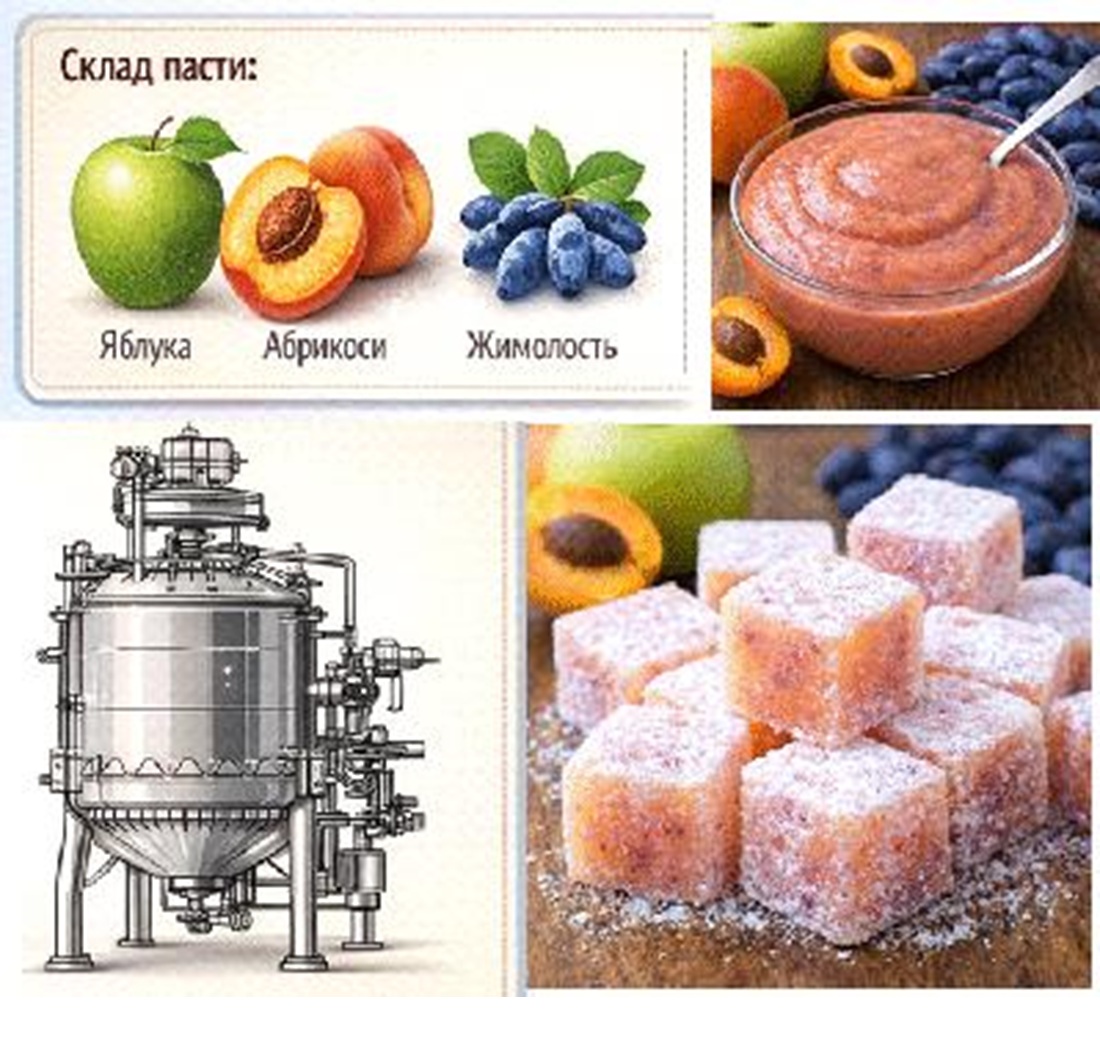
Об’єктом дослідження є технологічний процес виробництва рахат-лукуму із використанням плодово-ягідної пасти, виготовленої з яблук, абрикосів та жимолості. Вирішується проблема формування структури, збереження традиційних органолептичних показників якості рахат-лукуму без використання різноманітних добавок, підвищення харчової цінності шляхом використання натуральної плодово-ягідної пасти. Використання природних властивостей зазначеної сировини дає змогу обґрунтувати створення рослинної пасти та впровадити її у технологію рахат-лукуму.
Результатами досліджень встановлено, що запровадження короткочасного концентрування за температури 62…65°C забезпечує збереження функціональних компонентів у пасті, яка характеризується динамічною в’язкістю 320 Па∙с, вмістом некрохмальних полісахаридів 3,3 г, вітаміну С – 19 мг та вітаміну А – 210 мг.
Введення плодово-ягідної пасти у рецептуру рахат-лукуму сприяє підвищенню його якості. Відзначено зниження вологості з 17,2% до 16,8%, зростання титрованої кислотності з 1,5° до 1,7° та збільшення вмісту редукуючих речовин з 22,1% до 22,6%. Структурно-механічні дослідження показали, що міцність дослідного зразка станом на 1, 12 та 24 год становила 21, 38 та 42 кПа відповідно, що перевищує контрольні значення (14, 32 і 38 кПа), тоді як адгезія знизилася з 1,7 до 1,5 кПа. Отримані результати підтверджують ефективність використання плодово-ягідної пасти для створення рахат-лукуму з покращеною текстурою та підвищеною харчовою цінністю.
Запропонована технологія відкриває можливості для створення широкого асортименту натуральних кондитерських виробів з підвищеною функціональністю. Впровадження цієї технології може сприяти розширенню ринку екологічно безпечних солодощів та інтеграції у виробництво продукції з високою конкурентоспроможністю
Посилання
- de Oliveira, Z. B., Silva da Costa, D. V., da Silva dos Santos, A. C., da Silva Júnior, A. Q., de Lima Silva, A., de Santana, R. C. F. et al. (2024). Synthetic Colors in Food: A Warning for Children’s Health. International Journal of Environmental Research and Public Health, 21 (6), 682. https://doi.org/10.3390/ijerph21060682
- Lam, H.-P., Arli, D., Nguyen, T. H., Nguyen, T. Q. (2025). Homestay experience and eWOM among Generation Z tourists: The role of guest delight, guest satisfaction, and the need for uniqueness. Acta Psychologica, 255, 104980. https://doi.org/10.1016/j.actpsy.2025.104980
- Yuan, Y., Wei, X., Mao, Y., Zheng, Y., He, N., Guo, Y. et al. (2025). Innovative Food Processing Technologies Promoting Efficient Utilization of Nutrients in Staple Food Crops. Engineering, 50, 229–244. https://doi.org/10.1016/j.eng.2025.04.014
- Zagorulko, A., Zahorulko, A., Kasabova, K., Chuiko, L., Yakovets, L., Pugach, A. et al. (2022). Improving the production technology of functional paste-like fruit-and-berry semi-finished products. Eastern-European Journal of Enterprise Technologies, 4 (11 (118)), 43–52. https://doi.org/10.15587/1729-4061.2022.262924
- Zahorulko, A., Zagorulko, A., Kasabova, K., Liashenko, B., Postadzhiev, A., Sashnova, M. (2022). Improving a tempering machine for confectionery masses. Eastern-European Journal of Enterprise Technologies, 2 (11 (116)), 6–11. https://doi.org/10.15587/1729-4061.2022.254873
- Zagorulko, A., Shydakova-Kameniuka, O., Kasabova, K., Zahorulko, A., Budnyk, N., Kholobtseva, I. et al. (2023). Substantiating the technology of cream-whipped candy masses with the addition of berry and fruit paste. Eastern-European Journal of Enterprise Technologies, 3 (11 (123)), 50–59. https://doi.org/10.15587/1729-4061.2023.279287
- Zahorulko, A., Zagorulko, A., Kasabova, K., Shmatchenko, N. (2020). Improvement of zefir production by addition of the developed blended fruit and vegetable pasteinto its recipe. Eastern-European Journal of Enterprise Technologies, 2 (11 (104)), 39–45. https://doi.org/10.15587/1729-4061.2020.185684
- Samokhvalova, O., Kasabova, K., Shmatchenko, N., Zagorulko, A., Zahorulko, A. (2021). Improving the marmalade technology by adding a multicomponent fruit-and-berry paste. Eastern-European Journal of Enterprise Technologies, 6 (11 (114)), 6–14. https://doi.org/10.15587/1729-4061.2021.245986
- Batu, A., Kirmaci, B. (2009). Production of Turkish delight (lokum). Food Research International, 42 (1), 1–7. https://doi.org/10.1016/j.foodres.2008.08.007
- Batu, A., Arslan, A. (2014). Effects of Black Grape Syrup on Texture, Colour and Sensory Qualies of Value Added Turkish Delight (Lokum). Journal of Nutrition & Food Sciences, s8. https://doi.org/10.4172/2155-9600.s8-005
- Samokhvalova, O., Chernikova, Y., Oliinyk, S., Kasabova, K. (2015). The effect of microbial polysaccharides on the properties of wheat flour. Eastern-European Journal of Enterprise Technologies, 6 (10 (77)), 11. https://doi.org/10.15587/1729-4061.2015.56177
- Mykhaylov, V., Samokhvalova, O., Kucheruk, Z., Kasabova, K., Simakova, O., Goriainova, I. et al. (2019). Influence of microbial polysaccharides on the formation of structure of protein-free and gluten-free flour-based products. Eastern-European Journal of Enterprise Technologies, 6 (11 (102)), 23–32. https://doi.org/10.15587/1729-4061.2019.184464
- Karakaş Budak, B. (2019). Şekerleme ürününde nişastanın pullulan ile ikame edilmesinin lokumda nişasta jel yapısı üzerine etkisi. Mediterranean Agricultural Sciences, 32 (3), 323–327. https://doi.org/10.29136/mediterranean.609017
- Kasabova, K., Samokhvalova, O., Zagorulko, A., Zahorulko, A., Babaiev, S., Bereza, O. et al. (2022). Improvement of Turkish delight production technology using a developed multi-component fruit and vegetable paste. Eastern-European Journal of Enterprise Technologies, 6 (11 (120)), 51–59. https://doi.org/10.15587/1729-4061.2022.269393
- Kavak, D. D., Ogun, S. (2025). Use of quince (Cydonia oblonga mill.) as artificial coloring and flavoring substitute in functional soft candy (lokum) production. LWT, 225, 117831. https://doi.org/10.1016/j.lwt.2025.117831
- Çoban, B., Bilgin, B., Yurt, B., Kopuk, B., Atik, D. S., Palabiyik, I. (2021). Utilization of the barberry extract in the confectionery products. LWT, 145, 111362. https://doi.org/10.1016/j.lwt.2021.111362
- Özen, G., Akbulut, M., Artik, N. (2011). Stability Of Black Carrot Anthocyanins In The Turkish Delight (Lokum) During Storage. Journal of Food Process Engineering, 34 (4), 1282–1297. https://doi.org/10.1111/j.1745-4530.2009.00412.x
- Lapytska, N., Syza, O., Gorodyska, O., Savchenko, O., Rebenok, E. (2023). Improving the jelly plum juice technology by using secondary products of oil production. Eastern-European Journal of Enterprise Technologies, 3 (11 (123)), 68–77. https://doi.org/10.15587/1729-4061.2023.281929
- Kavak, D. D., Akpunar, E. B. (2018). Quality characteristics of Turkish delight (lokum) as influenced by different concentrations of cornelian cherry pulp. Journal of Food Processing and Preservation, 42 (7), e13656. https://doi.org/10.1111/jfpp.13656
- Hayoğlu, İ., Başyiğit, B., Dirik, A. (2017). Tane Nar İlaveli Lokum Üretimi Ve Vakum Ambalajlamanin Raf Ömrü Üzerine Etkisi. Gida / The Journal Of Food, 42 (5), 553–560. https://doi.org/10.15237/gida.gd17023
- Akinlolu-Ojo, T., Nwanna, E. E., Badejo, A. A. (2022). Physicochemical constituents and anti-oxidative properties of ripening hog plum (Spondias Mombin) fruits and the quality attributes of jam produced from the fruits. Measurement: Food, 7, 100037. https://doi.org/10.1016/j.meafoo.2022.100037
- Farzaliev, E. B., Ökten, S. (2023). Production and characterization of fruit jam with activated pectin using wild hawthorn puree (Crataegus monogyna Jacq.). Natural Product Research, 39 (4), 993–997. https://doi.org/10.1080/14786419.2023.2283760
- Fil, M., Mikhailyuk, O. (2017). Innovative approach technologies fruit marmalade. Scientific Messenger of LNU of Veterinary Medicine and Biotechnologies. Series: Food Technologies, 19 (75), 55–58. https://doi.org/10.15421/nvlvet7511
- Panasiuk, S., Myskovets, M. (2023). Innovative technology of diabetic jelly-fruit marmalade production. Commodity Bulletin, 16 (1), 73–84. https://doi.org/10.36910/6775-2310-5283-2023-17-6
- Alrasheedi, A. A., Ali, A. A., Hijazi, M. A. (2023). Modification and sensory evaluation of Turkish delight (lokum); supplemented with different levels of dried date powders. Food Science and Technology, 43. https://doi.org/10.5327/fst.00107
- Hanoğlu, A., Karaoğlu, M. M. (2024). The effect of different pulp powders incorporation on the instrumental texture and rheological properties of Turkish delight. International Journal of Gastronomy and Food Science, 35, 100872. https://doi.org/10.1016/j.ijgfs.2024.100872
- Lapytska, N., Rebenok, Y., Syza, O., Shkliaiev, O., Novik, А., Lystopad, T., Haliasnyi, I. (2025). Developing moсhi frozen desserts technology using by-products of juice production. Eastern-European Journal of Enterprise Technologies, 2 (11 (134)), 54–66. https://doi.org/10.15587/1729-4061.2025.324602
- Liu, R. H. (2013). Health-Promoting Components of Fruits and Vegetables in the Diet. Advances in Nutrition, 4 (3), 384S-392S. https://doi.org/10.3945/an.112.003517
- Skwarek, P., Karwowska, M. (2023). Fruit and vegetable processing by-products as functional meat product ingredients -a chance to improve the nutritional value. LWT, 189, 115442. https://doi.org/10.1016/j.lwt.2023.115442
- Samokhvalova, O., Kasabova, K., Oliinyk, S. (2014). The influence of the enriching additives on the dough structure formation and baked muffins. Eastern-European Journal of Enterprise Technologies, 1 (10 (67)), 32–36. https://doi.org/10.15587/1729-4061.2014.20024
- Kiptelaya, L., Zagorulko, A., Zagorulko, A. (2015). Improvement of equipment for manufacture of vegetable convenience foods. Eastern-European Journal of Enterprise Technologies, 2 (10 (74)), 4–8. https://doi.org/10.15587/1729-4061.2015.39455
- Tipsina, N. N. (2018). Vostochnye sladosti i nacional'nye izdeliya. Krasnoyarsk, 150. Available at: https://www.twirpx.com/file/3079130/
##submission.downloads##
Опубліковано
Як цитувати
Номер
Розділ
Ліцензія
Авторське право (c) 2025 Kateryna Kasabova, Olga Samokhvalova, Olena Bolkhovitina, Ighor Lebedinec, Nina Budnyk, Inna Choni, Oksana Skoromna, Alla Sitkovska, Svitlana Nuzhna, Olena Stukalo

Ця робота ліцензується відповідно до Creative Commons Attribution 4.0 International License.
Закріплення та умови передачі авторських прав (ідентифікація авторства) здійснюється у Ліцензійному договорі. Зокрема, автори залишають за собою право на авторство свого рукопису та передають журналу право першої публікації цієї роботи на умовах ліцензії Creative Commons CC BY. При цьому вони мають право укладати самостійно додаткові угоди, що стосуються неексклюзивного поширення роботи у тому вигляді, в якому вона була опублікована цим журналом, але за умови збереження посилання на першу публікацію статті в цьому журналі.
Ліцензійний договір – це документ, в якому автор гарантує, що володіє усіма авторськими правами на твір (рукопис, статтю, тощо).
Автори, підписуючи Ліцензійний договір з ПП «ТЕХНОЛОГІЧНИЙ ЦЕНТР», мають усі права на подальше використання свого твору за умови посилання на наше видання, в якому твір опублікований. Відповідно до умов Ліцензійного договору, Видавець ПП «ТЕХНОЛОГІЧНИЙ ЦЕНТР» не забирає ваші авторські права та отримує від авторів дозвіл на використання та розповсюдження публікації через світові наукові ресурси (власні електронні ресурси, наукометричні бази даних, репозитарії, бібліотеки тощо).
За відсутності підписаного Ліцензійного договору або за відсутністю вказаних в цьому договорі ідентифікаторів, що дають змогу ідентифікувати особу автора, редакція не має права працювати з рукописом.
Важливо пам’ятати, що існує і інший тип угоди між авторами та видавцями – коли авторські права передаються від авторів до видавця. В такому разі автори втрачають права власності на свій твір та не можуть його використовувати в будь-який спосіб.