Construction of a mathematical model of the heat and mass transfer process in the main fairing of a launch vehicle at the pre-launch preparation stage
DOI:
https://doi.org/10.15587/1729-4061.2025.347454Keywords:
thermal pollution, main fairing, protective screen, numerical model, computational experimentAbstract
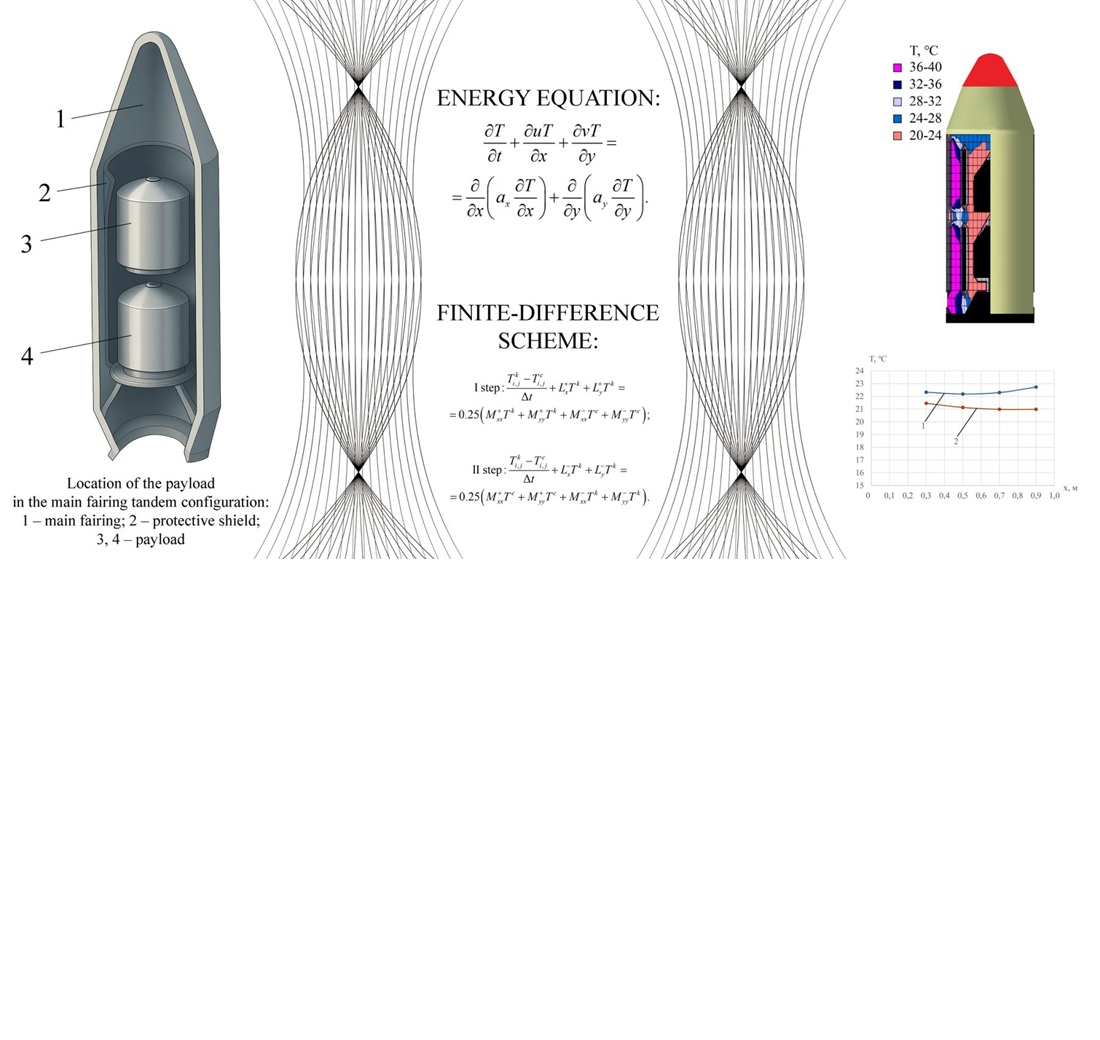
This study investigates the sequential and continuous formation of thermal fields in the main fairing of a launch vehicle when using protective screens. While thermostating, it is necessary to predict the risk in overheating the payload body and, if necessary, take measures to reduce the temperature near the payload.
An engineering solution to this problem can be found through the use of protective screens of various configurations inside the main fairing. These screens reduce the heat flow from the heated outer wall of the fairing to the payload surface. However, there are no standard methods for solving this problem.
To evaluate the effectiveness of this protection, a numerical model based on the fundamental equations of continuum mechanics has been constructed. The modeling equations include the energy equation and the equation of motion of a non-viscous gas. Using the numerical model built, a computational experiment was conducted, which confirmed the effectiveness of using protective screens to shield the payload body from excessive heating. The computer time required to perform the computational experiment is 3 seconds. This makes it possible to perform a significant number of calculations in a working day.
The proposed simple technical means for protecting the payload from excessive heating could be used in the design of new models for rocket technology. Applying these screens slightly reduces the need for large volumes of clean air. The numerical model built could be used at specialized organizations at the “for-sketch” design stage. Numerical experiments have shown that the use of protective screens inside the main fairing makes it possible to achieve a temperature 2–4°C lower than the maximum permissible temperature near the payload
References
- Groves, C. E. (2014). Dissertation defense computational fluid dynamics uncertainty analysis for payload fairing spacecraft environmental control systems. Florida, 160. Available at: https://ntrs.nasa.gov/api/citations/20140008549/downloads/20140008549.pdf
- Alcayde, V., Vercher-Martínez, A., Fuenmayor, F. J. (2021). Thermal control of a spacecraft: Backward-implicit scheme programming and coating materials analysis. Advances in Space Research, 68 (4), 1975–1988. https://doi.org/10.1016/j.asr.2021.03.041
- New Glenn Payload User’s Guide. Revision C. NGPM – MA0001 (2018). Blue Origin. Available at: https://yellowdragonblog.com/wp-content/uploads/2019/01/new_glenn_payload_users_guide_rev_c.pdf
- Potapov, A. M., Kovalenko, V. A., Kondratiev, А. V. (2015). Payload fairings comparison of existing and prospective launch vehicles and their foreign counterparts. Aviacinno-kosmicheskaya tehnika i tehnologiya, 1 (118), 35–43. Available at: https://www.researchgate.net/publication/295920078_Sravnenie_golovnyh_obtekatelej_susestvuusih_i_perspektivnyh_otecestvennyh_raket-nositelej_i_ih_zarubeznyh_analogov
- Kashanov, A. E., Degtyarev, A. V., Gladkiy, E. G., Baranov, E. Yu. (2012). Ocenka tehnicheskih riskov pri puske rakety-nositelya «Dnepr». Aviacionno-kosmicheskayatehnika i tehnologiya, 5 (92), 113–117.
- Timoshenko, V. I., Agarkov, A. V., Moshnenko, Yu. I., Sirenko, V. N., Knyshenko, Yu. V., Lyashenko, Yu. G. (1999). Problemy termostatirovaniya i obespecheniya sohrannosti kosmicheskogo apparata v period predstartovoy podgotovki i pri vyvedenii na orbitu. Kosmichna nauka i tekhnolohiya, 5 (5/6), 56–64. Available at: https://www.mao.kiev.ua/biblio/jscans/knit/1999-05/knit-1999-05-5-6-09-timoshenko.pdf
- Falcon User’s Guide. Version 8 (2025). SPACEX. Available at: https://www.spacex.com/assets/media/falcon-users-guide-2025-05-09.pdf
- LM-3A Series Launch Vehicle User’s Manual (2011). Available at: http://www.georing.biz/usefull/LM-3A%20Series%20Launch%20Vehicles%20User's%20Manual%20Issue%202011.pdf
- Ariane 6 User’s Manual. Issue 2 Revision 0. Arianespace. Available at: https://ariane.group/app/uploads/sites/4/2024/10/Mua-6_Issue-2_Revision-0_March-2021.pdf
- Pamuk, M. T. (2019). Numerical simulation of forced convection in an enclosure. JP Journal of Heat and Mass Transfer, 18 (1), 133–144. https://doi.org/10.17654/hm018010133
- Dutra, M., Monteiro, M., Martí, A. C. (2024). Cooling of an object by forced convection. European Journal of Physics, 45 (4), 045101. https://doi.org/10.1088/1361-6404/ad5393
- Riaz, A., Ibrahim, A., Bashir, M. S., Abdullah, M., Shah, A., Quddus, A. (2022). Convection Heat Transfer from Heated Thin Cylinders Inside a Ventilated Enclosure. Semiconductor Science and Information Devices, 4 (2), 10–16. https://doi.org/10.30564/ssid.v4i2.4719
- Lou, Y.-Y., Cai, B.-Y., Li, Y.-Z., Li, J.-X., Li, E.-H. (2020). Numerical Simulation of the Air Cooling System for Scientific Payload Rack on a Space Station. Energies, 13 (22), 6145. https://doi.org/10.3390/en13226145
- Junxin, Z., Wenan, Z., Zhongye, W., Laping, X., Gang, L., Chuang, Z. et al. (2021). Strategy for Enhancing Fairing Air Conditioning Security Capacity in the On-Time Launch of Chinese Mars-1 Exploration. Journal of Physics: Conference Series, 2006 (1), 012060. https://doi.org/10.1088/1742-6596/2006/1/012060
- Biliaiev, M., Rusakova, T., Biliaieva, V., Kozachyna, V., Berlov, O., Semenenko, P. (2022). Analysis of Temperature Field in the Transport Compartment of the Launch Vehicle. 26th International Scientific Conference Transport Means 2022, 122–127. Available at: https://transportmeans.ktu.edu/wp-content/uploads/sites/307/2023/02/Transport-Means-2022-Part-I.pdf
Downloads
Published
How to Cite
Issue
Section
License
Copyright (c) 2025 Mykola Biliaiev, Viktoriia Biliaieva, Tetiana Rusakova, Vitalii Kozachyna, Pavlo Semenenko, Oleksandr Berlov, Pavlo Kirichenko, Nataliia Hrudkina, Yuliia Voitenko, Olena Dolzhenkova

This work is licensed under a Creative Commons Attribution 4.0 International License.
The consolidation and conditions for the transfer of copyright (identification of authorship) is carried out in the License Agreement. In particular, the authors reserve the right to the authorship of their manuscript and transfer the first publication of this work to the journal under the terms of the Creative Commons CC BY license. At the same time, they have the right to conclude on their own additional agreements concerning the non-exclusive distribution of the work in the form in which it was published by this journal, but provided that the link to the first publication of the article in this journal is preserved.
A license agreement is a document in which the author warrants that he/she owns all copyright for the work (manuscript, article, etc.).
The authors, signing the License Agreement with TECHNOLOGY CENTER PC, have all rights to the further use of their work, provided that they link to our edition in which the work was published.
According to the terms of the License Agreement, the Publisher TECHNOLOGY CENTER PC does not take away your copyrights and receives permission from the authors to use and dissemination of the publication through the world's scientific resources (own electronic resources, scientometric databases, repositories, libraries, etc.).
In the absence of a signed License Agreement or in the absence of this agreement of identifiers allowing to identify the identity of the author, the editors have no right to work with the manuscript.
It is important to remember that there is another type of agreement between authors and publishers – when copyright is transferred from the authors to the publisher. In this case, the authors lose ownership of their work and may not use it in any way.







