Розробка математичної моделі процесу тепломасо-переносу у головному обтічнику ракети-носія на етапі передстартової підготовки
DOI:
https://doi.org/10.15587/1729-4061.2025.347454Ключові слова:
теплове забруднення, захисний екран, чисельна модель, обчислювальний експеримент, головний обтічникАнотація
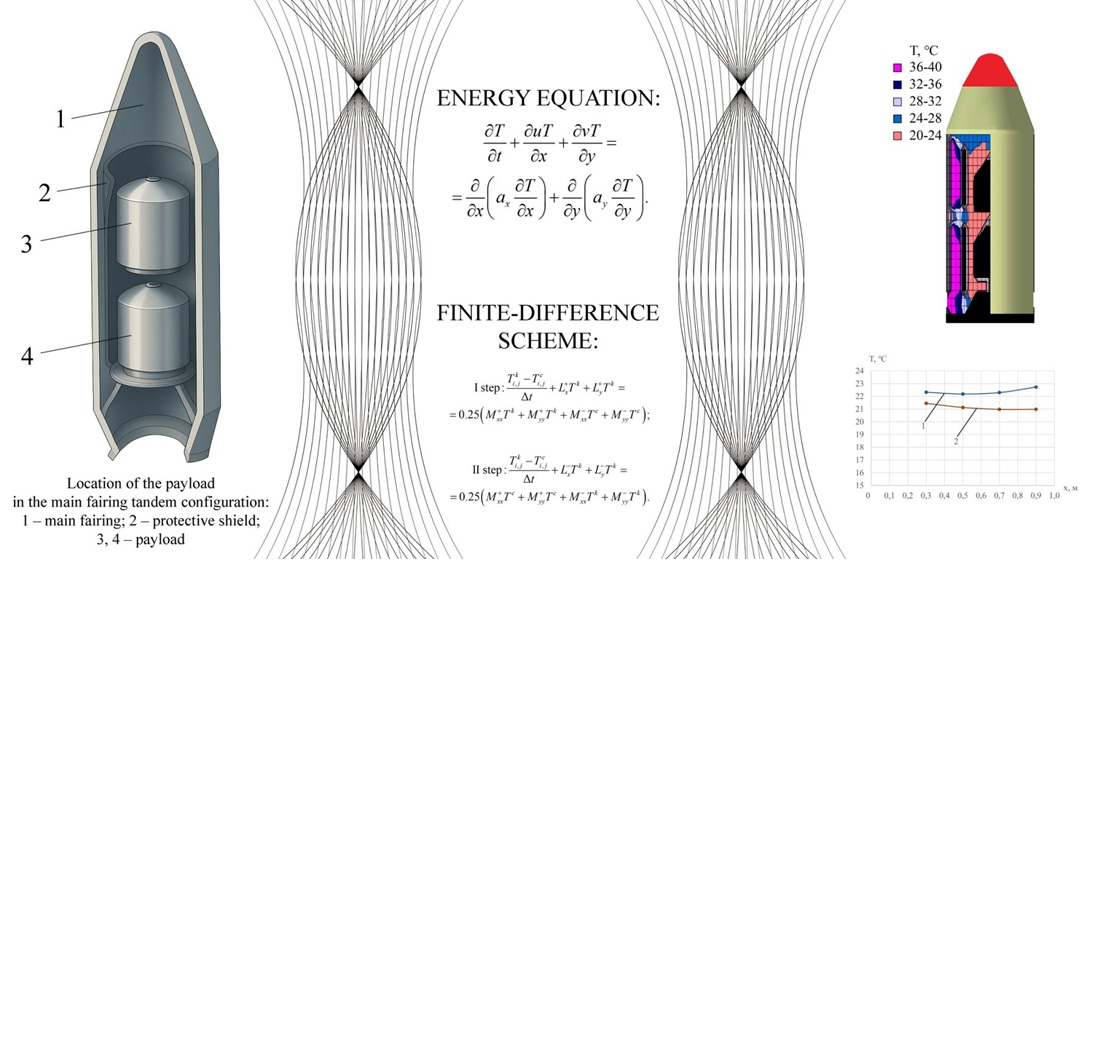
Об’єктом дослідження є послідовне та неперервне формування теплових полів в головному обтічнику ракети-носія при використанні захисних екранів. При термостатуванні необхідно спрогнозувати ризик перегріву корпусу корисного навантаження та при необхідності здійснити заходи по зниженню температури біля корисного навантаження. Інженерним рішенням такої задачі може бути знайдено у використанні захисних екранів різної конфігурації в середині головного обтічника. Ці екрани зменшують тепловий потік від нагрітої зовнішньої стінки обтічника до поверхні корисного навантаження. Але відсутні нормативні методи розв’язку цієї задачі. Для оцінювання ефективності даного захисту побудована чисельна модель на базі фундаментальних рівнянь механіки суцільного середовища. Моделюючі рівняння включають в себе рівняння енергії та рівняння руху нев’язкого газу. За допомогою розробленої чисельної моделі проведено обчислювальний експеримент, що підтвердив ефективність використання захисних екранів для захисту корпусу корисного навантаження від надлишкового нагріву. Витрати комп’ютерного часу на проведення обчислювального експерименту дорівнюють 3 секунди. Це дає можливість проводити значну кількість розрахунків протягом робочого дня. Запропонований простий технічний засіб захисту корисного навантаження від надлишкового нагріву може використовуватися при створенні нових зразків ракетної техніки. Використання цих екранів дещо зменшує потребу використання великих об’ємів чистого повітря. Розроблена чисельна модель може бути використана в спеціалізованих організаціях на етапі проектування «фор-ескіз». Чисельні експерименти показали, що використання захисних екранів в середині головного обтічника дає можливість отримати температуру на 2°C – 4°C нижче, ніж максимально допустима температура біля корисного навантаження
Посилання
- Groves, C. E. (2014). Dissertation defense computational fluid dynamics uncertainty analysis for payload fairing spacecraft environmental control systems. Florida, 160. Available at: https://ntrs.nasa.gov/api/citations/20140008549/downloads/20140008549.pdf
- Alcayde, V., Vercher-Martínez, A., Fuenmayor, F. J. (2021). Thermal control of a spacecraft: Backward-implicit scheme programming and coating materials analysis. Advances in Space Research, 68 (4), 1975–1988. https://doi.org/10.1016/j.asr.2021.03.041
- New Glenn Payload User’s Guide. Revision C. NGPM – MA0001 (2018). Blue Origin. Available at: https://yellowdragonblog.com/wp-content/uploads/2019/01/new_glenn_payload_users_guide_rev_c.pdf
- Potapov, A. M., Kovalenko, V. A., Kondratiev, А. V. (2015). Payload fairings comparison of existing and prospective launch vehicles and their foreign counterparts. Aviacinno-kosmicheskaya tehnika i tehnologiya, 1 (118), 35–43. Available at: https://www.researchgate.net/publication/295920078_Sravnenie_golovnyh_obtekatelej_susestvuusih_i_perspektivnyh_otecestvennyh_raket-nositelej_i_ih_zarubeznyh_analogov
- Kashanov, A. E., Degtyarev, A. V., Gladkiy, E. G., Baranov, E. Yu. (2012). Ocenka tehnicheskih riskov pri puske rakety-nositelya «Dnepr». Aviacionno-kosmicheskayatehnika i tehnologiya, 5 (92), 113–117.
- Timoshenko, V. I., Agarkov, A. V., Moshnenko, Yu. I., Sirenko, V. N., Knyshenko, Yu. V., Lyashenko, Yu. G. (1999). Problemy termostatirovaniya i obespecheniya sohrannosti kosmicheskogo apparata v period predstartovoy podgotovki i pri vyvedenii na orbitu. Kosmichna nauka i tekhnolohiya, 5 (5/6), 56–64. Available at: https://www.mao.kiev.ua/biblio/jscans/knit/1999-05/knit-1999-05-5-6-09-timoshenko.pdf
- Falcon User’s Guide. Version 8 (2025). SPACEX. Available at: https://www.spacex.com/assets/media/falcon-users-guide-2025-05-09.pdf
- LM-3A Series Launch Vehicle User’s Manual (2011). Available at: http://www.georing.biz/usefull/LM-3A%20Series%20Launch%20Vehicles%20User's%20Manual%20Issue%202011.pdf
- Ariane 6 User’s Manual. Issue 2 Revision 0. Arianespace. Available at: https://ariane.group/app/uploads/sites/4/2024/10/Mua-6_Issue-2_Revision-0_March-2021.pdf
- Pamuk, M. T. (2019). Numerical simulation of forced convection in an enclosure. JP Journal of Heat and Mass Transfer, 18 (1), 133–144. https://doi.org/10.17654/hm018010133
- Dutra, M., Monteiro, M., Martí, A. C. (2024). Cooling of an object by forced convection. European Journal of Physics, 45 (4), 045101. https://doi.org/10.1088/1361-6404/ad5393
- Riaz, A., Ibrahim, A., Bashir, M. S., Abdullah, M., Shah, A., Quddus, A. (2022). Convection Heat Transfer from Heated Thin Cylinders Inside a Ventilated Enclosure. Semiconductor Science and Information Devices, 4 (2), 10–16. https://doi.org/10.30564/ssid.v4i2.4719
- Lou, Y.-Y., Cai, B.-Y., Li, Y.-Z., Li, J.-X., Li, E.-H. (2020). Numerical Simulation of the Air Cooling System for Scientific Payload Rack on a Space Station. Energies, 13 (22), 6145. https://doi.org/10.3390/en13226145
- Junxin, Z., Wenan, Z., Zhongye, W., Laping, X., Gang, L., Chuang, Z. et al. (2021). Strategy for Enhancing Fairing Air Conditioning Security Capacity in the On-Time Launch of Chinese Mars-1 Exploration. Journal of Physics: Conference Series, 2006 (1), 012060. https://doi.org/10.1088/1742-6596/2006/1/012060
- Biliaiev, M., Rusakova, T., Biliaieva, V., Kozachyna, V., Berlov, O., Semenenko, P. (2022). Analysis of Temperature Field in the Transport Compartment of the Launch Vehicle. 26th International Scientific Conference Transport Means 2022, 122–127. Available at: https://transportmeans.ktu.edu/wp-content/uploads/sites/307/2023/02/Transport-Means-2022-Part-I.pdf
##submission.downloads##
Опубліковано
Як цитувати
Номер
Розділ
Ліцензія
Авторське право (c) 2025 Mykola Biliaiev, Viktoriia Biliaieva, Tetiana Rusakova, Vitalii Kozachyna, Pavlo Semenenko, Oleksandr Berlov, Pavlo Kirichenko, Nataliia Hrudkina, Yuliia Voitenko, Olena Dolzhenkova

Ця робота ліцензується відповідно до Creative Commons Attribution 4.0 International License.
Закріплення та умови передачі авторських прав (ідентифікація авторства) здійснюється у Ліцензійному договорі. Зокрема, автори залишають за собою право на авторство свого рукопису та передають журналу право першої публікації цієї роботи на умовах ліцензії Creative Commons CC BY. При цьому вони мають право укладати самостійно додаткові угоди, що стосуються неексклюзивного поширення роботи у тому вигляді, в якому вона була опублікована цим журналом, але за умови збереження посилання на першу публікацію статті в цьому журналі.
Ліцензійний договір – це документ, в якому автор гарантує, що володіє усіма авторськими правами на твір (рукопис, статтю, тощо).
Автори, підписуючи Ліцензійний договір з ПП «ТЕХНОЛОГІЧНИЙ ЦЕНТР», мають усі права на подальше використання свого твору за умови посилання на наше видання, в якому твір опублікований. Відповідно до умов Ліцензійного договору, Видавець ПП «ТЕХНОЛОГІЧНИЙ ЦЕНТР» не забирає ваші авторські права та отримує від авторів дозвіл на використання та розповсюдження публікації через світові наукові ресурси (власні електронні ресурси, наукометричні бази даних, репозитарії, бібліотеки тощо).
За відсутності підписаного Ліцензійного договору або за відсутністю вказаних в цьому договорі ідентифікаторів, що дають змогу ідентифікувати особу автора, редакція не має права працювати з рукописом.
Важливо пам’ятати, що існує і інший тип угоди між авторами та видавцями – коли авторські права передаються від авторів до видавця. В такому разі автори втрачають права власності на свій твір та не можуть його використовувати в будь-який спосіб.