Detection of fire by comparison of sampling coefficients of variation of current measurements of dangerous parameters of the gas environment
DOI:
https://doi.org/10.15587/1729-4061.2024.317825Keywords:
prompt detection of fires, sample coefficient of variation, dangerous parameters, gas environmentAbstract
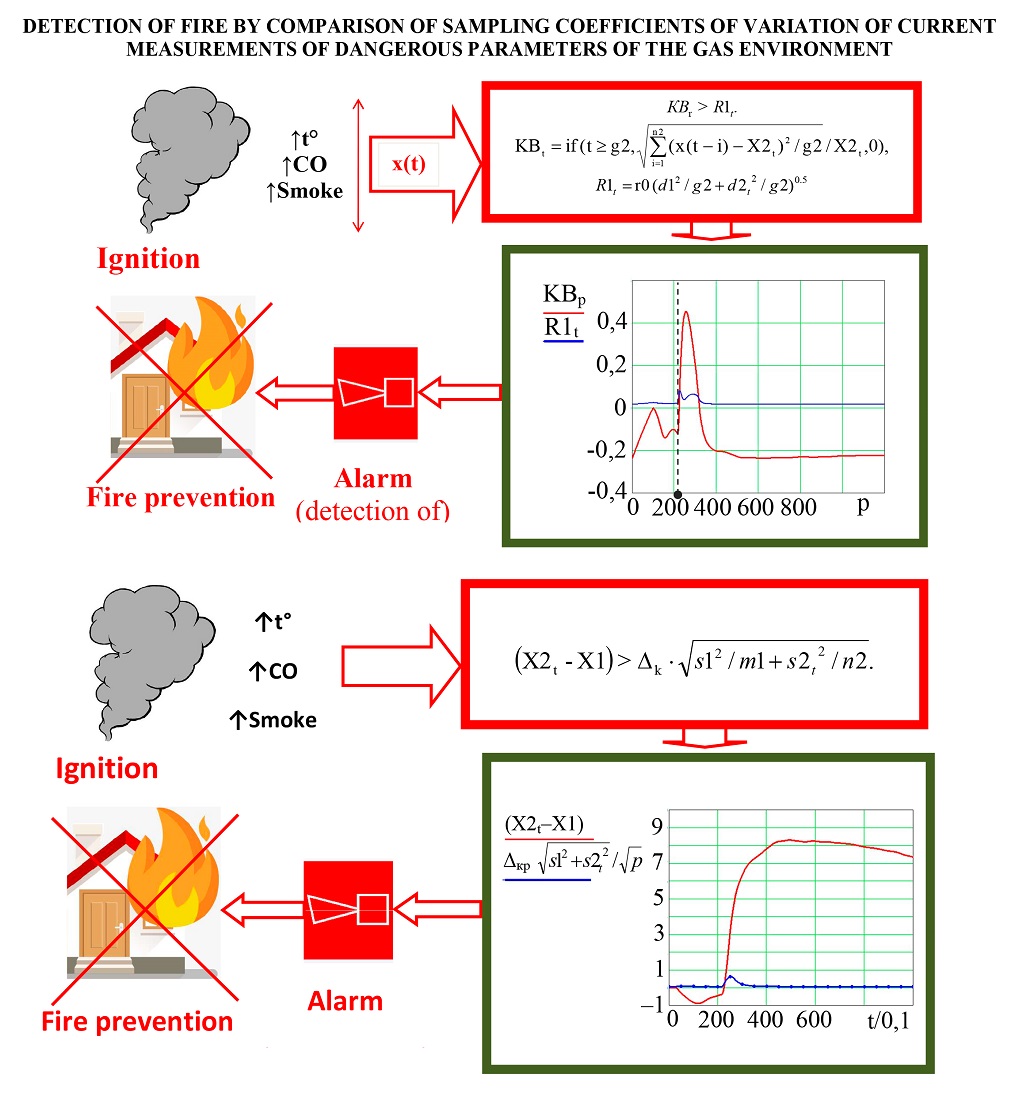
The object of this study is the selective coefficient of variation of dangerous parameters of the gas environment, which are caused by the general aggregates of reliable absence or occurrence of ignition of materials. The method of prompt detection of fires based on the comparison of the sample coefficients of variation of the hazardous parameters of the gas environment of the specified general populations and the verification for each moment of time of the result of the comparison of the sample coefficients of variation and exceeding the current threshold is theoretically substantiated. At the same time, the value of the current threshold is calculated taking into account the given probability of false detection of ignition and the current error of the result of comparing the sample coefficients of variation. This method makes it possible to ensure the maximum current probability of correct ignition detection. Experiments were conducted to verify the performance of the proposed method. The obtained results in general indicate the efficiency of the method. It was established that the result of the comparison of the sample coefficients of variation of the hazardous parameters of the gas environment, which correspond to the specified general populations for carbon monoxide at the time of ignition of alcohol, paper, wood, and textiles, is 0.47, 0.14, 0.2, and 0.001, respectively. For the temperature, the results of the comparison of the sample coefficients of variation during the ignition of similar materials are 0.12, 0.13, 0.015 and 0.045, respectively. At the same time, for prompt detection of fires based on the proposed method, it is necessary to preferably use the concentration of carbon monoxide and the temperature of the gas environment as dangerous parameters of the gas environment. The practical importance of the research is the use of selective coefficients of hazardous parameters of the gas environment for the detection of material fires in real time
References
- Zabulonov, Y. L., Popov, O. O., Skurativskyi, S. I., Stokolos, M. O., Puhach, O. V., Molitor, N. (2023). Mathematical tools of solving the problem of restoring the surface distribution of radiation pollution based on remote measurement data. IOP Conference Series: Earth and Environmental Science, 1254 (1), 012099. https://doi.org/10.1088/1755-1315/1254/1/012099
- Truong, C. T., Nguyen, T. H., Vu, V. Q., Do, V. H., Nguyen, D. T. (2023). Enhancing Fire Detection Technology: A UV-Based System Utilizing Fourier Spectrum Analysis for Reliable and Accurate Fire Detection. Applied Sciences, 13 (13), 7845. https://doi.org/10.3390/app13137845
- Gaur, A., Singh, A., Kumar, A., Kulkarni, K. S., Lala, S., Kapoor, K. et al. (2019). Fire Sensing Technologies: A Review. IEEE Sensors Journal, 19 (9), 3191–3202. https://doi.org/10.1109/jsen.2019.2894665
- Pospelov, B., Andronov, V., Rybka, E., Bezuhla, Y., Liashevska, O., Butenko, T. et al. (2022). Empirical cumulative distribution function of the characteristic sign of the gas environment during fire. Eastern-European Journal of Enterprise Technologies, 4 (10 (118)), 60–66. https://doi.org/10.15587/1729-4061.2022.263194
- Wu, Y., Harada, T. (2004). Study on the Burning Behaviour of Plantation Wood. Scientia Silvae Sinicae, 40, 131.
- Ji, J., Yang, L., Fan, W. (2003). Experimental Study on Effects of Burning Behaviours of Materials Caused by External Heat Radiation. Journal of Combustion Science and Technology, 9, 139.
- Peng, X., Liu, S., Lu, G. (2005). Experimental Analysis on Heat Release Rate of Materials. Journal of Chongqing University, 28, 122.
- Li, J., Yan, B., Zhang, M., Zhang, J., Jin, B., Wang, Y., Wang, D. (2019). Long-Range Raman Distributed Fiber Temperature Sensor With Early Warning Model for Fire Detection and Prevention. IEEE Sensors Journal, 19 (10), 3711–3717. https://doi.org/10.1109/jsen.2019.2895735
- Frizzi, S., Kaabi, R., Bouchouicha, M., Ginoux, J.-M., Moreau, E., Fnaiech, F. (2016). Convolutional neural network for video fire and smoke detection. IECON 2016 - 42nd Annual Conference of the IEEE Industrial Electronics Society, 877–882. https://doi.org/10.1109/iecon.2016.7793196
- Wang, H., Fang, X., Li, Y., Zheng, Z., Shen, J. (2021). Research and application of the underground fire detection technology based on multi-dimensional data fusion. Tunnelling and Underground Space Technology, 109, 103753. https://doi.org/10.1016/j.tust.2020.103753
- Pospelov, B., Rybka, E., Samoilov, M., Morozov, I., Bezuhla, Y., Butenko, T. et al. (2022). Defining the features of amplitude and phase spectra of dangerous factors of gas medium during the ignition of materials in the premises. Eastern-European Journal of Enterprise Technologies, 2 (10 (116)), 57–65. https://doi.org/10.15587/1729-4061.2022.254500
- Pospelov, B., Rybka, E., Krainiukov, O., Fedyna, V., Bezuhla, Y., Melnychenko, A. et al. (2024). Method for early ignition detection based on the sampling dispersion of dangerous parameter. Eastern-European Journal of Enterprise Technologies, 1 (10 (127)), 55–63. https://doi.org/10.15587/1729-4061.2024.299001
- Hogg, R. V., McKean, J. W., Craig, A. T. (2013). Introduction to mathematical statistics. Pearson Education.
- Kovach, V. O., Kutsenko, V. O., Pylypchuk, I. V., Krasnov, Y. B., Bliznyuk, V. N., Budnyak, T. M. (2023). Development of a conceptual scheme for the creation of environmentally friendly Gd-containing neutron-absorbing nanocomposites. IOP Conference Series: Earth and Environmental Science, 1254 (1), 012100. https://doi.org/10.1088/1755-1315/1254/1/012100
- Sadkovyi, V., Andronov, V., Semkiv, O., Kovalov, A., Rybka, E., Otrosh, Yu. et al.; Sadkovyi, V., Rybka, E., Otrosh, Yu. (Eds.) (2021). Fire resistance of reinforced concrete and steel structures. Kharkiv: РС ТЕСHNOLOGY СЕNTЕR, 180. https://doi.org/10.15587/978-617-7319-43-5
- Pospelov, B., Kovrehin, V., Rybka, E., Krainiukov, O., Petukhova, O., Butenko, T. et al. (2020). Development of a method for detecting dangerous states of polluted atmospheric air based on the current recurrence of the combined risk. Eastern-European Journal of Enterprise Technologies, 5 (9 (107)), 49–56. https://doi.org/10.15587/1729-4061.2020.213892
- Cramér, H. (2016). Mathematical methods of statistics. Princeton University Press, 26.
- Pospelov, B., Rybka, E., Krainiukov, O., Yashchenko, O., Bezuhla, Y., Bielai, S. et al. (2021). Short-term forecast of fire in the premises based on modification of the Brown’s zero-order model. Eastern-European Journal of Enterprise Technologies, 4 (10 (112)), 52–58. https://doi.org/10.15587/1729-4061.2021.238555
- Otrosh, Y., Rybka, Y., Danilin, O., Zhuravskyi, M. (2019). Assessment of the technical state and the possibility of its control for the further safe operation of building structures of mining facilities. E3S Web of Conferences, 123, 01012. https://doi.org/10.1051/e3sconf/201912301012
Downloads
Published
How to Cite
Issue
Section
License
Copyright (c) 2024 Igor Tolok, Boris Pospelov, Evgenіy Rybka, Andrii Iatsyshyn, Yurii Kozar, Olekcii Krainiukov, Ihor Morozov, Yuliia Bezuhla, Mikhail Kravtsov, Olga Salamatina

This work is licensed under a Creative Commons Attribution 4.0 International License.
The consolidation and conditions for the transfer of copyright (identification of authorship) is carried out in the License Agreement. In particular, the authors reserve the right to the authorship of their manuscript and transfer the first publication of this work to the journal under the terms of the Creative Commons CC BY license. At the same time, they have the right to conclude on their own additional agreements concerning the non-exclusive distribution of the work in the form in which it was published by this journal, but provided that the link to the first publication of the article in this journal is preserved.
A license agreement is a document in which the author warrants that he/she owns all copyright for the work (manuscript, article, etc.).
The authors, signing the License Agreement with TECHNOLOGY CENTER PC, have all rights to the further use of their work, provided that they link to our edition in which the work was published.
According to the terms of the License Agreement, the Publisher TECHNOLOGY CENTER PC does not take away your copyrights and receives permission from the authors to use and dissemination of the publication through the world's scientific resources (own electronic resources, scientometric databases, repositories, libraries, etc.).
In the absence of a signed License Agreement or in the absence of this agreement of identifiers allowing to identify the identity of the author, the editors have no right to work with the manuscript.
It is important to remember that there is another type of agreement between authors and publishers – when copyright is transferred from the authors to the publisher. In this case, the authors lose ownership of their work and may not use it in any way.







