Обґрунтування вибору раціональної відстані між кабіною водія і напівпричепом для зменшення аеродинамічного опору автопоїзда
DOI:
https://doi.org/10.15587/1729-4061.2025.320494Ключові слова:
сила опору повітря, аеродинаміка магістральних автопоїздів, CFD моделювання аеродинаміки автопоїзда, витрата пального, аеродинамічний опір, вплив відстані між кабіною і кузовом на аеродинамікуАнотація
Об’єктом дослідження є аеродинамічний опір магістрального автопоїзда та його вплив на ефективність перевізного процесу.
Зменшення аеродинамічного опору автопоїздів є важливою проблемою, оскільки від нього залежить витрата палива і ефективність перевезень. Зменшення аеродинамічного опору на 2 % зменшує витрату палива на 1 %. Зменшення аеродинамічного опору досягається використанням спеціальних аеродинамічних пристроїв. Але їх використання створює ряд проблем – збільшення маси автопоїзда та його габаритних розмірів і ін.
Зроблено припущення, що шляхом підбору раціональної відстані між кабіною і напівпричепом автопоїзда можна суттєво зменшити витрату палива.
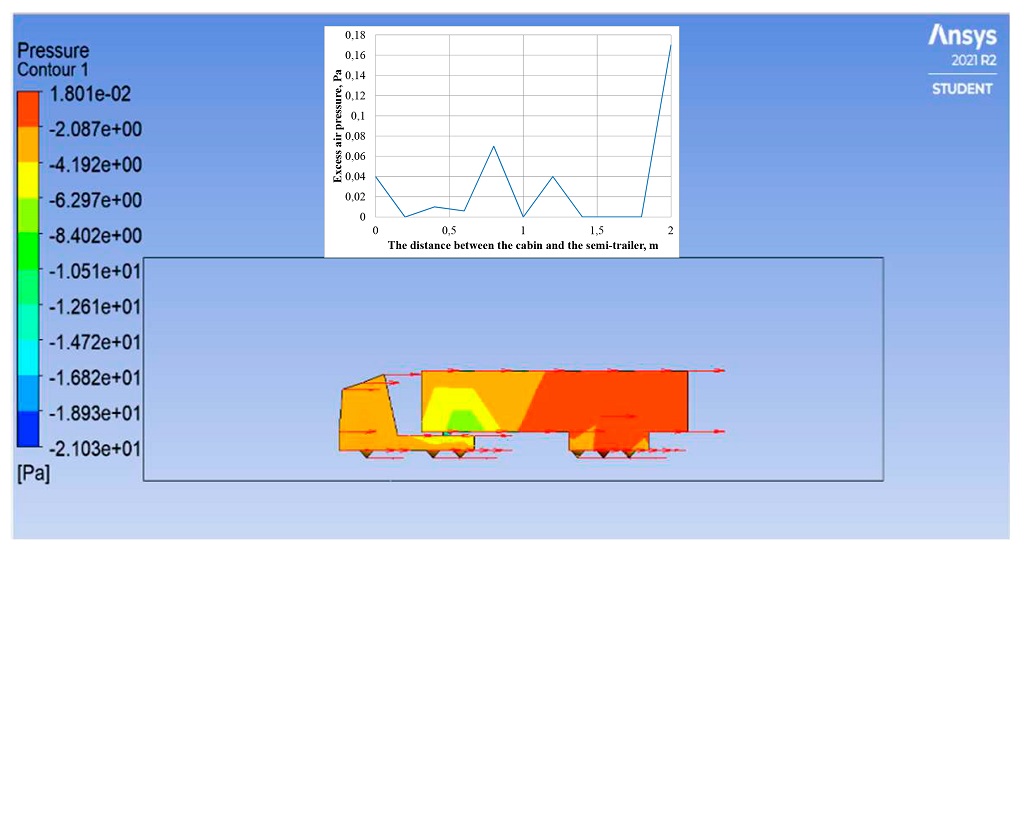
Отримані результати показують, що сумарний аеродинамічний опір автопоїзда суттєво залежить від відстані між кабіною водія і напівпричепом. Це пояснюється тим, що у просторі між кабіною і напівпричепом виникають завихрення повітряного потоку, що призводить до збільшення аеродинамічного опору. Отримана залежність надлишкового тиску у просторі між кабіною і напівпричепом від відстані між ними дає можливість визначити два діапазони відстаней де цей тиск буде мінімальним. На відміну від відомих досліджень, результати моделювання дають змогу встановлення раціональної відстані між кабіною і напівпричепом автопоїзда з точки зору отримання мінімального сумарного аеродинамічного опору. Проте, зміна відстані між кабіною і напівпричепом може впливати на показники керованості та стійкості автопоїзда.
Отримані результати можуть бути використані при розробці конструкцій напівпричепів, які забезпечать зменшення сумарного аеродинамічного опору автопоїздів. А це призведе до зменшення витрати палива на виконання перевізного процесу
Посилання
- Begerskyi, D. B., Vityk, I. V., Koval, A. O., Tsymbal, S. V. (2024). Influence of the geometric parameters of the vehicle on its aerodynamic characteristics. Journal of Mechanical Engineering and Transport, 18 (2), 10–15. https://doi.org/10.31649/2413-4503-2023-18-2-10-15
- Nesterenko, M., Zhyla, I., Kashuba, D., Marchenko, I. (2022). Research of truck train aerodynamic indicators by using computer simulation. Academic Journal Industrial Machine Building Civil Engineering, 1 (58), 5–10. Available at: https://journals.nupp.edu.ua/znp/article/view/3076
- Raj, R. T. K., Gupta, A., Gupta, S., Khan, S. (2013). Numerical and experimental study of fluid flow over an automobile body to optimize aerodynamic characteristics using CFD codes. International Journal of Applied Engineering Research, 8 (6), 733–744. Available at: https://www.researchgate.net/publication/289605929_Numerical_and_experimental_study_of_fluid_flow_over_an_automobile_body_to_optimize_aerodynamic_characteristics_using_CFD_codes
- Salati, L., Schito, P., Cheli, F. (2017). Wind tunnel experiment on a heavy truck equipped with front-rear trailer device. Journal of Wind Engineering and Industrial Aerodynamics, 171, 101–109. https://doi.org/10.1016/j.jweia.2017.09.016
- Opanasyuk, Ye., Beherskyi, D., Mozharovskyi, M., Opanasyuk, O. (2019). The study of the aerodynamic performance of a train using a physical simulation method. The Journal of Zhytomyr State Technological University. Series: Engineering, 1 (83), 25–34. https://doi.org/10.26642/tn-2019-1(83)-25-34
- Josefsson, E. (2019). Examination of robustness and accuracy of CFD simulations for external aerodynamics of commercial vehicles. Goteborg. Available at: https://hdl.handle.net/20.500.12380/257069
- Nasir, M. (2023). A Comparative Analysis of a Scaled Car Model To Determine Drag Effects Using Wind Tunnel and CFD. http://dx.doi.org/10.13140/RG.2.2.10807.50087
- Hassan, S. M. R., Islam, T., Ali, M., Islam, Md. Q. (2014). Numerical Study on Aerodynamic Drag Reduction of Racing Cars. Procedia Engineering, 90, 308–313. https://doi.org/10.1016/j.proeng.2014.11.854
- Ilea, L., Iozsa, D., Fratila, G. (2022). Modelling a virtual wind tunnel for vehicle aerodynamic measurements. IOP Conference Series: Materials Science and Engineering, 1220 (1), 012027. https://doi.org/10.1088/1757-899x/1220/1/012027
- Vieru, E. M., Iozsa, D., Ilea, L., Frăţilă, G. (2022). Influence of air flow in the lateral areas of a tractor unit on its aerodynamic performance. IOP Conference Series: Materials Science and Engineering, 1262 (1), 012075. https://doi.org/10.1088/1757-899x/1262/1/012075
##submission.downloads##
Опубліковано
Як цитувати
Номер
Розділ
Ліцензія
Авторське право (c) 2025 Dmytro Beherskyi, Ivan Vitiuk, Andrii Koval, Andrii Golubovskyi, Mykhailo Perehuda

Ця робота ліцензується відповідно до Creative Commons Attribution 4.0 International License.
Закріплення та умови передачі авторських прав (ідентифікація авторства) здійснюється у Ліцензійному договорі. Зокрема, автори залишають за собою право на авторство свого рукопису та передають журналу право першої публікації цієї роботи на умовах ліцензії Creative Commons CC BY. При цьому вони мають право укладати самостійно додаткові угоди, що стосуються неексклюзивного поширення роботи у тому вигляді, в якому вона була опублікована цим журналом, але за умови збереження посилання на першу публікацію статті в цьому журналі.
Ліцензійний договір – це документ, в якому автор гарантує, що володіє усіма авторськими правами на твір (рукопис, статтю, тощо).
Автори, підписуючи Ліцензійний договір з ПП «ТЕХНОЛОГІЧНИЙ ЦЕНТР», мають усі права на подальше використання свого твору за умови посилання на наше видання, в якому твір опублікований. Відповідно до умов Ліцензійного договору, Видавець ПП «ТЕХНОЛОГІЧНИЙ ЦЕНТР» не забирає ваші авторські права та отримує від авторів дозвіл на використання та розповсюдження публікації через світові наукові ресурси (власні електронні ресурси, наукометричні бази даних, репозитарії, бібліотеки тощо).
За відсутності підписаного Ліцензійного договору або за відсутністю вказаних в цьому договорі ідентифікаторів, що дають змогу ідентифікувати особу автора, редакція не має права працювати з рукописом.
Важливо пам’ятати, що існує і інший тип угоди між авторами та видавцями – коли авторські права передаються від авторів до видавця. В такому разі автори втрачають права власності на свій твір та не можуть його використовувати в будь-який спосіб.