Dominant disaster detection and prediction in coastal areas using neural network system to optimize disaster management in coastal areas
DOI:
https://doi.org/10.15587/1729-4061.2025.321966Keywords:
deep neural network (DNN), disaster prediction, coastal area, mitigation, smart detection system (SDS), geographic information system (GIS) mapping, early warning system (EWS)Abstract
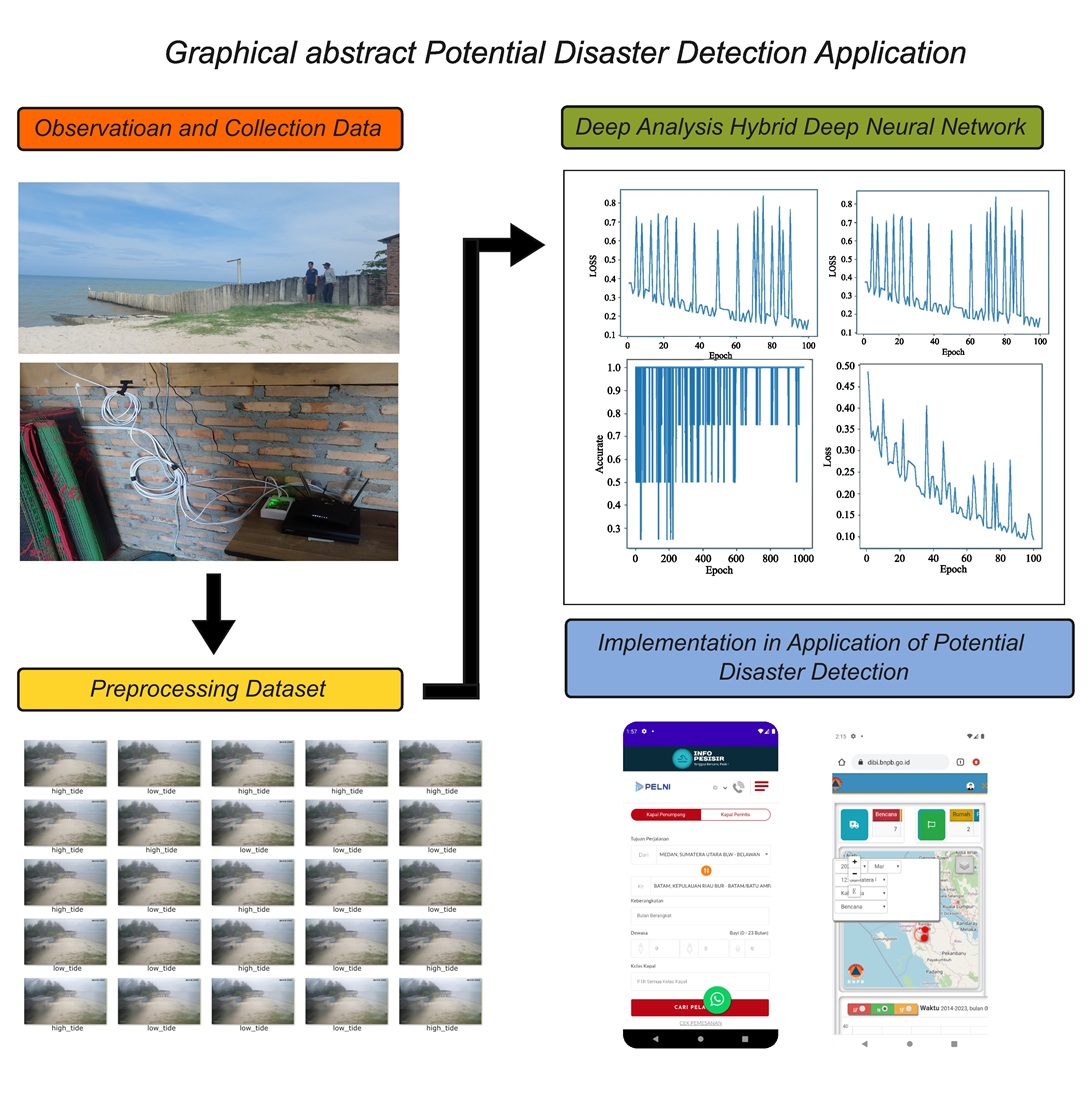
The object of the study is detection and prediction dominant disaster in coastal areas. The problem being addressed is the lack of accurate and efficient early warning systems for these disasters, which can result in significant damage and economic loss. To solve this problem, this study develops an innovative application and website designed to predict the most dominant disasters in coastal areas. This system utilizes real-time data processing to provide early warnings and risk assessments, assisting communities and emergency response teams in preparing for potential threats. Testing results indicate that 89 % of the system’s predictions are effective in disaster management. The research methodology includes observation, data collection, dataset preprocessing, analysis, and the development of a smart detection system (SDS) using Geographic Information System (GIS)-based mapping and clustering techniques. The findings are explained through the hybrid deep neural network (DNN) method, which analyzes various environmental factors, including temperature, wind speed, wave height, weather disturbances, and sea level fluctuations. Additional features, such as daily weather forecasts, enhance the system’s predictive capabilities. This intelligent disaster management system, powered by a neural network, ensures effective disaster prediction and mitigation. The system is designed to be applied in coastal areas with limited technology, thereby improving disaster preparedness. Additionally, the application enables governments to monitor and respond to disasters more efficiently. By integrating artificial intelligence (AI)-based solutions, this research significantly contributes to disaster management, offering innovative strategies to minimize risks and enhance emergency response efforts
References
- Tanzil Furqon, M., Muflikhah, L. (2016). Clustering The Potential Risk Of Tsunami Using Density-Based Spatial Clustering Of Application With Noise (Dbscan). Journal of Enviromental Engineering and Sustainable Technology, 3 (1), 1–8. https://doi.org/10.21776/ub.jeest.2016.003.01.1
- Li, Y., Goda, K. (2023). Risk-based tsunami early warning using random forest. Computers & Geosciences, 179, 105423. https://doi.org/10.1016/j.cageo.2023.105423
- Moya, L., Muhari, A., Adriano, B., Koshimura, S., Mas, E., Marval-Perez, L. R., Yokoya, N. (2020). Detecting urban changes using phase correlation and ℓ1-based sparse model for early disaster response: A case study of the 2018 Sulawesi Indonesia earthquake-tsunami. Remote Sensing of Environment, 242, 111743. https://doi.org/10.1016/j.rse.2020.111743
- Wang, Y., Imai, K., Miyashita, T., Ariyoshi, K., Takahashi, N., Satake, K. (2023). Coastal tsunami prediction in Tohoku region, Japan, based on S-net observations using artificial neural network. Earth, Planets and Space, 75 (1). https://doi.org/10.1186/s40623-023-01912-6
- Xu, H., Wu, H. (2023). Accurate tsunami wave prediction using long short-term memory based neural networks. Ocean Modelling, 186, 102259. https://doi.org/10.1016/j.ocemod.2023.102259
- Lin, A., Wu, H., Liang, G., Cardenas-Tristan, A., Wu, X., Zhao, C., Li, D. (2020). A big data-driven dynamic estimation model of relief supplies demand in urban flood disaster. International Journal of Disaster Risk Reduction, 49, 101682. https://doi.org/10.1016/j.ijdrr.2020.101682
- Zhai, W. (2022). A multi-level analytic framework for disaster situational awareness using Twitter data. Computational Urban Science, 2 (1). https://doi.org/10.1007/s43762-022-00052-z
- Jain, N., Virmani, D., Abraham, A., Salas-Morera, L., Garcia-Hernandez, L. (2020). Did They Sense it Coming? A Pipelined Approach for Tsunami Prediction Based on Aquatic Behavior Using Ensemble Clustering and Fuzzy Rule-Based Classification. IEEE Access, 8, 166922–166939. https://doi.org/10.1109/access.2020.3022865
- Behrens, J., Løvholt, F., Jalayer, F., Lorito, S., Salgado-Gálvez, M. A., Sørensen, M. et al. (2021). Probabilistic Tsunami Hazard and Risk Analysis: A Review of Research Gaps. Frontiers in Earth Science, 9. https://doi.org/10.3389/feart.2021.628772
- Jia, J., Ye, W. (2023). Deep Learning for Earthquake Disaster Assessment: Objects, Data, Models, Stages, Challenges, and Opportunities. Remote Sensing, 15 (16), 4098. https://doi.org/10.3390/rs15164098
- Virtriana, R., Harto, A. B., Atmaja, F. W., Meilano, I., Fauzan, K. N., Anggraini, T. S. et al. (2022). Machine learning remote sensing using the random forest classifier to detect the building damage caused by the Anak Krakatau Volcano tsunami. Geomatics, Natural Hazards and Risk, 14 (1), 28–51. https://doi.org/10.1080/19475705.2022.2147455
- Cheng, A.-C., Suppasri, A., Pakoksung, K., Imamura, F. (2023). Characteristics of consecutive tsunamis and resulting tsunami behaviors in southern Taiwan induced by the Hengchun earthquake doublet on 26 December 2006. Natural Hazards and Earth System Sciences, 23 (2), 447–479. https://doi.org/10.5194/nhess-23-447-2023
- Khan, A., Gupta, S., Gupta, S. K. (2020). Multi-hazard disaster studies: Monitoring, detection, recovery, and management, based on emerging technologies and optimal techniques. International Journal of Disaster Risk Reduction, 47, 101642. https://doi.org/10.1016/j.ijdrr.2020.101642
- Isnaeni, A. Y., Prasetyo, S. Y. J. (2022). Klasifikasi Wilayah Potensi Risiko Kerusakan Lahan Akibat Bencana Tsunami Menggunakan Machine Learning. Jurnal Teknik Informatika Dan Sistem Informasi, 8 (1). https://doi.org/10.28932/jutisi.v8i1.4056
- Toha, H. R., Hashim, J. H., Sahani, M., Shamsir, M. S. (2014). Spatial occurrence of dengue fever and its relationship with land use in Selangor, Malaysia. BMC Public Health, 14 (S1). https://doi.org/10.1186/1471-2458-14-s1-p16
- Harumy, T. H. F., Yustika Manik, F., Altaha. (2021). Optimization Classification of Diseases Which is Dominant Suffered by Coastal Areas Using Neural Network. 2021 International Conference on Data Science, Artificial Intelligence, and Business Analytics (DATABIA), 136–141. https://doi.org/10.1109/databia53375.2021.9650223
- Hidayat, M. A., Husni, N. L., Damsi, F. (2022). Pendeteksi Banjir Dengan Image Processing Berbasis Convolutional Neural Network (CNN) pada Kamera Pengawas. MALCOM: Indonesian Journal of Machine Learning and Computer Science, 2 (2), 10–18. https://doi.org/10.57152/malcom.v2i2.382
- Isdianto, A., Asyari, I. M., Haykal, M. F., Adibah, F., Irsyad, M. J., Supriyadi, S. (2020). Analisis Perubahan Garis Pantai Dalam Mendukung Ketahanan Ekosistem Pesisir. Jukung (Jurnal Teknik Lingkungan), 6 (2). https://doi.org/10.20527/jukung.v6i2.9260
- Sadollah, A., Eskandar, H., Lee, H. M., Yoo, D. G., Kim, J. H. (2016). Water cycle algorithm: A detailed standard code. SoftwareX, 5, 37–43. https://doi.org/10.1016/j.softx.2016.03.001
- Henríquez, P. A., Ruz, G. A. (2018). A non-iterative method for pruning hidden neurons in neural networks with random weights. Applied Soft Computing, 70, 1109–1121. https://doi.org/10.1016/j.asoc.2018.03.013
- Balamurugan, P., Amudha, T., Satheeshkumar, J., Somam, M. (2021). Optimizing Neural Network Parameters For Effective Classification of Benign and Malicious Websites. Journal of Physics: Conference Series, 1998 (1), 012015. https://doi.org/10.1088/1742-6596/1998/1/012015
- Yumanda, E., Pakereng, M. A. I. (2021). Klasifikasi Resiko Kerusakan Lahan Akibat Tsunami Menggunakan Citra Landsat 8 Di Kabupaten Bantul. JATISI (Jurnal Teknik Informatika Dan Sistem Informasi), 8 (3), 1496–1507. https://doi.org/10.35957/jatisi.v8i3.1109
- Arsa, D. M. S., Ma’sum, M. A., Rachmadi, M. F., Jatmiko, W. (2017). Optimization of Stacked Unsupervised Extreme Learning Machine to improve classifier performance. 2017 International Workshop on Big Data and Information Security (IWBIS), 63–68. https://doi.org/10.1109/iwbis.2017.8275104
- Eskandar, H., Sadollah, A., Bahreininejad, A., Hamdi, M. (2012). Water cycle algorithm – A novel metaheuristic optimization method for solving constrained engineering optimization problems. Computers & Structures, 110–111, 151–166. https://doi.org/10.1016/j.compstruc.2012.07.010
- Mohammed, A. J., Al-Majidi, S. D., Al-Nussairi, M. Kh., Abbod, M. F., Al-Raweshidy, H. S. (2022). Design of a Load Frequency Controller based on Artificial Neural Network for Single-Area Power System. 2022 57th International Universities Power Engineering Conference (UPEC), 1–5. https://doi.org/10.1109/upec55022.2022.9917853
- Poostchi, M., Silamut, K., Maude, R. J., Jaeger, S., Thoma, G. (2018). Image analysis and machine learning for detecting malaria. Translational Research, 194, 36–55. https://doi.org/10.1016/j.trsl.2017.12.004
Downloads
Published
How to Cite
Issue
Section
License
Copyright (c) 2025 Henny Febriana Harumy, Dewi Sartika Ginting, Fuzy Yustika Manik, Mesra Betty Yel

This work is licensed under a Creative Commons Attribution 4.0 International License.
The consolidation and conditions for the transfer of copyright (identification of authorship) is carried out in the License Agreement. In particular, the authors reserve the right to the authorship of their manuscript and transfer the first publication of this work to the journal under the terms of the Creative Commons CC BY license. At the same time, they have the right to conclude on their own additional agreements concerning the non-exclusive distribution of the work in the form in which it was published by this journal, but provided that the link to the first publication of the article in this journal is preserved.
A license agreement is a document in which the author warrants that he/she owns all copyright for the work (manuscript, article, etc.).
The authors, signing the License Agreement with TECHNOLOGY CENTER PC, have all rights to the further use of their work, provided that they link to our edition in which the work was published.
According to the terms of the License Agreement, the Publisher TECHNOLOGY CENTER PC does not take away your copyrights and receives permission from the authors to use and dissemination of the publication through the world's scientific resources (own electronic resources, scientometric databases, repositories, libraries, etc.).
In the absence of a signed License Agreement or in the absence of this agreement of identifiers allowing to identify the identity of the author, the editors have no right to work with the manuscript.
It is important to remember that there is another type of agreement between authors and publishers – when copyright is transferred from the authors to the publisher. In this case, the authors lose ownership of their work and may not use it in any way.





