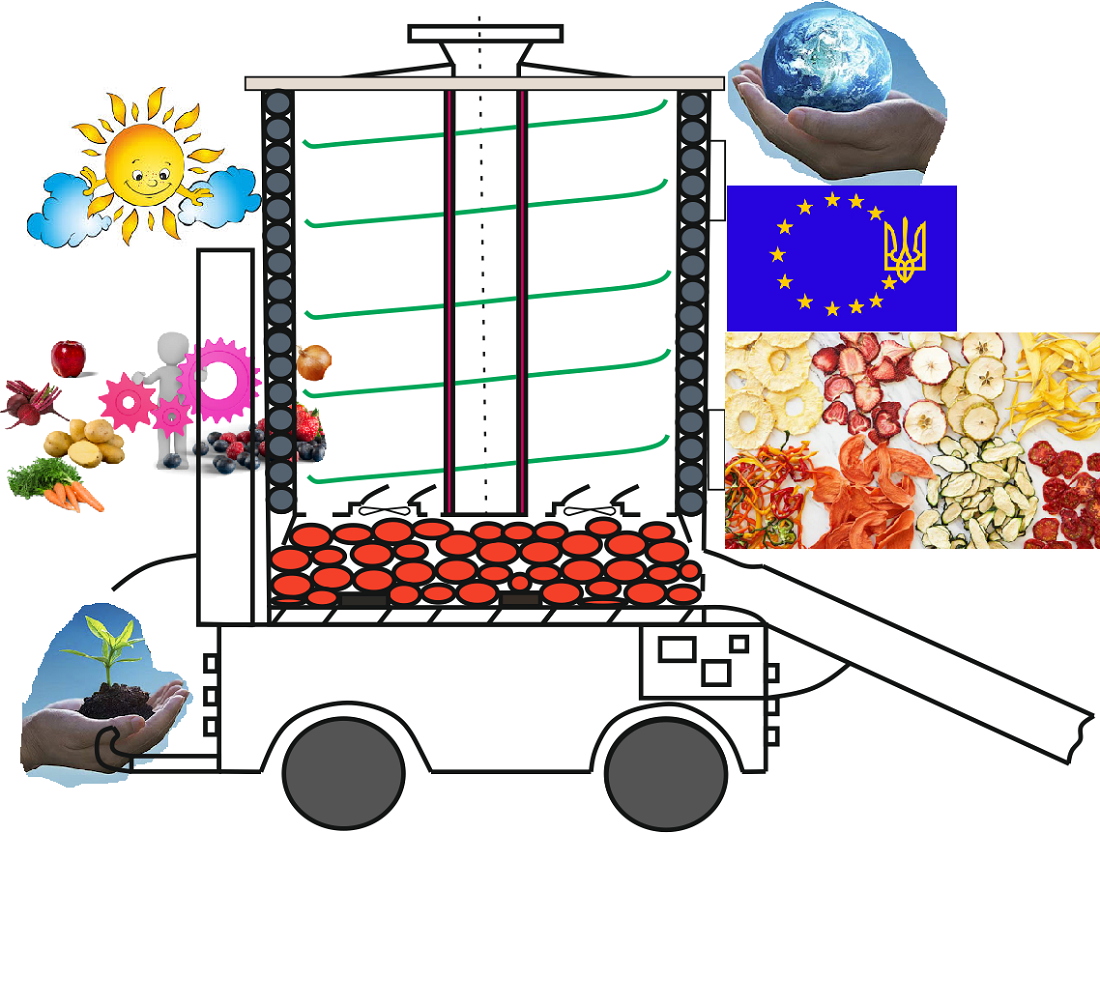
Удосконалення мобільної конструкції вертикально-модульної геліосушарки для агросектору «Від лану до столу»
DOI:
https://doi.org/10.15587/1729-4061.2025.323607Ключові слова:
геліосушарка, мобільність, агросировина, напівсферичні колектори, термоакумулятор, автономні вентилятори, конкурентоспроможність, експортний потенціалАнотація
Об’єктом дослідження є радіаційне сушіння власної агросировини (топінамбуру сорту «Київський білий» та яблука сорту «Вільямс») у мобільній конструкції вертикально-модульної геліосушарки. Дослідження спрямоване на підвищення ресурсоощадного сушіння агросировини. Геліосушарка має регульовані напівсферичні повітряні колектори (кут нахилу 20…45°) та теплоізольовану камеру з термоакумулятором (кам’яна галька, розмір 50–80 мм), резервний інфрачервоний нагрівач (600 Вт) і автономні вентилятори у комплексі з елементами Пельтьє. Сушіння агросировини товщиною 4–12 мм та швидкості теплоносія 0,05–2,0 м/с реалізовувалось в літньо-осінні декади 2024 р. Тривалість сушіння топінамбура становила 38,6–50 год, для яблук – 30,5…37 год; температура сушіння – 22…50 °C. Видалення вологи склало 77,8 % для топінамбура та 87,0 % для яблук. Видалення вологи при завантаженні 6,0 кг сировини склало 3,5 кг для топінамбура (77,8 % вологості) та 4,2 кг для яблук (87,0 % вологості) за умов сушіння до вмісту 20,0 % вологи. Втрати вітаміну С при геліосушінні у топінамбурі становлять 2,17 рази (проти 3,21 рази при конвективному сушінні), а в яблуках – 2,26 рази (проти 2,58 рази). Харчові волокна в топінамбурі зменшуються в 2,29 рази (проти 3,33 рази), а в яблуках – в 2,25 рази (проти 3,91 рази). Втрати β-каротину в топінамбурі при геліосушінні – 2,65 рази (проти 3,08 рази). Також спостерігається менше зменшення фосфору та моно- і дисахаридів. Сушені напівфабрикати мають рівномірний зовнішній вигляд, світло-жовтий колір та природні смакові й ароматичні властивості. Вдосконалений механізм управління конкурентоспроможністю агропідприємств поєднує технічні, економічні та організаційні аспекти для виходу на європейський ринок і розширення експорту
Посилання
- Farm to Fork strategy. European Commission. Available at: https://food.ec.europa.eu/horizontal-topics/farm-fork-strategy_en
- Mamchur, V., Studinska, G. (2023). Innovative development of the agrarian sphere under the conditions of the implementation of the national system of sustainability. Economy and Society, 56. https://doi.org/10.32782/2524-0072/2023-56-144
- Savchuk, Ye. V. (2019). Perspektyvy rozvytku soniachnoiy enerhetyky Ukraiyny. World Science, 3 (6 (46)), 42–44. https://doi.org/10.31435/rsglobal_ws/30062019/6575
- Abdul Razak, A., Tarminzi, M. A. S. M., Azmi, M. A. A., Ming, Y. H., Akramin, M., Mokhtar, N. (2021). Recent advances in solar drying system: A Review. International Journal of Engineering Technology and Sciences, 8 (1), 1–13. https://doi.org/10.15282/ijets.8.1.2021.1001
- Klymenko, N., Voronenko, I., Nehrey, M., Rogoza, K., Rogoza, N. (2023). Risk assessment of shock periods and investment attractiveness of agroholdings of Ukraine. Agricultural and Resource Economics: International Scientific E-Journal, 9 (2). https://doi.org/10.51599/are.2023.09.02.07
- Zahorulko, A., Zagorulko, A., Minenko, S., Bozhydai, I. (2024). Scientific and practical justification of innovative approaches to production of multicomponent semi-finished products for food products in the conditions of food security of the country. Food Production: Innovative Technological Solutions. Kharkiv: TECHNOLOGY CENTER PC, 64–91. Available at: http://monograph.com.ua/pctc/catalog/book/978-617-7319-99-2.ch3
- Kherrafi, M. A., Benseddik, A., Saim, R., Bouregueba, A., Badji, A., Nettari, C., Hasrane, I. (2024). Advancements in solar drying technologies: Design variations, hybrid systems, storage materials and numerical analysis: A review. Solar Energy, 270, 112383. https://doi.org/10.1016/j.solener.2024.112383
- Sharma, A., Chen, C. R., Vu Lan, N. (2009). Solar-energy drying systems: A review. Renewable and Sustainable Energy Reviews, 13 (6-7), 1185–1210. https://doi.org/10.1016/j.rser.2008.08.015
- Koshta, V., Patel, H., Mudgil, D. (2021). CHAPTER 17 Solar Energy in Food Processing. Available at: https://www.researchgate.net/publication/348590762_CHAPTER_17_Solar_Energy_in_Food_Processing
- Pandey, S., Kumar, A., Sharma, A. (2024). Sustainable solar drying: Recent advances in materials, innovative designs, mathematical modeling, and energy storage solutions. Energy, 308, 132725. https://doi.org/10.1016/j.energy.2024.132725
- Anderson, C. B., Picotti, G., Schmidt, T., Cholette, M. E., Bern, G., Steinberg, T. A., Manzolini, G. (2024). The impact of condensation on solar collector soiling: An experimental study. Solar Energy Materials and Solar Cells, 275, 112998. https://doi.org/10.1016/j.solmat.2024.112998
- Ikrang, E. G., Whyte, A. A., Maurice, A. M., Akubuo, C. O., Onwude, D. I. (2017). Design and fabrication of a direct passive solar dryer for tilapia fish filets. Acta Horticulturae, 1152, 63–70. https://doi.org/10.17660/actahortic.2017.1152.9
- Tuncer, A. D., Amini, A., Khanlari, A. (2023). Developing an infrared-assisted solar drying system using a vertical solar air heater with perforated baffles and nano-enhanced black paint. Solar Energy, 263, 111958. https://doi.org/10.1016/j.solener.2023.111958
- Heydari, A. (2022). Experimental analysis of hybrid dryer combined with spiral solar air heater and auxiliary heating system: Energy, exergy and economic analysis. Renewable Energy, 198, 1162–1175. https://doi.org/10.1016/j.renene.2022.08.110
- Chanda, P. R., Podder, B., Biswas, A., Sengupta, A. R. (2023). Advancements in solar assisted drying technologies: A comprehensive review post 2017. Journal of Stored Products Research, 104, 102190. https://doi.org/10.1016/j.jspr.2023.102190
- Shekata, G. D., Tibba, G. S., Baheta, A. T. (2024). Recent advancements in indirect solar dryer performance and the associated thermal energy storage. Results in Engineering, 24, 102877. https://doi.org/10.1016/j.rineng.2024.102877
- Hadibi, T., Boubekri, A., Mennouche, D., Benhamza, A., Kumar, A., Bensaci, C., Xiao, H.-W. (2022). Effect of ventilated solar-geothermal drying on 3E (exergy, energy, and economic analysis), and quality attributes of tomato paste. Energy, 243, 122764. https://doi.org/10.1016/j.energy.2021.122764
- Rahman, M. A., Hasnain, S. M. M., Paramasivam, P., Zairov, R., Ayanie, A. G. (2025). Solar Drying for Domestic and Industrial Applications: A Comprehensive Review of Innovations and Efficiency Enhancements. Global Challenges, 9 (2). https://doi.org/10.1002/gch2.202400301
- Villagran, E., Espitia, J. J., Velázquez, F. A., Rodriguez, J. (2024). Solar Dryers: Technical Insights and Bibliometric Trends in Energy Technologies. AgriEngineering, 6 (4), 4041–4063. https://doi.org/10.3390/agriengineering6040228
- Kolosok, S., Lyeonov, S., Voronenko, I., Goncharenko, O., Maksymova, J., Chumak, O. (2022). Sustainable Business Models and IT Innovation: The Case of the REMIT. Journal of Information Technology Management, 14, 147–156. https://doi.org/10.22059/jitm.2022.88894
- Olokor, J., Oghenekaro, Omojowo, F., Samuel (2009). Adaptation And Improvement Of A Simple Solar Tent Dryer To Enhance Fish Drying. Nature and Science of Sleep, 7 (10). Available at: https://www.researchgate.net/publication/274370310_Adaptation_And_Improvement_Of_A_Simple_Solar_Tent_Dryer_To_Enhance_Fish_Drying
- EL-Mesery, H. S., EL-Seesy, A. I., Hu, Z., Li, Y. (2022). Recent developments in solar drying technology of food and agricultural products: A review. Renewable and Sustainable Energy Reviews, 157, 112070. https://doi.org/10.1016/j.rser.2021.112070
- Kafetzis, A., Ziogou, C., Panopoulos, K. D., Papadopoulou, S., Seferlis, P., Voutetakis, S. (2020). Energy management strategies based on hybrid automata for islanded microgrids with renewable sources, batteries and hydrogen. Renewable and Sustainable Energy Reviews, 134, 110118. https://doi.org/10.1016/j.rser.2020.110118
- Zahorulko, A., Zagorulko, A., Mykhailov, V., Ibaiev, E. (2021). Improved rotary film evaporator for concentrating organic fruit and berry puree. Eastern-European Journal of Enterprise Technologies, 4 (11 (112)), 92–98. https://doi.org/10.15587/1729-4061.2021.237948
- Minenko, S., Cherevko, O., Skrynnik, V., Tesliuk, H., Bondar, M., Skoromna, O. et al. (2023). Improvement of the vacuum evaporator for the production of paste-like semi-finished products with a high degree of readiness. Eastern-European Journal of Enterprise Technologies, 5 (11 (125)), 76–83. https://doi.org/10.15587/1729-4061.2023.288896
- Zahorulko, A., Cherevko, O., Zagorulko, A., Yancheva, M., Budnyk, N., Nakonechna, Y. et al. (2021). Design of an apparatus for low-temperature processing of meat delicacies. Eastern-European Journal of Enterprise Technologies, 5 (11 (113)), 6–12. https://doi.org/10.15587/1729-4061.2021.240675
- Zahorulko, A., Zagorulko, A., Savytska, N., Minenko, S., Pugach, A., Ponomarenko, N. et al. (2023). Design of a universal apparatus for heat treatment of meat and vegetable cooked and smoked products with the addition of dried semi-finished products of a high degree of readiness to the recipe. Eastern-European Journal of Enterprise Technologies, 4 (11 (124)), 73–82. LOCKSS. https://doi.org/10.15587/1729-4061.2023.285406
- Slobodniuk, R. Ye., Horalchuk, A. B. (2018). Analitychna khimiya ta analiz kharchovoi produktsiyi. Kyiv: VD «Kondor», 336.
- Ladyka, V. I., Shylman, L. Z., Pertsevoi, F. V. et al. (2021). Metodolohiya naukovykh doslidzhen. Kherson: OLDI-PLIuS, 222. Available at: https://repo.btu.kharkov.ua/bitstream/123456789/8269/1/NP_Metodolohiya_21.pdf
- Zahorulko, A. M., Zahorulko, O. Ye. (2021). Pat. No. 149981 UA. Plivkopodibnyi rezystyvnyi elektronahrivach vyprominiuiuchoho typu. No. u202102839; declareted: 28. 05.2021; published: 23.12.2021.
##submission.downloads##
Опубліковано
Як цитувати
Номер
Розділ
Ліцензія
Авторське право (c) 2025 Andrii Zahorulko, Iryna Voronenko, Sofiia Minenko, Andrii Pugach, Оlena Nazarenko, Olesya Lebedenko, Eldar Ibaiev, Nataliia Tytarenko

Ця робота ліцензується відповідно до Creative Commons Attribution 4.0 International License.
Закріплення та умови передачі авторських прав (ідентифікація авторства) здійснюється у Ліцензійному договорі. Зокрема, автори залишають за собою право на авторство свого рукопису та передають журналу право першої публікації цієї роботи на умовах ліцензії Creative Commons CC BY. При цьому вони мають право укладати самостійно додаткові угоди, що стосуються неексклюзивного поширення роботи у тому вигляді, в якому вона була опублікована цим журналом, але за умови збереження посилання на першу публікацію статті в цьому журналі.
Ліцензійний договір – це документ, в якому автор гарантує, що володіє усіма авторськими правами на твір (рукопис, статтю, тощо).
Автори, підписуючи Ліцензійний договір з ПП «ТЕХНОЛОГІЧНИЙ ЦЕНТР», мають усі права на подальше використання свого твору за умови посилання на наше видання, в якому твір опублікований. Відповідно до умов Ліцензійного договору, Видавець ПП «ТЕХНОЛОГІЧНИЙ ЦЕНТР» не забирає ваші авторські права та отримує від авторів дозвіл на використання та розповсюдження публікації через світові наукові ресурси (власні електронні ресурси, наукометричні бази даних, репозитарії, бібліотеки тощо).
За відсутності підписаного Ліцензійного договору або за відсутністю вказаних в цьому договорі ідентифікаторів, що дають змогу ідентифікувати особу автора, редакція не має права працювати з рукописом.
Важливо пам’ятати, що існує і інший тип угоди між авторами та видавцями – коли авторські права передаються від авторів до видавця. В такому разі автори втрачають права власності на свій твір та не можуть його використовувати в будь-який спосіб.