Оптимізація ціноутворення та замовлення рішень в рамках дуополічної конкуренції для нових та відновлених продукцій у кільцевому ланцюгу постачання
DOI:
https://doi.org/10.15587/1729-4061.2025.325177Ключові слова:
циркулярна економіка, дуополічна конкуренція, гра Неша, цінова стратегія, переробка, дизайн ланцюга поставокАнотація
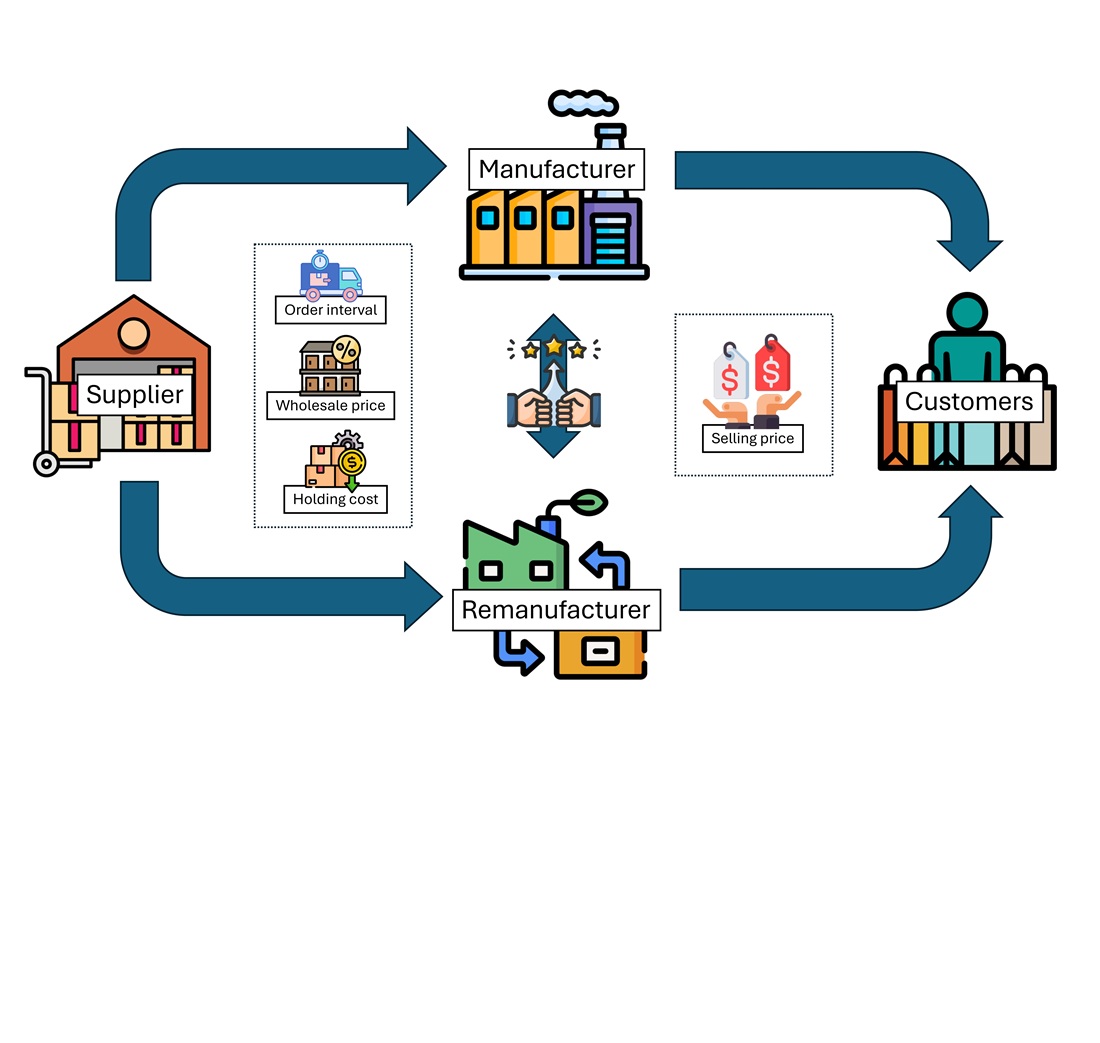
У цій роботі досліджуються рішення щодо ціноутворення та інтервалу замовлення для конкуруючих виробників у циклічному ланцюжку поставок. Приділяючи дедалі більшу увагу екологічній стійкості в бізнесі, два дуополічно конкуруючі виробники пропонують своїм клієнтам різні продукти, включаючи як нові, так і відновлені продукти. У цій роботі досліджується вплив різних продуктів на ринковий попит, враховуючи ціни продажу та запаси. Це підкреслює, як на ціну продажу у функції попиту впливає не лише його ціна, але й ціни конкурентів. Крім того, це підкреслює ключову роль інтервалу замовлення у визначенні запасів продукту. Це дослідження виконує кількісний метод в оперативному дослідженні. Спочатку він структурує функції попиту та прибутку для кожного виробника. Розробляючи модель рівноваги Неша на основі теорії ігор, це дослідження визначає оптимальні рішення щодо ціноутворення та інтервалу замовлення, щоб максимізувати прибуток для кожного виробника. Чисельні результати підтвердили, що оптимальні ціни та прибутки для виробника, який продає нову продукцію (p1=67, π1=1443,96), вищі, ніж для виробника (p2=65, π2=1435,22). У той же час комплексний аналіз чутливості показує, що збільшення ціни продажу (pi=45~85) та інтервалу замовлення (Ti=5,2~6) зменшить прибуток виробника. З іншого боку, збільшення ціни продажу конкурентів і інтервалу замовлення стратегічно збільшить прибуток виробника. Крім того, збільшення оптової ціни (wi=35~70) і вартості зберігання (hi=0~15) зменшить інтервал замовлення, збільшить ціну продажу та, зрештою, зменшить прибуток. Менеджерські висновки підсумовують, що для виробника вкрай важливо визначити оптимальну ціну продажу та інтервал замовлень, щоб отримати конкурентну перевагу під час прийняття рішень щодо ціноутворення та інтервалу замовлень
Посилання
- Sakthivelmurugan, E., Senthilkumar, G., Karthick, K. N. (2022). Analysis of the impact of circular economy over linear economy in the paper processing industry. Materials Today: Proceedings, 66, 1446–1452. https://doi.org/10.1016/j.matpr.2022.05.449
- Neves, S. A., Marques, A. C. (2022). Drivers and barriers in the transition from a linear economy to a circular economy. Journal of Cleaner Production, 341, 130865. https://doi.org/10.1016/j.jclepro.2022.130865
- Cesur, E., Cesur, M. R., Kayikci, Y., Mangla, S. K. (2022). Optimal number of remanufacturing in a circular economy platform. International Journal of Logistics Research and Applications, 25 (4-5), 454–470. https://doi.org/10.1080/13675567.2020.1825656
- Hazen, B. T., Mollenkopf, D. A., Wang, Y. (2017). Remanufacturing for the Circular Economy: An Examination of Consumer Switching Behavior. Business Strategy and the Environment, 26 (4), 451–464. https://doi.org/10.1002/bse.1929
- Sitcharangsie, S., Ijomah, W., Wong, T. C. (2019). Decision makings in key remanufacturing activities to optimise remanufacturing outcomes: A review. Journal of Cleaner Production, 232, 1465–1481. https://doi.org/10.1016/j.jclepro.2019.05.204
- Yang, S. S., Ngiam, H. Y., Ong, S. K., Nee, A. Y. C. (2015). The Impact of Automotive Product Remanufacturing on Environmental Performance. Procedia CIRP, 29, 774–779. https://doi.org/10.1016/j.procir.2015.01.017
- Baldassarre, B., Maury, T., Mathieux, F., Garbarino, E., Antonopoulos, I., Sala, S. (2022). Drivers and Barriers to the Circular Economy Transition: The Case of Recycled Plastics in the Automotive Sector in the European Union. Procedia CIRP, 105, 37–42. https://doi.org/10.1016/j.procir.2022.02.007
- Kurudzhy, Y., Mayorova, I., Moskvichenko, I. (2022). Building a model of supply chains duopoly taking into account the marketing and innovative activities of manufacturing enterprises. Eastern-European Journal of Enterprise Technologies, 2 (3 (116)), 15–21. https://doi.org/10.15587/1729-4061.2022.253821
- Andriani, D. P., Tseng, F.-S. (2023). Coordinating a dual-channel supply chain with pricing and extended warranty strategies under demand substitution effects. Eastern-European Journal of Enterprise Technologies, 3 (3 (123)), 45–56. https://doi.org/10.15587/1729-4061.2023.277293
- Bobba, S., Tecchio, P., Ardente, F., Mathieux, F., Dos Santos, F. M., Pekar, F. (2020). Analysing the contribution of automotive remanufacturing to the circularity of materials. Procedia CIRP, 90, 67–72. https://doi.org/10.1016/j.procir.2020.02.052
- Omair, M., Alkahtani, M., Ayaz, K., Hussain, G., Buhl, J. (2022). Supply Chain Modelling of the Automobile Multi-Stage Production Considering Circular Economy by Waste Management Using Recycling and Reworking Operations. Sustainability, 14 (22), 15428. https://doi.org/10.3390/su142215428
- Agrawal, R., Wankhede, V. A., Kumar, A., Luthra, S. (2021). Analysing the roadblocks of circular economy adoption in the automobile sector: Reducing waste and environmental perspectives. Business Strategy and the Environment, 30 (2), 1051–1066. https://doi.org/10.1002/bse.2669
- Prochatzki, G., Mayer, R., Haenel, J., Schmidt, A., Götze, U., Ulber, M. et al. (2023). A critical review of the current state of circular economy in the automotive sector. Journal of Cleaner Production, 425, 138787. https://doi.org/10.1016/j.jclepro.2023.138787
- Liu, B., Chen, D., Zhou, W., Nasr, N., Wang, T., Hu, S., Zhu, B. (2018). The effect of remanufacturing and direct reuse on resource productivity of China’s automotive production. Journal of Cleaner Production, 194, 309–317. https://doi.org/10.1016/j.jclepro.2018.05.119
- Shao, J., Huang, S., Lemus-Aguilar, I., Ünal, E. (2019). Circular business models generation for automobile remanufacturing industry in China: Barriers and opportunities. Journal of Manufacturing Technology Management, 31(3), 542–571. https://doi.org/10.1108/JMTM-02-2019-0076
- Geist, H., Balle, F. (2024). Remanufactured products, components, and their materials: A circularity engineering focused empirical status quo analysis. Sustainable Production and Consumption, 45, 525–537. https://doi.org/10.1016/j.spc.2024.02.003
- Liu, H., Ye, L., Sun, J. (2023). Automotive parts remanufacturing models: Consequences for ELV take-back under government regulations. Journal of Cleaner Production, 416, 137760. https://doi.org/10.1016/j.jclepro.2023.137760
- Wang, Y., Huscroft, J. R., Hazen, B. T., Zhang, M. (2018). Green information, green certification and consumer perceptions of remanufctured automobile parts. Resources, Conservation and Recycling, 128, 187–196. https://doi.org/10.1016/j.resconrec.2016.07.015
- Moosmayer, D. C., Abdulrahman, M. D.-A., Subramanian, N., Bergkvist, L. (2020). Strategic and operational remanufacturing mental models: A study on Chinese automotive consumers buying choice. International Journal of Operations & Production Management, 40 (2), 173–195. https://doi.org/10.1108/IJOPM-12-2018-0684
- Wang, Y., Hazen, B. T. (2016). Consumer product knowledge and intention to purchase remanufactured products. International Journal of Production Economics, 181, 460–469. https://doi.org/10.1016/j.ijpe.2015.08.031
- Yuliawati, E., Pratikto, P., Sugiono, S., Novareza, O. (2021). Development of cores acquisition model with two switching mechanisms in a retailer-oriented closed-loop supply chain system. Eastern-European Journal of Enterprise Technologies, 2 (3 (110)), 6–15. https://doi.org/10.15587/1729-4061.2021.225147
- Chinen, K., Matsumoto, M. (2021). Indonesians’ Perceptions of Auto Parts Remanufactured in China: Implications for Global Remanufacturing Operations. Sustainability, 13 (7), 3968. https://doi.org/10.3390/su13073968
- Chakraborty, K. (2021). Key decision-making areas of automotive engine remanufacturing: A case study. International Journal of Logistics Systems and Management, 39 (3), 333. https://doi.org/10.1504/IJLSM.2021.115794
- Yu, Y., Zhou, D., Zha, D., Wang, Q. (2021). Joint optimization of charging facility investment and pricing in automobile retail supply chain and coordination. Computers & Industrial Engineering, 156, 107296. https://doi.org/10.1016/j.cie.2021.107296
- Andriani, D. P., Tseng, F.-S. (2023). Pricing and investment decisions when facing heterogeneous customers under different supply chain power structures. Alexandria Engineering Journal, 78, 390–405. https://doi.org/10.1016/j.aej.2023.07.057
- Chakraborty, K., Mondal, S., Mukherjee, K. (2019). Critical analysis of enablers and barriers in extension of useful life of automotive products through remanufacturing. Journal of Cleaner Production, 227, 1117–1135. https://doi.org/10.1016/j.jclepro.2019.04.265
- Gunasekara, H., Gamage, J., Punchihewa, H. (2020). Remanufacture for sustainability: Barriers and solutions to promote automotive remanufacturing. Procedia Manufacturing, 43, 606–613. https://doi.org/10.1016/j.promfg.2020.02.146
##submission.downloads##
Опубліковано
Як цитувати
Номер
Розділ
Ліцензія
Авторське право (c) 2025 Debrina Puspita Andriani, Sugiono Sugiono, L. Tri Wijaya N. Kusuma, Riesa Aliya Tuhfah, Muhammad Rizki Ardiansah

Ця робота ліцензується відповідно до Creative Commons Attribution 4.0 International License.
Закріплення та умови передачі авторських прав (ідентифікація авторства) здійснюється у Ліцензійному договорі. Зокрема, автори залишають за собою право на авторство свого рукопису та передають журналу право першої публікації цієї роботи на умовах ліцензії Creative Commons CC BY. При цьому вони мають право укладати самостійно додаткові угоди, що стосуються неексклюзивного поширення роботи у тому вигляді, в якому вона була опублікована цим журналом, але за умови збереження посилання на першу публікацію статті в цьому журналі.
Ліцензійний договір – це документ, в якому автор гарантує, що володіє усіма авторськими правами на твір (рукопис, статтю, тощо).
Автори, підписуючи Ліцензійний договір з ПП «ТЕХНОЛОГІЧНИЙ ЦЕНТР», мають усі права на подальше використання свого твору за умови посилання на наше видання, в якому твір опублікований. Відповідно до умов Ліцензійного договору, Видавець ПП «ТЕХНОЛОГІЧНИЙ ЦЕНТР» не забирає ваші авторські права та отримує від авторів дозвіл на використання та розповсюдження публікації через світові наукові ресурси (власні електронні ресурси, наукометричні бази даних, репозитарії, бібліотеки тощо).
За відсутності підписаного Ліцензійного договору або за відсутністю вказаних в цьому договорі ідентифікаторів, що дають змогу ідентифікувати особу автора, редакція не має права працювати з рукописом.
Важливо пам’ятати, що існує і інший тип угоди між авторами та видавцями – коли авторські права передаються від авторів до видавця. В такому разі автори втрачають права власності на свій твір та не можуть його використовувати в будь-який спосіб.