Optimization of pricing and ordering decisions under duopoly competition for new and remanufactured products in a circular supply chain
DOI:
https://doi.org/10.15587/1729-4061.2025.325177Keywords:
circular economy, duopoly competition, Nash game, pricing strategy, remanufacturing, supply chain designAbstract
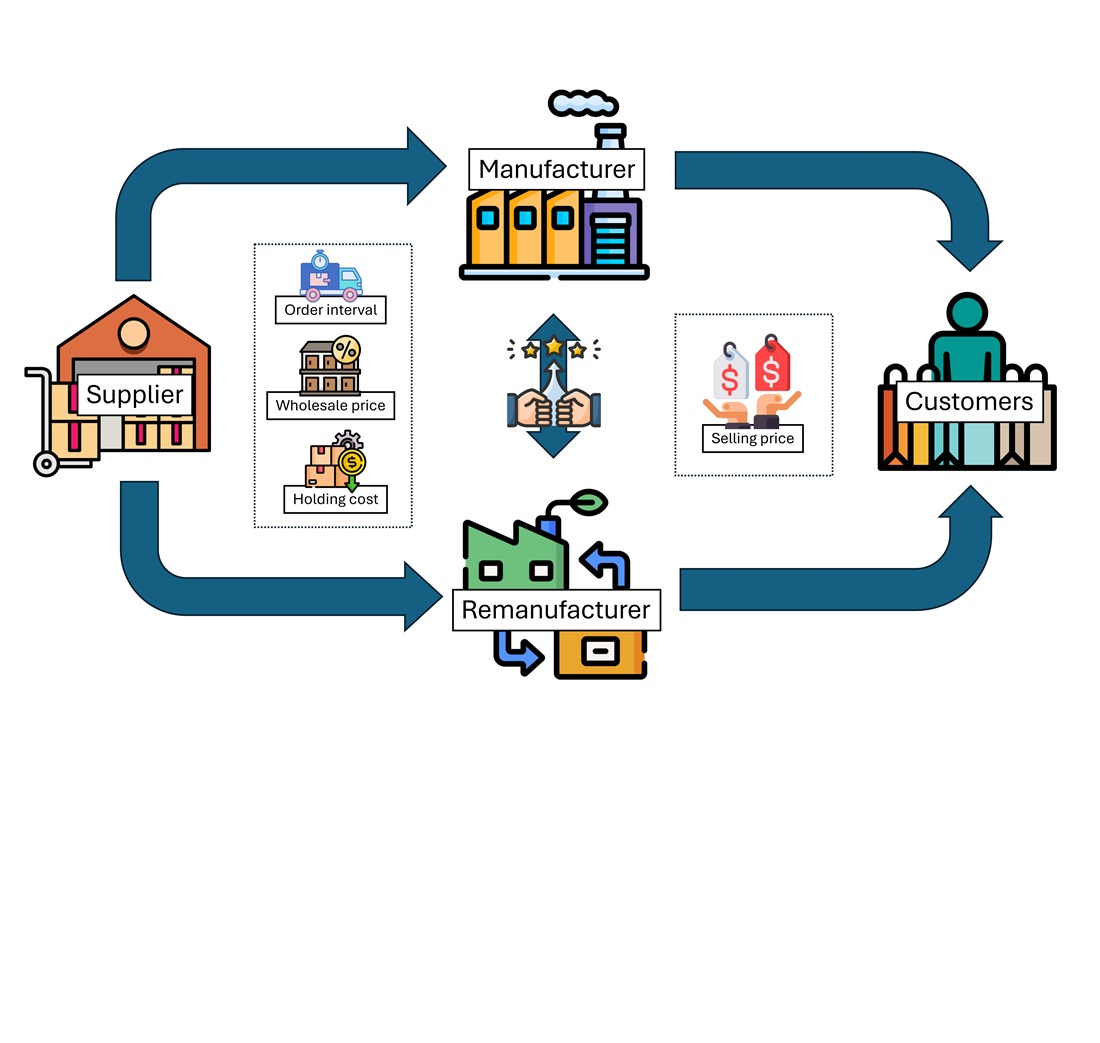
This study explores pricing and order interval decisions for competing manufacturers in a circular supply chain. With a growing focus on environmental sustainability in a business, two duopolistically competing manufacturers offer different products to their customers, involving both new and remanufactured products. This research investigates the impact of various products on market demand by considering selling prices and inventories. It highlights how the selling price in the demand function is influenced not only by its price but also by competitors’ prices. Additionally, it emphasizes the pivotal role of the order interval in determining product inventory. This research performs a quantitative method in the operational research. Initially, it structures the demand and profit functions for each manufacturer. By developing a Nash equilibrium model on the game theory, this study determines the optimal decisions for pricing and ordering interval to maximize profit for each manufacturer. The numerical results confirmed that the optimal prices and profits for the manufacturer selling new products (p1=67, π1=1443.96) are higher than the manufacturer (p2=65, π2=1435.22). Meanwhile, the comprehensive sensitivity analysis demonstrates that increasing the selling price (pi=45~85) and order interval (Ti=5.2~6) will reduce the manufacturer’s profit. On the other hand, increasing the competitors’ selling price and order interval will strategically increase the manufacturer’s profit. Furthermore, increasing the wholesale price (wi=35~70) and holding cost (hi=0~15) will decrease the order interval, increase the selling price, and ultimately reduce profit. The managerial insights summarize that it is imperative for a manufacturer to determine the optimal selling price and order interval to gain a competitive advantage when making pricing and ordering interval decisions
References
- Sakthivelmurugan, E., Senthilkumar, G., Karthick, K. N. (2022). Analysis of the impact of circular economy over linear economy in the paper processing industry. Materials Today: Proceedings, 66, 1446–1452. https://doi.org/10.1016/j.matpr.2022.05.449
- Neves, S. A., Marques, A. C. (2022). Drivers and barriers in the transition from a linear economy to a circular economy. Journal of Cleaner Production, 341, 130865. https://doi.org/10.1016/j.jclepro.2022.130865
- Cesur, E., Cesur, M. R., Kayikci, Y., Mangla, S. K. (2022). Optimal number of remanufacturing in a circular economy platform. International Journal of Logistics Research and Applications, 25 (4-5), 454–470. https://doi.org/10.1080/13675567.2020.1825656
- Hazen, B. T., Mollenkopf, D. A., Wang, Y. (2017). Remanufacturing for the Circular Economy: An Examination of Consumer Switching Behavior. Business Strategy and the Environment, 26 (4), 451–464. https://doi.org/10.1002/bse.1929
- Sitcharangsie, S., Ijomah, W., Wong, T. C. (2019). Decision makings in key remanufacturing activities to optimise remanufacturing outcomes: A review. Journal of Cleaner Production, 232, 1465–1481. https://doi.org/10.1016/j.jclepro.2019.05.204
- Yang, S. S., Ngiam, H. Y., Ong, S. K., Nee, A. Y. C. (2015). The Impact of Automotive Product Remanufacturing on Environmental Performance. Procedia CIRP, 29, 774–779. https://doi.org/10.1016/j.procir.2015.01.017
- Baldassarre, B., Maury, T., Mathieux, F., Garbarino, E., Antonopoulos, I., Sala, S. (2022). Drivers and Barriers to the Circular Economy Transition: The Case of Recycled Plastics in the Automotive Sector in the European Union. Procedia CIRP, 105, 37–42. https://doi.org/10.1016/j.procir.2022.02.007
- Kurudzhy, Y., Mayorova, I., Moskvichenko, I. (2022). Building a model of supply chains duopoly taking into account the marketing and innovative activities of manufacturing enterprises. Eastern-European Journal of Enterprise Technologies, 2 (3 (116)), 15–21. https://doi.org/10.15587/1729-4061.2022.253821
- Andriani, D. P., Tseng, F.-S. (2023). Coordinating a dual-channel supply chain with pricing and extended warranty strategies under demand substitution effects. Eastern-European Journal of Enterprise Technologies, 3 (3 (123)), 45–56. https://doi.org/10.15587/1729-4061.2023.277293
- Bobba, S., Tecchio, P., Ardente, F., Mathieux, F., Dos Santos, F. M., Pekar, F. (2020). Analysing the contribution of automotive remanufacturing to the circularity of materials. Procedia CIRP, 90, 67–72. https://doi.org/10.1016/j.procir.2020.02.052
- Omair, M., Alkahtani, M., Ayaz, K., Hussain, G., Buhl, J. (2022). Supply Chain Modelling of the Automobile Multi-Stage Production Considering Circular Economy by Waste Management Using Recycling and Reworking Operations. Sustainability, 14 (22), 15428. https://doi.org/10.3390/su142215428
- Agrawal, R., Wankhede, V. A., Kumar, A., Luthra, S. (2021). Analysing the roadblocks of circular economy adoption in the automobile sector: Reducing waste and environmental perspectives. Business Strategy and the Environment, 30 (2), 1051–1066. https://doi.org/10.1002/bse.2669
- Prochatzki, G., Mayer, R., Haenel, J., Schmidt, A., Götze, U., Ulber, M. et al. (2023). A critical review of the current state of circular economy in the automotive sector. Journal of Cleaner Production, 425, 138787. https://doi.org/10.1016/j.jclepro.2023.138787
- Liu, B., Chen, D., Zhou, W., Nasr, N., Wang, T., Hu, S., Zhu, B. (2018). The effect of remanufacturing and direct reuse on resource productivity of China’s automotive production. Journal of Cleaner Production, 194, 309–317. https://doi.org/10.1016/j.jclepro.2018.05.119
- Shao, J., Huang, S., Lemus-Aguilar, I., Ünal, E. (2019). Circular business models generation for automobile remanufacturing industry in China: Barriers and opportunities. Journal of Manufacturing Technology Management, 31(3), 542–571. https://doi.org/10.1108/JMTM-02-2019-0076
- Geist, H., Balle, F. (2024). Remanufactured products, components, and their materials: A circularity engineering focused empirical status quo analysis. Sustainable Production and Consumption, 45, 525–537. https://doi.org/10.1016/j.spc.2024.02.003
- Liu, H., Ye, L., Sun, J. (2023). Automotive parts remanufacturing models: Consequences for ELV take-back under government regulations. Journal of Cleaner Production, 416, 137760. https://doi.org/10.1016/j.jclepro.2023.137760
- Wang, Y., Huscroft, J. R., Hazen, B. T., Zhang, M. (2018). Green information, green certification and consumer perceptions of remanufctured automobile parts. Resources, Conservation and Recycling, 128, 187–196. https://doi.org/10.1016/j.resconrec.2016.07.015
- Moosmayer, D. C., Abdulrahman, M. D.-A., Subramanian, N., Bergkvist, L. (2020). Strategic and operational remanufacturing mental models: A study on Chinese automotive consumers buying choice. International Journal of Operations & Production Management, 40 (2), 173–195. https://doi.org/10.1108/IJOPM-12-2018-0684
- Wang, Y., Hazen, B. T. (2016). Consumer product knowledge and intention to purchase remanufactured products. International Journal of Production Economics, 181, 460–469. https://doi.org/10.1016/j.ijpe.2015.08.031
- Yuliawati, E., Pratikto, P., Sugiono, S., Novareza, O. (2021). Development of cores acquisition model with two switching mechanisms in a retailer-oriented closed-loop supply chain system. Eastern-European Journal of Enterprise Technologies, 2 (3 (110)), 6–15. https://doi.org/10.15587/1729-4061.2021.225147
- Chinen, K., Matsumoto, M. (2021). Indonesians’ Perceptions of Auto Parts Remanufactured in China: Implications for Global Remanufacturing Operations. Sustainability, 13 (7), 3968. https://doi.org/10.3390/su13073968
- Chakraborty, K. (2021). Key decision-making areas of automotive engine remanufacturing: A case study. International Journal of Logistics Systems and Management, 39 (3), 333. https://doi.org/10.1504/IJLSM.2021.115794
- Yu, Y., Zhou, D., Zha, D., Wang, Q. (2021). Joint optimization of charging facility investment and pricing in automobile retail supply chain and coordination. Computers & Industrial Engineering, 156, 107296. https://doi.org/10.1016/j.cie.2021.107296
- Andriani, D. P., Tseng, F.-S. (2023). Pricing and investment decisions when facing heterogeneous customers under different supply chain power structures. Alexandria Engineering Journal, 78, 390–405. https://doi.org/10.1016/j.aej.2023.07.057
- Chakraborty, K., Mondal, S., Mukherjee, K. (2019). Critical analysis of enablers and barriers in extension of useful life of automotive products through remanufacturing. Journal of Cleaner Production, 227, 1117–1135. https://doi.org/10.1016/j.jclepro.2019.04.265
- Gunasekara, H., Gamage, J., Punchihewa, H. (2020). Remanufacture for sustainability: Barriers and solutions to promote automotive remanufacturing. Procedia Manufacturing, 43, 606–613. https://doi.org/10.1016/j.promfg.2020.02.146
Downloads
Published
How to Cite
Issue
Section
License
Copyright (c) 2025 Debrina Puspita Andriani, Sugiono Sugiono, L. Tri Wijaya N. Kusuma, Riesa Aliya Tuhfah, Muhammad Rizki Ardiansah

This work is licensed under a Creative Commons Attribution 4.0 International License.
The consolidation and conditions for the transfer of copyright (identification of authorship) is carried out in the License Agreement. In particular, the authors reserve the right to the authorship of their manuscript and transfer the first publication of this work to the journal under the terms of the Creative Commons CC BY license. At the same time, they have the right to conclude on their own additional agreements concerning the non-exclusive distribution of the work in the form in which it was published by this journal, but provided that the link to the first publication of the article in this journal is preserved.
A license agreement is a document in which the author warrants that he/she owns all copyright for the work (manuscript, article, etc.).
The authors, signing the License Agreement with TECHNOLOGY CENTER PC, have all rights to the further use of their work, provided that they link to our edition in which the work was published.
According to the terms of the License Agreement, the Publisher TECHNOLOGY CENTER PC does not take away your copyrights and receives permission from the authors to use and dissemination of the publication through the world's scientific resources (own electronic resources, scientometric databases, repositories, libraries, etc.).
In the absence of a signed License Agreement or in the absence of this agreement of identifiers allowing to identify the identity of the author, the editors have no right to work with the manuscript.
It is important to remember that there is another type of agreement between authors and publishers – when copyright is transferred from the authors to the publisher. In this case, the authors lose ownership of their work and may not use it in any way.








