Визначення підходу до розпізнавання райдужної оболонки ока у залежності від умов зйомки
DOI:
https://doi.org/10.15587/1729-4061.2025.325517Ключові слова:
розпізнавання райдужки, Hamming Distance, HMI-системи, DenseNet, CLAHE, Equalization HistogramАнотація
Об’єктом дослідження є методи обробки та аналізу зображень райдужної оболонки ока, які можуть бути імплементовані у системи взаємодії людини з машиною на основі біометричних даних або інших безконтактних способів взаємодії.
Забезпечення високої точності та надійності біометричних систем розпізнавання райдужної оболонки ока у варіативних умовах зйомки залишається відкритою науковою проблемою. Однією з основних труднощів є вплив змінного освітлення, нахилу голови та часткової відкритості ока на результати ідентифікації.
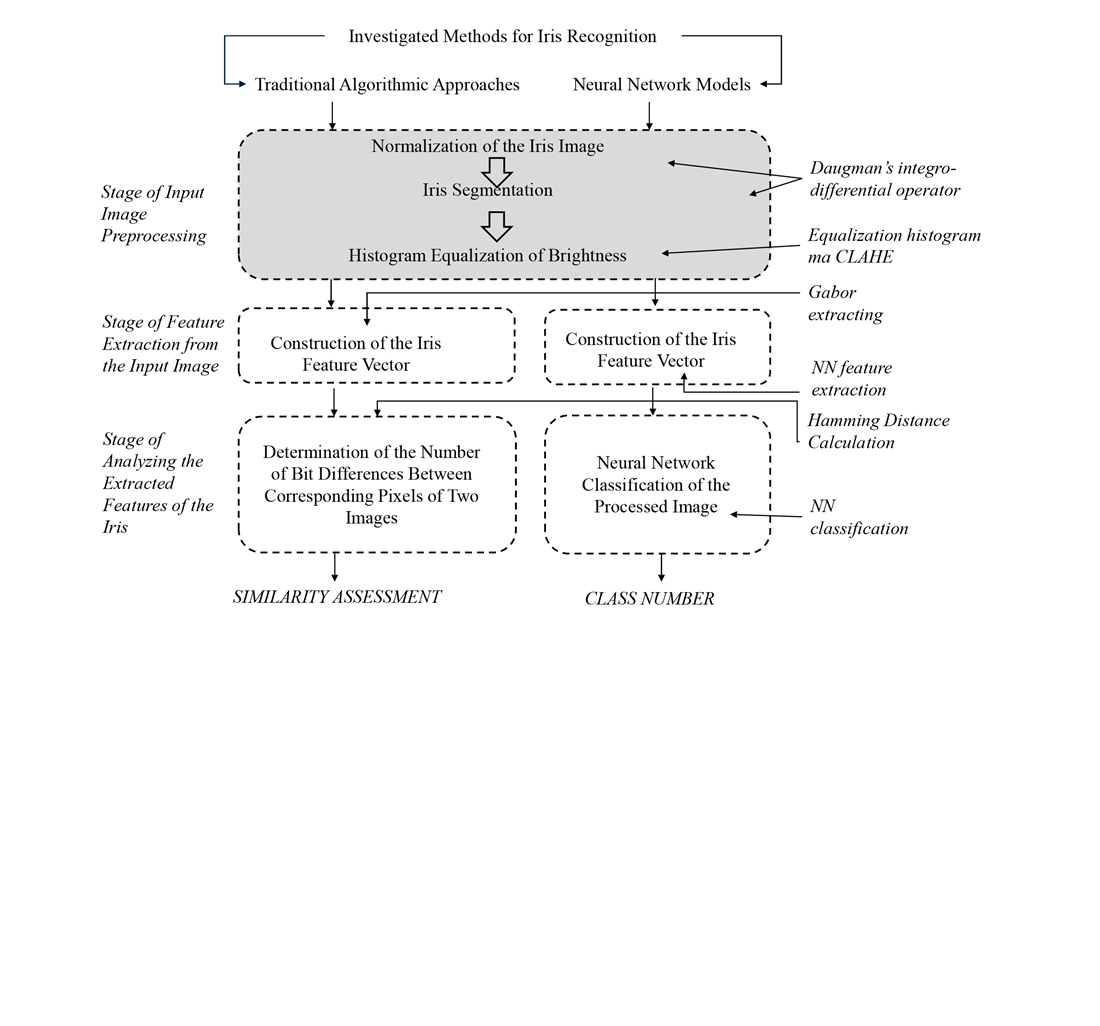
В дослідженні проведено оцінку впливу методів попередньої обробки зображень райдужної оболонки ока (Equalization Histogram, CLAHE) на якість розпізнавання, здійснено порівняння алгоритмічного методу (Hamming Distance) з нейромережевими моделями (CNN, DenseNet) за показниками точності, False Match Rate, False Non-Match Rate та Equal Error Rate. Додатково проведено аналіз впливу структури навчальних вибірок та гіперпараметрів нейромережі на ефективність класифікації.
Отримані результати показали, що при використанні Hamming Distance (HD = 0.35) досягається точність 95.5 %, що є конкурентоспроможним результатом у порівнянні з нейромережами. Встановлено, що поєднання CLAHE та Equalization Histogram дозволяє зменшити вплив шумів та покращити точність сегментації. Визначено, що нейромережевий підхід (DenseNet 201) досягає точності 99.93 % при оптимальному розподілі датасету (70 %:15 %:15 %). Доведено, що використання попередньої нормалізації та адаптивного вирівнювання контрасту суттєво зменшує похибки розпізнавання при змінних умовах освітлення.
Запропоноване рішення має потенціал застосування у безконтактних системах керування, інклюзивних технологіях для людей із порушенням зору, автомобільній промисловості, а також у безпекових системах
Посилання
- Mourtzis, D., Angelopoulos, J., Panopoulos, N. (2023). The Future of the Human-Machine Interface (HMI) in Society 5.0. Future Internet, 15 (5), 162. https://doi.org/10.3390/fi15050162
- Zhou, H., Wang, D., Yu, Y., Zhang, Z. (2023). Research Progress of Human-Computer Interaction Technology Based on Gesture Recognition. Electronics, 12 (13), 2805. https://doi.org/10.3390/electronics12132805
- Ban, S., Lee, Y. J., Yu, K. J., Chang, J. W., Kim, J.-H., Yeo, W.-H. (2023). Persistent Human-Machine Interfaces for Robotic Arm Control Via Gaze and Eye Direction Tracking. Advanced Intelligent Systems, 5 (7). https://doi.org/10.1002/aisy.202200408
- Desmarais, Y., Mottet, D., Slangen, P., Montesinos, P. (2021). A review of 3D human pose estimation algorithms for markerless motion capture. Computer Vision and Image Understanding, 212, 103275. https://doi.org/10.1016/j.cviu.2021.103275
- Malgheet, J. R., Manshor, N. B., Affendey, L. S. (2021). Iris Recognition Development Techniques: A Comprehensive Review. Complexity, 2021 (1). https://doi.org/10.1155/2021/6641247
- Barkovska, O., Liapin, Y., Muzyka, T., Ryndyk, I., Botnar, P. (2024). Gaze direction monitoring model in computer system for academic performance assessment. Information Technologies and Learning Tools, 99 (1), 63–75. https://doi.org/10.33407/itlt.v99i1.5503
- Barkovska, O., Axak, N., Rosinskiy, D., Liashenko, S. (2018). Application of mydriasis identification methods in parental control systems. 2018 IEEE 9th International Conference on Dependable Systems, Services and Technologies (DESSERT), 459–463. https://doi.org/10.1109/dessert.2018.8409177
- Perea-García, J. O., Danel, D. P., Monteiro, A. (2021). Diversity in Primate External Eye Morphology: Previously Undescribed Traits and Their Potential Adaptive Value. Symmetry, 13 (7), 1270. https://doi.org/10.3390/sym13071270
- Sunilkumar, M., Rudresh, D. R., Prakash, H., Santosh, P., Jambukesh, H. J., Harakannanavar, S. S. (2023). Development of iris recognition model using transform domain approaches with Hamming distance classifier. International Journal of Advances in Engineering and Management, 5 (5), 459–469. Available at: https://ijaem.net/issue_dcp/Development%20of%20iris%20recognition%20model%20using%20transform%20domain%20approaches%20with%20Hamming%20distance%20classifier.pdf
- Xiong, Q., Zhang, X., He, S., Shen, J. (2022). Data Augmentation for Small Sample Iris Image Based on a Modified Sparrow Search Algorithm. International Journal of Computational Intelligence Systems, 15 (1). https://doi.org/10.1007/s44196-022-00173-7
- Hapsari, R. K., Utoyo, M. I., Rulaningtyas, R., Suprajitno, H. (2020). Comparison of Histogram Based Image Enhancement Methods on Iris Images. Journal of Physics: Conference Series, 1569 (2), 022002. https://doi.org/10.1088/1742-6596/1569/2/022002
- Hassan, R., Kasim, S., Wan Chek Jafery, W. A. Z., Ali Shah, Z. (2017). Image Enhancement Technique at Different Distance for Iris Recognition. International Journal on Advanced Science, Engineering and Information Technology, 7 (4-2), 1510. https://doi.org/10.18517/ijaseit.7.4-2.3392
- Kintonova, A., Povkhan, I., Mussaif, M., Gabdreshov, G. (2022). Improvement of iris recognition technology for biometric identification of a person. Eastern-European Journal of Enterprise Technologies, 6 (2 (120)), 60–69. https://doi.org/10.15587/1729-4061.2022.269948
- Venkatesh, P., Shyam, G. K., Alam, S. (2024). Enhancement of detection accuracy for preventing iris presentation attack. International Journal of Electrical and Computer Engineering (IJECE), 14 (4), 4376. https://doi.org/10.11591/ijece.v14i4.pp4376-4385
- Nguyen, K., Proença, H., Alonso-Fernandez, F. (2024). Deep Learning for Iris Recognition: A Survey. ACM Computing Surveys, 56 (9), 1–35. https://doi.org/10.1145/3651306
- Damayanti, F. A., Andri Asmara, R., Prasetyo, G. B. (2024). Residual Network Deep Learning Model with Data Augmentation Effects in the Implementation of Iris Recognition. International Journal of Frontier Technology and Engineering, 2 (2), 79–86. https://doi.org/10.33795/ijfte.v2i2.6223
##submission.downloads##
Опубліковано
Як цитувати
Номер
Розділ
Ліцензія
Авторське право (c) 2025 Olesia Barkovska, Igor Ruban, Yuri Romanenkov, Pavlo Botnar, Anton Havrashenko

Ця робота ліцензується відповідно до Creative Commons Attribution 4.0 International License.
Закріплення та умови передачі авторських прав (ідентифікація авторства) здійснюється у Ліцензійному договорі. Зокрема, автори залишають за собою право на авторство свого рукопису та передають журналу право першої публікації цієї роботи на умовах ліцензії Creative Commons CC BY. При цьому вони мають право укладати самостійно додаткові угоди, що стосуються неексклюзивного поширення роботи у тому вигляді, в якому вона була опублікована цим журналом, але за умови збереження посилання на першу публікацію статті в цьому журналі.
Ліцензійний договір – це документ, в якому автор гарантує, що володіє усіма авторськими правами на твір (рукопис, статтю, тощо).
Автори, підписуючи Ліцензійний договір з ПП «ТЕХНОЛОГІЧНИЙ ЦЕНТР», мають усі права на подальше використання свого твору за умови посилання на наше видання, в якому твір опублікований. Відповідно до умов Ліцензійного договору, Видавець ПП «ТЕХНОЛОГІЧНИЙ ЦЕНТР» не забирає ваші авторські права та отримує від авторів дозвіл на використання та розповсюдження публікації через світові наукові ресурси (власні електронні ресурси, наукометричні бази даних, репозитарії, бібліотеки тощо).
За відсутності підписаного Ліцензійного договору або за відсутністю вказаних в цьому договорі ідентифікаторів, що дають змогу ідентифікувати особу автора, редакція не має права працювати з рукописом.
Важливо пам’ятати, що існує і інший тип угоди між авторами та видавцями – коли авторські права передаються від авторів до видавця. В такому разі автори втрачають права власності на свій твір та не можуть його використовувати в будь-який спосіб.