Вдосконалення аналітичної моделі ближнього магнітного поля електромагнітів системи керування орієнтацією космічного апарату
DOI:
https://doi.org/10.15587/1729-4061.2025.326676Ключові слова:
магнітне поле, аналітична модель, циліндричний електромагніт, магнітна чистота, космічний апаратАнотація
Розглянуто особливість застосування технології забезпечення магнітної чистоти малих космічних апаратів, які мають у системі керування орієнтацією на орбіті циліндричні електромагніти з магнітним моментом 10–50 A·m2. Показано, що електромагніти системи керування орієнтацією являються найпотужнішим джерелом магнітної завади з індукцією до 1 Тл для магніточутливого обладнання космічного апарату. Обґрунтована необхідність моделювання магнітного поля електромагніту на попередньому етапі розробки космічного апарату для раціонального вибору його компоновки. З метою вдосконалення технології забезпечення магнітної чистоти, яка спрямована на підвищення надійності експлуатації космічних апаратів, проведено пошук кращої моделі магнітного поля таких електромагнітів.
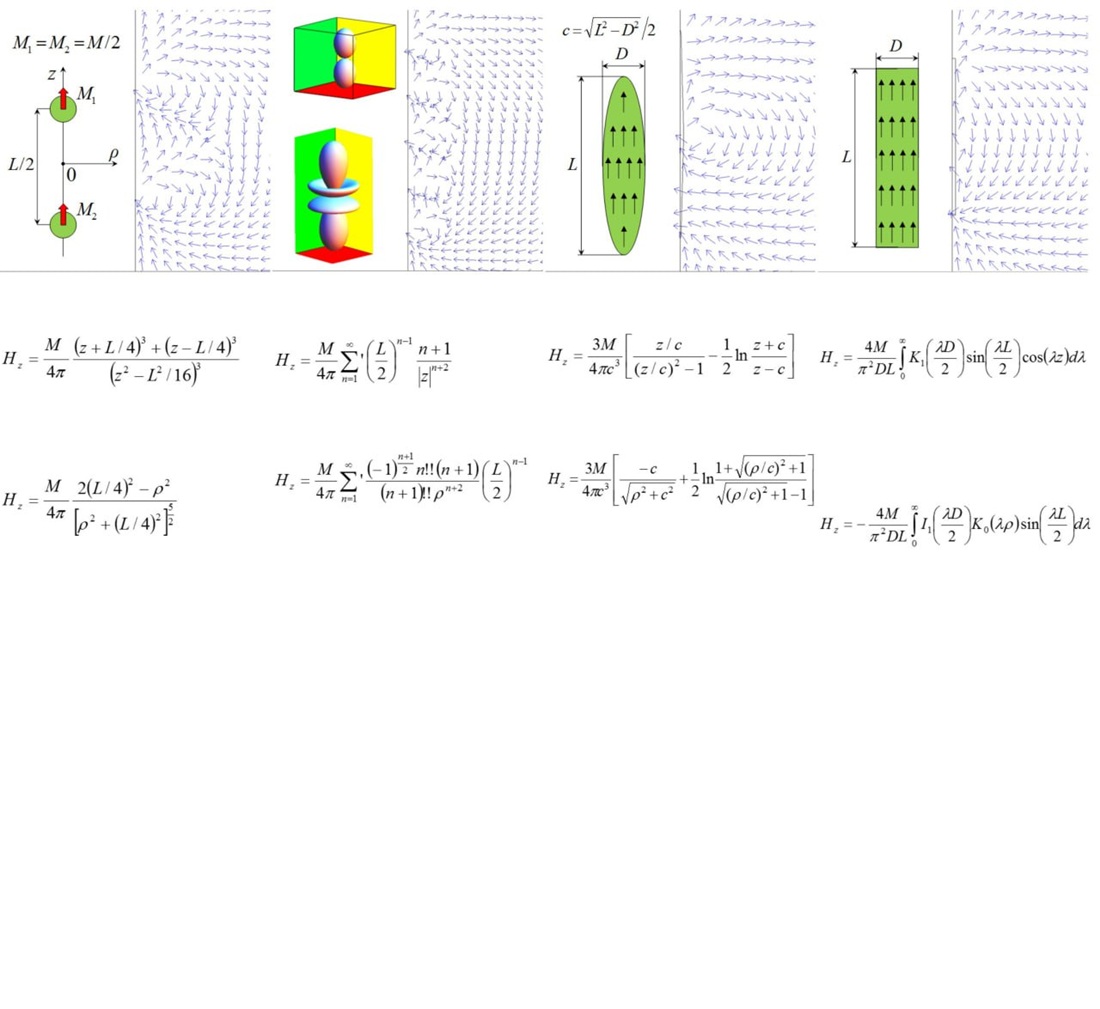
Проведено порівняльний аналіз наближених аналітичних моделей ближнього магнітного поля циліндричного електромагніту, які базуються на його магнітному моменті та габаритних розмірах. Встановлено, що модель на основі двох зсунутих дипольних моментів та мультипольна модель мають недопустимо великі відхилення результатів розрахунку ближнього магнітного поля поблизу корпусу циліндричного електромагніта. Теоретично обґрунтовані переваги у вигляді розширеної області застосування та зменшеного до 5% відхилення представлення ближнього магнітного поля при застосуванні моделі на основі циліндричних гармонік електромагніта. Отримані формули для інженерного розрахунку магнітного поля створюваного циліндричним електромагнітом в середині космічного апарату за допомогою його покращеної аналітичної моделі. Запропоновано використовувати модель на основі циліндричних гармонік для попереднього розрахунку магнітної завади, створюваної електромагнітами системи керування орієнтацією магніточутливому обладнанню космічного апарата
Посилання
- ECSS-E-HB-20-07A. Space engineering: Electromagnetic compatibility hand-book. ESA-ESTEC (2012). Noordwijk: Requirements & Standards Division, 228.
- ECSS-E-HB-20-07С Rev.2. Space engineering: Electromagnetic compatibility hand-book. ESA-ESTEC (2022). Noordwijk, 116.
- Weikert, S., Mehlem, K., Wiegand, A. (2012). Spacecraft magnetic cleanliness prediction and control. ESA Workshop on Aerospace EMC. Available at: https://www.researchgate.net/publication/241633435_Spacecraft_magnetic_cleanliness_prediction_and_control
- Connerney, J. E. P., Benn, M., Bjarno, J. B., Denver, T., Espley, J., Jorgensen, J. L. et al. (2017). The Juno Magnetic Field Investigation. Space Science Reviews, 213 (1-4), 39–138. https://doi.org/10.1007/s11214-017-0334-z
- Lee, J., Jin, H., Kim, K.-H., Park, H., Jo, W., Jang, Y. et al. (2023). Correction of Spacecraft Magnetic Field Noise: Initial Korean Pathfinder Lunar Orbiter MAGnetometer Observation in Solar Wind. Sensors, 23 (23), 9428. https://doi.org/10.3390/s23239428
- de Soria-Santacruz, M., Soriano, M., Quintero, O., Wong, F., Hart, S., Kokorowski, M. et al. (2020). An Approach to Magnetic Cleanliness for the Psyche Mission. 2020 IEEE Aerospace Conference, 1–15. https://doi.org/10.1109/aero47225.2020.9172801
- Arranz, C. J., Marchese, V., Léger, J.-M., Vallmitjana, M., Jager, T., Pous, M. (2023). Magnetic cleanliness on NanoMagSat, a CubeSats’ constellation science mission. 2023 International Symposium on Electromagnetic Compatibility – EMC Europe, 1–6. https://doi.org/10.1109/emceurope57790.2023.10274205
- Park, H. H., Jin, H., Kim, T. Y., Kim, K. H., Lee, H. J., Shin, J. H. et al. (2022). Analysis of the KPLO magnetic cleanliness for the KMAG instrument. Advances in Space Research, 69 (2), 1198–1204. https://doi.org/10.1016/j.asr.2021.11.015
- Mentges, A., Rawal, B. S. (2022). Magnetic Dipole Moment Estimation from Nearfield Measurements Using Stochastic Gradient Descent AI Model. 2022 International Conference on Machine Learning, Big Data, Cloud and Parallel Computing (COM-IT-CON), 327–332. https://doi.org/10.1109/com-it-con54601.2022.9850855
- Busch, S., Koss, P. A., Horch, C., Schäfer, K., Schimmerohn, M., Schäfer, F., Kühnemann, F. (2023). Magnetic cleanliness verification of miniature satellites for high precision pointing. Acta Astronautica, 210, 243–252. https://doi.org/10.1016/j.actaastro.2023.05.017
- Dorman, C. J., Piker, C., Miles, D. M. (2024). Automated static magnetic cleanliness screening for the TRACERS small-satellite mission. Geoscientific Instrumentation, Methods and Data Systems, 13 (1), 43–50. https://doi.org/10.5194/gi-13-43-2024
- Pudney, M. A., Carr, C. M., Schwartz, S. J., Howarth, S. I. (2013). Near-magnetic-field scaling for verification of spacecraft equipment. Geoscientific Instrumentation, Methods and Data Systems, 2 (2), 249–255. https://doi.org/10.5194/gi-2-249-2013
- Getman, A. (2023). Improving the technology for ensuring the magnetic cleanliness of small spacecraft. Eastern-European Journal of Enterprise Technologies, 3 (5 (123)), 33–42. https://doi.org/10.15587/1729-4061.2023.282444
- Lassakeur, A., Underwood, C. (2019). Magnetic Cleanliness Program on CubeSats for Improved Attitude Stability. 2019 9th International Conference on Recent Advances in Space Technologies (RAST), 123–129. https://doi.org/10.1109/rast.2019.8767816
- Belsten, N. (2022). Magnetic Cleanliness, Sensing, and Calibration for CubeSats. Massachusetts Institute of Technology. Available at: https://dspace.mit.edu/handle/1721.1/143167
- Vanderlinde, J. (2005). Classical Electromagnetic Theory. Springer Netherlands. https://doi.org/10.1007/1-4020-2700-1
- Smythe, W. (1989). Static and Dynamic Electricity. Hemisphere Publishing Corporation, 623.
- Getman, A. V., Konstantinov, A. V. (2013). Cylindrical harmonics of magnetic field of linear magnetized cylinder. Technical Electrodynamics, 1, 3–8. Available at: http://dspace.nbuv.gov.ua/handle/123456789/62253
##submission.downloads##
Опубліковано
Як цитувати
Номер
Розділ
Ліцензія
Авторське право (c) 2025 Andriy Getman, Oleksandr Konstantinov

Ця робота ліцензується відповідно до Creative Commons Attribution 4.0 International License.
Закріплення та умови передачі авторських прав (ідентифікація авторства) здійснюється у Ліцензійному договорі. Зокрема, автори залишають за собою право на авторство свого рукопису та передають журналу право першої публікації цієї роботи на умовах ліцензії Creative Commons CC BY. При цьому вони мають право укладати самостійно додаткові угоди, що стосуються неексклюзивного поширення роботи у тому вигляді, в якому вона була опублікована цим журналом, але за умови збереження посилання на першу публікацію статті в цьому журналі.
Ліцензійний договір – це документ, в якому автор гарантує, що володіє усіма авторськими правами на твір (рукопис, статтю, тощо).
Автори, підписуючи Ліцензійний договір з ПП «ТЕХНОЛОГІЧНИЙ ЦЕНТР», мають усі права на подальше використання свого твору за умови посилання на наше видання, в якому твір опублікований. Відповідно до умов Ліцензійного договору, Видавець ПП «ТЕХНОЛОГІЧНИЙ ЦЕНТР» не забирає ваші авторські права та отримує від авторів дозвіл на використання та розповсюдження публікації через світові наукові ресурси (власні електронні ресурси, наукометричні бази даних, репозитарії, бібліотеки тощо).
За відсутності підписаного Ліцензійного договору або за відсутністю вказаних в цьому договорі ідентифікаторів, що дають змогу ідентифікувати особу автора, редакція не має права працювати з рукописом.
Важливо пам’ятати, що існує і інший тип угоди між авторами та видавцями – коли авторські права передаються від авторів до видавця. В такому разі автори втрачають права власності на свій твір та не можуть його використовувати в будь-який спосіб.