Devising a technology for manufacturing wine from mulberry using osmotic dehydration
DOI:
https://doi.org/10.15587/1729-4061.2025.328926Keywords:
mulberry wine, grape wine, osmotic solution, color intensity, redox potential indicator, redoxAbstract
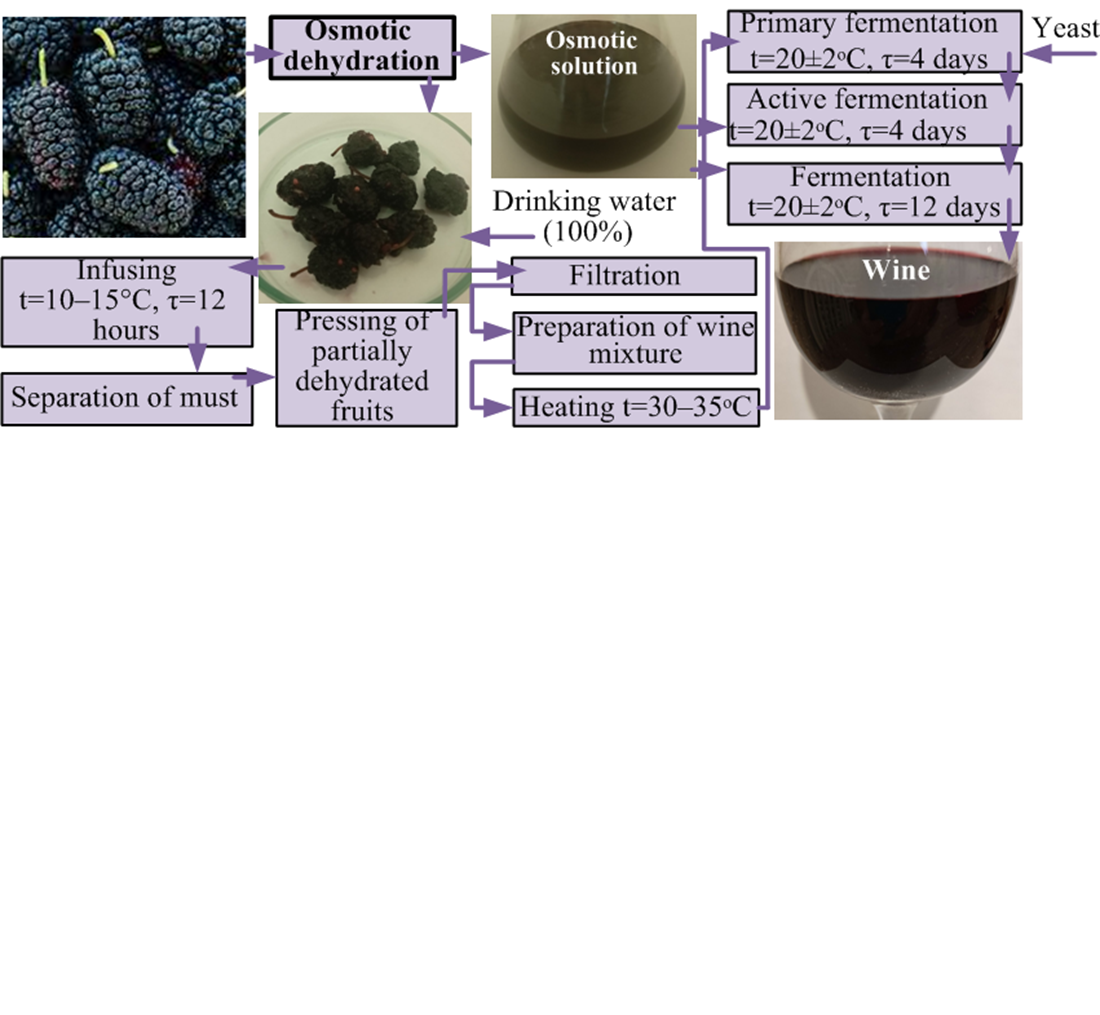
The object of this study is a technique for making mulberry wine using osmotic dehydration. The task addressed is to establish the compliance of mulberry wine quality indicators with current standards. The quality of industrially produced red semi-sweet grape wine and mulberry wine made according to original technology using osmotic dehydration has been analyzed. Some physicochemical indicators of wine quality, color intensity, and antioxidant properties were investigated using standard methodology. It was found that the mass concentration of acids in mulberry wine is slightly lower (by 0.75 ± 0.05 g/l) than in grape wine, which leads to an increase in pH (3.93 ± 0.05). Due to the use of an osmotic solution obtained during the preliminary dehydration of mulberry fruits in the fermentation process of wine, its density (1.049 ± 0.05 g/cm3) and the mass fraction of sugars (106.95 ± 0.05 g/dm3) increase. The volume fraction of ethyl alcohol in mulberry wine is 5% lower than in grape wine, which makes the drink more acceptable for health-conscious consumers. The color of mulberry wine is more saturated. The color intensity of mulberry wine is 9.98 ± 0.05, which is typical for aged red wines. At the same time, the color intensity of grape wine is within 3.82 ± 0.05, which may indicate the beginning of oxidative processes in it. It has been established that mulberry wine has better antioxidant properties. The redox potential of mulberry wine (14.9 ± 0.05) is lower than that of grape wine (15.2 ± 0.05). The redox potential of mulberry wine is 23.8 ± 0.05 mV higher than that of grape wine. Mulberry wine has a lower concentration of components capable of oxidation. Thus, mulberry is a potentially important raw material for the development of winemaking
References
- Cosme, F., Nunes, F. M., Filipe-Ribeiro, L. (2024). Winemaking: Advanced Technology and Flavor Research. Foods, 13 (12), 1937. https://doi.org/10.3390/foods13121937
- Zhu, Y., Su, Q., Jiao, J., Kelanne, N., Kortesniemi, M., Xu, X. et al. (2023). Exploring the Sensory Properties and Preferences of Fruit Wines Based on an Online Survey and Partial Projective Mapping. Foods, 12 (9), 1844. https://doi.org/10.3390/foods12091844
- Chen, X., Wang, Z., Li, Y., Liu, Q., Yuan, C. (2022). Survey of the phenolic content and antioxidant properties of wines from five regions of China according to variety and vintage. LWT, 169, 114004. https://doi.org/10.1016/j.lwt.2022.114004
- Čakar, U., Čolović, M., Milenković, D., Pagnacco, M., Maksimović, J., Krstić, D., Đorđević, B. (2025). Strawberry and Drupe Fruit Wines Antioxidant Activity and Protective Effect Against Induced Oxidative Stress in Rat Synaptosomes. Antioxidants, 14 (2), 155. https://doi.org/10.3390/antiox14020155
- He, L., Yan, Y., Wu, M., Ke, L. (2024). Advances in the Quality Improvement of Fruit Wines: A Review. Horticulturae, 10 (1), 93. https://doi.org/10.3390/horticulturae10010093
- Cai, J., Peng, H., Zhang, W., Yuan, L., Liu, Y., Kang, W., Teng, B. (2024). Impact of Long-Term Bottle Aging on Color Transition, Polymers, and Aromatic Compounds in Mulberry Wine. Fermentation, 10 (6), 271. https://doi.org/10.3390/fermentation10060271
- Hao, J., Gao, Y., Xue, J., Yang, Y., Yin, J., Wu, T., Zhang, M. (2022). Phytochemicals, Pharmacological Effects and Molecular Mechanisms of Mulberry. Foods, 11 (8), 1170. https://doi.org/10.3390/foods11081170
- Yu, M., Shi, W., Liang, Y., Shabala, S. (2024). Hormonal regulation of plant adaptation to hostile soils. Plant and Soil, 505 (1-2), 1–5. https://doi.org/10.1007/s11104-024-07065-z
- Bian, M., Xu, Q., Zhou, A., Yuan, T., Fang, Y., Han, B. (2024). Study on the Synthesis Metabolism of Anthocyanins in the Fruit and Wine of Hongguo No. 2 Mulberry at Different Ripeness Stages. https://doi.org/10.2139/ssrn.4944260
- Lian, W., Lei, J., Han, C., Wu, J., Liu, Z., Liu, W. et al. (2024). Effect of Different Yeasts on the Higher Alcohol Content of Mulberry Wine. Foods, 13 (12), 1788. https://doi.org/10.3390/foods13121788
- Samilyk, M., Bal’-Prylipko, L., Korniienko, D., Paska, M., Ryzhkova, T., Yatsenko, I. et al. (2023). Determination of quality indicators of sugar fortified with a by-product of elderberry processing. Eastern-European Journal of Enterprise Technologies, 4 (11 (124)), 65–72. https://doi.org/10.15587/1729-4061.2023.284885
- Qin, Y., Xu, H., Chen, Y., Lei, J., Sun, J., Zhao, Y. et al. (2023). Metabolomics-Based Analyses of Dynamic Changes in Flavonoid Profiles in the Black Mulberry Winemaking Process. Foods, 12 (11), 2221. https://doi.org/10.3390/foods12112221
- Gambuti, A., Picariello, L., Forino, M., Errichiello, F., Guerriero, A., Moio, L. (2022). How the Management of pH during Winemaking Affects Acetaldehyde, Polymeric Pigments and Color Evolution of Red Wine. Applied Sciences, 12 (5), 2555. https://doi.org/10.3390/app12052555
- Samilyk, M., Nosyk, M., Ryzhkova, T., Bolhova, N., Tkachuk, S., Sakhnenko, A. et al. (2024). Determining the possibility of making mulberry wine by using the osmotic dehydration process. Eastern-European Journal of Enterprise Technologies, 3 (11 (129)), 31–36. https://doi.org/10.15587/1729-4061.2024.306443
- Liu, J., Wang, Q., Weng, L., Zou, L., Jiang, H., Qiu, J., Fu, J. (2023). Analysis of sucrose addition on the physicochemical properties of blueberry wine in the main fermentation. Frontiers in Nutrition, 9. https://doi.org/10.3389/fnut.2022.1092696
- He, C., Mkunga, J. J., Zhang, D., Mao, Y., Fei, L., Chen, P. et al. (2025). Integrative analysis of the fermentation mechanisms, antioxidant properties, and potential health benefits of mulberry wine using multiple bioinformatics approaches. Food Bioscience, 66, 106185. https://doi.org/10.1016/j.fbio.2025.106185
Downloads
Published
How to Cite
Issue
Section
License
Copyright (c) 2025 Maryna Samilyk, Viktoriia Ivchenko, Mykola Nosyk, Vasyl Tischenko, Taisia Ryzhkova, Ihor Hnoievyі, Alla Petrenko, Dmytro Hrinchenko

This work is licensed under a Creative Commons Attribution 4.0 International License.
The consolidation and conditions for the transfer of copyright (identification of authorship) is carried out in the License Agreement. In particular, the authors reserve the right to the authorship of their manuscript and transfer the first publication of this work to the journal under the terms of the Creative Commons CC BY license. At the same time, they have the right to conclude on their own additional agreements concerning the non-exclusive distribution of the work in the form in which it was published by this journal, but provided that the link to the first publication of the article in this journal is preserved.
A license agreement is a document in which the author warrants that he/she owns all copyright for the work (manuscript, article, etc.).
The authors, signing the License Agreement with TECHNOLOGY CENTER PC, have all rights to the further use of their work, provided that they link to our edition in which the work was published.
According to the terms of the License Agreement, the Publisher TECHNOLOGY CENTER PC does not take away your copyrights and receives permission from the authors to use and dissemination of the publication through the world's scientific resources (own electronic resources, scientometric databases, repositories, libraries, etc.).
In the absence of a signed License Agreement or in the absence of this agreement of identifiers allowing to identify the identity of the author, the editors have no right to work with the manuscript.
It is important to remember that there is another type of agreement between authors and publishers – when copyright is transferred from the authors to the publisher. In this case, the authors lose ownership of their work and may not use it in any way.







