Determination of the effectiveness of the application of radial wheel pair installation and body tilt on high-speed vehicles when driving on curved sections of the track
DOI:
https://doi.org/10.15587/1729-4061.2025.330924Keywords:
railroad transport, radial installation, wheelset, body inclination, undamped accelerationAbstract
The object of this study is a high-speed railroad vehicle. The introduction of high-speed traffic on Ukrzaliznytsia is constrained by the structure of the track, which has up to 30% of curved sections where the speed is limited in terms of traffic safety and passenger comfort. In addition, with increasing speed, the wear of wheel rims increases significantly. This gives rise to the problem of organizing high-speed traffic. One direction to solve it (very expensive) is to design a high-speed track where curved sections are absent or have a radius of several kilometers. Another option (less expensive) is to design vehicles with devices that partially compensate for centrifugal force – gravitational, by tilting the body. To reduce the wear of wheel rims, systems for radial installation of wheelsets in curves are quite effective.
Almost 50 years of experience in using radial wheelset and body tilt systems on curved track sections in Switzerland, Norway, etc. proves their high efficiency in solving the problems of rim wear and passenger comfort.
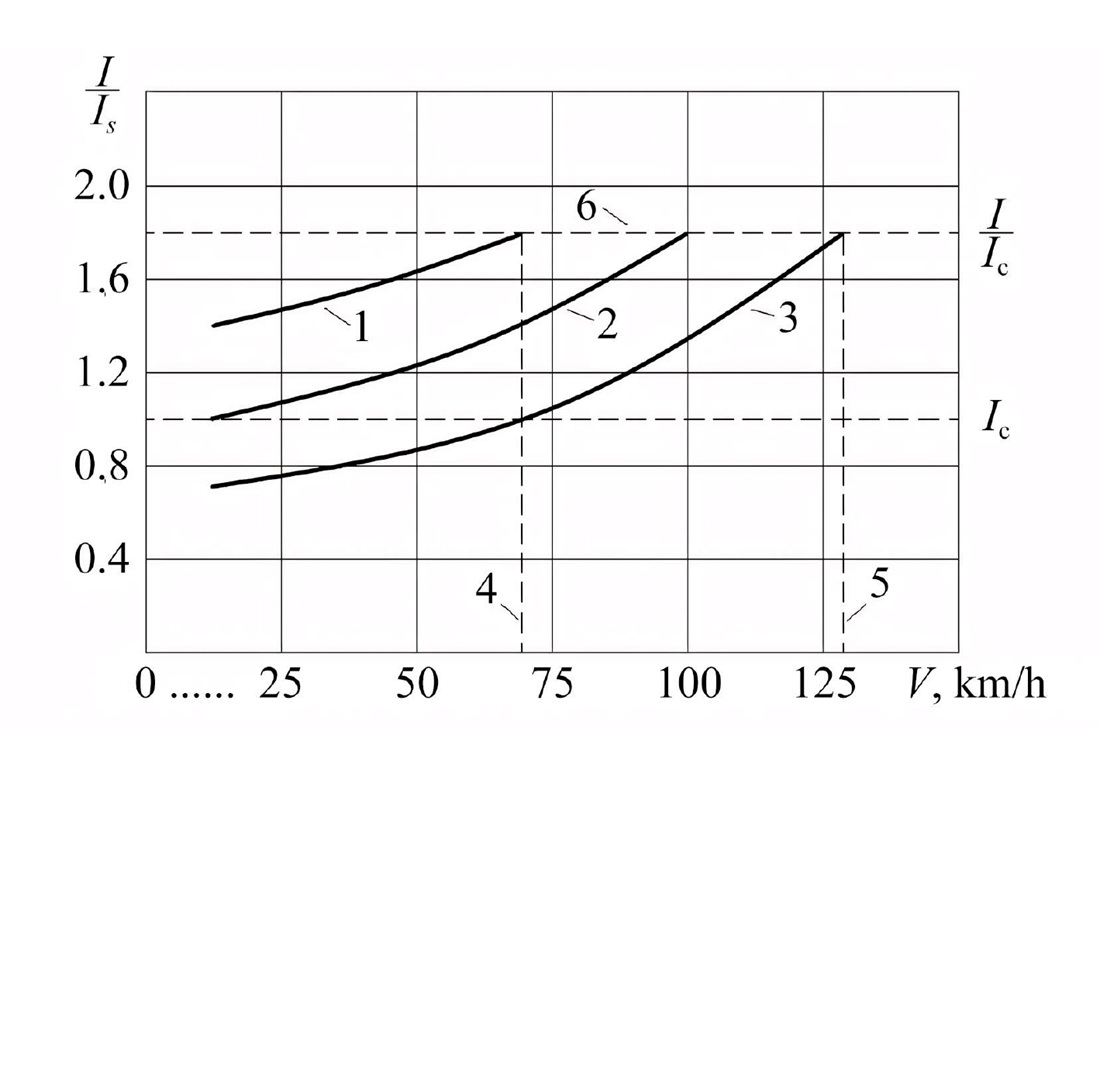
The study reported here was conducted by computer simulation. For this purpose, a mathematical model of the dynamics of high-speed rail vehicle movement along a curved track section with a radius of 350 m and an increase in the outer rail by 0.15 m was synthesized. The feasibility of simultaneously equipping vehicles with systems for forced radial wheelsets and forced body tilt has been proven.
On routes containing 30% of curves with a radius close to 350 m, this will reduce train travel time by 8.3%. This percentage will increase proportionally in accordance with the increase in the length of curved sections along the route
References
- Lawrence, M., Bullock, R., Liu, Z. (2019). China’s High-Speed Rail Development. Washington, DC: World Bank. https://doi.org/10.1596/978-1-4648-1425-9
- Huang, Y., Zong, H. (2020). The spatial distribution and determinants of China’s high-speed train services. Transportation Research Part A: Policy and Practice, 142, 56–70. https://doi.org/10.1016/j.tra.2020.10.009
- Tkachenko, V., Sapronova, S., Braikovska, N., Tverdomed, V. (2021). Dynamic interaction of rolling stock and track on lines of speed motion combined with freight. Vinnytsia: NGO "European Scientific Platform". https://doi.org/10.36074/dvrsklshrsv-monograph.2021
- Hubar, O., Markul, R., Tiutkin, O., Andrieiev, V., Arbuzov, M., Kovalchuk, O. (2020). Study of the interaction of the railway track and the rolling stock under conditions of accelerated movement. IOP Conference Series: Materials Science and Engineering, 985 (1), 012007. https://doi.org/10.1088/1757-899x/985/1/012007
- Matej, J. L., Orliński, P. (2023). Reducing wheel wear of a motorised metro car on a curved track with a small curve radius. Rail Vehicles/Pojazdy Szynowe, 3-4, 25–32. https://doi.org/10.53502/rail-175921
- Yeritsyan, B., Liubarskyi, B., Iakunin, D. (2016). Simulation of combined body tilt system of high-speed railway rolling stock. Eastern-European Journal of Enterprise Technologies, 2 (9 (80)), 4–17. https://doi.org/10.15587/1729-4061.2016.66782
- Lin, Y., Qin, Y., Xie, Z. (2021). Does foreign technology transfer spur domestic innovation? Evidence from the high-speed rail sector in China. Journal of Comparative Economics, 49 (1), 212–229. https://doi.org/10.1016/j.jce.2020.08.004
- Gerlici, J., Lovska, A., Pavliuchenkov, M. (2024). Study of the Dynamics and Strength of the Detachable Module for Long Cargoes under Asymmetric Loading Diagrams. Applied Sciences, 14 (8), 3211. https://doi.org/10.3390/app14083211
- Masliev, V. G., Kalinina, S. A., Yakunin, D. I. (2000). Bazovaya matematicheskaya model' gorizontal'noy dinamiki lokomotiva. Visnyk Kharkivskoho politekhnichnoho universytetu, 118, 17–20.
- Masliev, V. G. (2008). Dinamika teplovozov s ustroystvami, umen'shayuschimi iznos bandazhey koles. Kharkiv: NTU «KhPI», 288.
Downloads
Published
How to Cite
Issue
Section
License
Copyright (c) 2025 Vyacheslav Masliev, Oleksandr Yakunin

This work is licensed under a Creative Commons Attribution 4.0 International License.
The consolidation and conditions for the transfer of copyright (identification of authorship) is carried out in the License Agreement. In particular, the authors reserve the right to the authorship of their manuscript and transfer the first publication of this work to the journal under the terms of the Creative Commons CC BY license. At the same time, they have the right to conclude on their own additional agreements concerning the non-exclusive distribution of the work in the form in which it was published by this journal, but provided that the link to the first publication of the article in this journal is preserved.
A license agreement is a document in which the author warrants that he/she owns all copyright for the work (manuscript, article, etc.).
The authors, signing the License Agreement with TECHNOLOGY CENTER PC, have all rights to the further use of their work, provided that they link to our edition in which the work was published.
According to the terms of the License Agreement, the Publisher TECHNOLOGY CENTER PC does not take away your copyrights and receives permission from the authors to use and dissemination of the publication through the world's scientific resources (own electronic resources, scientometric databases, repositories, libraries, etc.).
In the absence of a signed License Agreement or in the absence of this agreement of identifiers allowing to identify the identity of the author, the editors have no right to work with the manuscript.
It is important to remember that there is another type of agreement between authors and publishers – when copyright is transferred from the authors to the publisher. In this case, the authors lose ownership of their work and may not use it in any way.







