Determining the influence of vegetable powders on the formation of ginger cookie quality
DOI:
https://doi.org/10.15587/1729-4061.2025.331105Keywords:
ginger cookies, carrot powder, pumpkin powder, nutritional value, dietary fiberAbstract
The object of this study is the technology of ginger cookies.
A serious issue is the spread of non-infectious diseases: obesity, diabetes, cancer, intestinal diseases, etc. This is caused by the consumption of "refined" foods, lack of dietary fiber and other nutrients in diets. Therefore, it is important to fortify flour confectionery products with sources of useful nutrients.
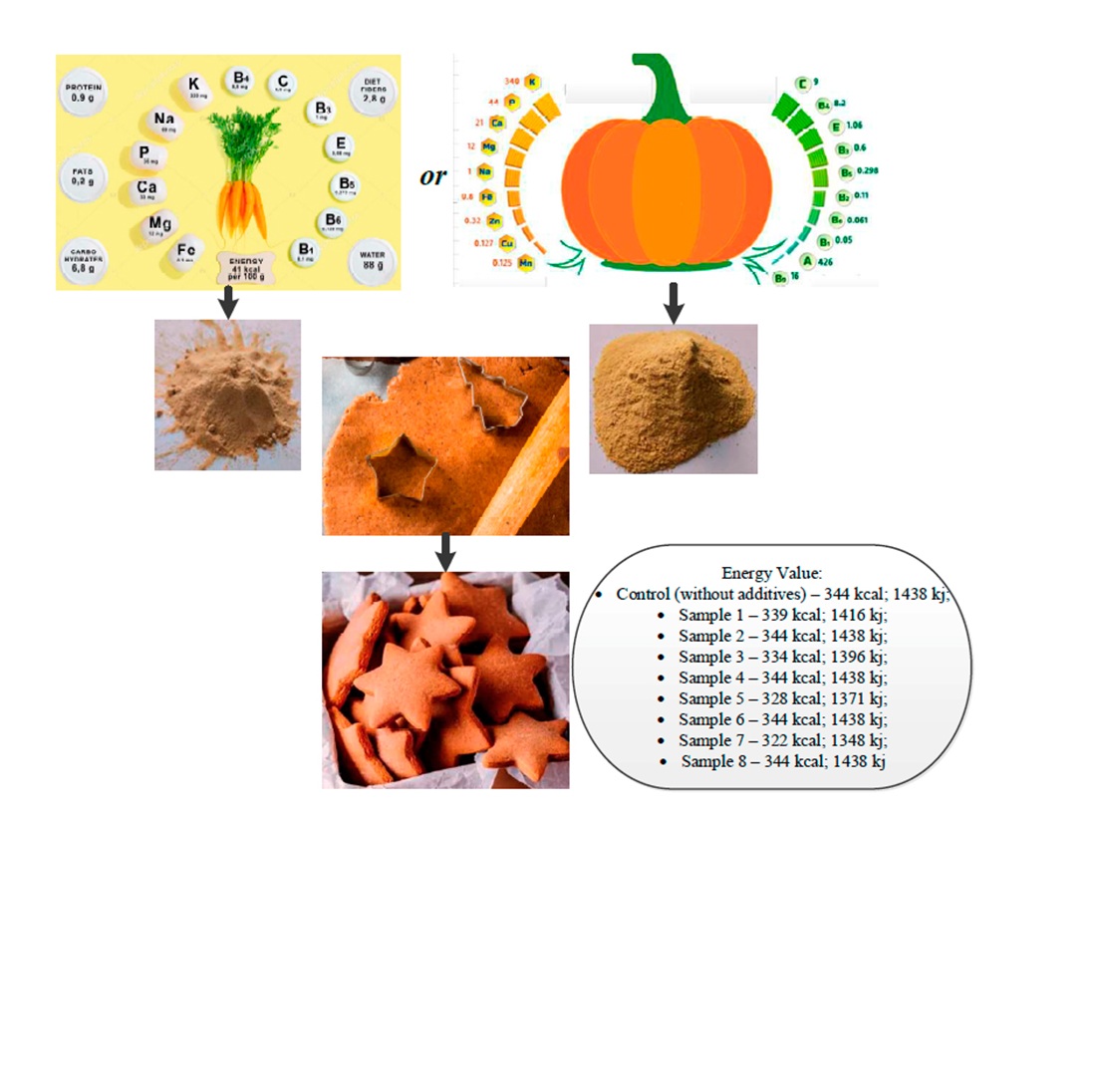
This paper has proven the effectiveness of using carrot powder to replace 10% of the total amount of flour and 4% of sugar and pumpkin powder to replace 15% and 6%, respectively, in the production of ginger cookies. Such solutions make it possible to fortify products with dietary fiber by 27.1% when adding carrot powder, and by 39.6% when using pumpkin powder. When using the latter, additional fortification with proteins occurs, by 23.1%. The addition of carrot powder helps reduce the glycemic index of ginger cookies by 5.1%, while the addition of pumpkin powder reduces this indicator within the margin of error.
It was found that the addition of carrot and pumpkin powders in the specified quantities increases the stretchability of gluten by 11.8% and 38.0%, respectively. At the same time, the elasticity decreases by 6.5% and 30.4%, respectively. Therefore, the fortified products are more fragile and have more developed porosity. Also, the devised ginger cookies have a darker color. This is explained by the significant content of β-carotene in vegetable powders: 10.2 mg/100 g and 18.5 mg/100 g, respectively. In addition, the powders contain a significant amount of simple sugars, which enhances the melanoidin formation reaction and positively affects the color of the products.
The results have practical significance for confectionery and craft manufacturers. The proposed technological solutions could make it possible to expand the range of ginger cookies with increased nutritional value and high quality indicators
References
- Hite, A. H. (2018). Nutritional Epidemiology of Chronic Disease and Defining “Healthy Diet.” Global Food History, 4 (2), 207–225. https://doi.org/10.1080/20549547.2018.1498256
- Wei, B., Liu, Y., Lin, X., Fang, Y., Cui, J., Wan, J. (2018). Dietary fiber intake and risk of metabolic syndrome: A meta-analysis of observational studies. Clinical Nutrition, 37 (6), 1935–1942. https://doi.org/10.1016/j.clnu.2017.10.019
- He, Y., Wang, B., Wen, L., Wang, F., Yu, H., Chen, D. et al. (2022). Effects of dietary fiber on human health. Food Science and Human Wellness, 11 (1), 1–10. https://doi.org/10.1016/j.fshw.2021.07.001
- Solomon, A. M. (2024). The role of dietary fiber in functional nutrition. Scientific Messenger of LNU of Veterinary Medicine and Biotechnologies, 26 (101), 77–83. https://doi.org/10.32718/nvlvet-f10112
- Sorokina, A. (2023). Problems of the development of the confectionery industry of Ukraine in modern conditions. Scientific Bulletin of Kherson State University. Series Economic Sciences, 47, 27–32. https://doi.org/10.32999/ksu2307-8030/2023-47-4
- Samokhvalova, O. V., Kucheruk, Z. I., Oliynyk, S. H., Artamonova, M. V., Hrevtseva, N. V., Shydakova-Kameniuka, O. H. et al. (2017). Tekhnolohiya boroshnianykh kondyterskykh vyrobiv. Kharkiv, 572.
- Shydakova-Kameniuka, E., Novik, A., Zhukov, Y., Matsuk, Y., Zaparenko, A., Babich, P., Oliinyk, S. (2019). Estimation of technological properties of nut meals and their effect on the quality of emulsion for butter biscuits with liquid oils. Eastern-European Journal of Enterprise Technologies, 2 (11 (98)), 56–64. https://doi.org/10.15587/1729-4061.2019.159983
- Shidakova-Kamenyuka, E., Novik, A., Rogovaya, A., Savenko, A. (2018). Evaluation of the influence of nutty oil meal on the quality of butter biscuits during storage. Prohresyvni tekhnika ta tekhnolohiya kharchovykh vyrobnytstv, restorannoho hospodarstva ta torhivli, 1 (27). 268–280. Available at: https://repo.btu.kharkov.ua/handle/123456789/578
- Mykhailo, K., Vitalii, M., Tetiana, M. (2021). Quality of shortbread cookies with a composition of meal. The International Scientific-Practical Journal “Commodities And Markets,” 39 (3), 141–150. https://doi.org/10.31617/tr.knute.2021(39)11
- Khutsidze, T., Pruidze, E., Silagadze, M., Dzneladze, E., Pkhakadze, G., Berulava, I. (2024). A flour composite mixture for gluten-free confectionery. Potravinarstvo Slovak Journal of Food Sciences, 18, 453–467. https://doi.org/10.5219/1958
- Ervina, E. (2023). The sensory profiles and preferences of gluten-free cookies made from alternative flours sourced from Indonesia. International Journal of Gastronomy and Food Science, 33, 100796. https://doi.org/10.1016/j.ijgfs.2023.100796
- Anzhelika, M., Iryna, A., Olena, G. (2021). Technology of gluten-free gingerbreads fromsesame flour. The International Scientific-Practical Journal “Commodities And Markets,” 38 (2), 85–93. https://doi.org/10.31617/tr.knute.2021(38)08
- Kravchenko, M., Yaroshenko, N. (2017). Study into effect of plant supplements on the quality indicators of gingerbread and similar spice-cakes. Eastern-European Journal of Enterprise Technologies, 5 (11 (89)), 45–54. https://doi.org/10.15587/1729-4061.2017.110168
- Kravchenko, M., Yaroshenko, N. (2016). Change of qualitative characteristics gingerbreadduring storage. Food Science and Technology, 10 (4), 47–53. https://doi.org/10.15673/fst.v10i4.254
- Golovko, T. M., Pasichnyi, V. M., Golovko, M. P., Stepanova, T. M., Lapytska, N. V., Nazarenko, Y. V. et al. (2023). Vegetarian shortbread enriched with sweet potato (ipomoea batatas var. portu beterraba). Journal of Chemistry and Technologies, 31 (2), 325–333. https://doi.org/10.15421/jchemtech.v31i2.279127
- Zemelko, M. L., Bukhkalo, S. I. (2023). Selection of functional components from plant raw materials and their application in chocolate mass recipes. Journal of Chemistry and Technologies, 31 (3), 601–610. https://doi.org/10.15421/jchemtech.v31i3.284837
- Varenyk, A., Pertsevoi, F. (2023). The usage of cannabis processing products in production of food products in confectionery flour products. Scientific Bulletin of the Tavria State Agrotechnological University, 1 (13). https://doi.org/10.31388/2220-8674-2023-1-27
- Muldabekova, B., Zhazykbayeva, G., Maliktayeva, P., Izteliyeva, R., Alashbayeva, L. (2023). Preparation and examination of the quality of gingerbread made with composite flour and sugar beet. Potravinarstvo Slovak Journal of Food Sciences, 17, 514–528. https://doi.org/10.5219/1880
- Sutkovich, T. Yu., Gorobets, O. M., Sheludko, V. M., Polozhyshnikova, L. O. (2021). Using of caroteneide raw material in technology of gingerbreads. Herald of Lviv University of Trade and Economics Technical Sciences, 25, 120–126. https://doi.org/10.36477/2522-1221-2021-25-16
- Manual of methods of analysis of foods. Fruit and vegetable products (2015). Food safety and standards authority of India Ministry of health and family welfare government of India. New Delhi. Available at: https://www.fssai.gov.in/upload/uploadfiles/files/FRUITS_AND_VEGETABLE.pdf
- Shelukhina, N. P., Fedichkina, L. G. (1994). A rapid method for quantitative determination of pectic substances. Acta Botanica Neerlandica, 43 (2), 205–207. https://doi.org/10.1111/j.1438-8677.1994.tb00745.x
- Lapytska, N., Syza, O., Gorodyska, O., Savchenko, O., Rebenok, E. (2023). Improving the jelly plum juice technology by using secondary products of oil production. Eastern-European Journal of Enterprise Technologies, 3 (11 (123)), 68–77. https://doi.org/10.15587/1729-4061.2023.281929
- Drobot, V. I., Arsenieva, L. Yu., Bilyk, O. A. et al. (2006). Laboratornyi praktykum z tekhnolohiyi khlibopekarskoho ta makaronnoho vyrobnytstva. Kyiv, 341.
- Helikh, A., Filon, A. (2025). Study of the amino acid profile of alternative proteins (Helix pomatia, Lissachatina fulica, Helix aspersa) and their potential application in a healthy diet: optimization of a modern brandade recipe. Technology Audit and Production Reserves, 2 (3 (82)), 71–79. https://doi.org/10.15587/2706-5448.2025.326896
- Samohvalova, O., Grevtseva, N., Brykova, T., Grigorenko, A. (2016). The effect of grape seed powder on the quality of butter biscuits. Eastern-European Journal of Enterprise Technologies, 3 (11 (81)), 61–66. https://doi.org/10.15587/1729-4061.2016.69838
- Nabiyev, A., Kazimova, I., Kazimova, İ., Gasimova, A., Yusifova, M., Nasrullayeva, G. (2025). Development of technology for producing juices from pumpkin, persimmon, and rosehip considering various extraction methods. Eastern-European Journal of Enterprise Technologies, 2 (11 (134)), 42–53. https://doi.org/10.15587/1729-4061.2025.324425
- Lapytska, N., Rebenok, Y., Syza, O., Shkliaiev, O., Novik, А., Lystopad, T., Haliasnyi, I. (2025). Developing moснi frozen desserts technology using by-products of juice production. Eastern-European Journal of Enterprise Technologies, 2 (11 (134)), 54–66. https://doi.org/10.15587/1729-4061.2025.324602
Downloads
Published
How to Cite
Issue
Section
License
Copyright (c) 2025 Nadiia Lapytska, Oleksii Shkliaiev, Galyna Stepankova, Аnna Novik, Nataliia Hrevtseva, Olena Shydakova-Kameniuka, Тetiana Brykova, Tatiana Gontar, Olena Gorodyska, Olha Vasylenko

This work is licensed under a Creative Commons Attribution 4.0 International License.
The consolidation and conditions for the transfer of copyright (identification of authorship) is carried out in the License Agreement. In particular, the authors reserve the right to the authorship of their manuscript and transfer the first publication of this work to the journal under the terms of the Creative Commons CC BY license. At the same time, they have the right to conclude on their own additional agreements concerning the non-exclusive distribution of the work in the form in which it was published by this journal, but provided that the link to the first publication of the article in this journal is preserved.
A license agreement is a document in which the author warrants that he/she owns all copyright for the work (manuscript, article, etc.).
The authors, signing the License Agreement with TECHNOLOGY CENTER PC, have all rights to the further use of their work, provided that they link to our edition in which the work was published.
According to the terms of the License Agreement, the Publisher TECHNOLOGY CENTER PC does not take away your copyrights and receives permission from the authors to use and dissemination of the publication through the world's scientific resources (own electronic resources, scientometric databases, repositories, libraries, etc.).
In the absence of a signed License Agreement or in the absence of this agreement of identifiers allowing to identify the identity of the author, the editors have no right to work with the manuscript.
It is important to remember that there is another type of agreement between authors and publishers – when copyright is transferred from the authors to the publisher. In this case, the authors lose ownership of their work and may not use it in any way.





