Substantiating the criteria for evaluating the quality of frozen sweet cherry fruits using the method of multi-criteria optimization
DOI:
https://doi.org/10.15587/1729-4061.2025.331599Keywords:
biochemical parameters, sensory parameters, geometric convolution of criteria, grading, waste-free chainAbstract
The object of this study is the process of preserving the biochemical and sensory quality parameters in frozen semi-finished sweet cherry products.
The modern food industry requires stable product quality, expanding the range of products, and preserving the nutritional value of raw materials, taking into account seasonality. An important role belongs to frozen fruit raw materials. However, their quality is often unpredictable, making it difficult to ensure stable technological characteristics of the end product. In this context, the scientific substantiation of the criteria for assessing the quality of frozen sweet cherry fruit is of particular relevance. For the current study, the fruits of 33 varieties of sweet cherries of different ripening periods were used. The statistical evaluation of freshly frozen fruits of cherry varieties by a set of parameters and values of the objective function was analyzed.
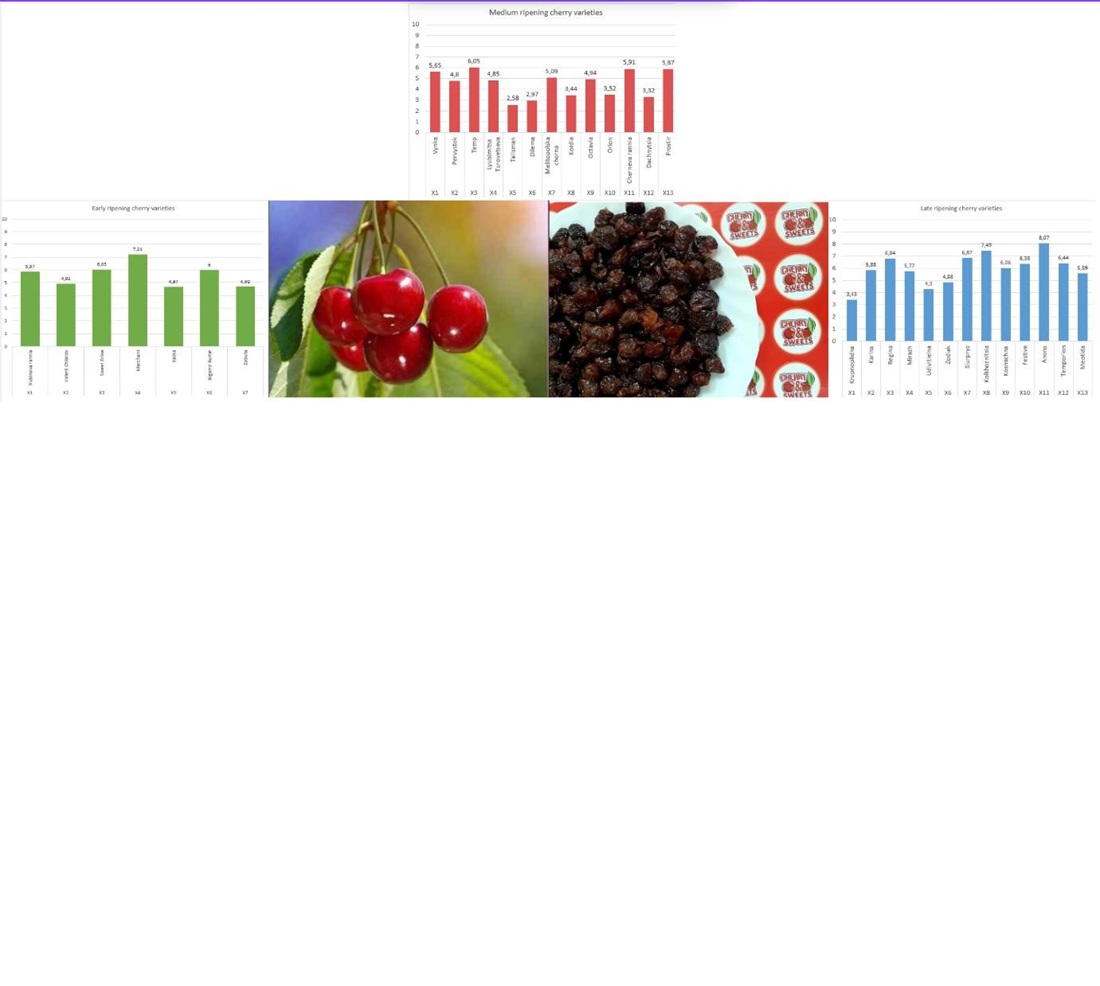
Using the method of multicriteria optimization, the most suitable sweet cherry varieties for freezing were identified. The best early ripening sweet cherry variety was determined to be Skazka (rank 1) – φ(x5)=4.67. Optimal for freezing were cherry fruits of medium ripening, the Talisman variety (rank 1) - φ(x5)=3.58. Based on the values of objective functions, the best for freezing is the late-ripening sweet cherry, the Krupnoplidna variety (rank 1) - φ(x1)=3.43. On the basis of the research, biochemical and sensory criteria for assessing the quality of frozen semi-finished products of early, medium, and late ripening sweet cherry varieties were devised for their further use in production. The results could be used to improve the criteria for assessing the quality of frozen fruit raw materials within the zero-waste fruit supply chain, which ensures the efficiency and sustainable use of resources for all stakeholders
References
- Priss, O., Pugachov, M., Pugachov, V., Yaremko, I., Shchabelska, V. (2023). The Development of the World Economy and the Impact of the Global Food Crisis 2022-2023. Economic Affairs, 68 (1s). https://doi.org/10.46852/0424-2513.1s.2023.5
- Krasnova, I., Seglina, D., Pole, V. (2018). The effect of pre-treatment methods on the quality of dehydrated candied Japanese quince fruits during storage. Journal of Food Science and Technology, 55 (11), 4468–4476. https://doi.org/10.1007/s13197-018-3375-8
- Ivanova, I., Tymoshchuk, T., Kravchuk, M., Ishchenko, I., Kryvenko, A. (2023). Sensory evaluation of sweet cherries for sustainable fruit production in the European market. Scientific Horizons, 26 (10), 93–106. https://doi.org/10.48077/scihor10.2023.93
- Blando, F., Oomah, B. D. (2019). Sweet and sour cherries: Origin, distribution, nutritional composition and health benefits. Trends in Food Science & Technology, 86, 517–529. https://doi.org/10.1016/j.tifs.2019.02.052
- Magri, A., Malorni, L., Cozzolino, R., Adiletta, G., Siano, F., Picariello, G. et al. (2023). Agronomic, Physicochemical, Aromatic and Sensory Characterization of Four Sweet Cherry Accessions of the Campania Region. Plants, 12 (3), 610. https://doi.org/10.3390/plants12030610
- González-Gómez, D., Bernalte, M. J., Ayuso, M. C., Fernández-León, M. F., Lozano, M., Rato, A. E. et al. (2017). Evaluation of different postharvest conditions to preserve the amount of bioactive compounds, physicochemical quality parameters and sensory attributes of ‘Sweetheart’ cherries. Acta Horticulturae, 1161, 581–586. https://doi.org/10.17660/actahortic.2017.1161.92
- Ivanova, I., Serdyuk, M., Kryvonos, I., Yeremenko, O., Тymoshchuk, Т. (2020). Formation of flavoring qualities of sweet cherry fruits under the influence of weather factors. Scientific Horizons, 89 (4), 72–81. https://doi.org/10.33249/2663-2144-2020-89-4-72-81
- Ivanova, I., Serdyuk, M., Tymoshchuk, T., Malkina, V., Zinovieva, O., Lisohurska, D. et al. (2024). Minimizing sweet cherry fruit losses during storage under the influence of hydrocooling and protective organic composition. Eastern-European Journal of Enterprise Technologies, 4 (11 (130)), 16–25. https://doi.org/10.15587/1729-4061.2024.309595
- Ivanova, I., Serdyuk, M., Tymoshchuk, T., Malkina, V., Shkinder-Barmina, A., Drobitko, A. et al. (2024). Prediction of cherry fruit technological characteristics by RIDGE-regression method. Future of Food: Journal on Food, Agriculture & Society, 12 (1), 39–50. Available at: https://thefutureoffoodjournal.com/manuscript/index.php/FOFJ/article/view/691
- Huang, H., Ni, Z., Xie, J., Li, Y., Wen, H., Huang, Z. et al. (2024). Good Feasibility of Ozone-Microwave Treatment as a Sterilization Technology to Extend the Edible Life of Candied Fruit as a Post-processed Fresh Fruit Product. Food and Bioprocess Technology, 17 (10), 3086–3100. https://doi.org/10.1007/s11947-023-03315-7
- Huzova, I. (2020). Investigation of the Energy-Saving Method during Candied Fruits Filtration Drying. Periodica Polytechnica Chemical Engineering, 64 (4), 555–561. https://doi.org/10.3311/ppch.15107
- Ursache, F. M., Andronoiu, D. G., Ghinea, I. O., Barbu, V., Ioniţă, E., Cotârleţ, M. et al. (2018). Valorizations of carotenoids from sea buckthorn extract by microencapsulation and formulation of value-added food products. Journal of Food Engineering, 219, 16–24. https://doi.org/10.1016/j.jfoodeng.2017.09.015
- Ivanova, І., Serdyuk, М., Malkina, V., Tymoshchuk, T., Vorovka, M., Mrynskyi, I., Adamovych, A. (2022). Studies of the impact of environmental conditions and varietal features of sweet cherry on the accumulation of vitamin C in fruits by using the regression analysis method. Acta Agriculturae Slovenica, 118 (2). https://doi.org/10.14720/aas.2022.118.2.2404
- Mari, A., Parisouli, D. N., Krokida, M. (2024). Exploring Osmotic Dehydration for Food Preservation: Methods, Modelling, and Modern Applications. Foods, 13 (17), 2783. https://doi.org/10.3390/foods13172783
- Pandiselvam, R., Tak, Y., Olum, E., Sujayasree, O. J., Tekgül, Y., Çalışkan Koç, G. et al. (2021). Advanced osmotic dehydration techniques combined with emerging drying methods for sustainable food production: Impact on bioactive components, texture, color, and sensory properties of food. Journal of Texture Studies, 53 (6), 737–762. https://doi.org/10.1111/jtxs.12643
- Ivanova, I., Serdyuk, M., Malkina, V., Tymoshchuk, T., Kotelnytska, A., Moisiienko, V. (2021). The forecasting of polyphenolic substances in sweet cherry fruits under the impact of weather factors. Agraarteadus, 32(2), 239–250. https://doi.org/10.15159/jas.21.27
- Vasylyshina, O., Postolenko, Ye. (2019). Influence of variety characteristics on the quality of frozen cherry fruit. Scientific Horizons, 75 (2), 44–49. https://doi.org/10.33249/2663-2144-2019-75-2-44-49
- Aulin, V., Rogovskii, I., Lyashuk, O., Titova, L., Hrynkiv, A., Mironov, D. et al. (2024). Comprehensive assessment of technical condition of vehicles during operation based on Harrington’s desirability function. Eastern-European Journal of Enterprise Technologies, 1 (3 (127)), 37–46. https://doi.org/10.15587/1729-4061.2024.298567
- Vural, N., Algan-Cavuldak, Ö., Akay, M. A. (2024). Desirability Function Approach for the Optimization of Hydroalcoholic Solvent Extraction Conditions for Antioxidant Compounds from Olive Leaves. Anais Da Academia Brasileira de Ciências, 96 (1). https://doi.org/10.1590/0001-3765202420230602
- Vasylyshyna, O. (2019). Application of multicriteria optimization method to select the best varieties of frozen cherry fruit. Scientific Horizons, 80 (7), 70–74. https://doi.org/10.33249/2663-2144-2019-80-7-70-74
- Silva, V., Pereira, S., Vilela, A., Bacelar, E., Guedes, F., Ribeiro, C. et al. (2021). Preliminary Insights in Sensory Profile of Sweet Cherries. Foods, 10 (3), 612. https://doi.org/10.3390/foods10030612
- Ivanova, I., Kryvonos, I., Shleina, L., Taranenko, G., Gerasko, T. (2019). Multicriteria Optimization of Quality Indicators of Sweet Cherry Fruits of Ukrainian Selection During Freezing and Storage. Modern Development Paths of Agricultural Production, 707–717. https://doi.org/10.1007/978-3-030-14918-5_69
- Hutsol, T., Priss, O., Ivanova, I., Serdуuk, M., Cupiał, M., Tymoshchuk, T. et al. (2024). Effectiveness of Cooling Methods in Reducing Losses During Cherry Storage. Agricultural Engineering, 28 (1), 321–340. https://doi.org/10.2478/agriceng-2024-0020
- Ivanova, I., Serdyuk, M., Malkina, V., Tymoshchuk, T., Shlieina, L., Pokoptseva, L. et al. (2023). The effects of weather factors on titrating acids accumulation in sweet cherry fruits. Future of Food: Journal on Food, Agriculture & Society, 11 (1), 1–15. https://doi.org/10.17170/kobra-202210056938
- Mineață, I., Murariu, O. C., Sîrbu, S., Tallarita, A. V., Caruso, G., Jităreanu, C. D. (2024). Effects of Ripening Phase and Cultivar under Sustainable Management on Fruit Quality and Antioxidants of Sweet Cherry. Horticulturae, 10 (7), 720. https://doi.org/10.3390/horticulturae10070720
- Fonseca, L. R. S., Silva, G. R., Luís, Â., Cardoso, H. J., Correia, S., Vaz, C. V. et al. (2021). Sweet Cherries as Anti-Cancer Agents: From Bioactive Compounds to Function. Molecules, 26 (10), 2941. https://doi.org/10.3390/molecules26102941
- Perju, I., Mineață, I., Sîrbu, S., Golache, I. E., Ungureanu, I. V., Jităreanu, C. D. (2025). Fruit Quality and Production Parameters of Some Bitter Cherry Cultivars. Horticulturae, 11 (1), 87. https://doi.org/10.3390/horticulturae11010087
- Vilela, A., Sobreira, C., Abraão, A. S., Lemos, A. M., Nunes, F. M. (2016). Texture Quality of Candied Fruits as Influenced by Osmotic Dehydration Agents. Journal of Texture Studies, 47 (3), 239–252. https://doi.org/10.1111/jtxs.12177
- Patel, S., Torres, C. A., Tang, J., Sablani, S., Munson, C. L. (2025). Influence of fruit size on sweet cherry respiration: a multi-cultivar analysis introducing the size factor. Journal of Food Measurement and Characterization. https://doi.org/10.1007/s11694-025-03235-4
- Ropelewska, E., Konopacka, D., Piecko, J. (2023). The Quality Assessment of Sour Cherries Dried Using an Innovative Simultaneous Osmotic–Microwave–Vacuum Approach Based on Image Textures, Color Parameters, and Sensory Attributes. Agriculture, 14 (1), 54. https://doi.org/10.3390/agriculture14010054
Downloads
Published
How to Cite
Issue
Section
License
Copyright (c) 2025 Іryna Ivanova, Marina Serdyuk, Tetiana Tymoshchuk, Svitlana Stotska, Viktor Smahlii, Natalia Slobodyanyuk, Nataliia Golembovska, Nadiia Zahorko

This work is licensed under a Creative Commons Attribution 4.0 International License.
The consolidation and conditions for the transfer of copyright (identification of authorship) is carried out in the License Agreement. In particular, the authors reserve the right to the authorship of their manuscript and transfer the first publication of this work to the journal under the terms of the Creative Commons CC BY license. At the same time, they have the right to conclude on their own additional agreements concerning the non-exclusive distribution of the work in the form in which it was published by this journal, but provided that the link to the first publication of the article in this journal is preserved.
A license agreement is a document in which the author warrants that he/she owns all copyright for the work (manuscript, article, etc.).
The authors, signing the License Agreement with TECHNOLOGY CENTER PC, have all rights to the further use of their work, provided that they link to our edition in which the work was published.
According to the terms of the License Agreement, the Publisher TECHNOLOGY CENTER PC does not take away your copyrights and receives permission from the authors to use and dissemination of the publication through the world's scientific resources (own electronic resources, scientometric databases, repositories, libraries, etc.).
In the absence of a signed License Agreement or in the absence of this agreement of identifiers allowing to identify the identity of the author, the editors have no right to work with the manuscript.
It is important to remember that there is another type of agreement between authors and publishers – when copyright is transferred from the authors to the publisher. In this case, the authors lose ownership of their work and may not use it in any way.







