Establishing the dependence of fermentation process of milk clots with mesophilic lactic acid streptococci on the genotype of cows in terms of the kappa-casein gene
DOI:
https://doi.org/10.15587/1729-4061.2025.333997Keywords:
kappa-casein, milk clot, lactic acid bacteria, consistency, viscosity, biotechnological processing, lactococci, technological properties, storage of fermented milk productsAbstract
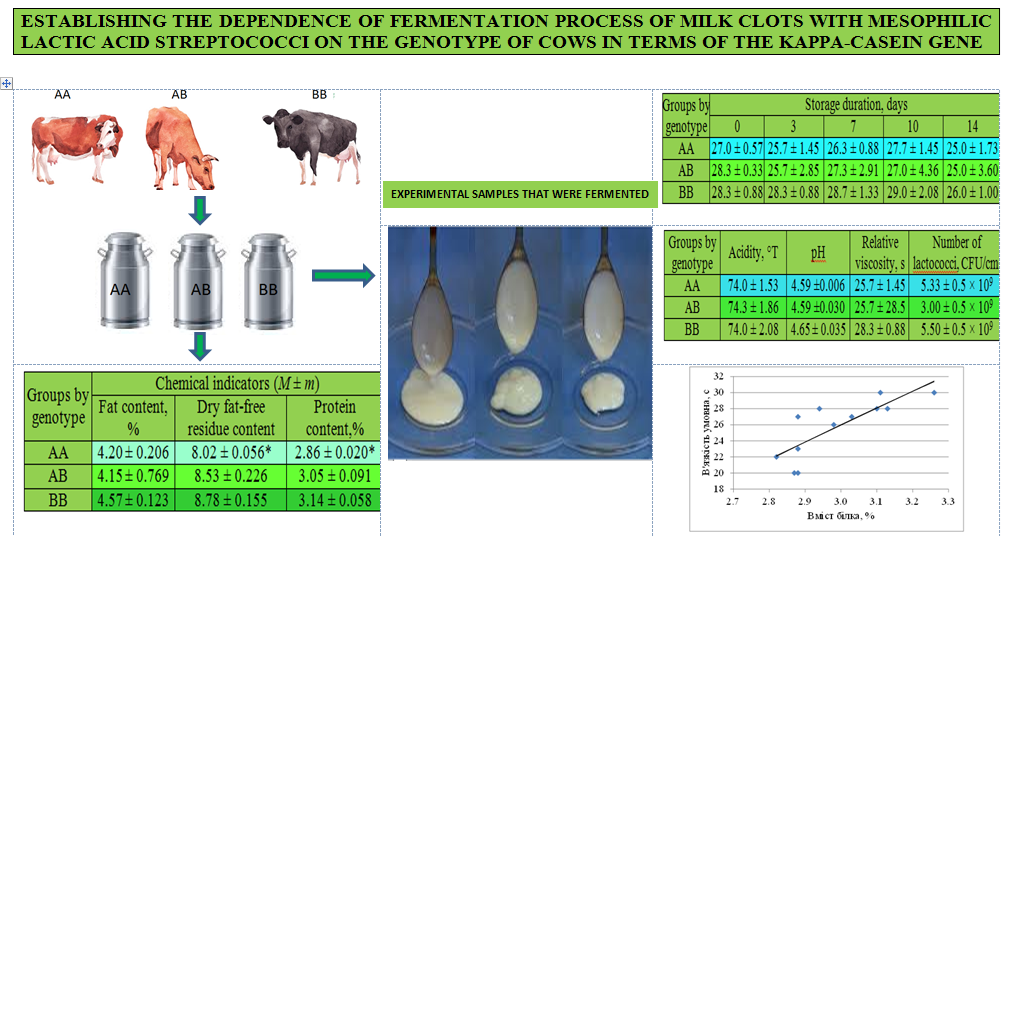
The object of research is patterns in a technological process related to the fermentation of milk clots from dairy raw materials obtained from cows with different genotypes by the kappa-casein gene. The task still unresolved is the need to adjust the technological process in the manufacture of fermented milk products from dairy raw materials obtained from cows with different genotypes by this gene. This is associated with the interest of animal owners to create herds of cows with the BB genotype in order to improve milk suitability for cheese making.
Changes in physical-chemical, microbiological, and organoleptic parameters in the process of targeted use of mesophilic lactic acid bacteria of biotechnological processing and during storage have been studied.
Based on the results of the study of fermented clots, their physical-chemical and microbiological parameters, the absence of dependence of the fermentation process of milk clots by mesophilic lactic acid streptococci on the cow genotype according to the kappa-casein gene has been found.
The study has resulted in confirming the hypothesis that genetic variants of the kappa-casein (CSN3) gene in cows (AA, AB, BB) affect the physical-chemical characteristics of milk, the dynamics of fermentation, and the properties of milk clots formed under the action of mesophilic lactic acid streptococci, and therefore the quality of finished fermented milk products. The use of milk from the cow genotype based on the kappa-casein gene is possible using classical technology and does not require adjustment of technological conditions.
The results of the work could be used in the milk processing industry in the development of technology for fermented milk products from raw milk of cows with different genotypes based on the kappa-casein gene
References
- Sakihara, T., Otsuji, K., Arakaki, Y., Hamada, K., Sugiura, S., Ito, K. (2022). Early Discontinuation of Cow’s Milk Protein Ingestion Is Associated with the Development of Cow’s Milk Allergy. The Journal of Allergy and Clinical Immunology: In Practice, 10 (1), 172–179. https://doi.org/10.1016/j.jaip.2021.07.053
- Giannetti, A., Toschi Vespasiani, G., Ricci, G., Miniaci, A., di Palmo, E., Pession, A. (2021). Cow’s Milk Protein Allergy as a Model of Food Allergies. Nutrients, 13 (5), 1525. https://doi.org/10.3390/nu13051525
- Čítek, J., Brzáková, M., Hanusová, L., Hanuš, O., Večerek, L., Samková, E. et al. (2020). Technological properties of cow’s milk: correlations with milk composition, effect of interactions of genes and other factors. Czech Journal of Animal Science, 65 (1), 13–22. https://doi.org/10.17221/150/2019-cjas
- Sokoliuk, V. M., Dukhnytsky, V. B., Krupelnytsky, T. V., Ligomina, I. P., Revunets, A. S., Prus, V. M. (2022). Influence of technological factors on milk quality indicators. Scientific Messenger of LNU of Veterinary Medicine and Biotechnologies, 24 (105), 37–43. https://doi.org/10.32718/nvlvet10506
- Giribaldi, M., Lamberti, C., Cirrincione, S., Giuffrida, M. G., Cavallarin, L. (2022). A2 Milk and BCM-7 Peptide as Emerging Parameters of Milk Quality. Frontiers in Nutrition, 9. https://doi.org/10.3389/fnut.2022.842375
- Plivachuk, О. P., Dyman, T. M. (2018). Interdependence of complex genotypes of alfa-lactalbumin and beta-lactoglobulin with composition and technological properties of milk of ukrainian black-and-white dairy cattle. Animal Breeding and Genetics, 51, 124–131. https://doi.org/10.31073/abg.51.17
- Manguy, J., Shields, D. C. (2019). Implications of kappa-casein evolutionary diversity for the self-assembly and aggregation of casein micelles. Royal Society Open Science, 6 (10), 190939. https://doi.org/10.1098/rsos.190939
- Khastayeva, A. Zh., Mamayeva, L. A., Abylgazinova, A. T., Zhamurova, V. S., Karimov, N. Zh., Muratbekova, K. M. (2021). RETRACTED ARTICLE: Influence of the kappa casein genotype on the technological properties of cow milk of Simmental and Alatau breeds. Functional & Integrative Genomics, 21 (2), 231–238. https://doi.org/10.1007/s10142-021-00772-1
- Bonfatti, V., Di Martino, G., Cecchinato, A., Vicario, D., Carnier, P. (2010). Effects of β-κ-casein (CSN2-CSN3) haplotypes and β-lactoglobulin (BLG) genotypes on milk production traits and detailed protein composition of individual milk of Simmental cows. Journal of Dairy Science, 93 (8), 3797–3808. https://doi.org/10.3168/jds.2009-2778
- Bonfatti, V., Chiarot, G., Carnier, P. (2014). Glycosylation of κ-casein: Genetic and nongenetic variation and effects on rennet coagulation properties of milk. Journal of Dairy Science, 97 (4), 1961–1969. https://doi.org/10.3168/jds.2013-7418
- Kyselová, J., Ječmínková, K., Matějíčková, J., Hanuš, O., Kott, T., Štípková, M., Krejčová, M. (2019). Physiochemical characteristics and fermentation ability of milk from Czech Fleckvieh cows are related to genetic polymorphisms of β-casein, κ-casein, and β-lactoglobulin. Asian-Australasian Journal of Animal Sciences, 32 (1), 14–22. https://doi.org/10.5713/ajas.17.0924
- Abeykoon, C. D., Rathnayake, R. M. C., Johansson, M., Silva, G. L. L. P., Ranadheera, C. S., Lundh, Å., Vidanarachchi, J. K. (2016). Milk Coagulation Properties and Milk Protein Genetic Variants of Three Cattle Breeds/Types in Sri Lanka. Procedia Food Science, 6, 348–351. https://doi.org/10.1016/j.profoo.2016.02.070
- Gustavsson, F., Buitenhuis, A. J., Johansson, M., Bertelsen, H. P., Glantz, M., Poulsen, N. A. et al. (2014). Effects of breed and casein genetic variants on protein profile in milk from Swedish Red, Danish Holstein, and Danish Jersey cows. Journal of Dairy Science, 97 (6), 3866–3877. https://doi.org/10.3168/jds.2013-7312
- Bijl, E., van Valenberg, H., Sikkes, S., Jumelet, S., Sala, G., Olieman, K. et al. (2014). Chymosin-induced hydrolysis of caseins: Influence of degree of phosphorylation of alpha-s1-casein and genetic variants of beta-casein. International Dairy Journal, 39 (2), 215–221. https://doi.org/10.1016/j.idairyj.2014.07.005
- Sun, Y., Ding, Y., Liu, B., Guo, J., Su, Y., Yang, X. et al. (2024). Recent advances in the bovine β-casein gene mutants on functional characteristics and nutritional health of dairy products: Status, challenges, and prospects. Food Chemistry, 443, 138510. https://doi.org/10.1016/j.foodchem.2024.138510
- Bolgova, N. V., Huba, S. O., Sokolenko, V. V., Mazhara, A. K. (2023). Study of the influence of vitamins on the fermentation process in the production of yogurt. Scientific Messenger of LNU of Veterinary Medicine and Biotechnologies, 25 (100), 43–46. https://doi.org/10.32718/nvlvet-f10007
- Bintsis, T., Papademas, P. (2022). The Evolution of Fermented Milks, from Artisanal to Industrial Products: A Critical Review. Fermentation, 8 (12), 679. https://doi.org/10.3390/fermentation8120679
- Samilyk, M., Bolgova, N., Samokhina, E., Cherniavska, T., Kharchenko, S. (2024). Use of hop extract in the biotechnology of kefir beverage. Scientific Horizons, 27 (3), 97–106. https://doi.org/10.48077/scihor3.2024.97
- Wang, X., Yu, Z., Zhao, X., Han, R., Huang, D., Yang, Y., Cheng, G. (2020). Comparative proteomic characterization of bovine milk containing β‐casein variants A1A1 and A2A2, and their heterozygote A1A2. Journal of the Science of Food and Agriculture, 101 (2), 718–725. https://doi.org/10.1002/jsfa.10684
- Liu, T., Li, Y., Yang, Y., Yi, H., Zhang, L., He, G. (2020). The influence of different lactic acid bacteria on sourdough flavor and a deep insight into sourdough fermentation through RNA sequencing. Food Chemistry, 307, 125529. https://doi.org/10.1016/j.foodchem.2019.125529
- Romanchuk, I., Minorova, A., Rudakova, T., Moiseeva, L. (2020). Regularities of lactose hydrolysis in dairy raw materials. Food Resources, 8 (14), 165–174. Available at: https://iprjournal.kyiv.ua/index.php/pr/article/view/55
- Gao, D., Helikh, A., Duan, Z. (2021). Functional properties of four kinds of oilseed protein isolates. Journal of Chemistry and Technologies, 29 (1), 155–163. https://doi.org/10.15421/082116
- Kieliszek, M., Pobiega, K., Piwowarek, K., Kot, A. M. (2021). Characteristics of the Proteolytic Enzymes Produced by Lactic Acid Bacteria. Molecules, 26 (7), 1858. https://doi.org/10.3390/molecules26071858
- Cheng, T., Wang, L., Guo, Z., Li, B. (2022). Technological characterization and antibacterial activity of Lactococcus lactis subsp. cremoris strains for potential use as starter culture for cheddar cheese manufacture. Food Science and Technology, 42. https://doi.org/10.1590/fst.13022
- Thum, C., Roy, N. C., Everett, D. W., McNabb, W. C. (2021). Variation in milk fat globule size and composition: A source of bioactives for human health. Critical Reviews in Food Science and Nutrition, 63 (1), 87–113. https://doi.org/10.1080/10408398.2021.1944049
- Ladyka, V., Drevytska, T., Pavlenko, J., Skliarenko, Y., Lahuta, T., Drevytskyi, O., Dosenko, V. (2022). Evaluation of cow genotypes by kappa-casein of dairy breeds. Acta Fytotechnica et Zootechnica, 25 (1). https://doi.org/10.15414/afz.2022.25.01.1-6
- Directive 2010/63/EU of the European Parliament and of the Council of 22 September 2010 on the protection of animals used for scientific purposes Text with EEA relevance. Available at: https://eur-lex.europa.eu/eli/dir/2010/63/oj/eng
- Nakaz No. 249 vid 01.03.2012 Pro zatverdzhennia Poriadku provedennia naukovymy ustanovamy doslidiv, eksperymentiv na tvarynakh. Available at: https://zakononline.com.ua/documents/show/329995___330060
- Teliuk, P. A. (2021). Vplyv natriu, kaliu ta kaltsiu na rozvytok Lactococcus lactis. Kyiv. Available at: https://er.nau.edu.ua/items/4e03963d-1bb0-44f0-a01c-d9fa0b65c93f
- Miluchová, M., Gábor, M., Candrák, J., Trakovická, A., Candráková, K. (2018). Association of HindIII-polymorphism in kappa-casein gene with milk, fat and protein yield in holstein cattle*. Acta Biochimica Polonica, 65 (3). https://doi.org/10.18388/abp.2017_2313
Downloads
Published
How to Cite
Issue
Section
License
Copyright (c) 2025 Volodymyr Ladyka, Yury Skliarenko, Nataliia Bolhova, Viktoriia Vechorka, Serhiy Tereshchenko, Vitalii Pysariev

This work is licensed under a Creative Commons Attribution 4.0 International License.
The consolidation and conditions for the transfer of copyright (identification of authorship) is carried out in the License Agreement. In particular, the authors reserve the right to the authorship of their manuscript and transfer the first publication of this work to the journal under the terms of the Creative Commons CC BY license. At the same time, they have the right to conclude on their own additional agreements concerning the non-exclusive distribution of the work in the form in which it was published by this journal, but provided that the link to the first publication of the article in this journal is preserved.
A license agreement is a document in which the author warrants that he/she owns all copyright for the work (manuscript, article, etc.).
The authors, signing the License Agreement with TECHNOLOGY CENTER PC, have all rights to the further use of their work, provided that they link to our edition in which the work was published.
According to the terms of the License Agreement, the Publisher TECHNOLOGY CENTER PC does not take away your copyrights and receives permission from the authors to use and dissemination of the publication through the world's scientific resources (own electronic resources, scientometric databases, repositories, libraries, etc.).
In the absence of a signed License Agreement or in the absence of this agreement of identifiers allowing to identify the identity of the author, the editors have no right to work with the manuscript.
It is important to remember that there is another type of agreement between authors and publishers – when copyright is transferred from the authors to the publisher. In this case, the authors lose ownership of their work and may not use it in any way.







