Розробка технології виробництва м’якого сиру з верблюжого молока
DOI:
https://doi.org/10.15587/1729-4061.2025.335523Ключові слова:
верблюже молоко, м’який сир, температура коагуляції, доза коагулянту, вихід сируАнотація
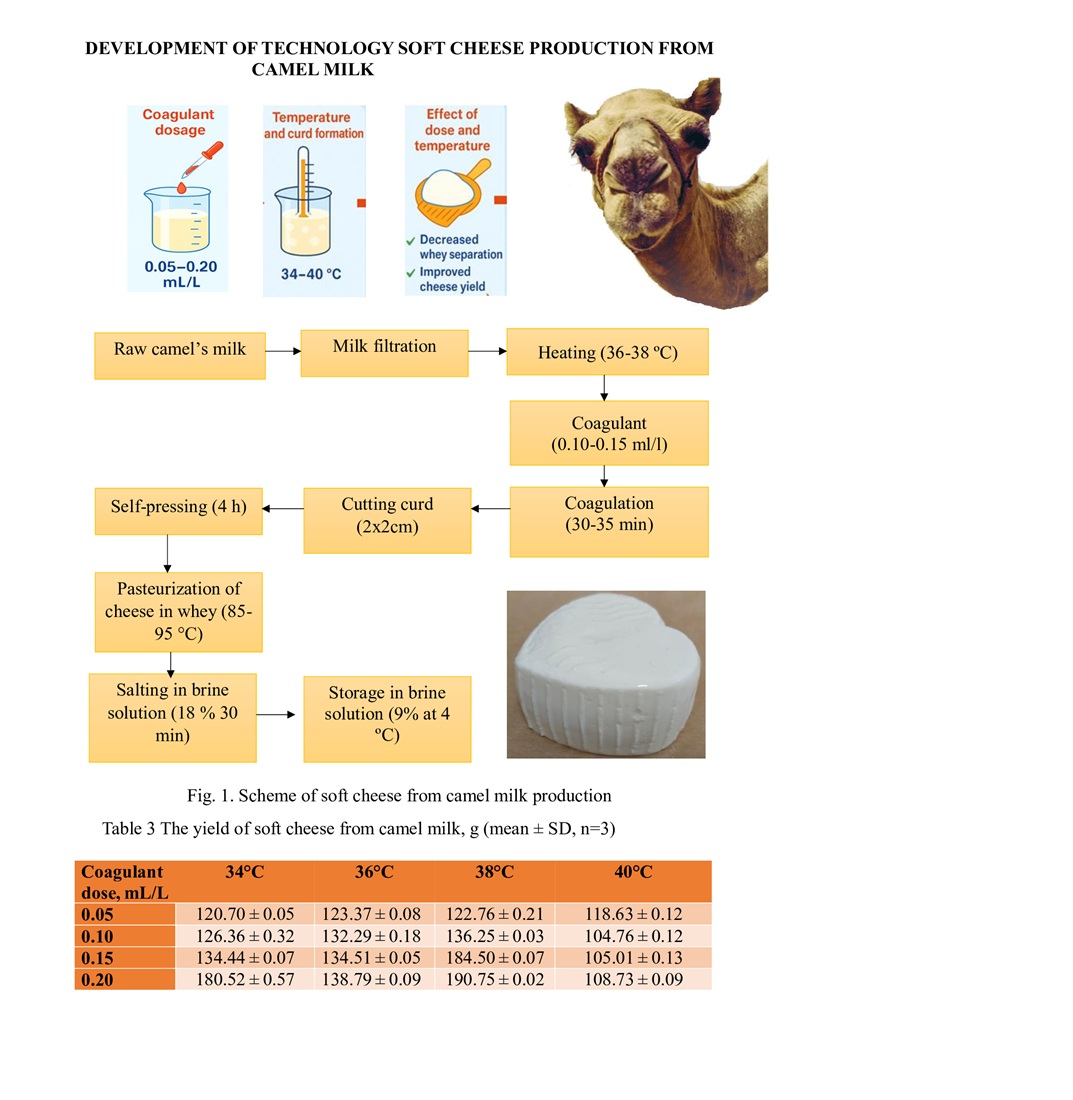
Об’єктом цього дослідження є виробництво м’якого сиру з верблюжого молока (Camelus dromedarius) зі спеціальним акцентом на формування згустку та структурно-якісні характеристики готового продукту. У дослідженні розглянуто ключову проблему: слабке гелеутворення та нестабільна структура згустку верблюжого молока, що пов’язані з його атиповим білковим складом і ускладнюють його використання у сироварінні. Основним завданням було визначення оптимальних значень дози коагулянту та температури коагуляції для підвищення як виходу, так і якості сиру.
Експериментальні дослідження оцінювали вплив ChyMax® M 1000 у дозах 0.05–0.20 мл/л та температури коагуляції в межах 34–40 °C на основні технологічні показники: вихід, сировиділення, утримання вологи та текстурні властивості. Обидва фактори суттєво впливали на формування згустку та якість кінцевого продукту. Найкращі результати отримано при дозі коагулянту 0.10–0.15 мл/л і температурі коагуляції 36–38 °C. За цих умов вихід сиру досягав 184.5 г/л, вміст вологи збільшувався до 60.5 %, зменшувалося сировиділення та покращувалися текстурні характеристики. Такі результати пояснюються підвищеною протеолітичною активністю та формуванням стабільнішої гелевої матриці за оптимальних умов.
Відмінною рисою отриманих результатів є встановлення оптимального співвідношення дози коагулянту і температури, що забезпечило стабільну структуру згустку та вищий вихід сиру. Розроблено технологічну схему виробництва м’якого сиру з верблюжого молока, придатну до впровадження в промислових масштабах. Запропонований процес може бути використаний молокопереробними підприємствами для розширення асортименту функціональних та регіонально адаптованих м’яких сирів на основі верблюжого молока.
Посилання
- Bilal, Z., Amutova, F., Kabdullina, Z., Utemuratova, D., Kondybayev, A., Akhmetsadykova, S. et al. (2025). Study of biological safety of camel milk after treatment with different antibiotics. PLOS One, 20 (4), e0321807. https://doi.org/10.1371/journal.pone.0321807
- Konuspayeva, G., Camier, B., Aleilawi, N., Al‐Shumeimyri, M., Al‐Hammad, K., Algruin, K. et al. (2016). Manufacture of dry‐ and brine‐salted soft camel cheeses for the camel dairy industry. International Journal of Dairy Technology, 70 (1), 92–101. https://doi.org/10.1111/1471-0307.12319
- Alia, O. A. E., Zine-Eddine, Y., Ajbli, N., Kzaiber, F., Oussama, A., Boutoial, K. (2023). Optimization of camel milk coagulation: the use of coagulants of microbiological and plant origin. Acta Scientiarum Polonorum Technologia Alimentaria, 22 (1), 81–91. https://doi.org/10.17306/j.afs.2023.1106
- Gabrilyants, E., Alibekov, R. (2024). The influence of lactic acid bacteria on a number of aspects of the process of producing cheese from camel milk. Bulletin of the L. N. Gumilyov Eurasian National University. Bioscience Series, 149 (4), 63–74. https://doi.org/10.32523/2616-7034-2024-149-4-63-74
- Mihretie, Y., Tadesse, N., Amakelew, S., Fikru, S. (2018). Cheese production from camel milk using lemon juice as a coagulant. Journal of Environmental and Agricultural Sciences, 17, 11–19. https://doi.org/10.13140/RG.2.2.27716.37760
- Omrani, A., Sboui, A., Hannachi, H., Hamouda, M., Dbara, M., Hammadi, M. et al. (2024). Optimisation of soft camel cheese production coagulated with green carob extract using response surface methodology: Yield, physicochemical, microbial, sensorial, and rheological properties. International Journal of Dairy Technology, 77 (4), 1159–1170. https://doi.org/10.1111/1471-0307.13118
- Konuspayeva, G., Camier, B., Gaucheron, F., Faye, B. (2014). Some parameters to process camel milk into cheese. Emirates Journal of Food and Agriculture, 26 (4), 354. https://doi.org/10.9755/ejfa.v26i4.17277
- Al-zoreky, N. S., Almathen, F. S. (2021). Using recombinant camel chymosin to make white soft cheese from camel milk. Food Chemistry, 337, 127994. https://doi.org/10.1016/j.foodchem.2020.127994
- IDF Standard 157: 2007/ISO 11815 Milk – Determination of total milk-clotting activity of bovine rennets (2007). ISO and IDF. Available at: https://cdn.standards.iteh.ai/samples/43876/16e0de8955e74c1fbc8f912e96c85b7b/ISO-11815-2007.pdf
- Official Methods of Analysis (1997). Arlington: Association of Official Analytical Chemists.
- Kamal, M., Foukani, M., Karoui, R. (2017). Effects of heating and calcium and phosphate mineral supplementation on the physical properties of rennet-induced coagulation of camel and cow milk gels. Journal of Dairy Research, 84 (2), 220–228. https://doi.org/10.1017/s0022029917000152
- Panthi, R. R., Kelly, A. L., Sheehan, J. J., Bulbul, K., Vollmer, A. H., & McMahon, D. J. (2019). Influence of protein concentration and coagulation temperature on rennet-induced gelation characteristics and curd microstructure. Journal of Dairy Science, 102(1), 177–189. https://doi.org/10.3168/jds.2018-15039
- Fox, P. F., McSweeney, P. L. H. (Eds.) (2013). Advanced Dairy Chemistry, Volume 1A: Proteins: Basic Aspects. Springer. https://doi.org/10.1007/978-1-4614-4714-6
- Walstra, P., Walstra, P., Wouters, J. T. M., Geurts, T. J. (2005). Dairy Science and Technology. Boca Raton: CRC Press, 808. https://doi.org/10.1201/9781420028010
- Warncke, M., Keienburg, S., Kulozik, U. (2021). Cold-Renneted Milk Powders for Cheese Production: Impact of Casein/Whey Protein Ratio and Heat on the Gelling Behavior of Reconstituted Rennet Gels and on the Survival Rate of Integrated Lactic Acid Bacteria. Foods, 10 (7), 1606. https://doi.org/10.3390/foods10071606
- Bekele, B., Hansen, E. B., Eshetu, M., Ipsen, R., Hailu, Y. (2019). Effect of starter cultures on properties of soft white cheese made from camel (Camelus dromedarius) milk. Journal of Dairy Science, 102 (2), 1108–1115. https://doi.org/10.3168/jds.2018-15084
- Mbye, M., Ayyash, M., Abu-Jdayil, B., Kamal-Eldin, A. (2022). The Texture of Camel Milk Cheese: Effects of Milk Composition, Coagulants, and Processing Conditions. Frontiers in Nutrition, 9. https://doi.org/10.3389/fnut.2022.868320
- Madadlou, A., Khosroshahi, A., Mousavi, S. M., Djome, Z. E. (2006). Microstructure and Rheological Properties of Iranian White Cheese Coagulated at Various Temperatures. Journal of Dairy Science, 89 (7), 2359–2364. https://doi.org/10.3168/jds.s0022-0302(06)72308-6
- Bunka, F., Pachlová, V., Nenutilová, L. (2013). Texture Properties of Dutch-Type Cheese as a Function of Its Location and Ripening. International Journal of Food Properties, 16 (5), 1016–1027. https://doi.org/10.1080/10942912.2011.575496
##submission.downloads##
Опубліковано
Як цитувати
Номер
Розділ
Ліцензія
Авторське право (c) 2025 Eleonora Gabrilyants, Aidana Utebaeva, Ravshanbek Alibekov

Ця робота ліцензується відповідно до Creative Commons Attribution 4.0 International License.
Закріплення та умови передачі авторських прав (ідентифікація авторства) здійснюється у Ліцензійному договорі. Зокрема, автори залишають за собою право на авторство свого рукопису та передають журналу право першої публікації цієї роботи на умовах ліцензії Creative Commons CC BY. При цьому вони мають право укладати самостійно додаткові угоди, що стосуються неексклюзивного поширення роботи у тому вигляді, в якому вона була опублікована цим журналом, але за умови збереження посилання на першу публікацію статті в цьому журналі.
Ліцензійний договір – це документ, в якому автор гарантує, що володіє усіма авторськими правами на твір (рукопис, статтю, тощо).
Автори, підписуючи Ліцензійний договір з ПП «ТЕХНОЛОГІЧНИЙ ЦЕНТР», мають усі права на подальше використання свого твору за умови посилання на наше видання, в якому твір опублікований. Відповідно до умов Ліцензійного договору, Видавець ПП «ТЕХНОЛОГІЧНИЙ ЦЕНТР» не забирає ваші авторські права та отримує від авторів дозвіл на використання та розповсюдження публікації через світові наукові ресурси (власні електронні ресурси, наукометричні бази даних, репозитарії, бібліотеки тощо).
За відсутності підписаного Ліцензійного договору або за відсутністю вказаних в цьому договорі ідентифікаторів, що дають змогу ідентифікувати особу автора, редакція не має права працювати з рукописом.
Важливо пам’ятати, що існує і інший тип угоди між авторами та видавцями – коли авторські права передаються від авторів до видавця. В такому разі автори втрачають права власності на свій твір та не можуть його використовувати в будь-який спосіб.