Evaluation of the efficiency of energy characteristics of an asynchronous motor using frequency conversion with pulse-width modulation
DOI:
https://doi.org/10.15587/1729-4061.2025.337918Keywords:
frequency converter, pulse-width modulation, asynchronous motor, power factor, harmonic distortionAbstract
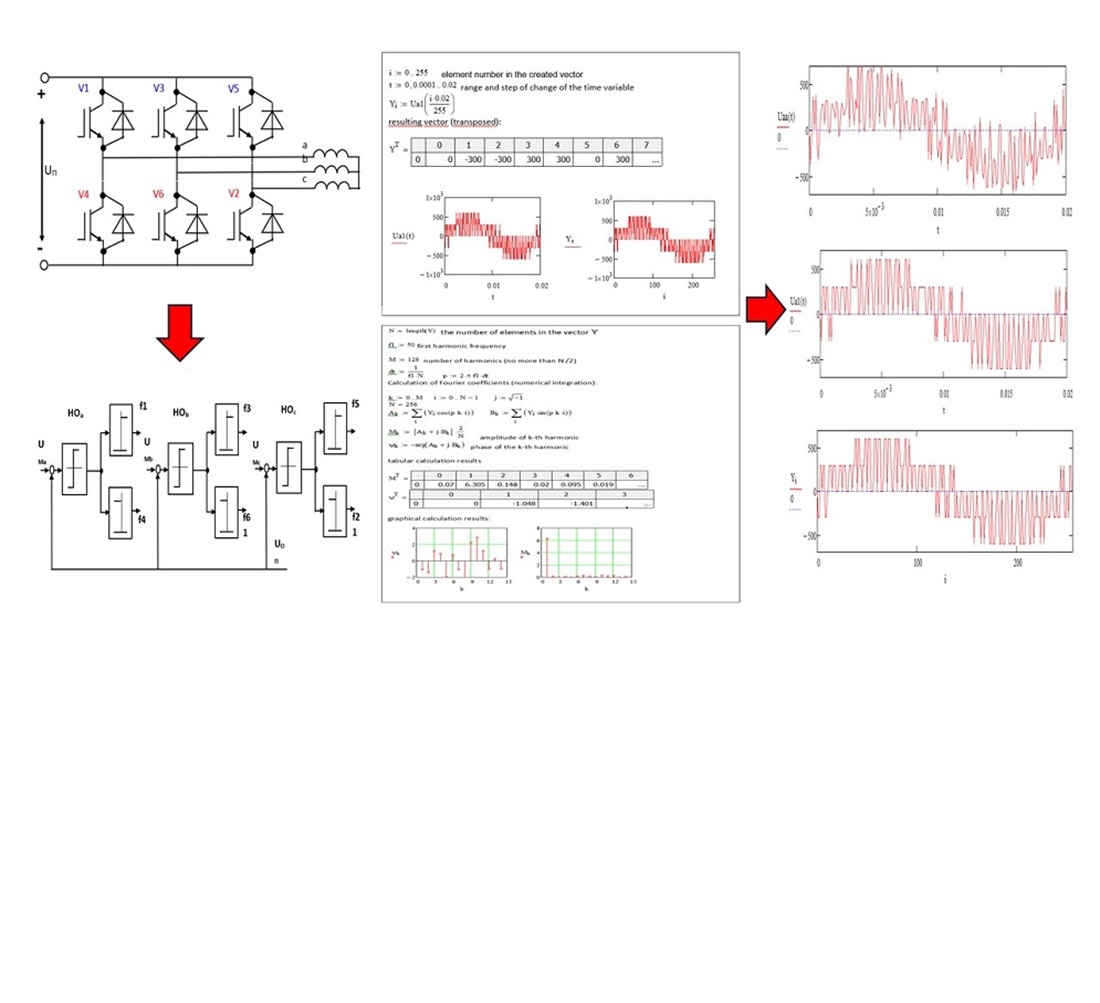
The object of the study is a three-phase frequency converter (FC) with an uncontrolled rectifier and pulse-width modulation (PWM) of the output voltage, used for frequency regulation of asynchronous motors (AM). The problem to be solved is the improve the energy efficiency of the electric drive and the accuracy of speed control while reducing harmonic distortions of voltage and current, which is especially important for industrial installations operating in continuous or alternating mode. In the work in the Mathcad environment, a mathematical model of the FC was developed, including a power circuit, an algorithm for generating PWM and dependencies for calculating the power factor, efficiency and total harmonic distortion (THD). The model allows performing parametric studies of the effect of frequency and amplitude of the output voltage on the energy indicators of the drive with a high degree of detail. The simulation results showed that the optimized sinusoidal PWM algorithm with ordered switching distribution reduces THD by 18–22% and increases the power factor to 0.94–0.96 due to a more uniform harmonic spectrum distribution and reduced reactive losses. The advantage of the proposed model is the ability to adapt to various AM operating modes and load conditions without changing the structure of the power section, which expands its practical application. The obtained results can be used in the design and modernization of industrial electric drive systems, pump and fan units, as well as in automated complexes where economical, reliable and high-precision speed control is required. It further enables sensitivity checks and controller tuning to evaluate PWM strategies under realistic limit
References
- Darimbaeva, N., Mustafin, M., Almuratova, N., Zhauyt, A. (2021). Development of a mathematical model of frequency controlled induction electric drive. Journal of Vibroengineering, 23 (8), 1833–1844. https://doi.org/10.21595/jve.2021.22051
- Mustafin, M., Almuratova, N. (2019). “Mathcad” for electric power students. Almaty: AUPET, 78.
- Postnikov, I. M. (1962). Designing of electrical machines. Kyiv, 736.
- Sieklucki, G., Sobieraj, S., Gromba, J., Necula, R.-E. (2023). Analysis and Approximation of THD and Torque Ripple of Induction Motor for SVPWM Control of VSI. Energies, 16 (12), 4628. https://doi.org/10.3390/en16124628
- Dems, M., Komęza, K., Majer, K. (2021). Core losses of the induction motor operating in a wide frequency range supplied from the inverter. International Journal of Applied Electromagnetics and Mechanics, 64, S65–S82. https://doi.org/10.3233/jae-209506
- Novokshenov, V. S., Sembin, D. Ye. (2000). Energosberegayushchiy asinkhronniy dvigatel' provoda nasosa [Energy-saving asynchronous motor pump wire]. Sat. «Energy and Fuel Resources of Kazakhstan», 2.
- Sembin, D. Ye. (2000). Optimizatsiya geometrii statora energosberegayushchego asinkhronnogo dvigatelya chastotno-reguliruyemogo privoda nasosa nefteperekachivayushchey stantsii [Optimization of the geometry of the stator of an energy-saving asynchronous motor of a variable frequency drive of a pump of an oil pumping station]. Sat. scientific papers based on the materials of the second international scientific and technical conference AIPET.
- Petrushyn, V., Horoshko, V., Plotkin, J., Almuratova, N., Toigozhinova, Z. (2021). Power Balance and Power Factors of Distorted Electrical Systems and Variable Speed Asynchronous Electric Drives. Electronics, 10 (14), 1676. https://doi.org/10.3390/electronics10141676
- Yamazaki, K., Kuramochi, S. (2012). Additional harmonic losses of induction motors by PWM inverters: Comparison between result of finite element method and IEC/TS 60034. 2012 XXth International Conference on Electrical Machines, 1552–1558. https://doi.org/10.1109/icelmach.2012.6350085
- Petrushin, V., Plotkin, J., Almuratova, N., Mustafin, M., Zharkymbekova, M. (2023). Discounted Costs Range Criterion Modification for Controlled Asynchronous Electric Drives. Energies, 16 (15), 5704. https://doi.org/10.3390/en16155704
Downloads
Published
How to Cite
Issue
Section
License
Copyright (c) 2025 Makpal Zharkymbekova, Marat Mustafin, Nurgul Almuratova, Katipa Chezhimbayeva, Markhabat Sakitzhanov, Yerzhan Domalatov

This work is licensed under a Creative Commons Attribution 4.0 International License.
The consolidation and conditions for the transfer of copyright (identification of authorship) is carried out in the License Agreement. In particular, the authors reserve the right to the authorship of their manuscript and transfer the first publication of this work to the journal under the terms of the Creative Commons CC BY license. At the same time, they have the right to conclude on their own additional agreements concerning the non-exclusive distribution of the work in the form in which it was published by this journal, but provided that the link to the first publication of the article in this journal is preserved.
A license agreement is a document in which the author warrants that he/she owns all copyright for the work (manuscript, article, etc.).
The authors, signing the License Agreement with TECHNOLOGY CENTER PC, have all rights to the further use of their work, provided that they link to our edition in which the work was published.
According to the terms of the License Agreement, the Publisher TECHNOLOGY CENTER PC does not take away your copyrights and receives permission from the authors to use and dissemination of the publication through the world's scientific resources (own electronic resources, scientometric databases, repositories, libraries, etc.).
In the absence of a signed License Agreement or in the absence of this agreement of identifiers allowing to identify the identity of the author, the editors have no right to work with the manuscript.
It is important to remember that there is another type of agreement between authors and publishers – when copyright is transferred from the authors to the publisher. In this case, the authors lose ownership of their work and may not use it in any way.







