Improving food security in East Java Province through dynamic modeling of broiler chicken availability
DOI:
https://doi.org/10.15587/1729-4061.2025.338751Keywords:
dynamic system modeling, broiler chicken supply chain, sustainable food securityAbstract
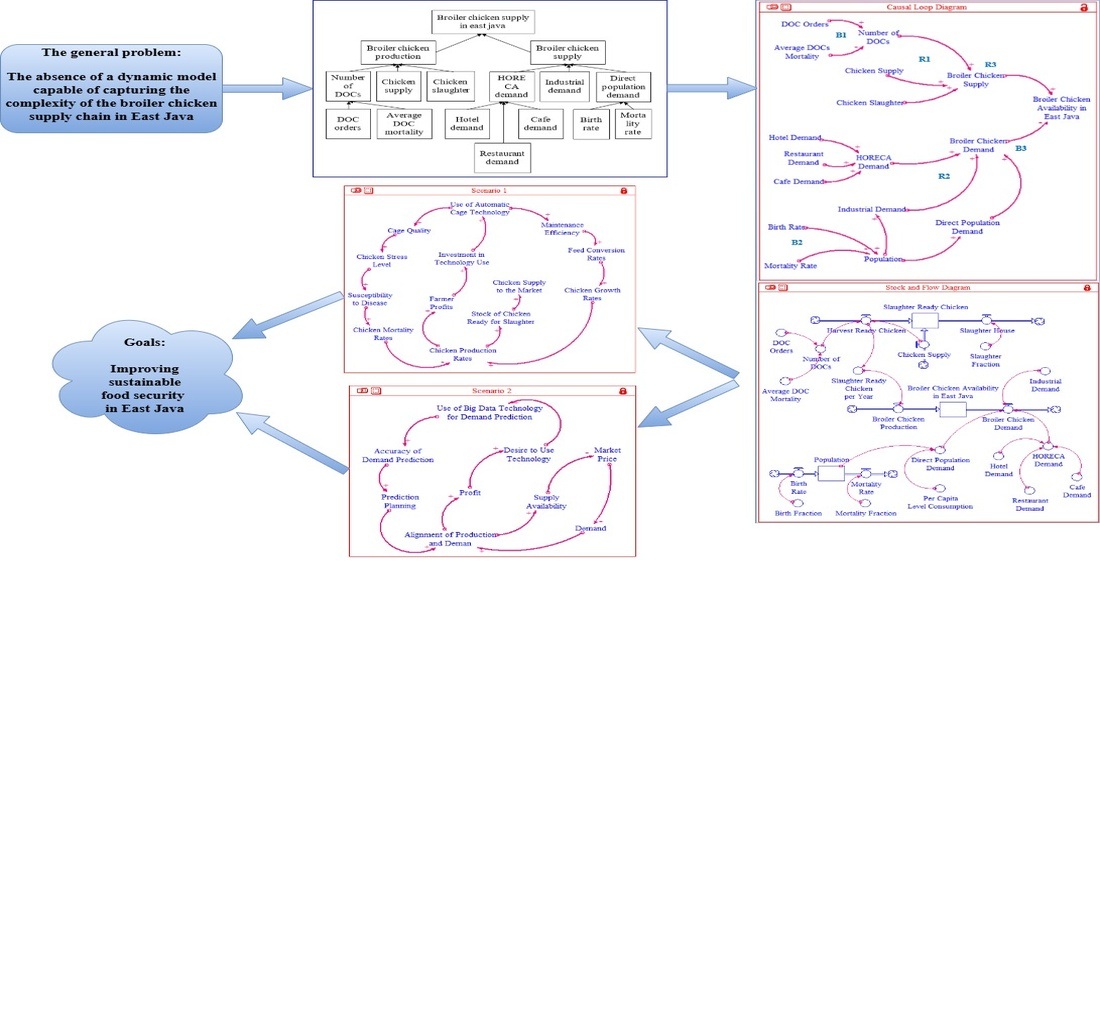
This study models the broiler chicken supply chain in East Java Province using a dynamic system modeling approach to improve food security. The research focuses on the broiler chicken supply chain system, which, despite increasing production, still faces challenges of availability and price volatility. The main problem addressed is the lack of dynamic model capable of capturing the complex and non-linear relationships within this system, which hinders the development of proactive strategic insights.
The dynamic model was successfully validated with a high degree of accuracy, with the E1 error value being less than 2.59% and E2 less than 2.09%. Simulation results demonstrate that the adoption of industrial technology has a significant and measurable impact. The automated cage technology (closed-house) scenario can increase average production by 5.5% in the long term, with projected production reaching 633,684 tons by 2034. This is explained by a decrease in mortality rates from 4–5% to 2–3%, which creates a positive reinforcing loop. Meanwhile, the big data scenario can increase the accuracy of demand predictions by 3.7%, enabling better and more stable supply adjustments and consequently reducing the gap between production and consumption.
The key advantage of these findings is their ability to predict long-term system behavior and integrate the cumulative impact of technological changes, a feature that conventional static methods lack. The solution can be used by policymakers and industry players to design proactive, data-driven strategies. The results can be applied to formulate investment policies, resource allocation, and supply chain management strategies to ensure a stable supply of animal protein in East Java, directly contributing to the achievement of sustainable food security goals
References
- Rosita, G., Prawesti, L. N., Fadlilah, U., Nugrahini, Y. L. R. E. (2020). Pengembangan potensi ayam lokal untuk menunjang ketahanan pangan di era new normal covid-19. Agrista J. Ilm. Mhs. Agribisnis UNS, 4 (1), 452–460. Available at: https://www.neliti.com/id/publications/365637/
- Haryana, A., Suprayogi, Wangsaputra, R., Govindaraju, R. (2025). Estimating Day Old Chick (DOC) Final Stock (FS) Broiler Demand Based on Broiler Meat Consumption Using System Dynamics Model. IOP Conference Series: Earth and Environmental Science, 1502 (1), 012042. https://doi.org/10.1088/1755-1315/1502/1/012042
- Mmila, G., Myeki, L. W. (2025). The Dynamics of Broiler Meat Supply in South Africa and Its Implications for Achieving SDG 2: Zero Hunger. Agriculture, 15 (12), 1236. https://doi.org/10.3390/agriculture15121236
- Fernanda, M. F., Yudhistiro, K. (2024). Sistem peramalan produksi daging ayam pedagang di provinsi jawa timur tahun 2024 dengan metode double exponential smoothing menggunakan PHP dan MySQL. Semin. Nas. Sist. Inf., 8, 4827–4836. Available at: https://jurnalfti.unmer.ac.id/index.php/senasif/article/view/574/527
- Surya Atmaja, I. P., Satriawan, I. K., Sedana Yoga, I. W. G. (2019). Sistem Dinamis Ketersediaan Daging Ayam Ras Pedaging (Broiler) Di Provinsi Bali. Jurnal Rekayasa Dan Manajemen Agroindustri, 7 (2), 229. https://doi.org/10.24843/jrma.2019.v07.i02.p07
- Idamokoro, E. M., Hosu, Y. S. (2022). Village chicken production and food security: a two-decade bibliometric analysis of global research trends. Agriculture & Food Security, 11 (1). https://doi.org/10.1186/s40066-022-00379-0
- Turner, B., Menendez, H., Gates, R., Tedeschi, L., Atzori, A. (2016). System Dynamics Modeling for Agricultural and Natural Resource Management Issues: Review of Some Past Cases and Forecasting Future Roles. Resources, 5 (4), 40. https://doi.org/10.3390/resources5040040
- Samudra, F. B., Sitorus, S. R., Santosa, E., Machfud, M. (2022). Systems dynamic modeling on sustainable apples agriculture. Jurnal Pengelolaan Sumberdaya Alam Dan Lingkungan (Journal of Natural Resources and Environmental Management), 11 (4), 567–577. https://doi.org/10.29244/jpsl.11.4.567-577
- Vanany, I., Maftuhah, D. I., Jaelani, L. M., Hajar, G., Utami, N. M. C. (2019). Modeling of Chicken Production for Food Security in Indonesia. 2019 IEEE International Conference on Industrial Engineering and Engineering Management (IEEM), 627–631. https://doi.org/10.1109/ieem44572.2019.8978877
- Aprillya, M. R., Suryani, E., Dzulkarnain, A. (2019). System Dynamics Simulation Model to Increase Paddy Production for Food Security. Journal of Information Systems Engineering and Business Intelligence, 5 (1), 67. https://doi.org/10.20473/jisebi.5.1.67-75
- Rahman, T., Arkeman, Y., Setyaningsih, D., Saparita, R. (2017). Indonesian CPO availability analysis to support food and energy security: a system dynamic approach. IOP Conference Series: Earth and Environmental Science, 65, 012024. https://doi.org/10.1088/1755-1315/65/1/012024
- Aminuddin, R. R., Okdinawati, L. (2023). A Dynamic Model For Poultry Supply Chain In West Java. Journal of Business and Management Review, 4 (2), 104–128. https://doi.org/10.47153/jbmr42.6272023
- Lolanda, H. A., Puspitasari, W. T. (2024). Rancangan Simulasi Model Sistem Dinamis Pasok Kentang di Indonesia. Journal of Agribusiness Science and Rural Development, 3 (2), 63–73. https://doi.org/10.32639/nn50ax39
- Veldhuis, G. A., Smits-Clijsen, E. M., van Waas, R. P. M., Hof, T., Maccatrozzo, V., Rouwette, E. A. J. A., Kerstholt, J. H. (2025). The influence of causal loop diagrams on systems thinking and information utilization in complex problem-solving. Computers in Human Behavior Reports, 17, 100613. https://doi.org/10.1016/j.chbr.2025.100613
- Baez, J., Li, X., Libkind, S., Osgood, N. D., Patterson, E. (2023). Compositional Modeling with Stock and Flow Diagrams. Electronic Proceedings in Theoretical Computer Science, 380, 77–96. https://doi.org/10.4204/eptcs.380.5
- Suryani, E., Rafi, H., Utamima, A. (2024). Model-based Decision Support System Using a System Dynamics Approach to Increase Corn Productivity. Journal of Information Systems Engineering and Business Intelligence, 10 (1), 139–151. https://doi.org/10.20473/jisebi.10.1.139-151
Downloads
Published
How to Cite
Issue
Section
License
Copyright (c) 2025 Hery Murnawan, Faradlillah Saves

This work is licensed under a Creative Commons Attribution 4.0 International License.
The consolidation and conditions for the transfer of copyright (identification of authorship) is carried out in the License Agreement. In particular, the authors reserve the right to the authorship of their manuscript and transfer the first publication of this work to the journal under the terms of the Creative Commons CC BY license. At the same time, they have the right to conclude on their own additional agreements concerning the non-exclusive distribution of the work in the form in which it was published by this journal, but provided that the link to the first publication of the article in this journal is preserved.
A license agreement is a document in which the author warrants that he/she owns all copyright for the work (manuscript, article, etc.).
The authors, signing the License Agreement with TECHNOLOGY CENTER PC, have all rights to the further use of their work, provided that they link to our edition in which the work was published.
According to the terms of the License Agreement, the Publisher TECHNOLOGY CENTER PC does not take away your copyrights and receives permission from the authors to use and dissemination of the publication through the world's scientific resources (own electronic resources, scientometric databases, repositories, libraries, etc.).
In the absence of a signed License Agreement or in the absence of this agreement of identifiers allowing to identify the identity of the author, the editors have no right to work with the manuscript.
It is important to remember that there is another type of agreement between authors and publishers – when copyright is transferred from the authors to the publisher. In this case, the authors lose ownership of their work and may not use it in any way.








