Determining the strength of a frame in a railroad open wagon with slings in its structure to improve its operational energy efficiency
DOI:
https://doi.org/10.15587/1729-4061.2025.340014Keywords:
railroad transport, railroad open wagon, open wagon frame, frame improvement, frame strength, structural energy efficiencyAbstract
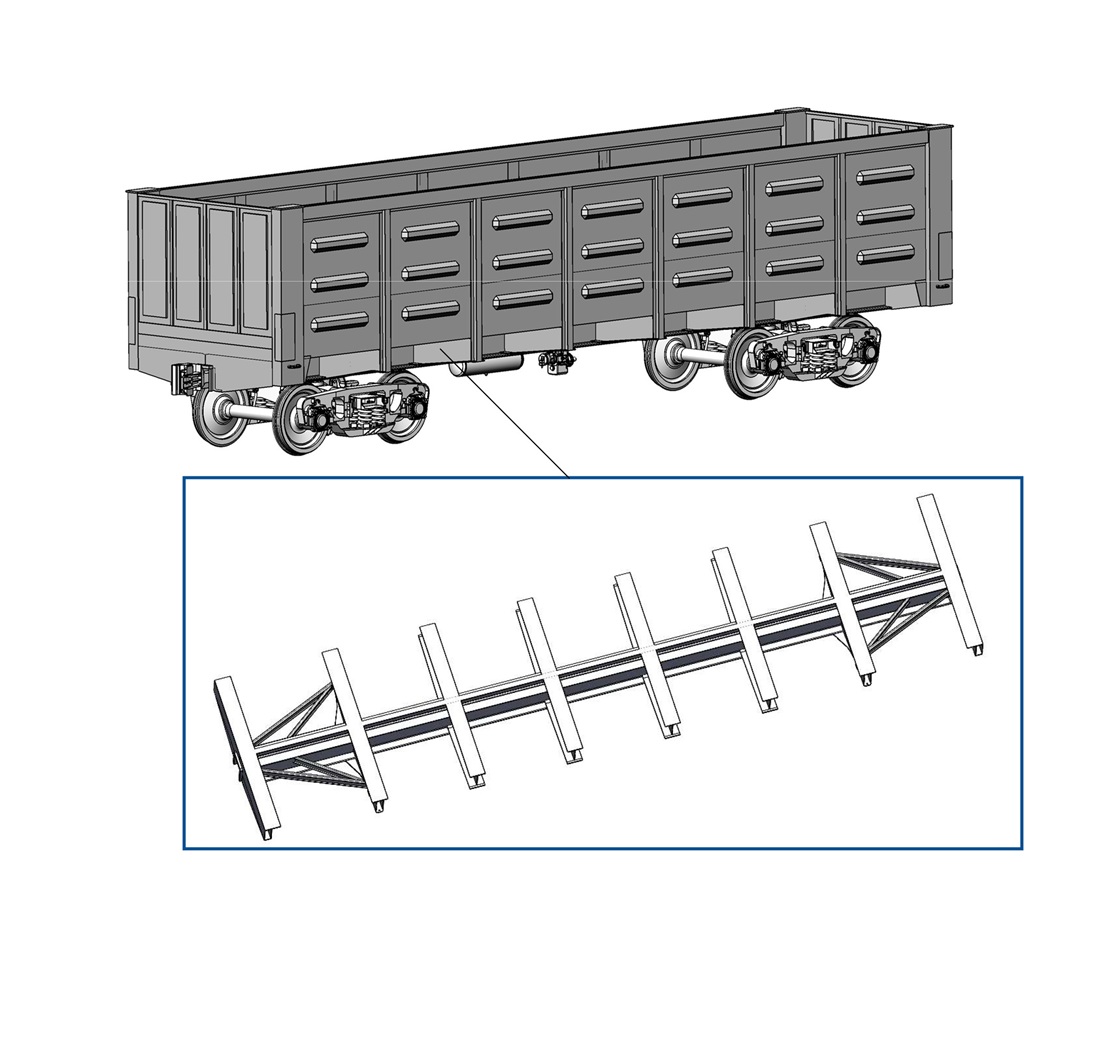
This study's object is the processes related to load acceptance and redistribution within the frame of a railroad open wagon with slings in the structure under operational loads. The task addressed in the study is to reduce the loading on the open wagon frame during operation by installing slings in its cantilever parts.
To substantiate this technological advancement, the strength of an open wagon frame was calculated under the basic load schemes in operation. The dynamic loads acting on the open wagon frame were determined by mathematical modeling. The strength calculations performed showed that the maximum stresses in the railroad open wagon frame occur under the first design mode. However, these stresses are 6% lower than those that occur in a typical frame structure.
In addition, within the framework of the study, the strength of a railroad open wagon frame was calculated while transported by railroad ferry. The calculation results showed that the strength of the open wagon frame is ensured. The estimated stresses are 4% lower than those in the typical structure of an open wagon frame.
A feature of the proposed technological advancement is that its implementation is feasible at the stage of wagon modernization, rather than only during the manufacture of new structures.
The area of practical use of the results is railroad transport.
A condition for the practical implementation of this study's results is to link the sling to the areas of arranging the front and rear stops of auto couplers.
The results of the research will contribute to improving the strength of the supporting structures in open wagons during operation and reducing the costs of their maintenance. The findings could also contribute to the design of freight wagons with improved technical and economic indicators
References
- Bulakh, M. (2025). Freight wagon body design with increased load capacity. Scientific Reports, 15 (1). https://doi.org/10.1038/s41598-025-97152-7
- Šťastniak, P., Smetanka, L., Moravčík, M. (2018). Structural Analysis of a Main Construction Assemblies of the New Wagon Prototype Type Zans. Manufacturing Technology, 18 (3), 510–517. https://doi.org/10.21062/ujep/130.2018/a/1213-2489/mt/18/3/510
- Caban, J., Vrabel, J., Górnicka, D., Nowak, R., Jankiewicz, M., Matijošius, J., Palka, M. (2023). Overview of Energy Harvesting Technologies Used in Road Vehicles. Energies, 16 (9), 3787. https://doi.org/10.3390/en16093787
- Lovska, A., Gerlici, J., Dižo, J., Pavliuchenkov, M. (2024). A Feasibility Study into the Use of Corrugated Beams in the Passenger Car Frame. Transport Means 2024. Proceedings of the 28th International Scientific Conference. https://doi.org/10.5755/e01.2351-7034.2024.p186-191
- Lovska, A., Gerlici, J., Dižo, J. (2025). Research of the possibility of using beams with corrugated walls in a passenger rail car frame. Scientific Reports, 15 (1). https://doi.org/10.1038/s41598-025-12783-0
- Kuczek, T. (2015). Application of manufacturing constraints to structural optimization of thin-walled structures. Engineering Optimization, 48 (2), 351–360. https://doi.org/10.1080/0305215x.2015.1017350
- Al-Sukhon, A., ElSayed, M. S. (2021). Design optimization of hopper cars employing functionally graded honeycomb sandwich panels. Proceedings of the Institution of Mechanical Engineers, Part F: Journal of Rail and Rapid Transit, 236 (8), 920–935. https://doi.org/10.1177/09544097211049640
- Jeong, D. Y., Tyrell, D. C., Carolan, M. E., Perlman, A. B. (2009). Improved Tank Car Design Development: Ongoing Studies on Sandwich Structures. 2009 Joint Rail Conference, 89–98. https://doi.org/10.1115/jrc2009-63025
- Lee, W. G., Kim, J.-S., Sun, S.-J., Lim, J.-Y. (2016). The next generation material for lightweight railway car body structures: Magnesium alloys. Proceedings of the Institution of Mechanical Engineers, Part F: Journal of Rail and Rapid Transit, 232 (1), 25–42. https://doi.org/10.1177/0954409716646140
- Lee, H.-A., Jung, S.-B., Jang, H.-H., Shin, D.-H., Lee, J. U., Kim, K. W., Park, G.-J. (2015). Structural-optimization-based design process for the body of a railway vehicle made from extruded aluminum panels. Proceedings of the Institution of Mechanical Engineers, Part F: Journal of Rail and Rapid Transit, 230 (4), 1283–1296. https://doi.org/10.1177/0954409715593971
- Gerlici, J., Lovska, A., Vatulia, G., Pavliuchenkov, M., Kravchenko, O., Solčanský, S. (2023). Situational Adaptation of the Open Wagon Body to Container Transportation. Applied Sciences, 13 (15), 8605. https://doi.org/10.3390/app13158605
- Koziar, M. M., Feshchuk, Yu. V., Parfeniuk, O. V. (2018). Kompiuterna hrafika: SolidWorks. Kherson: Oldi-plius, 252. Available at: https://ep3.nuwm.edu.ua/22175/1/Комп%27ютерна%20графіка.pdf
- Pustiulha, S. I., Samostian, V. R., Klak, Yu. V. (2018). Inzhenerna hrafika v SolidWorks. Lutsk: Vezha, 172. Available at: https://lib.lntu.edu.ua/sites/default/files/2021-02/Інженерна%20графіка%20в%20SolidWorks.pdf
- Gerlici, J., Lovska, A., Kozáková, K. (2025). Research into the Longitudinal Loading of an Improved Load-Bearing Structure of a Flat Car for Container Transportation. Designs, 9 (1), 12. https://doi.org/10.3390/designs9010012
- Gerlici, J., Lovska, A., Pavliuchenkov, M. (2024). Study of the Dynamics and Strength of the Detachable Module for Long Cargoes under Asymmetric Loading Diagrams. Applied Sciences, 14 (8), 3211. https://doi.org/10.3390/app14083211
- Stoilov, V., Simić, G., Purgić, S., Milković, D., Slavchev, S., Radulović, S., Maznichki, V. (2019). Comparative analysis of the results of theoretical and experimental studies of freight wagon Sdggmrss-twin. IOP Conference Series: Materials Science and Engineering, 664 (1), 012026. https://doi.org/10.1088/1757-899x/664/1/012026
- Lakshmikant, P., D V, R., Guha, S. (2025). Numerical investigation of the fatigue life of center sill of a BFNSM wagon. Proceedings of the Institution of Mechanical Engineers, Part L: Journal of Materials: Design and Applications. https://doi.org/10.1177/14644207251345076
- Dižo, J., Blatnický, M., Sága, M., Harušinec, J., Gerlici, J., Legutko, S. (2020). Development of a New System for Attaching the Wheels of the Front Axle in the Cross-Country Vehicle. Symmetry, 12 (7), 1156. https://doi.org/10.3390/sym12071156
- Caban, J., Marczuk, A., Šarkan, B., Vrábel, J. (2015). Studies on operational wear of glycol-based brake fluid Badania eksploatacyjnego zużycia płynu hamulcowego wytworzonego na bazie glikolu. PRZEMYSŁ CHEMICZNY, 94 (10), 1802–1806. https://doi.org/10.15199/62.2015.10.30
- Dizo, J., Blatnicky, M. (2019). Evaluation of Vibrational Properties of a Three-wheeled Vehicle in Terms of Comfort. Manufacturing Technology, 19 (2), 197–203. https://doi.org/10.21062/ujep/269.2019/a/1213-2489/mt/19/2/197
- Kowalski, S., Cieślikowski, B., Barta, D., Dižo, J., Dittrich, A. (2023). Analysis of the Operational Wear of the Combustion Engine Piston Pin. Lubricants, 11 (3), 100. https://doi.org/10.3390/lubricants11030100
- Lovska, A., Gerlici, J., Dižo, J., Ishchuk, V. (2023). The Strength of Rail Vehicles Transported by a Ferry Considering the Influence of Sea Waves on Its Hull. Sensors, 24 (1), 183. https://doi.org/10.3390/s24010183
- Domin, Yu. V., Cherniak, H. Yu. (2003). Osnovy dynamiky vahoniv. Kyiv: KUETT, 269.
- Panchenko, S., Gerlici, J., Vatulia, G., Lovska, A., Ravlyuk, V., Harusinec, J. (2023). Studying the load of composite brake pads under high-temperature impact from the rolling surface of wheels. EUREKA: Physics and Engineering, 4, 155–167. https://doi.org/10.21303/2461-4262.2023.002994
- Kondratiev, A. V., Kovalenko, V. O. (2019). Optimization of design parameters of the main composite fairing of the launch vehicle under simultaneous force and thermal loading. Space Science and Technology, 25 (4), 3–21. https://doi.org/10.15407/knit2019.04.003
- Blatnický, M., Dižo, J., Gerlici, J., Sága, M., Lack, T., Kuba, E. (2020). Design of a robotic manipulator for handling products of automotive industry. International Journal of Advanced Robotic Systems, 17 (1). https://doi.org/10.1177/1729881420906290
- Vatulia, G. L., Lovska, A. O., Krasnokutskyi, Y. S. (2023). Research into the transverse loading of the container with sandwich-panel walls when transported by rail. IOP Conference Series: Earth and Environmental Science, 1254 (1), 012140. https://doi.org/10.1088/1755-1315/1254/1/012140
Downloads
Published
How to Cite
Issue
Section
License
Copyright (c) 2025 Alyona Lovska, Iraida Stanovska, Yevhen Pelypenko, Hanna Barsukova, Oleksandr Yurchenko

This work is licensed under a Creative Commons Attribution 4.0 International License.
The consolidation and conditions for the transfer of copyright (identification of authorship) is carried out in the License Agreement. In particular, the authors reserve the right to the authorship of their manuscript and transfer the first publication of this work to the journal under the terms of the Creative Commons CC BY license. At the same time, they have the right to conclude on their own additional agreements concerning the non-exclusive distribution of the work in the form in which it was published by this journal, but provided that the link to the first publication of the article in this journal is preserved.
A license agreement is a document in which the author warrants that he/she owns all copyright for the work (manuscript, article, etc.).
The authors, signing the License Agreement with TECHNOLOGY CENTER PC, have all rights to the further use of their work, provided that they link to our edition in which the work was published.
According to the terms of the License Agreement, the Publisher TECHNOLOGY CENTER PC does not take away your copyrights and receives permission from the authors to use and dissemination of the publication through the world's scientific resources (own electronic resources, scientometric databases, repositories, libraries, etc.).
In the absence of a signed License Agreement or in the absence of this agreement of identifiers allowing to identify the identity of the author, the editors have no right to work with the manuscript.
It is important to remember that there is another type of agreement between authors and publishers – when copyright is transferred from the authors to the publisher. In this case, the authors lose ownership of their work and may not use it in any way.







