Comparative assessment of machine learning algorithms for forecasting wheat yields using climate indicators and satellite vegetation indices
DOI:
https://doi.org/10.15587/1729-4061.2025.340563Keywords:
wheat yield forecasting, random forest, support vector machine, convolutional neural network, normalized difference vegetation index, enhanced vegetation index, MODIS, ERA5Abstract
The object of the study is wheat yield forecasting based on the integration of climatic indicators, satellite vegetation indices, and machine learning algorithms. The problem to be solved is the limited accuracy of traditional crop yield forecasting methods, which fail to capture the complex nonlinear and multidimensional interactions among climatic, biophysical, and agronomic factors, thereby reducing their applicability for global food security tasks. The proposed approach is applied to a dataset comprising 345 observations from 2001–2023, combining vegetation indices (MODIS), climatic parameters (ERA5), and official statistics on yield and sown areas.
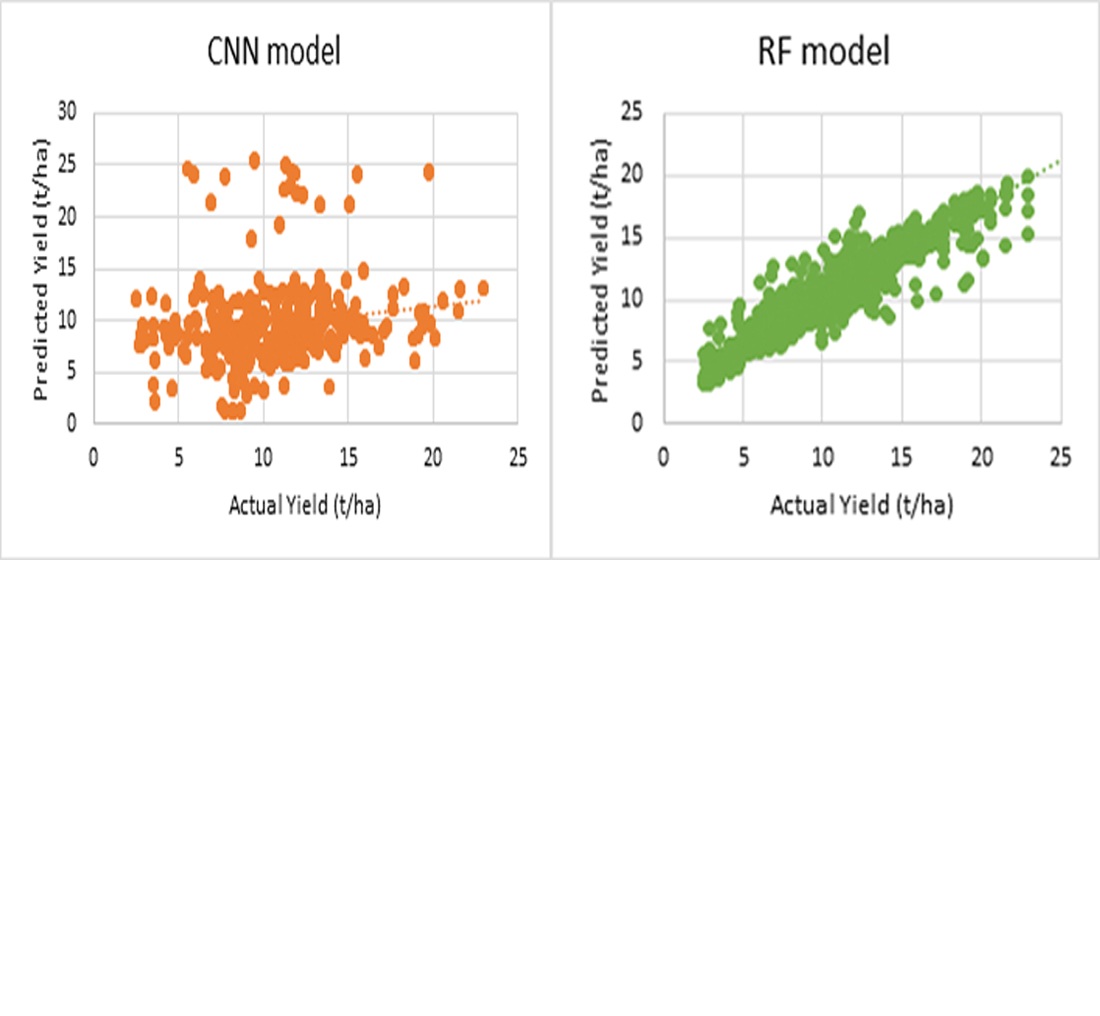
The methodology included descriptive statistics, correlation analysis and forecasting models based on random forest, support vector machine and convolutional neural network. Model performance was assessed using coefficient of determination, root mean square error and mean absolute error. Random forest and support vector machine showed the highest accuracy (R2 = 0.85 with low errors), while convolutional neural network was less effective due to the limited dataset. The analysis confirmed the decisive role of vegetation indices, especially the normalized difference vegetation index, together with precipitation, temperature and sown area.
The results address the identified research gap by demonstrating that the integration of climatic indicators and satellite vegetation indices significantly enhances the performance of machine learning models for wheat yield forecasting. In particular, the findings highlight the advantages of ensemble and support vector methods, which proved to be more robust and accurate under conditions of high climatic variability.
The practical value lies in the potential use of these models in early warning and decision-support systems for farmers and state institutions, improving agrotechnical planning, resource allocation, and reducing food security risks, thereby contributing to global food security
References
- Molotoks, A., Smith, P., Dawson, T. P. (2020). Impacts of land use, population, and climate change on global food security. Food and Energy Security, 10 (1). https://doi.org/10.1002/fes3.261
- Yu, W., Yue, Y., Wang, F. (2022). The spatial-temporal coupling pattern of grain yield and fertilization in the North China plain. Agricultural Systems, 196, 103330. https://doi.org/10.1016/j.agsy.2021.103330
- Lesk, C., Anderson, W., Rigden, A., Coast, O., Jägermeyr, J., McDermid, S. et al. (2022). Compound heat and moisture extreme impacts on global crop yields under climate change. Nature Reviews Earth & Environment, 3 (12), 872–889. https://doi.org/10.1038/s43017-022-00368-8
- Malhi, G. S., Kaur, M., Kaushik, P. (2021). Impact of Climate Change on Agriculture and Its Mitigation Strategies: A Review. Sustainability, 13 (3), 1318. https://doi.org/10.3390/su13031318
- Tamayo-Vera, D., Wang, X., Mesbah, M. (2024). A Review of Machine Learning Techniques in Agroclimatic Studies. Agriculture, 14 (3), 481. https://doi.org/10.3390/agriculture14030481
- Shammi, S. A., Meng, Q. (2021). Use time series NDVI and EVI to develop dynamic crop growth metrics for yield modeling. Ecological Indicators, 121, 107124. https://doi.org/10.1016/j.ecolind.2020.107124
- Swoish, M., Da Cunha Leme Filho, J. F., Reiter, M. S., Campbell, J. B., Thomason, W. E. (2022). Comparing satellites and vegetation indices for cover crop biomass estimation. Computers and Electronics in Agriculture, 196, 106900. https://doi.org/10.1016/j.compag.2022.106900
- Fadl, M. E., AbdelRahman, M. A. E., El-Desoky, A. I., Sayed, Y. A. (2024). Assessing soil productivity potential in arid region using remote sensing vegetation indices. Journal of Arid Environments, 222, 105166. https://doi.org/10.1016/j.jaridenv.2024.105166
- Jabed, Md. A., Azmi Murad, M. A. (2024). Crop yield prediction in agriculture: A comprehensive review of machine learning and deep learning approaches, with insights for future research and sustainability. Heliyon, 10 (24), e40836. https://doi.org/10.1016/j.heliyon.2024.e40836
- Elbasi, E., Zaki, C., Topcu, A. E., Abdelbaki, W., Zreikat, A. I., Cina, E. et al. (2023). Crop Prediction Model Using Machine Learning Algorithms. Applied Sciences, 13 (16), 9288. https://doi.org/10.3390/app13169288
- Asamoah, E., Heuvelink, G. B. M., Chairi, I., Bindraban, P. S., Logah, V. (2024). Random forest machine learning for maize yield and agronomic efficiency prediction in Ghana. Heliyon, 10 (17), e37065. https://doi.org/10.1016/j.heliyon.2024.e37065
- Guo, Y. (2023). Integrating genetic algorithm with ARIMA and reinforced random forest models to improve agriculture economy and yield forecasting. Soft Computing, 28 (2), 1685–1706. https://doi.org/10.1007/s00500-023-09516-8
- Ingole, V. S., Kshirsagar, U. A., Singh, V., Yadav, M. V., Krishna, B., Kumar, R. (2024). A Hybrid Model for Soybean Yield Prediction Integrating Convolutional Neural Networks, Recurrent Neural Networks, and Graph Convolutional Networks. Computation, 13 (1), 4. https://doi.org/10.3390/computation13010004
- Uluocak, I., Bilgili, M. (2023). Daily air temperature forecasting using LSTM-CNN and GRU-CNN models. Acta Geophysica, 72 (3), 2107–2126. https://doi.org/10.1007/s11600-023-01241-y
- Abdel-salam, M., Kumar, N., Mahajan, S. (2024). A proposed framework for crop yield prediction using hybrid feature selection approach and optimized machine learning. Neural Computing and Applications, 36 (33), 20723–20750. https://doi.org/10.1007/s00521-024-10226-x
- Celis, J., Xiao, X., Wagle, P., Adler, P. R., White, P. (2024). A Review of Yield Forecasting Techniques and Their Impact on Sustainable Agriculture. Transformation Towards Circular Food Systems, 139–168. https://doi.org/10.1007/978-3-031-63793-3_8
- Ashfaq, M., Khan, I., Alzahrani, A., Tariq, M. U., Khan, H., Ghani, A. (2024). Accurate Wheat Yield Prediction Using Machine Learning and Climate-NDVI Data Fusion. IEEE Access, 12, 40947–40961. https://doi.org/10.1109/access.2024.3376735
- Jiang, P., Yuan, Y., Li, Q. (2024). Advanced precipitation enhances vegetation primary productivity in Central Asia. Ecological Indicators, 166, 112276. https://doi.org/10.1016/j.ecolind.2024.112276
- Nurbekov, A., Kosimov, M., Islamov, S., Khaitov, B., Qodirova, D., Yuldasheva, Z. et al. (2024). No-till, crop residue management and winter wheat-based crop rotation strategies under rainfed environment. Frontiers in Agronomy, 6. https://doi.org/10.3389/fagro.2024.1453976
- Su, F., Liu, Y., Chen, L., Orozbaev, R., Tan, L. (2023). Impact of climate change on food security in the Central Asian countries. Science China Earth Sciences, 67 (1), 268–280. https://doi.org/10.1007/s11430-022-1198-4
- Sánchez, J. C. M., Mesa, H. G. A., Espinosa, A. T., Castilla, S. R., Lamont, F. G. (2025). Improving wheat yield prediction through variable selection using Support Vector Regression, Random Forest, and Extreme Gradient Boosting. Smart Agricultural Technology, 10, 100791. https://doi.org/10.1016/j.atech.2025.100791
- Sonmez, M. E., Sabanci, K., Aydin, N. (2024). Convolutional neural network-support vector machine-based approach for identification of wheat hybrids. European Food Research and Technology, 250 (5), 1353–1362. https://doi.org/10.1007/s00217-024-04473-4
- Ashfaq, M., Khan, I., Shah, D., Ali, S., Tahir, M. (2025). Predicting wheat yield using deep learning and multi-source environmental data. Scientific Reports, 15 (1). https://doi.org/10.1038/s41598-025-11780-7
- Nigam, S., Jain, R., Singh, V. K., Marwaha, S., Arora, A., Jain, S. (2024). EfficientNet architecture and attention mechanism-based wheat disease identification model. Procedia Computer Science, 235, 383–393. https://doi.org/10.1016/j.procs.2024.04.038
- Ma, J., Zhao, Y., Cui, B., Liu, L., Ding, Y., Chen, Y., Zhang, X. (2025). Prediction of Drought Thresholds Triggering Winter Wheat Yield Losses in the Future Based on the CNN-LSTM Model and Copula Theory: A Case Study of Henan Province. Agronomy, 15 (4), 954. https://doi.org/10.3390/agronomy15040954
- Rouse, J. W., Haas, R. H., Schell, J. A., Deering, D. W. (1974). Monitoring vegetation systems in the Great Plains with ERTS. NASA SP-351, 309–317. Available at: https://ntrs.nasa.gov/citations/19740022614
- Huete, A., Didan, K., Miura, T., Rodriguez, E. P., Gao, X., Ferreira, L. G. (2002). Overview of the radiometric and biophysical performance of the MODIS vegetation indices. Remote Sensing of Environment, 83 (1-2), 195–213. https://doi.org/10.1016/s0034-4257(02)00096-2
- Kussainov, T. A., Maitah, M., Kurmanov, N. A., Hájek, P., Tolysbaev, B. S., Baidakov, A. K. (2015). Economic Analysis of the Impact of Changing Production Conditions on Wheat Productivity Level. Review of European Studies, 7 (11). https://doi.org/10.5539/res.v7n11p125
- Kurmanov, N., Bakirbekova, A., Adiyetova, E., Satbayeva, A., Rakhimbekova, A., Nabiyeva, M. (2025). ICTs’ Impact on Energy Consumption and Economic Growth in the Countries of Central Asia: An Empirical Analysis. International Journal of Energy Economics and Policy, 15 (3), 8–16. https://doi.org/10.32479/ijeep.18779
- Kurmanov, N., Kabdullina, G., Baidakov, A., Kabdolla, A. (2025). Renewable Energy, Green Economic Growth and Food Security in Central Asian Countries: An Empirical Analysis. International Journal of Energy Economics and Policy, 15 (2), 1–8. https://doi.org/10.32479/ijeep.17922
Downloads
Published
How to Cite
Issue
Section
License
Copyright (c) 2025 Nurlan Kurmanov, Zhaxat Kenzhin, Darkhan Baxultanov, Bolat Zhagalbayev, Dinara Mussabalina, Meruyert Zhagalbayeva, Galiya Amrenova

This work is licensed under a Creative Commons Attribution 4.0 International License.
The consolidation and conditions for the transfer of copyright (identification of authorship) is carried out in the License Agreement. In particular, the authors reserve the right to the authorship of their manuscript and transfer the first publication of this work to the journal under the terms of the Creative Commons CC BY license. At the same time, they have the right to conclude on their own additional agreements concerning the non-exclusive distribution of the work in the form in which it was published by this journal, but provided that the link to the first publication of the article in this journal is preserved.
A license agreement is a document in which the author warrants that he/she owns all copyright for the work (manuscript, article, etc.).
The authors, signing the License Agreement with TECHNOLOGY CENTER PC, have all rights to the further use of their work, provided that they link to our edition in which the work was published.
According to the terms of the License Agreement, the Publisher TECHNOLOGY CENTER PC does not take away your copyrights and receives permission from the authors to use and dissemination of the publication through the world's scientific resources (own electronic resources, scientometric databases, repositories, libraries, etc.).
In the absence of a signed License Agreement or in the absence of this agreement of identifiers allowing to identify the identity of the author, the editors have no right to work with the manuscript.
It is important to remember that there is another type of agreement between authors and publishers – when copyright is transferred from the authors to the publisher. In this case, the authors lose ownership of their work and may not use it in any way.





