Визначення особливостей напружено-деформованого стану шпал із бетону з попередньо-напруженою композитною арматурою та їх моделей
DOI:
https://doi.org/10.15587/1729-4061.2025.341427Ключові слова:
залізнична шпала, бетон, сталева арматура, композитна арматура, попереднє напруження, тріщинаАнотація
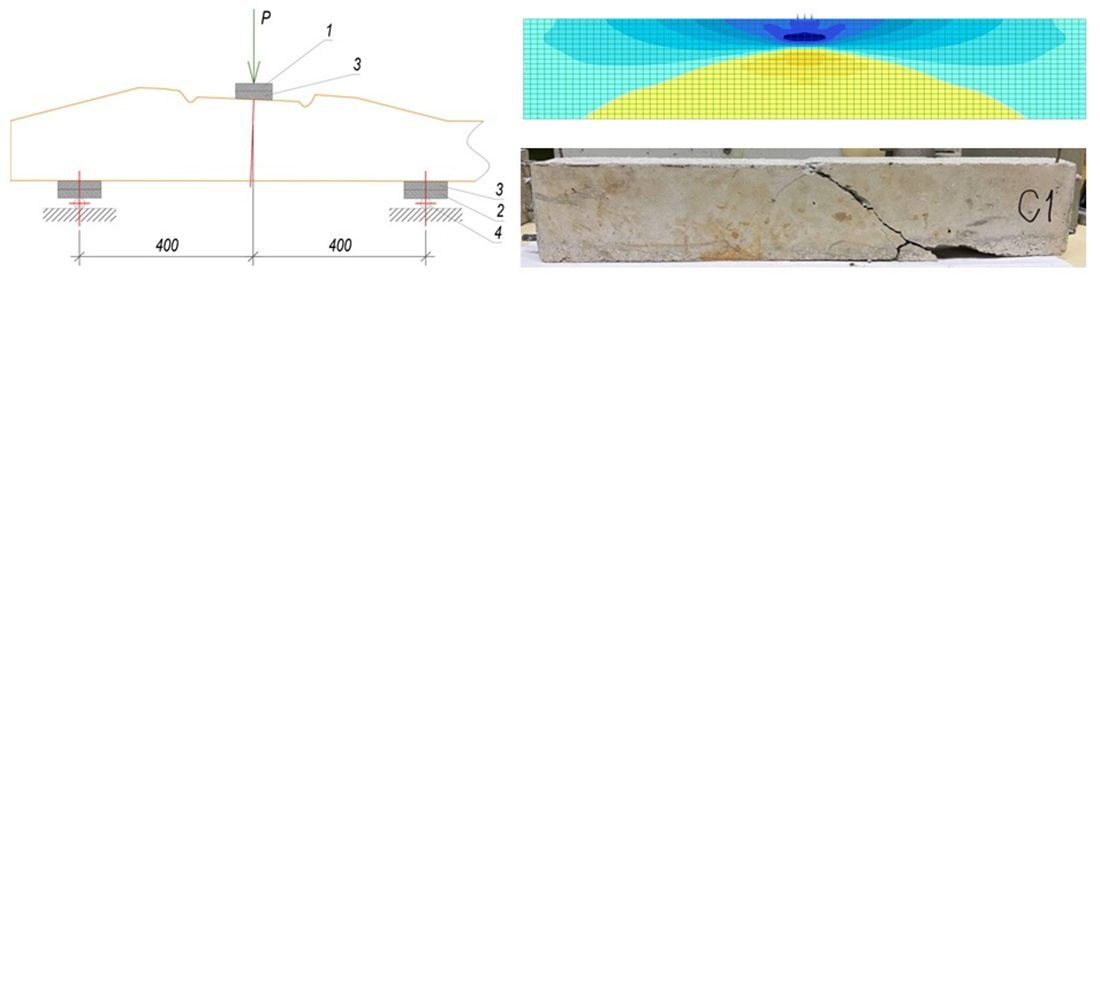
Об’єкт дослідження – скінченоелементні та фізичні моделі залізничних шпал із бетону зі сталевою та композитною попередньо напруженою арматурою. Залізобетонні шпали добре опираються механічним навантаженням, але мають невисокий електричний опір, що сприяє втратам тягового струму, струмам витоку та електрокорозії лінійних споруд на електрифікованих залізницях, порушенням автоблокування. Оскільки невисокий електричний опір обумовлений електропровідністю сталевої арматури, її заміна композитною дозволяє вирішити низку проблем експлуатації залізниць. Але її використання для шпал ускладнюється відміною від сталевої арматури за пружністю і залишається недостатньо дослідженим. Розроблено моделі шпал та схему їх випробування, яка відповідає стандартному випробуванню шпал. Виконано розрахунковий і натурний експерименти з навантаженням моделей. Встановлено, що по мірі навантаження моделей та збільшення моменту деформування розвивається трьома стадіями: утворення тріщин; їх розвиток до утворення пластичного шарніру; руйнування з проковзуванням арматури. У моделі з композитною арматурою порівняно зі сталевою моменти, відповідні цим стадіям, менші на величини, що корелюють з меншими зусиллям натягу і модулем пружності арматури. На всі моменти, що характеризують міцність та тріщиностійкість моделей, вид арматури впливає менше, ніж зусилля попереднього натягу. Порівняно результати розрахункового та натурного експериментів. Запропоновані поправочні коефіцієнти для розрахунку моментів утворення тріщин в шпалах. Отримані результати дозволяють конструювати шпали з композитною арматурою потрібної тріщиностійкості. Такі шпали можуть бути впроваджені за умови отримання позитивного результату їх дослідної експлуатації на електрифікованій ділянці залізниці.
Посилання
- Yee, J. J., Khong, S. C., Che, J., Tee, K. F., Chin, S. C. (2024). Sustainable Materials in Concrete Railway Sleepers: A Review of Current Developments and Future Prospects. Journal of Chemical Engineering and Industrial Biotechnology, 10 (1), 1–16. https://doi.org/10.15282/jceib.v10i1.10292
- Mbatha, A. J., Alugongo, A. A., Nkomo, N. Z. (2024). A Review of Composites Sleepers Used in the Railway Structure. International Journal of Engineering Trends and Technology, 72 (12), 360–366. https://doi.org/10.14445/22315381/ijett-v72i12p130
- Mirza, O., Camille, C., Clarke, T. (2025). Optimisation of Macro-Synthetic Fibre Reinforced Concrete (MSFRC) as Alternative Railway Sleepers. Engineering Materials, Structures, Systems and Methods for a More Sustainable Future. Taylor & Francis, 29–34. https://doi.org/10.1201/9781003677895-5
- Lau, D., Pam, H. J. (2010). Experimental study of hybrid FRP reinforced concrete beams. Engineering Structures, 32 (12), 3857–3865. https://doi.org/10.1016/j.engstruct.2010.08.028
- Alsayed, S. H. (1998). Flexural behaviour of concrete beams reinforced with GFRP bars. Cement and Concrete Composites, 20 (1), 1–11. https://doi.org/10.1016/s0958-9465(97)00061-9
- Chitsazan, I., Kobraei, M., Jumaat, M. Z., Shafigh, P. (2010). An experimental study on the flexural behavior of FRPRC beams and a comparison of the ultimate moment capacity with ACI. Journal of Civil Engineering and Construction Technology, 1 (2), 27–42. Available at: https://eprints.um.edu.my/6018/1/An_experimental_study_on_the_flexural_behaviour_of_FRP_RC_bemas_and_comparison_of_the_ultimate_moment_capacity_with_A.pdf
- Schmidt, J. W., Täljsten, B., Bennitz, A., Pedersen, H. (2008). FRP tendon anchorage in posttensioned concrete structures. Concrete Repair, Rehabilitation and Retrofitting II. CRC Press, 419–420. Available at: https://doi.org/10.1201/9781439828403.ch166
- Chang, X., Wang, X., Liu, C., Wu, Z., Noori, M. (2024). Anchoring and stressing methods for prestressed FRP plates: State-of-the-art review. Journal of Reinforced Plastics and Composites. https://doi.org/10.1177/07316844241258864
- Plugin, A., Kaliuzhna, O., Lobiak, O., Plugin, D., Nadzhafov, E. F. O., Lagler, M. (2024). Regarding the replacement of steel reinforcement in pre-stressed concrete sleepers with composite rebars. 14TH International Scientific Conference on Aeronautics, Automotive, and Railway Engineering and Technologies, 3064, 060003. https://doi.org/10.1063/5.0199575
- Lobiak, A., Plugin, A., Kravtsiv, L., Kovalova, O. (2018). Modelling of motorway bridge spans under modernization with consideration of rheological properties of the materials. MATEC Web of Conferences, 234, 04004. https://doi.org/10.1051/matecconf/201823404004
##submission.downloads##
Опубліковано
Як цитувати
Номер
Розділ
Ліцензія
Авторське право (c) 2025 Andrii Plugin, Maxim Murygin, Dmytro Plugin, Elshad Najafov, Serhii Musiienko, Oleksii Lobiak

Ця робота ліцензується відповідно до Creative Commons Attribution 4.0 International License.
Закріплення та умови передачі авторських прав (ідентифікація авторства) здійснюється у Ліцензійному договорі. Зокрема, автори залишають за собою право на авторство свого рукопису та передають журналу право першої публікації цієї роботи на умовах ліцензії Creative Commons CC BY. При цьому вони мають право укладати самостійно додаткові угоди, що стосуються неексклюзивного поширення роботи у тому вигляді, в якому вона була опублікована цим журналом, але за умови збереження посилання на першу публікацію статті в цьому журналі.
Ліцензійний договір – це документ, в якому автор гарантує, що володіє усіма авторськими правами на твір (рукопис, статтю, тощо).
Автори, підписуючи Ліцензійний договір з ПП «ТЕХНОЛОГІЧНИЙ ЦЕНТР», мають усі права на подальше використання свого твору за умови посилання на наше видання, в якому твір опублікований. Відповідно до умов Ліцензійного договору, Видавець ПП «ТЕХНОЛОГІЧНИЙ ЦЕНТР» не забирає ваші авторські права та отримує від авторів дозвіл на використання та розповсюдження публікації через світові наукові ресурси (власні електронні ресурси, наукометричні бази даних, репозитарії, бібліотеки тощо).
За відсутності підписаного Ліцензійного договору або за відсутністю вказаних в цьому договорі ідентифікаторів, що дають змогу ідентифікувати особу автора, редакція не має права працювати з рукописом.
Важливо пам’ятати, що існує і інший тип угоди між авторами та видавцями – коли авторські права передаються від авторів до видавця. В такому разі автори втрачають права власності на свій твір та не можуть його використовувати в будь-який спосіб.