Визначення раціонального рівня енергії для процесів обробки середовищ різної структури
DOI:
https://doi.org/10.15587/1729-4061.2025.341458Ключові слова:
збудник коливань, середовище, дискретно-континуальна модель, розсіяння енергії, амплітуда коливань, частотаАнотація
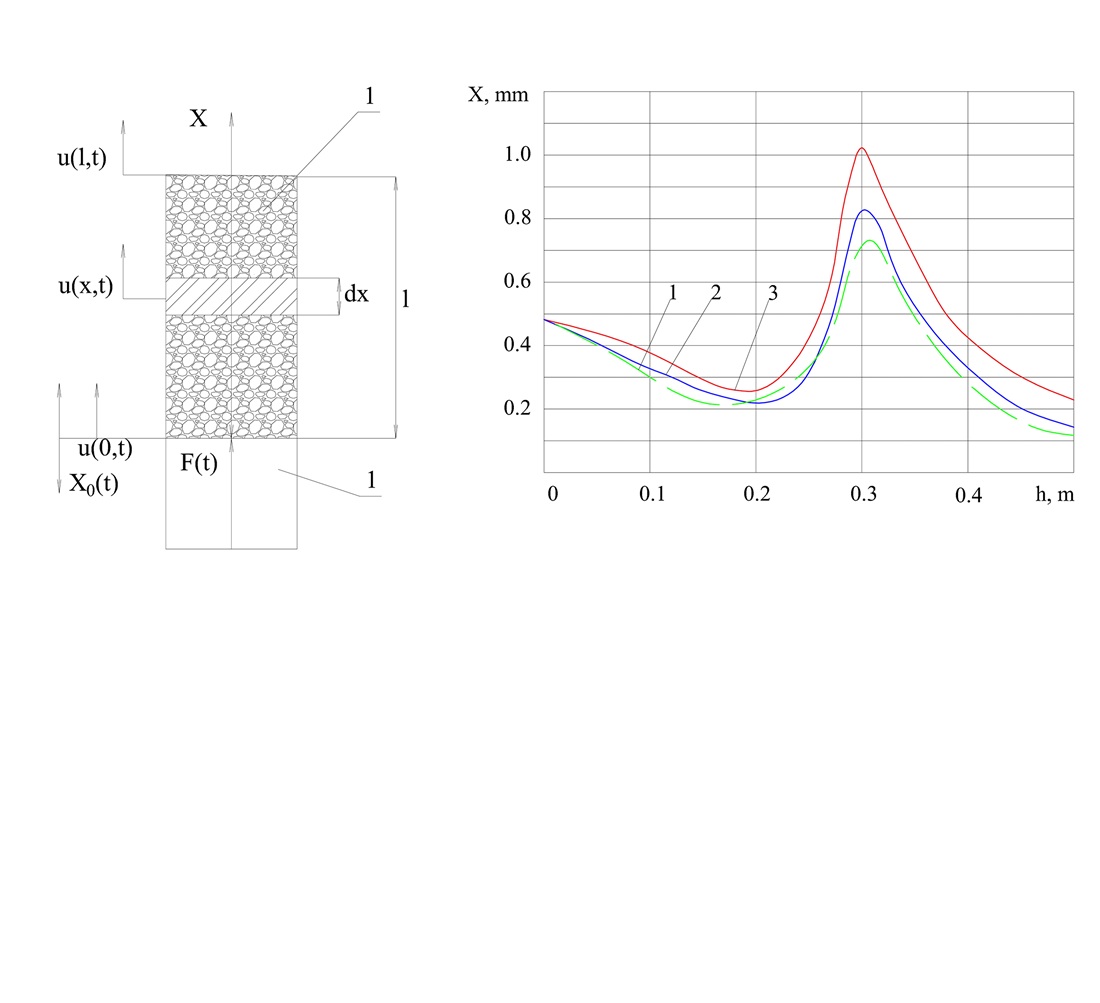
Вібраційна обробка лежить в основі багатьох технологічних процесів різних галузей народного господарства. Об’єктом досліджень є єдиний спільний хвильовий процес руху системи, а предметом – параметри і режими, які забезпечують раціональний рівень енергії. При цьому акцентується увага на використанні енергозберігаючих технологій. В більшості процесів використовуються енерговитратні технології і обладнання, розрахунки яких базуються на застосуванні формул для визначення енергії на дискретних та емпіричних залежностях. Такі підходи не розкривають сутність процесів обробки матеріалів і не можуть точно оцінити енергетичні витрати. В роботі вирішується дана проблема шляхом визначення параметрів і режимів на основі умов реалізації синергії системи «збудник коливань – оброблювальне середовище». В цьому полягає особливість та відмінність отриманих результатів досліджень. Розроблені дискретно-континуальні моделі із врахуванням реологічних властивостей середовищ та аналітичні рішення й експериментальні дослідження дозволили визначити параметри низькочастотних та високочастотних дій на оброблювальні середовища. В роботі використаний метод, за яким сукупність частоти і амплітуди коливань визначає інтенсивність вібраційного впливу на оброблювальне середовище. Визначено опір технологічного середовища на рух робочого органу збудника коливань, який складався із інерційної, пружної та дисипативної частин. Дослідженням визначена якісна та кількісної картини зміни розсіяння енергії в конкретних матеріалах і середовищах за різних законів їх навантаження та обробки. Визначено рівень енергії для обробки технологічних середовищ в режимах низькочастотних та високочастотних дій. Методика досліджень та аналітична залежність визначення енергії може бути використаною для різноманітних середовищ, які перебувають під навантаженням
Посилання
- Sotoudeh, Z. (2019). Entropy and Mixing Entropy for Weakly Nonlinear Mechanical Vibrating Systems. Entropy, 21 (5), 536. https://doi.org/10.3390/e21050536
- Bissembayev, K., Jomartov, A., Tuleshov, A., Dikambay, T. (2019). Analysis of the Oscillating Motion of a Solid Body on Vibrating Bearers. Machines, 7 (3), 58. https://doi.org/10.3390/machines7030058
- Hayashibe, M., Shimoda, S. (2022). Synergetic synchronized oscillation by distributed neural integrators to induce dynamic equilibrium in energy dissipation systems. Scientific Reports, 12 (1). https://doi.org/10.1038/s41598-022-21261-w
- Sun, Y., Vizzaccaro, A., Yuan, J., Salles, L. (2020). An extended energy balance method for resonance prediction in forced response of systems with non-conservative nonlinearities using damped nonlinear normal mode. Nonlinear Dynamics, 103 (4), 3315–3333. https://doi.org/10.1007/s11071-020-05793-2
- Nazarenko, I., Gaidaichuk, V., Dedov, O., Diachenko, O. (2018). Determination of stresses and strains in the shaping structure under spatial load. Eastern-European Journal of Enterprise Technologies, 6 (7 (96)), 13–18. https://doi.org/10.15587/1729-4061.2018.147195
- Son, K. J. (2025). Mathematical Modeling of High-Energy Shaker Mill Process with Lumped Parameter Approach for One-Dimensional Oscillatory Ball Motion with Collisional Heat Generation. Mathematics, 13 (3), 446. https://doi.org/10.3390/math13030446
- Liu, Z., Zhang, L., Zhao, L., Wu, Z., Guo, B. (2022). A Damage Model of Concrete including Hysteretic Effect under Cyclic Loading. Materials, 15 (14), 5062. https://doi.org/10.3390/ma15145062
- Cleante, V. G., Brennan, M. J., Gatti, G., Thompson, D. J. (2017). On the spectrum of rail vibration generated by a passing train. Procedia Engineering, 199, 2657–2662. https://doi.org/10.1016/j.proeng.2017.09.532
- AL-Shudeifat, M. A., Nasar, R. A. (2025). On rapid vibration suppression by nonlinear energy sink during first half cycle of oscillation. Communications in Nonlinear Science and Numerical Simulation, 142, 108534. https://doi.org/10.1016/j.cnsns.2024.108534
- Nazarenko, I., Gavryukov, O., Klyon, A., Ruchynsky, N. (2018). Determination of the optimal parameters of a tubular belt conveyor depending on such an economical. Eastern-European Journal of Enterprise Technologies, 3 (1 (93)), 34–42. https://doi.org/10.15587/1729-4061.2018.131552
- Luhovskyi, O., Bernyk, I., Gryshko, I., Abdulina, D., Zilinskyi, A. (2020). Mobile Equipment for Ultrasonic Cavitation Inactivation of Microorganisms in the Liquid Environment. Advances in Hydraulic and Pneumatic Drives and Control 2020, 272–281. https://doi.org/10.1007/978-3-030-59509-8_24
- Nazarenko, I., Bernyk, I., Dedov, O., Rogovskii, I., Ruchynskyi, M., Pereginets, I., Titova, L. (2021). Research of technical systems of processes of mixing materials. Dynamic Processes in Technological Technical Systems, 57–76. https://doi.org/10.15587/978-617-7319-49-7.ch4
- Bernyk, I., Luhovskyi, O., Wojcik, W., Shedreyeva, I., Karnakova, G. (2019). Theoretical investigations of the interaction of acoustic apparatus with technological environment working process. Przegląd Elektrotechniczny, 1 (4), 32–37. https://doi.org/10.15199/48.2019.04.06
- Kobus, Z., Krzywicka, M., Pecyna, A., Buczaj, A. (2021). Process Efficiency and Energy Consumption during the Ultrasound-Assisted Extraction of Bioactive Substances from Hawthorn Berries. Energies, 14 (22), 7638. https://doi.org/10.3390/en14227638
- Teoh, Y. H., Liew, S. Y., How, H. G., Yaqoob, H., Idroas, M. Y., Jamil, M. A. et al. (2025). Investigating sono-electrolysis for hydrogen generation and energy optimization. International Communications in Heat and Mass Transfer, 164, 108980. https://doi.org/10.1016/j.icheatmasstransfer.2025.108980
- Feng, J., Yan, T., Hou, Z. (2024). Numerical Simulation Study of Factors Influencing Ultrasonic Cavitation Bubble Evolution on Rock Surfaces during Ultrasonic-Assisted Rock Breaking. Water, 16 (16), 2234. https://doi.org/10.3390/w16162234
- Aliev, T., Korolev, I., Burdulenko, O., Alchinova, E., Subbota, A., Yasnov, M., Nosonovsky, M., Skorb, E. V. (2024). Automatic image processing of cavitation bubbles to analyze the properties of petroleum products. Digital Discovery, 3 (6), 1101–1107. https://doi.org/10.1039/d4dd00003j
- Langley, R. S., Hawes, D. H., Butlin, T., Ishii, Y. (2019). Response variance prediction using transient statistical energy analysis. The Journal of the Acoustical Society of America, 145 (2), 1088–1099. https://doi.org/10.1121/1.5090501
- Morton, J. A., Khavari, M., Priyadarshi, A., Kaur, A., Grobert, N., Mi, J. et al. (2023). Dual frequency ultrasonic cavitation in various liquids: High-speed imaging and acoustic pressure measurements. Physics of Fluids, 35 (1). https://doi.org/10.1063/5.0136469
- Zhu, X., Das, R. S., Bhavya, M. L., Garcia-Vaquero, M., Tiwari, B. K. (2024). Acoustic cavitation for agri-food applications: Mechanism of action, design of new systems, challenges and strategies for scale-up. Ultrasonics Sonochemistry, 105, 106850. https://doi.org/10.1016/j.ultsonch.2024.106850
- Nazarenko, I., Bernyk, I. (2021). Research of the processes of acoustic cavitation technology for processing dispersed media. Dynamic Processes in Technological Technical Systems, 94–109. https://doi.org/10.15587/978-617-7319-49-7.ch6
##submission.downloads##
Опубліковано
Як цитувати
Номер
Розділ
Ліцензія
Авторське право (c) 2025 Ivan Nazarenko, Oleg Dedov, Iryna Bernyk, Andrii Zapryvoda, Mykola Ruchynskyi, Andrii Bondarenko

Ця робота ліцензується відповідно до Creative Commons Attribution 4.0 International License.
Закріплення та умови передачі авторських прав (ідентифікація авторства) здійснюється у Ліцензійному договорі. Зокрема, автори залишають за собою право на авторство свого рукопису та передають журналу право першої публікації цієї роботи на умовах ліцензії Creative Commons CC BY. При цьому вони мають право укладати самостійно додаткові угоди, що стосуються неексклюзивного поширення роботи у тому вигляді, в якому вона була опублікована цим журналом, але за умови збереження посилання на першу публікацію статті в цьому журналі.
Ліцензійний договір – це документ, в якому автор гарантує, що володіє усіма авторськими правами на твір (рукопис, статтю, тощо).
Автори, підписуючи Ліцензійний договір з ПП «ТЕХНОЛОГІЧНИЙ ЦЕНТР», мають усі права на подальше використання свого твору за умови посилання на наше видання, в якому твір опублікований. Відповідно до умов Ліцензійного договору, Видавець ПП «ТЕХНОЛОГІЧНИЙ ЦЕНТР» не забирає ваші авторські права та отримує від авторів дозвіл на використання та розповсюдження публікації через світові наукові ресурси (власні електронні ресурси, наукометричні бази даних, репозитарії, бібліотеки тощо).
За відсутності підписаного Ліцензійного договору або за відсутністю вказаних в цьому договорі ідентифікаторів, що дають змогу ідентифікувати особу автора, редакція не має права працювати з рукописом.
Важливо пам’ятати, що існує і інший тип угоди між авторами та видавцями – коли авторські права передаються від авторів до видавця. В такому разі автори втрачають права власності на свій твір та не можуть його використовувати в будь-який спосіб.