Evaluation of sausage products with collagen hydrolysate and cranberry for elderly
DOI:
https://doi.org/10.15587/1729-4061.2025.341942Keywords:
collagen hydrolysate, cranberry, functional sausage, elderly, oxidative stability, protein digestibilityAbstract
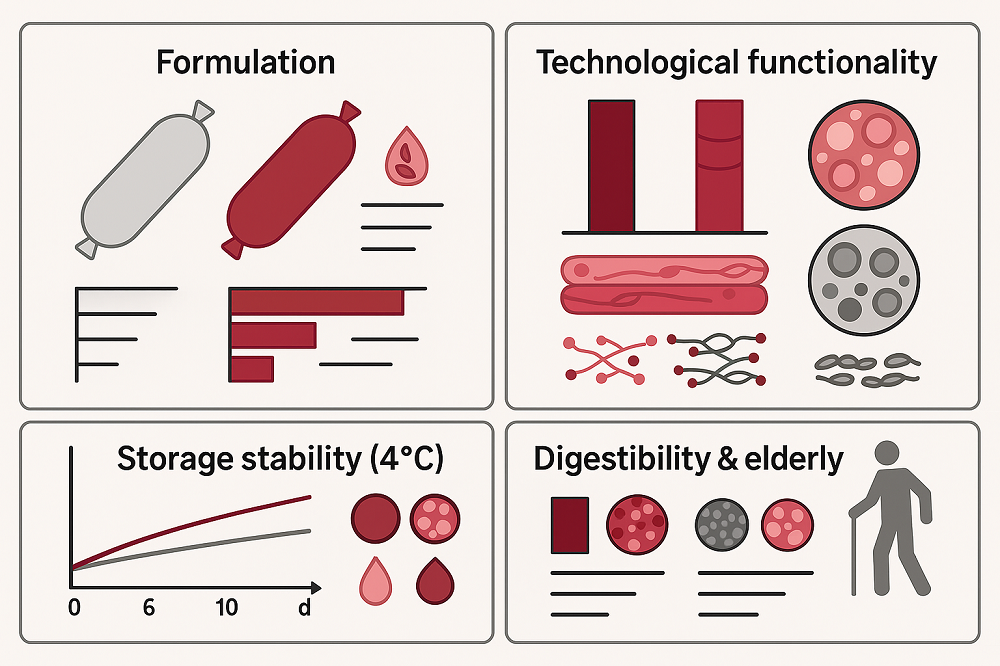
The object of this study was cooked sausages developed specifically for elderly nutrition, addressing the problem of achieving high protein density together with improved technological and oxidative stability. The study evaluated the combined effects of collagen hydrolysate 10 and cranberry powder 2% on composition, functionality, color, oxidative stability, and in-vitro digestibility. Enrichment significantly increased protein content 13.68 vs. 10.91%, moisture 77.2 vs. 72.7%, and reduced fat 6.7 vs. 9.1%. Alkali-soluble proteins rose 10.07 vs. 8.49%, texture strengthened 88.2 vs. 60.4 kPa, and water-holding capacity improved by 19%. The fatty acid profile shifted toward slightly higher SFA C16:0, C18:0 and lower MUFA C18:1, with a minor rise in ALA n-3, while trans isomers remained < 0.1%. After 10 days of storage, peroxide values were lower 8.1 vs. 9.8 meq/kg, indicating delayed lipid oxidation. Color stability reached 94%, with improved redness retention in enriched samples. In-vitro digestibility increased, with peptide release + 21.2% (pepsin) and + 10.3% (trypsin). These effects can be explained by the synergistic role of collagen peptides in enhancing protein functionality and the antioxidant properties of cranberry polyphenols in suppressing lipid peroxidation. The distinctive feature of this approach is the dual action of natural additives, providing a cleaner-label product with improved nutritional density and stability. Practical relevance lies in applying collagen hydrolysate and cranberry in functional meat technologies aimed at elderly-oriented diets, offering a feasible strategy for the meat industry to support healthy ageing and reduce risks related to poor protein intake and oxidative stress
References
- Prates, J. A. M. (2025). The Role of Meat Lipids in Nutrition and Health: Balancing Benefits and Risks. Nutrients, 17 (2), 350. https://doi.org/10.3390/nu17020350
- Geiker, N. R. W., Bertram, H. C., Mejborn, H., Dragsted, L. O., Kristensen, L., Carrascal, J. R., Bügel, S., Astrup, A. (2021). Meat and Human Health – Current Knowledge and Research Gaps. Foods, 10 (7), 1556. https://doi.org/10.3390/foods10071556
- Hill, E. R., Wang, Y., Davis, E. M., Campbell, W. W. (2024). Healthy Dietary Patterns with and without Meat Improved Cardiometabolic Disease Risk Factors in Adults: A Randomized Crossover Controlled Feeding Trial. Nutrients, 16 (15), 2542. https://doi.org/10.3390/nu16152542
- Pu, S.-Y., Huang, Y.-L., Pu, C.-M., Kang, Y.-N., Hoang, K. D., Chen, K.-H., Chen, C. (2023). Effects of Oral Collagen for Skin Anti-Aging: A Systematic Review and Meta-Analysis. Nutrients, 15 (9), 2080. https://doi.org/10.3390/nu15092080
- Demir-Dora, D., Ozsoy, U., Yildirim, Y., Yilmaz, O., Aytac, P., Yilmaz, B. et al. (2024). The Efficacy and Safety of CollaSel Pro® Hydrolyzed Collagen Peptide Supplementation without Addons in Improving Skin Health in Adult Females: A Double Blind, Randomized, Placebo-Controlled Clinical Study Using Biophysical and Skin Imaging Techniques. Journal of Clinical Medicine, 13 (18), 5370. https://doi.org/10.3390/jcm13185370
- Nemzer, B. V., Al-Taher, F., Yashin, A., Revelsky, I., Yashin, Y. (2022). Cranberry: Chemical Composition, Antioxidant Activity and Impact on Human Health: Overview. Molecules, 27 (5), 1503. https://doi.org/10.3390/molecules27051503
- Balawejder, M., Piechowiak, T., Kapusta, I., Chęciek, A., Matłok, N. (2023). In Vitro Analysis of Selected Antioxidant and Biological Properties of the Extract from Large-Fruited Cranberry Fruits. Molecules, 28 (23), 7895. https://doi.org/10.3390/molecules28237895
- Manessis, G., Kalogianni, A. I., Lazou, T., Moschovas, M., Bossis, I., Gelasakis, A. I. (2020). Plant-Derived Natural Antioxidants in Meat and Meat Products. Antioxidants, 9 (12), 1215. https://doi.org/10.3390/antiox9121215
- Orădan, A. C., Tocai (Moțoc), A. C., Rosan, C. A., Vicas, S. I. (2024). Fruit Extracts Incorporated into Meat Products as Natural Antioxidants, Preservatives, and Colorants. Processes, 12 (12), 2756. https://doi.org/10.3390/pr12122756
- Volkert, D., Beck, A. M., Cederholm, T., Cruz-Jentoft, A., Hooper, L., Kiesswetter, E., Maggio, M. et al. (2022). ESPEN practical guideline: Clinical nutrition and hydration in geriatrics. Clinical Nutrition, 41 (4), 958–989. https://doi.org/10.1016/j.clnu.2022.01.024
- Smith, G. I., Julliand, S., Reeds, D. N., Sinacore, D. R., Klein, S., Mittendorfer, B. (2015). Fish oil–derived n−3 PUFA therapy increases muscle mass and function in healthy older adults. The American Journal of Clinical Nutrition, 102 (1), 115–122. https://doi.org/10.3945/ajcn.114.105833
- Choi, F. D., Sung, C. T., Juhasz, M. L., Mesinkovsk, N. A. (2019). Oral Collagen Supplementation: A Systematic Review of Dermatological Applications. Journal of Drugs in Dermatology, 18 (1), 9–16.
- Asserin, J., Lati, E., Shioya, T., Prawitt, J. (2015). The effect of oral collagen peptide supplementation on skin moisture and the dermal collagen network: evidence from an ex vivo model and randomized, placebo‐controlled clinical trials. Journal of Cosmetic Dermatology, 14 (4), 291–301. https://doi.org/10.1111/jocd.12174
- Neto, C. C. (2007). Cranberry and blueberry: Evidence for protective effects against cancer and vascular diseases. Molecular Nutrition & Food Research, 51 (6), 652–664. https://doi.org/10.1002/mnfr.200600279
- Blumberg, J. B., Camesano, T. A., Cassidy, A., Kris-Etherton, P., Howell, A., Manach, C. et al. (2013). Cranberries and Their Bioactive Constituents in Human Health. Advances in Nutrition, 4 (6), 618–632. https://doi.org/10.3945/an.113.004473
- Shah, M. A., Bosco, S. J. D., Mir, S. A. (2014). Plant extracts as natural antioxidants in meat and meat products. Meat Science, 98 (1), 21–33. https://doi.org/10.1016/j.meatsci.2014.03.020
- Rop, O., Mlcek, J., Jurikova, T., Neugebauerova, J., Vabkova, J. (2012). Edible Flowers – A New Promising Source of Mineral Elements in Human Nutrition. Molecules, 17 (6), 6672–6683. https://doi.org/10.3390/molecules17066672
- Desmond, E. (2006). Reducing salt: A challenge for the meat industry. Meat Science, 74 (1), 188–196. https://doi.org/10.1016/j.meatsci.2006.04.014
- Lee, C. H., Chin, K. B. (2016). Effects of pork gelatin levels on the physicochemical and textural properties of model sausages at different fat levels. LWT, 74, 325–330. https://doi.org/10.1016/j.lwt.2016.07.032
- Jridi, M., Abdelhedi, O., Souissi, N., Kammoun, M., Nasri, M., Ayadi, M. A. (2015). Improvement of the physicochemical, textural and sensory properties of meat sausage by edible cuttlefish gelatin addition. Food Bioscience, 12, 67–72. https://doi.org/10.1016/j.fbio.2015.07.007
- Zhang, K., Huang, J., Wang, D., Wan, X., Wang, Y. (2024). Covalent polyphenols-proteins interactions in food processing: formation mechanisms, quantification methods, bioactive effects, and applications. Frontiers in Nutrition, 11. https://doi.org/10.3389/fnut.2024.1371401
- Bauer, J., Biolo, G., Cederholm, T., Cesari, M., Cruz-Jentoft, A. J., Morley, J. E. et al. (2013). Evidence-Based Recommendations for Optimal Dietary Protein Intake in Older People: A Position Paper From the PROT-AGE Study Group. Journal of the American Medical Directors Association, 14 (8), 542–559. https://doi.org/10.1016/j.jamda.2013.05.021
- Falowo, A. B., Fayemi, P. O., Muchenje, V. (2014). Natural antioxidants against lipid–protein oxidative deterioration in meat and meat products: A review. Food Research International, 64, 171–181. https://doi.org/10.1016/j.foodres.2014.06.022
- Lau, A. T. Y., Arvaj, L., Strange, P., Goodwin, M., Barbut, S., Balamurugan, S. (2021). Effect of cranberry pomace on the physicochemical properties and inactivation of Salmonella during the manufacture of dry fermented sausages. Current Research in Food Science, 4, 636–645. https://doi.org/10.1016/j.crfs.2021.09.001
- Estévez, M. (2021). Critical overview of the use of plant antioxidants in the meat industry: Opportunities, innovative applications and future perspectives. Meat Science, 181, 108610. https://doi.org/10.1016/j.meatsci.2021.108610
- Ham, Y.-K., Song, D.-H., Noh, S.-W., Gu, T.-W., Lee, J.-H., Kim, T.-K. et al. (2020). Effects of Gelatin Hydrolysates Addition on Technological Properties and Lipid Oxidation of Cooked Sausage. Food Science of Animal Resources, 40 (6), 1033–1043. https://doi.org/10.5851/kosfa.2020.e74
- Xue, H., Zhao, J., Wang, Y., Shi, Z., Xie, K., Liao, X., Tan, J. (2024). Factors affecting the stability of anthocyanins and strategies for improving their stability: A review. Food Chemistry: X, 24, 101883. https://doi.org/10.1016/j.fochx.2024.101883
- Iwai, K., Hasegawa, T., Taguchi, Y., Morimatsu, F., Sato, K., Nakamura, Y. et al. (2005). Identification of Food-Derived Collagen Peptides in Human Blood after Oral Ingestion of Gelatin Hydrolysates. Journal of Agricultural and Food Chemistry, 53 (16), 6531–6536. https://doi.org/10.1021/jf050206p
- Roobab, U., Khan, A. W., Lorenzo, J. M., Arshad, R. N., Chen, B.-R., Zeng, X.-A. et al. (2021). A systematic review of clean-label alternatives to synthetic additives in raw and processed meat with a special emphasis on high-pressure processing (2018–2021). Food Research International, 150, 110792. https://doi.org/10.1016/j.foodres.2021.110792
Downloads
Published
How to Cite
Issue
Section
License
Copyright (c) 2025 Yasin Uzakov, Kadyrzhan Makangali, Madina Kaldarbekova, Aziza Aitbayeva

This work is licensed under a Creative Commons Attribution 4.0 International License.
The consolidation and conditions for the transfer of copyright (identification of authorship) is carried out in the License Agreement. In particular, the authors reserve the right to the authorship of their manuscript and transfer the first publication of this work to the journal under the terms of the Creative Commons CC BY license. At the same time, they have the right to conclude on their own additional agreements concerning the non-exclusive distribution of the work in the form in which it was published by this journal, but provided that the link to the first publication of the article in this journal is preserved.
A license agreement is a document in which the author warrants that he/she owns all copyright for the work (manuscript, article, etc.).
The authors, signing the License Agreement with TECHNOLOGY CENTER PC, have all rights to the further use of their work, provided that they link to our edition in which the work was published.
According to the terms of the License Agreement, the Publisher TECHNOLOGY CENTER PC does not take away your copyrights and receives permission from the authors to use and dissemination of the publication through the world's scientific resources (own electronic resources, scientometric databases, repositories, libraries, etc.).
In the absence of a signed License Agreement or in the absence of this agreement of identifiers allowing to identify the identity of the author, the editors have no right to work with the manuscript.
It is important to remember that there is another type of agreement between authors and publishers – when copyright is transferred from the authors to the publisher. In this case, the authors lose ownership of their work and may not use it in any way.








