Інтеграція моделі та смартфон технологій для оцінювання терморегуляції у холодній воді
DOI:
https://doi.org/10.15587/1729-4061.2025.344042Ключові слова:
модель, фізична активність у воді, холодовий стрес, екстремальні умови середовища, ризики здоров’яАнотація
Об’єктом дослідження є теплові та фізіологічні реакції людини під час занурення у воду. Ключова проблема полягає в наявному розриві між складними математичними моделями терморегуляції, які вимагають експертних знань, та практичною потребою в доступній оцінці теплових ризиків під час перебування у відкритій воді. Для подолання цього розриву в роботі запропоновано метод, який базується на інтеграції математичної моделі з мобільним застосунком, а результати дослідження підтверджують його ефективність для прогнозування фізіологічних реакцій людини під час перебуванні у воді. Валідація моделі показала високу точність у прогнозуванні динаміки внутрішньої температури людини у холодній воді (показник Тейла ≈ 0; t(9) = 2.16, p > 0.05).
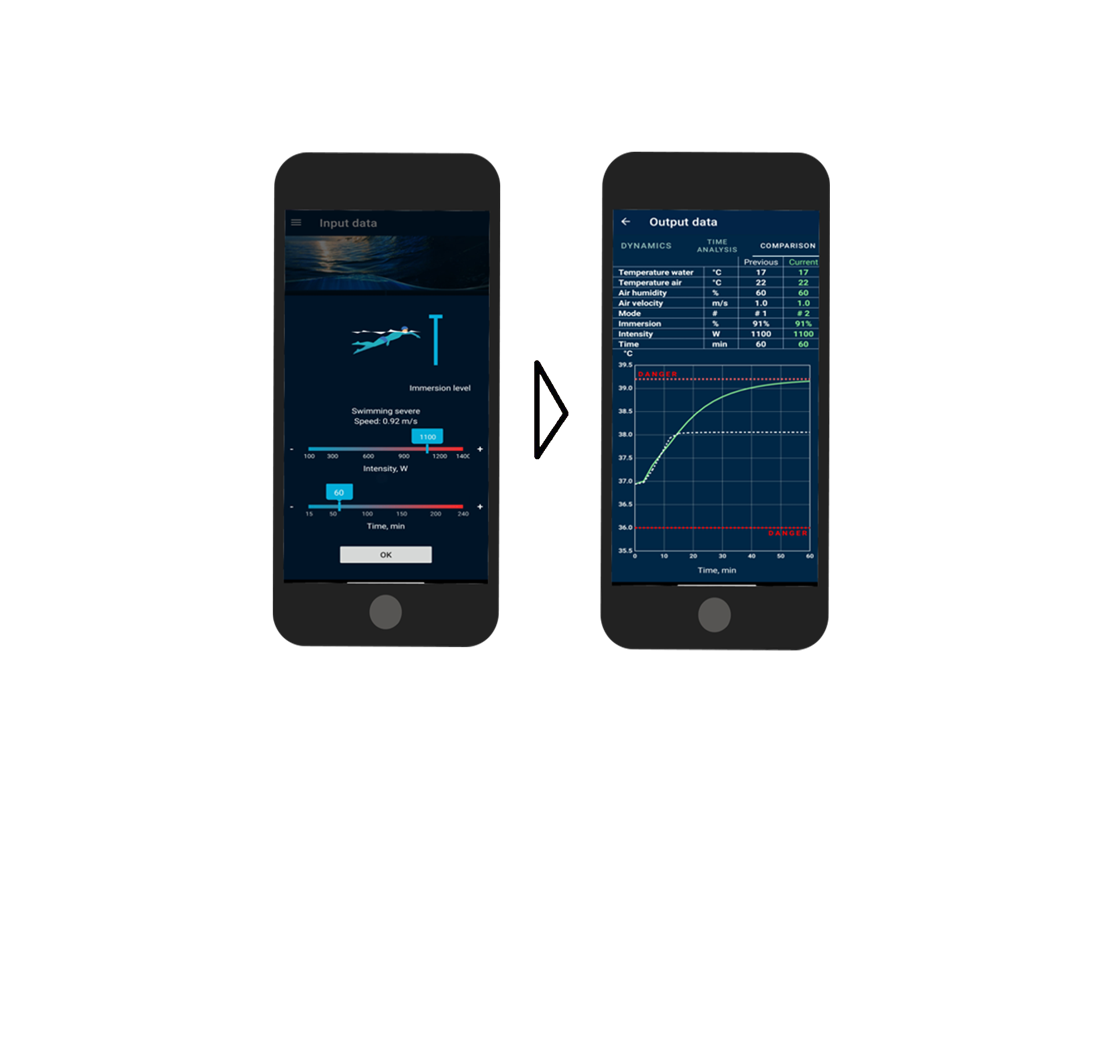
Моделювання показало, що помірна активність (300 Вт) у воді 10°C призводить до зниження внутрішньої температури, а вищий рівень активності (600 Вт) є достатнім для підтримання температури тіла. Гідрокостюм суттєво впливає на температурний режим людини. Перебування людини у спокої у воді 17°C без гідрокостюму спричиняє гіпотермію (Tcore < 36°C), а в ньому температура підтримується нормальною. За умов інтенсивного плавання (1100 Вт) гідрокостюм підвищує температуру людини до 39.2°C, тоді як за його відсутності Tcore = 38.1°C.
Отримані результати забезпечують кількісне розуміння впливу температури води, рівня занурення, фізичної активності та використання гідрокостюма на теплові реакції людини. Розроблений застосунок може прогнозувати безпечні умови для занять водними видами спорту та рекреаційної діяльності
Посилання
- Knechtle, B., Waśkiewicz, Z., Sousa, C. V., Hill, L., Nikolaidis, P. T. (2020). Cold Water Swimming – Benefits and Risks: A Narrative Review. International Journal of Environmental Research and Public Health, 17 (23), 8984. https://doi.org/10.3390/ijerph17238984
- Tipton, M. J., Collier, N., Massey, H., Corbett, J., Harper, M. (2017). Cold water immersion: kill or cure? Experimental Physiology, 102 (11), 1335–1355. https://doi.org/10.1113/ep086283
- Macaluso, F., Barone, R., Isaacs, A. W., Farina, F., Morici, G., Di Felice, V. (2013). Heat Stroke Risk for Open-Water Swimmers During Long-Distance Events. Wilderness & Environmental Medicine, 24 (4), 362–365. https://doi.org/10.1016/j.wem.2013.04.008
- Tipton, M., Bradford, C. (2014). Moving in extreme environments: open water swimming in cold and warm water. Extreme Physiology & Medicine, 3 (1). https://doi.org/10.1186/2046-7648-3-12
- Drigny, J., Rolland, M., Pla, R., Chesneau, C., Lebreton, T., Marais, B. et al. (2021). Risk Factors and Predictors of Hypothermia and Dropouts During Open-Water Swimming Competitions. International Journal of Sports Physiology and Performance, 16 (11), 1692–1699. https://doi.org/10.1123/ijspp.2020-0875
- Høiseth, L. Ø., Melau, J., Bonnevie-Svendsen, M., Nyborg, C., Eijsvogels, T. M. H., Hisdal, J. (2021). Core Temperature during Cold-Water Triathlon Swimming. Sports, 9 (6), 87. https://doi.org/10.3390/sports9060087
- Brannigan, D., Rogers, I. R., Jacobs, I., Montgomery, A., Williams, A., Khangure, N. (2009). Hypothermia Is a Significant Medical Risk of Mass Participation Long-Distance Open Water Swimming. Wilderness & Environmental Medicine, 20 (1), 14–18. https://doi.org/10.1580/08-weme-or-214.1
- Markey, K., Galan-Lopez, N., Esh, C., Carter, S., Chrismas, B., Mountjoy, M. et al. (2025). Thermoregulatory responses in open water and pool swimming: Presentation of hypothermia and hyperthermia within and outside of World Aquatics water temperature thresholds. Journal of Science and Medicine in Sport. https://doi.org/10.1016/j.jsams.2025.07.004
- Chalmers, S., Shaw, G., Mujika, I., Jay, O. (2021). Thermal Strain During Open-Water Swimming Competition in Warm Water Environments. Frontiers in Physiology, 12. https://doi.org/10.3389/fphys.2021.785399
- Dolson, C. M., Harlow, E. R., Phelan, D. M., Gabbett, T. J., Gaal, B., McMellen, C. et al. (2022). Wearable Sensor Technology to Predict Core Body Temperature: A Systematic Review. Sensors, 22 (19), 7639. https://doi.org/10.3390/s22197639
- Jegan, R., Nimi, W. S. (2023). On the development of low power wearable devices for assessment of physiological vital parameters: a systematic review. Journal of Public Health, 32 (7), 1093–1108. https://doi.org/10.1007/s10389-023-01893-6
- Vaghasiya, J. V., Mayorga-Martinez, C. C., Pumera, M. (2023). Wearable sensors for telehealth based on emerging materials and nanoarchitectonics. Npj Flexible Electronics, 7 (1). https://doi.org/10.1038/s41528-023-00261-4
- Beachsafe Website & App. Available at: https://www.surflifesaving.com.au/beach-safety/beachsafe-website
- Jalalifar, S., Kashizadeh, A., Mahmood, I., Belford, A., Drake, N., Razmjou, A., Asadnia, M. (2022). A Smart Multi-Sensor Device to Detect Distress in Swimmers. Sensors, 22 (3), 1059. https://doi.org/10.3390/s22031059
- Rush – Assisting lifeguards in locating and rescuing drowning victims to enhances swimming safety. Available at: https://designawards.core77.com/Sports-Outdoors/131064/Rush-Assisting-lifeguards-in-locating-and-rescuing-drowning-victims-to-enhances-swimming-safety.html
- Introducing GUARDian – The Most Advanced Drowning Detection System Ever Made. Available at: https://wavedds.com/guardian-system
- Drowning Prevention Technology. Available at: https://www.blueguardme.com/drowning-prevention-technology
- Castellani, M. P., Rioux, T. P., Castellani, J. W., Reed, M. D., Whalen, S., Cisternelli, M. et al. (2023). Validation of a human thermoregulatory model during prolonged immersion in warm water. Computers in Biology and Medicine, 167, 107575. https://doi.org/10.1016/j.compbiomed.2023.107575
- Keefe, A. A., Tikuisis, P. (2008). A guide to making stochastic and single point predictions using the Cold Exposure Survival Model (CESM). Defence R&D Canada. Available at: https://apps.dtic.mil/sti/pdfs/ADA489046.pdf
- Tipton, M., McCormack, E., Elliott, G., Cisternelli, M., Allen, A., Turner, A. C. (2022). Survival time and search time in water: Past, present and future. Journal of Thermal Biology, 110, 103349. https://doi.org/10.1016/j.jtherbio.2022.103349
- Potter, A. W., Yermakova, I. I., Hunt, A. P., Hancock, J. W., Oliveira, A. V. M., Looney, D. P., Montgomery, L. D. (2021). Comparison of two mathematical models for predicted human thermal responses to hot and humid environments. Journal of Thermal Biology, 97, 102902. https://doi.org/10.1016/j.jtherbio.2021.102902
- Yermakova, I., Montgomery, L. D. (2018). Predictive Simulation of Physiological Responses for Swimmers in Cold Water. 2018 IEEE 38th International Conference on Electronics and Nanotechnology (ELNANO), 292–297. https://doi.org/10.1109/elnano.2018.8477523
- Yermakova, I., Montgomery, L. D., Nikolaienko, A., Bondarenko, Y., Ivanushkina, N. (2021). Modeling Prediction of Human Thermal Responses in Warm Water. Medical Informatics and Engineering, 1, 51–60. Available at: https://ojs.tdmu.edu.ua/index.php/here/article/view/12190/11551
- Yermakova, I., Montgomery, L., Potter, A. W. (2022). Mathematical model of human responses to open air and water immersion: Modeling human thermoregulatory responses. Journal of Sport and Human Performance, 10 (1), 30–45. Available at: https://jhp-ojs-tamucc.tdl.org/JHP/article/view/187
- Yermakova, I. I., Potter, A. W., Chapman, C. L., Friedl, K. E. (2025). Modeling physiological and thermoregulatory responses during an Olympic triathlon. Journal of Thermal Biology, 131, 104203. v
- Hansen, J. F. (2015). Nusselt, Rayleigh, Grashof, and Prandtl: Direct calculation of a user-defined convective heat flux. In Excerpt from the Proceedings of the 2015 COMSOL Conference in Grenoble, 1–5. Available at: https://www.comsol.com/paper/download/291661/hansen_paper.pdf
- Nadel, E. R., Holmér, I., Bergh, U., Astrand, P. O., Stolwijk, J. A. (1974). Energy exchanges of swimming man. Journal of Applied Physiology, 36 (4), 465–471. https://doi.org/10.1152/jappl.1974.36.4.465
- Boutelier, C., Bougues, L., Timbal, J. (1977). Experimental study of convective heat transfer coefficient for the human body in water. Journal of Applied Physiology, 42 (1), 93–100. https://doi.org/10.1152/jappl.1977.42.1.93
- Henderson, M. E. T., Halsey, L. G. (2022). The metabolic upper critical temperature of the human thermoneutral zone. Journal of Thermal Biology, 110, 103380. https://doi.org/10.1016/j.jtherbio.2022.103380
- Rostomily, K. A., Jones, D. M., Pautz, C. M., Ito, D. W., Buono, M. J. (2020). Haemoconcentration, not decreased blood temperature, increases blood viscosity during cold water immersion. Diving and Hyperbaric Medicine Journal, 50 (1), 24–27. https://doi.org/10.28920/dhm50.1.24-27
- Yermakova, I., Ntoumani, M., Potter, A. W. (2024). Modeling thermophysiological responses during head-in and head-out whole-body water immersion. Journal of Sport and Human Performance, 12 (1), 32–43. Available at: https://jhp-ojs-tamucc.tdl.org/JHP/article/view/196
- Yermakova, I. I., Potter, A. W., Raimundo, A. M., Xu, X., Hancock, J. W., Oliveira, A. V. M. (2022). Use of Thermoregulatory Models to Evaluate Heat Stress in Industrial Environments. International Journal of Environmental Research and Public Health, 19 (13), 7950. https://doi.org/10.3390/ijerph19137950
- Yermakova, I., Nikolaienko, A., Solopchuk, Y., Regan, M. (2015). Modelling of human cooling in cold water: effect of immersion level. Extreme Physiology & Medicine, 4 (S1). https://doi.org/10.1186/2046-7648-4-s1-a132
- Crotti, G., Cantù, R., Malavasi, S., Gatti, G., Laurano, C., Svelto, C. (2024). Wetsuit Thermal Resistivity Measurements. Sensors, 24 (14), 4561. https://doi.org/10.3390/s24144561
- Competition Regulations. World Aquatics. Available at: https://www.worldaquatics.com/swimming/rules
##submission.downloads##
Опубліковано
Як цитувати
Номер
Розділ
Ліцензія
Авторське право (c) 2025 Irena Yermakova, Oleksandr Volkov, Anastasiia Nikolaienko, Oleh Hrytsaiuk, Julia Tadeieva

Ця робота ліцензується відповідно до Creative Commons Attribution 4.0 International License.
Закріплення та умови передачі авторських прав (ідентифікація авторства) здійснюється у Ліцензійному договорі. Зокрема, автори залишають за собою право на авторство свого рукопису та передають журналу право першої публікації цієї роботи на умовах ліцензії Creative Commons CC BY. При цьому вони мають право укладати самостійно додаткові угоди, що стосуються неексклюзивного поширення роботи у тому вигляді, в якому вона була опублікована цим журналом, але за умови збереження посилання на першу публікацію статті в цьому журналі.
Ліцензійний договір – це документ, в якому автор гарантує, що володіє усіма авторськими правами на твір (рукопис, статтю, тощо).
Автори, підписуючи Ліцензійний договір з ПП «ТЕХНОЛОГІЧНИЙ ЦЕНТР», мають усі права на подальше використання свого твору за умови посилання на наше видання, в якому твір опублікований. Відповідно до умов Ліцензійного договору, Видавець ПП «ТЕХНОЛОГІЧНИЙ ЦЕНТР» не забирає ваші авторські права та отримує від авторів дозвіл на використання та розповсюдження публікації через світові наукові ресурси (власні електронні ресурси, наукометричні бази даних, репозитарії, бібліотеки тощо).
За відсутності підписаного Ліцензійного договору або за відсутністю вказаних в цьому договорі ідентифікаторів, що дають змогу ідентифікувати особу автора, редакція не має права працювати з рукописом.
Важливо пам’ятати, що існує і інший тип угоди між авторами та видавцями – коли авторські права передаються від авторів до видавця. В такому разі автори втрачають права власності на свій твір та не можуть його використовувати в будь-який спосіб.