Integrating model and smartphone technologies for cold-water thermoregulation assessment
DOI:
https://doi.org/10.15587/1729-4061.2025.344042Keywords:
model, physical activity in water, cold stress, extreme environment, health riskAbstract
This study investigates human thermal and physiological responses during water immersion. The task addressed relates to the current gap between sophisticated, expert-driven mathematical models of thermoregulation and the practical demand for accessible tools to assess thermal risks in open water.
To bridge the gap, this paper proposes a method based on the integration of a multicompartmental mathematical model of human thermoregulation with a mobile application. The results of the study confirm the method's effectiveness in predicting human physiological responses during water immersion. Model validation against experimental data demonstrated strong concordance, particularly in reproducing core temperature dynamics under cold-water exposure (Theil index ≈ 0; t(9) = 2.16, p > 0.05).
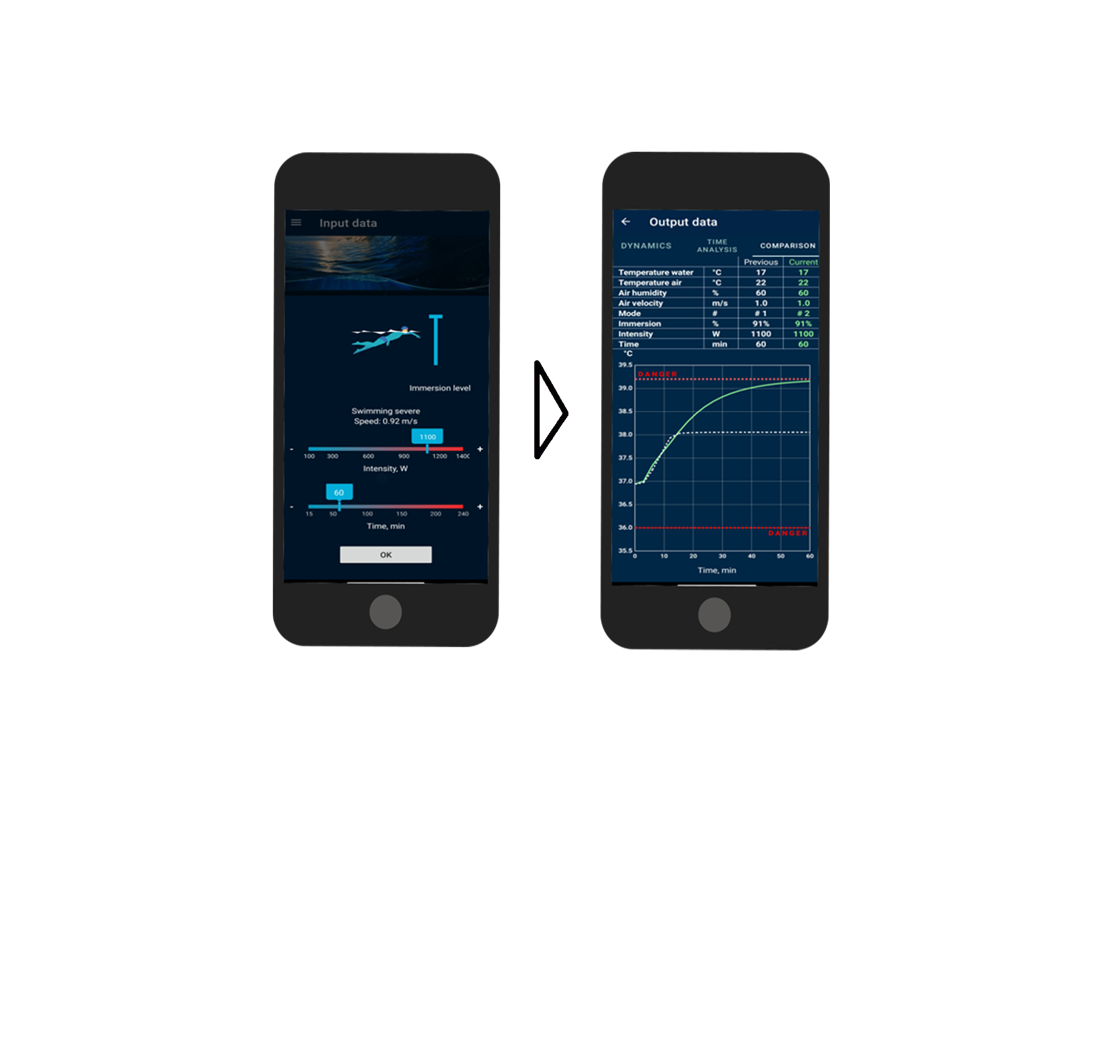
Modeling results indicate that moderate activity (300 W) in water at a temperature of 10°C leads to a decrease in internal temperature, whereas higher activity levels (600 W) are sufficient to maintain normal body temperature. Wetsuits play a critical role in preserving human temperature regime during cold-water immersion; without a wetsuit, passive immersion at 17°C results in hypothermia within 60 minutes (Tcore < 36°C). Conversely, during high-intensity exercise (1100 W), wetsuits may increase thermal strain, with body temperature rising to 39.2°C over 60 minutes, while in the absence of protective clothing – Tcore = 38.1°C.
The findings provide quantitative insights into the influence of water, immersion level, activity, and wetsuit on human thermal responses. The app that was developed could predict safety guidelines for aquatic sports and recreational activities.
References
- Knechtle, B., Waśkiewicz, Z., Sousa, C. V., Hill, L., Nikolaidis, P. T. (2020). Cold Water Swimming – Benefits and Risks: A Narrative Review. International Journal of Environmental Research and Public Health, 17 (23), 8984. https://doi.org/10.3390/ijerph17238984
- Tipton, M. J., Collier, N., Massey, H., Corbett, J., Harper, M. (2017). Cold water immersion: kill or cure? Experimental Physiology, 102 (11), 1335–1355. https://doi.org/10.1113/ep086283
- Macaluso, F., Barone, R., Isaacs, A. W., Farina, F., Morici, G., Di Felice, V. (2013). Heat Stroke Risk for Open-Water Swimmers During Long-Distance Events. Wilderness & Environmental Medicine, 24 (4), 362–365. https://doi.org/10.1016/j.wem.2013.04.008
- Tipton, M., Bradford, C. (2014). Moving in extreme environments: open water swimming in cold and warm water. Extreme Physiology & Medicine, 3 (1). https://doi.org/10.1186/2046-7648-3-12
- Drigny, J., Rolland, M., Pla, R., Chesneau, C., Lebreton, T., Marais, B. et al. (2021). Risk Factors and Predictors of Hypothermia and Dropouts During Open-Water Swimming Competitions. International Journal of Sports Physiology and Performance, 16 (11), 1692–1699. https://doi.org/10.1123/ijspp.2020-0875
- Høiseth, L. Ø., Melau, J., Bonnevie-Svendsen, M., Nyborg, C., Eijsvogels, T. M. H., Hisdal, J. (2021). Core Temperature during Cold-Water Triathlon Swimming. Sports, 9 (6), 87. https://doi.org/10.3390/sports9060087
- Brannigan, D., Rogers, I. R., Jacobs, I., Montgomery, A., Williams, A., Khangure, N. (2009). Hypothermia Is a Significant Medical Risk of Mass Participation Long-Distance Open Water Swimming. Wilderness & Environmental Medicine, 20 (1), 14–18. https://doi.org/10.1580/08-weme-or-214.1
- Markey, K., Galan-Lopez, N., Esh, C., Carter, S., Chrismas, B., Mountjoy, M. et al. (2025). Thermoregulatory responses in open water and pool swimming: Presentation of hypothermia and hyperthermia within and outside of World Aquatics water temperature thresholds. Journal of Science and Medicine in Sport. https://doi.org/10.1016/j.jsams.2025.07.004
- Chalmers, S., Shaw, G., Mujika, I., Jay, O. (2021). Thermal Strain During Open-Water Swimming Competition in Warm Water Environments. Frontiers in Physiology, 12. https://doi.org/10.3389/fphys.2021.785399
- Dolson, C. M., Harlow, E. R., Phelan, D. M., Gabbett, T. J., Gaal, B., McMellen, C. et al. (2022). Wearable Sensor Technology to Predict Core Body Temperature: A Systematic Review. Sensors, 22 (19), 7639. https://doi.org/10.3390/s22197639
- Jegan, R., Nimi, W. S. (2023). On the development of low power wearable devices for assessment of physiological vital parameters: a systematic review. Journal of Public Health, 32 (7), 1093–1108. https://doi.org/10.1007/s10389-023-01893-6
- Vaghasiya, J. V., Mayorga-Martinez, C. C., Pumera, M. (2023). Wearable sensors for telehealth based on emerging materials and nanoarchitectonics. Npj Flexible Electronics, 7 (1). https://doi.org/10.1038/s41528-023-00261-4
- Beachsafe Website & App. Available at: https://www.surflifesaving.com.au/beach-safety/beachsafe-website
- Jalalifar, S., Kashizadeh, A., Mahmood, I., Belford, A., Drake, N., Razmjou, A., Asadnia, M. (2022). A Smart Multi-Sensor Device to Detect Distress in Swimmers. Sensors, 22 (3), 1059. https://doi.org/10.3390/s22031059
- Rush – Assisting lifeguards in locating and rescuing drowning victims to enhances swimming safety. Available at: https://designawards.core77.com/Sports-Outdoors/131064/Rush-Assisting-lifeguards-in-locating-and-rescuing-drowning-victims-to-enhances-swimming-safety.html
- Introducing GUARDian – The Most Advanced Drowning Detection System Ever Made. Available at: https://wavedds.com/guardian-system
- Drowning Prevention Technology. Available at: https://www.blueguardme.com/drowning-prevention-technology
- Castellani, M. P., Rioux, T. P., Castellani, J. W., Reed, M. D., Whalen, S., Cisternelli, M. et al. (2023). Validation of a human thermoregulatory model during prolonged immersion in warm water. Computers in Biology and Medicine, 167, 107575. https://doi.org/10.1016/j.compbiomed.2023.107575
- Keefe, A. A., Tikuisis, P. (2008). A guide to making stochastic and single point predictions using the Cold Exposure Survival Model (CESM). Defence R&D Canada. Available at: https://apps.dtic.mil/sti/pdfs/ADA489046.pdf
- Tipton, M., McCormack, E., Elliott, G., Cisternelli, M., Allen, A., Turner, A. C. (2022). Survival time and search time in water: Past, present and future. Journal of Thermal Biology, 110, 103349. https://doi.org/10.1016/j.jtherbio.2022.103349
- Potter, A. W., Yermakova, I. I., Hunt, A. P., Hancock, J. W., Oliveira, A. V. M., Looney, D. P., Montgomery, L. D. (2021). Comparison of two mathematical models for predicted human thermal responses to hot and humid environments. Journal of Thermal Biology, 97, 102902. https://doi.org/10.1016/j.jtherbio.2021.102902
- Yermakova, I., Montgomery, L. D. (2018). Predictive Simulation of Physiological Responses for Swimmers in Cold Water. 2018 IEEE 38th International Conference on Electronics and Nanotechnology (ELNANO), 292–297. https://doi.org/10.1109/elnano.2018.8477523
- Yermakova, I., Montgomery, L. D., Nikolaienko, A., Bondarenko, Y., Ivanushkina, N. (2021). Modeling Prediction of Human Thermal Responses in Warm Water. Medical Informatics and Engineering, 1, 51–60. Available at: https://ojs.tdmu.edu.ua/index.php/here/article/view/12190/11551
- Yermakova, I., Montgomery, L., Potter, A. W. (2022). Mathematical model of human responses to open air and water immersion: Modeling human thermoregulatory responses. Journal of Sport and Human Performance, 10 (1), 30–45. Available at: https://jhp-ojs-tamucc.tdl.org/JHP/article/view/187
- Yermakova, I. I., Potter, A. W., Chapman, C. L., Friedl, K. E. (2025). Modeling physiological and thermoregulatory responses during an Olympic triathlon. Journal of Thermal Biology, 131, 104203. v
- Hansen, J. F. (2015). Nusselt, Rayleigh, Grashof, and Prandtl: Direct calculation of a user-defined convective heat flux. In Excerpt from the Proceedings of the 2015 COMSOL Conference in Grenoble, 1–5. Available at: https://www.comsol.com/paper/download/291661/hansen_paper.pdf
- Nadel, E. R., Holmér, I., Bergh, U., Astrand, P. O., Stolwijk, J. A. (1974). Energy exchanges of swimming man. Journal of Applied Physiology, 36 (4), 465–471. https://doi.org/10.1152/jappl.1974.36.4.465
- Boutelier, C., Bougues, L., Timbal, J. (1977). Experimental study of convective heat transfer coefficient for the human body in water. Journal of Applied Physiology, 42 (1), 93–100. https://doi.org/10.1152/jappl.1977.42.1.93
- Henderson, M. E. T., Halsey, L. G. (2022). The metabolic upper critical temperature of the human thermoneutral zone. Journal of Thermal Biology, 110, 103380. https://doi.org/10.1016/j.jtherbio.2022.103380
- Rostomily, K. A., Jones, D. M., Pautz, C. M., Ito, D. W., Buono, M. J. (2020). Haemoconcentration, not decreased blood temperature, increases blood viscosity during cold water immersion. Diving and Hyperbaric Medicine Journal, 50 (1), 24–27. https://doi.org/10.28920/dhm50.1.24-27
- Yermakova, I., Ntoumani, M., Potter, A. W. (2024). Modeling thermophysiological responses during head-in and head-out whole-body water immersion. Journal of Sport and Human Performance, 12 (1), 32–43. Available at: https://jhp-ojs-tamucc.tdl.org/JHP/article/view/196
- Yermakova, I. I., Potter, A. W., Raimundo, A. M., Xu, X., Hancock, J. W., Oliveira, A. V. M. (2022). Use of Thermoregulatory Models to Evaluate Heat Stress in Industrial Environments. International Journal of Environmental Research and Public Health, 19 (13), 7950. https://doi.org/10.3390/ijerph19137950
- Yermakova, I., Nikolaienko, A., Solopchuk, Y., Regan, M. (2015). Modelling of human cooling in cold water: effect of immersion level. Extreme Physiology & Medicine, 4 (S1). https://doi.org/10.1186/2046-7648-4-s1-a132
- Crotti, G., Cantù, R., Malavasi, S., Gatti, G., Laurano, C., Svelto, C. (2024). Wetsuit Thermal Resistivity Measurements. Sensors, 24 (14), 4561. https://doi.org/10.3390/s24144561
- Competition Regulations. World Aquatics. Available at: https://www.worldaquatics.com/swimming/rules
Downloads
Published
How to Cite
Issue
Section
License
Copyright (c) 2025 Irena Yermakova, Oleksandr Volkov, Anastasiia Nikolaienko, Oleh Hrytsaiuk, Julia Tadeieva

This work is licensed under a Creative Commons Attribution 4.0 International License.
The consolidation and conditions for the transfer of copyright (identification of authorship) is carried out in the License Agreement. In particular, the authors reserve the right to the authorship of their manuscript and transfer the first publication of this work to the journal under the terms of the Creative Commons CC BY license. At the same time, they have the right to conclude on their own additional agreements concerning the non-exclusive distribution of the work in the form in which it was published by this journal, but provided that the link to the first publication of the article in this journal is preserved.
A license agreement is a document in which the author warrants that he/she owns all copyright for the work (manuscript, article, etc.).
The authors, signing the License Agreement with TECHNOLOGY CENTER PC, have all rights to the further use of their work, provided that they link to our edition in which the work was published.
According to the terms of the License Agreement, the Publisher TECHNOLOGY CENTER PC does not take away your copyrights and receives permission from the authors to use and dissemination of the publication through the world's scientific resources (own electronic resources, scientometric databases, repositories, libraries, etc.).
In the absence of a signed License Agreement or in the absence of this agreement of identifiers allowing to identify the identity of the author, the editors have no right to work with the manuscript.
It is important to remember that there is another type of agreement between authors and publishers – when copyright is transferred from the authors to the publisher. In this case, the authors lose ownership of their work and may not use it in any way.








