Devising a technique for constructing tubular surfaces referred to a coordinate grid of lines of curvature
DOI:
https://doi.org/10.15587/1729-4061.2026.354601Keywords:
curvature lines, slope curve, arc length, Frenet trihedron, orthogonal gridAbstract
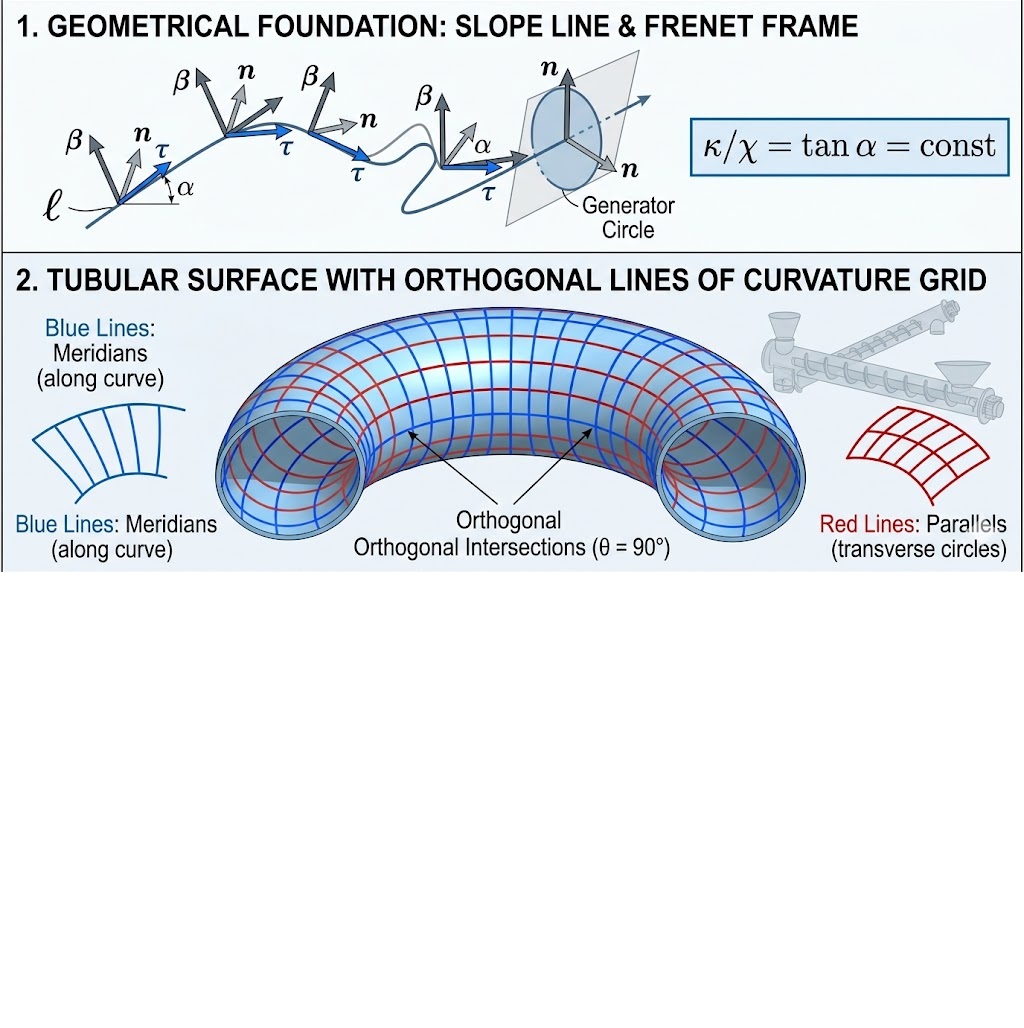
This study considers the construction of tubular surfaces with a spatial axis of slope, referred to a coordinate grid of curvature lines. Such surfaces have a number of mathematical advantages compared to surfaces described by arbitrary coordinate grids. In differential geometry, this has a theoretical justification and applied value. This follows from the special role of curvature lines as geometrically privileged directions on a surface with minimal and maximal curvatures.
To parameterize a tubular surface in this way, it is necessary that the length of its axis be described by analytical dependences in a finite form. Typically, the length of spatial curves is determined by numerical integration. There is a known group of plane curves that are described by parametric equations as a function of the arc length and for which such a problem does not exist. This work proposes taking such curves as a horizontal projection of a spatial curve. The spatial curve should be constructed as a slope curve with a constant elevation angle relative to the horizontal plane. Then the spatial curve, the equations of which include the elevation angle, will be described as a function of the arc length. Its use as the axis of the tubular surface makes it possible to attribute the latter to the families of coordinate lines of curvature.
In this paper, the horizontal projection of the axis of the tubular surface is a logarithmic spiral. Parametric equations of the tubular surface in analytical form have been derived. A surface with the elevation angle of the axis β = 10° and the radius of the generating circle ρ = 15 linear units was constructed. The orthogonality of the resulting coordinate grid has been proven through the analysis of the coefficients of the first quadratic form (F = 0), which confirms the assignment of the surface to the lines of curvature. This makes it possible to improve the accuracy of calculating the stress-strain state of shells in mechanical engineering and aerospace engineering at simultaneous minimization of computational costs
References
- Lytvynenko, A., Yukhymenko, M., Pavlenko, I., Pitel, J., Mizakova, J., Lytvynenko, O. et al. (2019). Ensuring the Reliability of Pneumatic Classification Process for Granular Material in a Rhomb-Shaped Apparatus. Applied Sciences, 9 (8), 1604. https://doi.org/10.3390/app9081604
- Nоvitskiy, A., Banniy, O., Novitskyi, Y. (2023). Logical-probabilistic model of the reliability of means for preparing and distributing fodder. Naukovij Žurnal «Tehnìka Ta Energetika», 14 (1). https://doi.org/10.31548/machinery/1.2023.57
- Pylypaka, S. F., Klendii, M. B., Trokhaniak, V. I., Kresan, T. A., Hryshchenko, I. Y., Pastushenko, A. S. (2021). External rolling of a polygon on closed curvilinear profile. Acta Polytechnica, 61 (1), 270–278. https://doi.org/10.14311/ap.2021.61.0270
- Pylypaka, S. F., Klendii, M. B., Nesvidomin, V. M., Trokhaniak, V. I. (2019). Particle motion over the edge of an inclined plane that performs axial movement in a vertical limiting cylinder. Acta Polytechnica, 59 (1), 67–76. https://doi.org/10.14311/ap.2019.59.0067
- Li, C.-Y., Wang, R.-H., Zhu, C.-G. (2013). An approach for designing a developable surface through a given line of curvature. Computer-Aided Design, 45 (3), 621–627. https://doi.org/10.1016/j.cad.2012.11.001
- Althibany, N. (2021). Construction of Developable Surface with Geodesic or Line of Curvature Coordinates. Journal of New Theory, 36, 75–87. https://doi.org/10.53570/jnt.987265
- Karacan, M. K., Yayli, Y. (2008). On the geodesics of tubular surfaces in Minkowski 3-space. Bulletin of the Malaysian Mathematical Sciences Society. Second Series, 31 (1). Available at: https://eudml.org/doc/54573
- Dogan, F., Yayli, Y. (2011). On the curvatures of tubular surface with bishop frame. Communications Faculty Of Science University of Ankara Series A1Mathematics and Statistics, 60 (1), 59–69. https://doi.org/10.1501/commua1_0000000669
- Khalifa Saad, M., Yüksel, N., Oğraş, N., Alghamdi, F., Abdel-Salam, A. A. (2024). Geometry of tubular surfaces and their focal surfaces in Euclidean 3-space. AIMS Mathematics, 9 (5), 12479–12493. https://doi.org/10.3934/math.2024610
- Eren, K. (2021). On the harmonic evolute surfaces of tubular surfaces in euclidean 3-space. Journal of Science and Arts, 21 (2), 449–460. https://doi.org/10.46939/j.sci.arts-21.2-a12
- Hevko, I. B., Lyashuk, O. L., Leshchuk, R. Y., Rogatinska, L. R., Melnychuk, A. L. (2016). Investigation of the radius of bending for flexible screw sectional conveyers. INMATEH - Agricultural Engineering, 48 (1), 35–42. Available at: https://inma-ita.ro/inmateh/INMATEH_1_2016/48_5_Hevko%20Iv.B.pdf
- Lyashuk, O., Rohatynskyi, R., Hevko, I., Dmytriv, O., Tson, O., Tkachenko, I. et al. (2023). Investigation of Bulk Material Transportation by Screw Conveyer with Hinge-Pan Operating Device. Key Engineering Materials, 948, 169–182. https://doi.org/10.4028/p-6qin7l
- Pylypaka, S., Kresan, T., Trokhaniak, O., Taras, I., Demchuk, I. (2021). Parametric equations of a spatlal curve as a function of length of the arc with given dependences of curvature and angle of ascent. Journal for Geometry and Graphics, 25 (2), 163–170. Available at: https://www.heldermann-verlag.de/jgg/jgg25/j25h2pyly.pdf
- Ju, Y., Konoplianchenko, I., Pu, J., Zhang, Z., Dong, Q., Dumanchuk, M. (2024). Optimization of structure and properties of WC-reinforced FeCoNiCr high-entropy alloy composite coating by laser melting. Results in Engineering, 21, 101985. https://doi.org/10.1016/j.rineng.2024.101985
- Myslyvchenko, O. M., Gaponova, O. P., Tarelnyk, V. B., Krapivka, M. O. (2020). The Structure Formation and Hardness of High-Entropy Alloy Coatings Obtained by Electrospark Deposition. Powder Metallurgy and Metal Ceramics, 59 (3-4), 201–208. https://doi.org/10.1007/s11106-020-00152-7
Downloads
Published
How to Cite
Issue
Section
License
Copyright (c) 2026 Andrii Nesvidomin, Serhii Pylypaka, Tetiana Volina, Victor Nesvidomin, Oleksandr Solarov, Taras Voloshko, Taras Pylypaka, Lidiia Savchenko, Oleksandr Savchenko, Irina Zakharova

This work is licensed under a Creative Commons Attribution 4.0 International License.
The consolidation and conditions for the transfer of copyright (identification of authorship) is carried out in the License Agreement. In particular, the authors reserve the right to the authorship of their manuscript and transfer the first publication of this work to the journal under the terms of the Creative Commons CC BY license. At the same time, they have the right to conclude on their own additional agreements concerning the non-exclusive distribution of the work in the form in which it was published by this journal, but provided that the link to the first publication of the article in this journal is preserved.
A license agreement is a document in which the author warrants that he/she owns all copyright for the work (manuscript, article, etc.).
The authors, signing the License Agreement with TECHNOLOGY CENTER PC, have all rights to the further use of their work, provided that they link to our edition in which the work was published.
According to the terms of the License Agreement, the Publisher TECHNOLOGY CENTER PC does not take away your copyrights and receives permission from the authors to use and dissemination of the publication through the world's scientific resources (own electronic resources, scientometric databases, repositories, libraries, etc.).
In the absence of a signed License Agreement or in the absence of this agreement of identifiers allowing to identify the identity of the author, the editors have no right to work with the manuscript.
It is important to remember that there is another type of agreement between authors and publishers – when copyright is transferred from the authors to the publisher. In this case, the authors lose ownership of their work and may not use it in any way.








