Revealing the bioaccumulation of heavy metals in honey plants and their translocation into apiproducts
DOI:
https://doi.org/10.15587/1729-4061.2026.354695Keywords:
bee pollen, heavy metals, translocation factor, military operations, safety of apiproductsAbstract
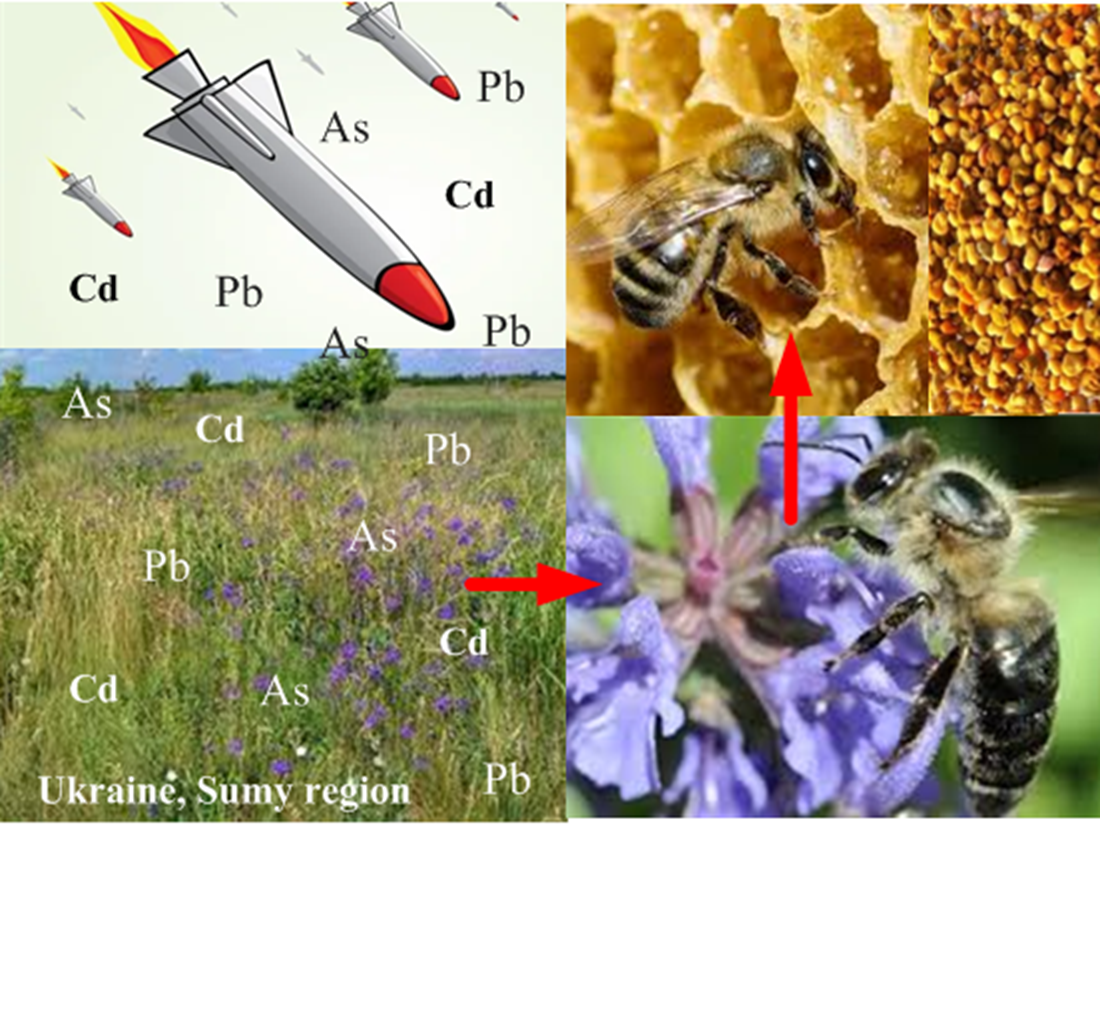
This study quantifies the translocation factor (TF) for heavy metals transferred from wild honey plants to beekeeping products. The research area is located near the war zone, so its contamination with heavy metals is possible.
Analysis of honey plants and bee products can make it possible to establish their safety. Field studies were conducted in July 2025 in the village of Stepanivka (Ukraine). The concentration of Cd, Pb, As, as well as the TF for these heavy metals transferred from wild honey plants to beekeeping products (bee pollen and honey), were determined using generally accepted methods.
It was found that the concentration of Pb in wild honey plants is 1.64 ± 0.44 mg/kg, which exceeds the level permitted in Europe and Ukraine for plants by 5.5–8.2 times. However, in bee bread and honey, the concentration of Pb is within the normal range (0.15 ± 0.01 mg/kg and 0.09 ± 0.01 mg/kg, respectively). This indicates that pollen is less contaminated compared to vegetative parts of the plant, acting as a barrier for heavy metals, and bees have the ability to reduce the concentration of pollutants. This is also confirmed by the fact that the concentration of Pb in bee bread is higher than in honey, which may indicate the ability of bees to act as a biofilter. The same effect is observed with other toxins. The level of Cd in honey (0.007 ± 0.01 mg/kg) was lower than its concentration in bee bread (0.01 ± 0.05 mg/kg). The concentration of As in honey is also 0.1 mg/kg lower than its concentration in bee bread. At the same time, it was found that the concentration of As in wild honey plants (< 0.0001 mg/kg) is significantly lower than its concentration in beekeeping products. The highest bioaccumulation of Cd was registered in bee bread (TF = 0.13). Considering that the translocation factor of heavy metals does not exceed 1, honey and bee bread collected in the study area can be considered safe for consumption
References
- Girotti, S., Ghini, S., Ferri, E., Bolelli, L., Colombo, R., Serra, G. et al. (2020). Bioindicators and biomonitoring: honeybees and hive products as pollution impact assessment tools for the Mediterranean area. Euro-Mediterranean Journal for Environmental Integration, 5 (3). https://doi.org/10.1007/s41207-020-00204-9
- Fuente-Ballesteros, A., Ciulu, M., Haque, S. M., Syrgabek, Y., Basaran, B. (2025). Honeybees as active bioindicators of plastic pollution: Environmental exposure, analytical strategies, and monitoring perspectives. Science of The Total Environment, 1003, 180722. https://doi.org/10.1016/j.scitotenv.2025.180722
- Glevitzky, M., Corcheş, M.-T., Popa, M., Vică, M. L. (2025). Honey as a Bioindicator: Pollution’s Effects on Its Quality in Mining vs. Protected Sites. Applied Sciences, 15 (13), 7297. https://doi.org/10.3390/app15137297
- Margaoan, R., Papa, G., Nicolescu, A., Cornea-Cipcigan, M., Kösoğlu, M., Topal, E., Negri, I. (2024). Environmental pollution effect on honey bees and their derived products: a comprehensive analysis. Environmental Science and Pollution Research, 32 (16), 10370–10391. https://doi.org/10.1007/s11356-024-33754-4
- Zavrtnik, S., Loborec, J., Kapelj, S., Grčić, I. (2024). Environmental Biomonitoring of Heavy and Toxic Metals Using Honeybees and Their Products – An Overview of Previous Research. Sustainability, 16 (19), 8526. https://doi.org/10.3390/su16198526
- Tong, D. Q., Gill, T. E., Sprigg, W. A., Van Pelt, R. S., Baklanov, A. A., Barker, B. M. et al. (2023). Health and Safety Effects of Airborne Soil Dust in the Americas and Beyond. Reviews of Geophysics, 61 (2). https://doi.org/10.1029/2021rg000763
- Borsuk, G., Sulborska, A., Stawiarz, E., Olszewski, K., Wiącek, D., Ramzi, N. et al. (2021). Capacity of honeybees to remove heavy metals from nectar and excrete the contaminants from their bodies. Apidologie, 52 (6), 1098–1111. https://doi.org/10.1007/s13592-021-00890-6
- Godebo, T. R., Stoner, H., Taylor, P., Jeuland, M. (2025). Metals in honey from bees as a proxy for environmental contamination in the United States. Environmental Pollution, 364, 125221. https://doi.org/10.1016/j.envpol.2024.125221
- Demková, L., Hauptvogl, M., Oboňa, J., Bobuľská, L., Jančo, I., Harangozo, Ľ. et al. (2024). Comprehensive assessment of mercury contamination in bees, bee products and moss and lichen bags. Ecotoxicology and Environmental Safety, 285, 117132. https://doi.org/10.1016/j.ecoenv.2024.117132
- Altahaan, Z., Dobslaw, D. (2024). The Impact of War on Heavy Metal Concentrations and the Seasonal Variation of Pollutants in Soils of the Conflict Zone and Adjacent Areas in Mosul City. Environments, 11 (11), 247. https://doi.org/10.3390/environments11110247
- Samilyk, M. (2025). Assessment of the state of lead contamination of soil and agricultural products in the territory near the combat zone. EUREKA: Life Sciences, 4, 30–38. https://doi.org/10.21303/2504-5695.2025.004071
- Zolfaghari, G., Akhgari Sang Atash, Z., Sazgar, A. (2018). Baseline heavy metals in plant species from some industrial and rural areas: Carcinogenic and non-carcinogenic risk assessment. MethodsX, 5, 43–60. https://doi.org/10.1016/j.mex.2018.01.003
- Tsytsiura, Ya. H., Shkatula, Yu. M., Zabarna, T. A., Pelekh, L. V. (2022) Innovatsiyni pidkhody do fitoremediatsiyi ta fitorekultyvatsiyi u suchasnykh systemakh zemlerobstva. Vinnytsia: TOV «Druk», 1200. Available at: https://repository.vsau.org/getfile.php/31038.pdf
- Aldgini, H. M. M., Abdullah Al-Abbadi, A., Abu-Nameh, E. S. M., Alghazeer, R. O. (2019). Determination of metals as bio indicators in some selected bee pollen samples from Jordan. Saudi Journal of Biological Sciences, 26 (7), 1418–1422. https://doi.org/10.1016/j.sjbs.2019.03.005
- Skrypka, G., Naidich, O., Timchenko, O., Dankevych, N. (2023). Toxicological and microbiological criteria for the safety of pollen load and propolis. Agrarian Bulletin of the Black Sea Littoral, 109, 95–102. https://doi.org/10.37000/abbsl.2023.109.15
- Šerevičienė, V., Zigmontienė, A., Paliulis, D. (2022). Heavy Metals in Honey Collected from Contaminated Locations: A Case of Lithuania. Sustainability, 14 (15), 9196. https://doi.org/10.3390/su14159196
- Anderson, C. W. N., Smith, S. L., Jeyakumar, P., Thompson-Morrison, H., Cavanagh, J.-A. E. (2022). Forage crops and cadmium: How changing farming systems might impact cadmium accumulation in animals. Science of The Total Environment, 827, 154256. https://doi.org/10.1016/j.scitotenv.2022.154256
- Samilyk, M., Bokovets, S., Kovalenko, O., Ryzhkova, T., Hnoievyi, I., Hrinchenko, D. et al. (2025). Revealing the impact of military activities on the safety of agricultural produce. Eastern-European Journal of Enterprise Technologies, 6 (11 (138)), 47–53. https://doi.org/10.15587/1729-4061.2025.343273
- Samilyk, M., Synenko, T., Bolgova, N., Lukhanin, B., Borozenets, N. (2025). Assessment of the risk of pollution of the ecosystem and agricultural products in the zone of military conflict. Technology Audit and Production Reserves, 5 (3 (85)), 23–28. https://doi.org/10.15587/2706-5448.2025.341902
- Scott, S. B., Gardiner, M. M. (2025). Trace Metals in Nectar of Important Urban Pollinator Forage Plants: A Direct Exposure Risk to Pollinators and Nectar‐Feeding Animals in Cities. Ecology and Evolution, 15 (4). https://doi.org/10.1002/ece3.71238
- Tomczyk, M., Zaguła, G., Kaczmarski, M., Puchalski, C., Dżugan, M. (2023). The Negligible Effect of Toxic Metal Accumulation in the Flowers of Melliferous Plants on the Mineral Composition of Monofloral Honeys. Agriculture, 13 (2), 273. https://doi.org/10.3390/agriculture13020273
- Végh, R., Csóka, M., Sörös, C., Sipos, L. (2021). Food safety hazards of bee pollen – A review. Trends in Food Science & Technology, 114, 490–509. https://doi.org/10.1016/j.tifs.2021.06.016
- Dżugan, M., Wesołowska, M., Zaguła, G., Kaczmarski, M., Czernicka, M., Puchalski, C. (2018). Honeybees (Apis mellifera) as a biological barrier for contamination of honey by environmental toxic metals. Environmental Monitoring and Assessment, 190 (2). https://doi.org/10.1007/s10661-018-6474-0
- Li, D., Liu, J., Yuan, Y., Chen, J., Mu, J. (2025). Cadmium Contaminants in Pollen and Nectar Are Variably Linked to the Growth and Foraging Behaviors of Honey Bees. Insects, 16 (3), 306. https://doi.org/10.3390/insects16030306
Downloads
Published
How to Cite
Issue
Section
License
Copyright (c) 2026 Maryna Samilyk, Svetlana Tkachuk, Volodymyr Onoprienko, Larysa Yepyk, Oleh Bakhmat, Danylo Plahtiy, Tetiana Krachan, Anna Hotvianska, Dmytro Kisil, Dmytro Nahirnyy

This work is licensed under a Creative Commons Attribution 4.0 International License.
The consolidation and conditions for the transfer of copyright (identification of authorship) is carried out in the License Agreement. In particular, the authors reserve the right to the authorship of their manuscript and transfer the first publication of this work to the journal under the terms of the Creative Commons CC BY license. At the same time, they have the right to conclude on their own additional agreements concerning the non-exclusive distribution of the work in the form in which it was published by this journal, but provided that the link to the first publication of the article in this journal is preserved.
A license agreement is a document in which the author warrants that he/she owns all copyright for the work (manuscript, article, etc.).
The authors, signing the License Agreement with TECHNOLOGY CENTER PC, have all rights to the further use of their work, provided that they link to our edition in which the work was published.
According to the terms of the License Agreement, the Publisher TECHNOLOGY CENTER PC does not take away your copyrights and receives permission from the authors to use and dissemination of the publication through the world's scientific resources (own electronic resources, scientometric databases, repositories, libraries, etc.).
In the absence of a signed License Agreement or in the absence of this agreement of identifiers allowing to identify the identity of the author, the editors have no right to work with the manuscript.
It is important to remember that there is another type of agreement between authors and publishers – when copyright is transferred from the authors to the publisher. In this case, the authors lose ownership of their work and may not use it in any way.








