Determining regularities in the stressed-strained state of a glass dome
DOI:
https://doi.org/10.15587/1729-4061.2026.355671Keywords:
glass dome, stressed-strained state, Siemens Simcenter Femap, Martian structures, structural behavior of glass structuresAbstract
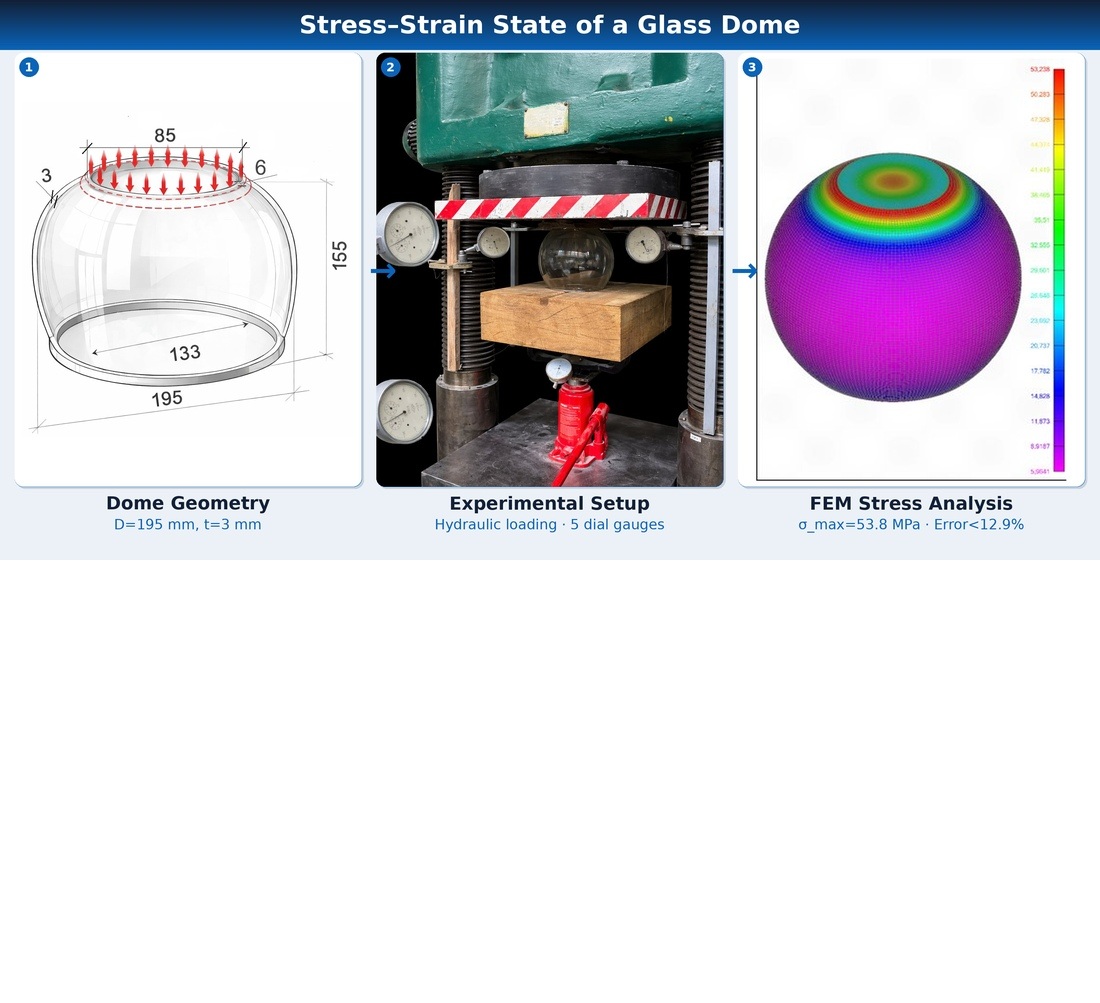
Two thin-walled glass domes in the form of a spherical segment with a truncated apex have been considered in this study. The task addressed relates to the lack of experimentally confirmed data on their stressed-strained state and fracture mechanisms, which compromises the reliability of numerical models and limits practical application.
This paper reports experimental results from testing glass dome models subjected to uniformly distributed loading, as well as and their numerical verification using the finite element method implemented in Siemens Simcenter Femap with NX Nastran (USA). The deformation behavior, ultimate load levels, and brittle explosive failure mechanism with crack initiation in the apex zone were identified. The maximum experimental vertical displacement reached 3.1 mm, while the discrepancy between numerical and experimental results did not exceed 12.9%, confirming the adequacy of the numerical model.
The results made it possible to identify tensile stress concentration zones and demonstrated consistency between numerically predicted critical regions and the experimentally observed failure pattern. This was achieved through a combined approach integrating controlled laboratory testing and detailed spatial FEM analysis. The results are attributed to the predominantly membrane behavior of the dome and local stress concentration in the load application zone.
The findings could be applied in the design of transparent dome structures as well as annealed and additively manufactured glass shells intended for special operating conditions, including prospective hermetic modules for extraterrestrial environments such as Mars
References
- Demchyna, B., Surmai, M., Tkach, R. (2019). The experimental study of glass multilayer columns using digital image correlation. Archives of Materials Science and Engineering, 1 (96), 32–41. https://doi.org/10.5604/01.3001.0013.1990
- Demchyna, B., Vozniuk, L., Surmai, M. (2023). Testing of the Ribbed Dome Which is Manufactured by 3D Printing. Proceedings of CEE 2023, 70–77. https://doi.org/10.1007/978-3-031-44955-0_8
- Demchyna, B., Vozniuk, L., Surmai, M., Havryliak, S., Famulyak, Y. (2023). Experimental study of the dome model made using a 3D printer from PLA plastic. INTERNATIONAL SCIENTIFIC SESSION ON APPLIED MECHANICS XI: Proceedings of the 11th International Conference on Applied Mechanics, 2949, 020025. https://doi.org/10.1063/5.0165270
- Haldimann, M., Luible, A., Overend, M. (2008). Structural use of Glass. International Association for Bridge and Structural Engineering (IABSE). https://doi.org/10.2749/sed010
- Feldmann, M., Laurs, M., Belis, J., Buljan, N., Criaud, A., Dupont, E. et al. (2023). The new CEN/TS 19100: Design of glass structures. Glass Structures & Engineering, 8 (3), 317–337. https://doi.org/10.1007/s40940-023-00219-y
- Demchyna, B., Surmai, M., Tkach, R., Hula, V., Kozak, R. (2020). An analysis of using the method of two-dimensional digital image correlation in glass column research. Eastern-European Journal of Enterprise Technologies, 4 (12 (106)), 52–59. https://doi.org/10.15587/1729-4061.2020.209761
- Caiazzo, A., Casaburo, A., Petrone, G., De Rosa, S., Franco, F. (2026). Structures for extraterrestrial habitat: A review. Acta Astronautica, 238, 471–493. https://doi.org/10.1016/j.actaastro.2025.10.029
- Razeto, C., Foncheva, D., Trotti, G., Sumini, V. (2024). Optimizing translucent multilayer membrane for lunar habitats: A design study. Acta Astronautica, 223, 316–327. https://doi.org/10.1016/j.actaastro.2024.07.007
- Demchyna, B., Tkach, R., Kotselko, R. (2024). Analysis of additive manufacturing of glass domes: challenges and prospects for use on Mars. Archives of Materials Science and Engineering, 128 (2). https://doi.org/10.5604/01.3001.0054.9062
- Ayvaz, I., Peters, T., Fildhuth, T., Rusenova, G., Buksak, A., Haller, M. et al. (2025). Structural performance of linearly laminated metal fittings for frameless glass shell structures. Glass Structures & Engineering, 10 (4). https://doi.org/10.1007/s40940-025-00312-4
- Zaccaria, M., Peters, T., Ebert, J., Lucca, N., Schneider, J., Louter, C. (2022). The clamp bender: a new testing equipment for thin glass. Glass Structures & Engineering, 7 (2), 173–186. https://doi.org/10.1007/s40940-022-00188-8
- Huang, B., Hu, W., Xu, K., Guan, X., Lu, W. (2023). Experimental and numerical investigation on glass panel subjected to pendulum impact. International Journal of Impact Engineering, 173, 104457. https://doi.org/10.1016/j.ijimpeng.2022.104457
- Galuppi, L., Riva, E. (2022). Experimental and numerical characterization of twisting response of thin glass. Glass Structures & Engineering, 7 (1), 45–69. https://doi.org/10.1007/s40940-022-00166-0
- Le Gourriérec, C., Chang, X., Durand, B., Villey, R., Voillot, B., Brajer, X., Roux, S. (2023). High speed stereo-vision study of laminated glass fragmentation upon impact. Glass Structures & Engineering, 8 (3), 423–442. https://doi.org/10.1007/s40940-023-00231-2
- Kozłowski, M., Zemła, K. (2023). Experiments on the Dynamic Behavior of Curved Glass Panes Subjected to Low-Velocity Impact. Materials, 16 (23), 7335. https://doi.org/10.3390/ma16237335
- Galuppi, L., Franco, A., Bedon, C. (2023). Architectural Glass under Climatic Actions and Fire: Review of State of the Art, Open Problems and Future Perspectives. Buildings, 13 (4), 939. https://doi.org/10.3390/buildings13040939
- Galuppi, L., Riva, E. (2024). Constant-curvature bending response of thin glass: Analytical, numerical and experimental study of “clamp-bending” tests. Glass Structures & Engineering, 9 (2), 99–116. https://doi.org/10.1007/s40940-024-00249-0
- Kalapodis, N., Kampas, G., Ktenidou, O.-J. (2020). A review towards the design of extraterrestrial structures: From regolith to human outposts. Acta Astronautica, 175, 540–569. https://doi.org/10.1016/j.actaastro.2020.05.038
- Galuppi, L., Royer-Carfagni, G. (2012). The effective thickness of laminated glass plates. Journal of Mechanics of Materials and Structures, 7 (4), 375–400. https://doi.org/10.2140/jomms.2012.7.375
- Galuppi, L., Royer-Carfagni, G. F. (2012). Effective thickness of laminated glass beams: New expression via a variational approach. Engineering Structures, 38, 53–67. https://doi.org/10.1016/j.engstruct.2011.12.039
- Galuppi, L., Royer-Carfagni, G. (2018). Post-breakage Tensile and Bending Response of Laminated Glass. Challenging Glass 6: Conference on Architectural and Structural Applications of Glass (Proceedings). https://doi.org/10.7480/cgc.6.2163
- Gupta, N. K., Mohamed Sheriff, N., Velmurugan, R. (2008). Experimental and theoretical studies on buckling of thin spherical shells under axial loads. International Journal of Mechanical Sciences, 50 (3), 422–432. https://doi.org/10.1016/j.ijmecsci.2007.10.002
- Terzi, V. G., Makarios, T. K. (2023). Finite Element In-Depth Verification: Base Displacements of a Spherical Dome Loaded by Edge Forces and Moments. Modelling, 5 (1), 37–54. https://doi.org/10.3390/modelling5010003
- Vető, D., Sajtos, I. (2017). Theoretical, Numerical and Experimental Analysis of Polygonal Buckling Shapes of Spherical Shells Subjected to Concentrated Load. Journal of the International Association for Shell and Spatial Structures, 58 (2), 145–158. https://doi.org/10.20898/j.iass.2017.192.813
- Shariati, M., Allahbakhsh, H. R. (2010). Numerical and experimental investigations on the buckling of steel semi-spherical shells under various loadings. Thin-Walled Structures, 48 (8), 620–628. https://doi.org/10.1016/j.tws.2010.03.002
- Fritzsche, K., van der Sluis, W., Smits, E., Bakker, J. (2020). Capital C, geometric optimization of a free-form steel gridshell towards planar quadrilateral glass units. Challenging Glass 7: Conference on Architectural and Structural Applications of Glass. https://doi.org/10.7480/cgc.7.4493
- Bijster, J., Noteboom, C., Eekhout, M. (2016). Glass Entrance Van Gogh Museum Amsterdam. Glass Structures & Engineering, 1 (1), 205–231. https://doi.org/10.1007/s40940-016-0022-5
- Goel, S. (2016). Optimal Segmentation of Glass Shell Structures. Challenging Glass 5: Conference on Architectural and Structural Applications of Glass. http://doi.org/10.7480/cgc.5.2225
Downloads
Published
How to Cite
Issue
Section
License
Copyright (c) 2026 Bogdan Demchyna, Roman Tkach, Roman Kotselko, Khrystyna Demchyna

This work is licensed under a Creative Commons Attribution 4.0 International License.
The consolidation and conditions for the transfer of copyright (identification of authorship) is carried out in the License Agreement. In particular, the authors reserve the right to the authorship of their manuscript and transfer the first publication of this work to the journal under the terms of the Creative Commons CC BY license. At the same time, they have the right to conclude on their own additional agreements concerning the non-exclusive distribution of the work in the form in which it was published by this journal, but provided that the link to the first publication of the article in this journal is preserved.
A license agreement is a document in which the author warrants that he/she owns all copyright for the work (manuscript, article, etc.).
The authors, signing the License Agreement with TECHNOLOGY CENTER PC, have all rights to the further use of their work, provided that they link to our edition in which the work was published.
According to the terms of the License Agreement, the Publisher TECHNOLOGY CENTER PC does not take away your copyrights and receives permission from the authors to use and dissemination of the publication through the world's scientific resources (own electronic resources, scientometric databases, repositories, libraries, etc.).
In the absence of a signed License Agreement or in the absence of this agreement of identifiers allowing to identify the identity of the author, the editors have no right to work with the manuscript.
It is important to remember that there is another type of agreement between authors and publishers – when copyright is transferred from the authors to the publisher. In this case, the authors lose ownership of their work and may not use it in any way.








