Встановлення закономірностей напружено-деформованого стану скляного купола
DOI:
https://doi.org/10.15587/1729-4061.2026.355671Ключові слова:
скляний купол, напружено-деформований стан, Siemens Simcenter Femap, марсіанські конструкції, робота скляних конструкційАнотація
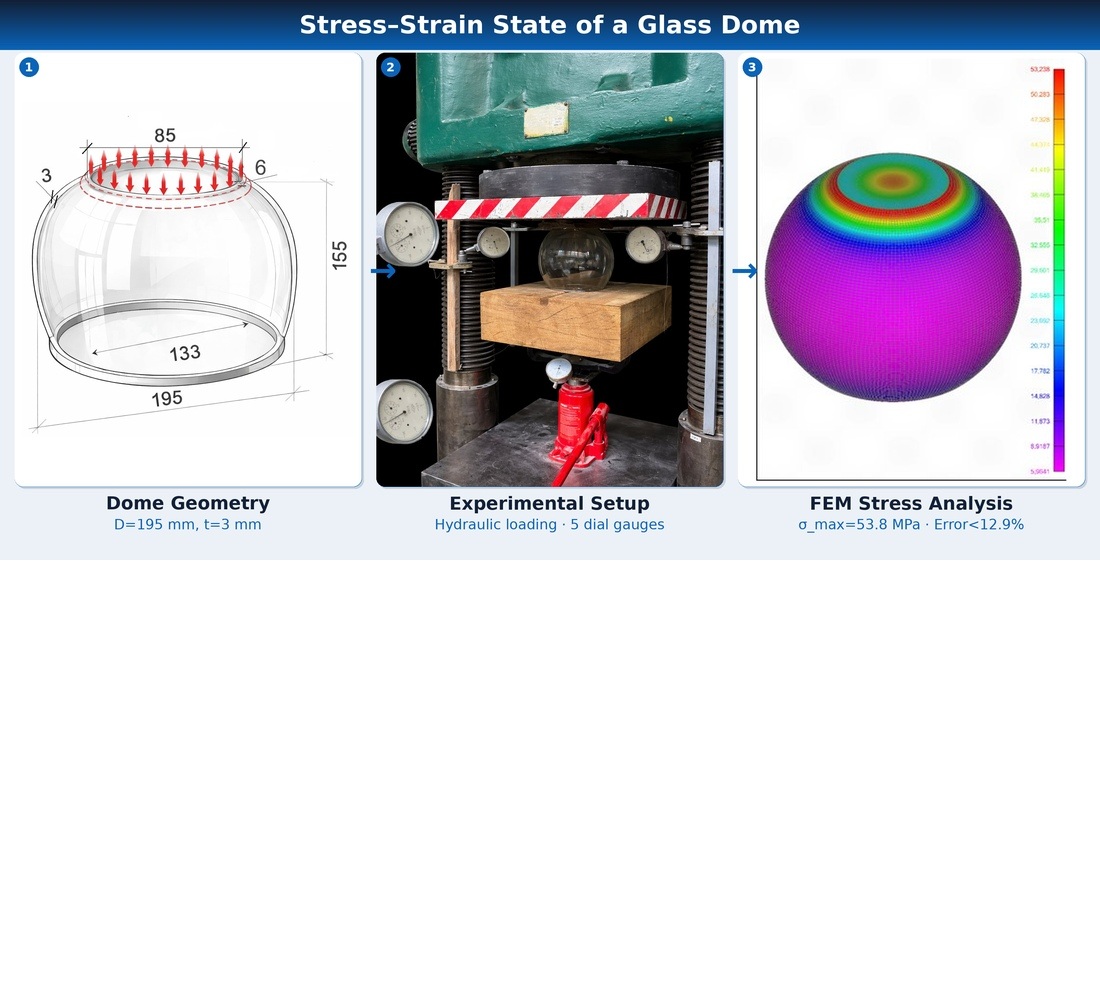
Об’єкт дослідження – два тонкостінні скляні куполи у формі сферичного сегмента зі зрізаною вершиною. Проблема полягає у відсутності експериментально підтверджених даних про їх напружено-деформований стан і механізми руйнування, що знижує достовірність числових моделей та обмежує практичне застосування.
У роботі наведено результати експериментальних випробувань моделей скляного купола під дією рівномірно розподіленого навантаження та виконано їх числову верифікацію методом скінченних елементів із використанням програмного комплексу Siemens Simcenter Femap with NX Nastran (США). Встановлено характер деформування оболонки, рівень граничних навантажень і крихкий, вибухоподібний механізм руйнування з ініціацією тріщин у вершинній зоні. Максимальне експериментальне вертикальне переміщення становило 3,1 мм, а різниця між розрахунковими та експериментальними значеннями не перевищила 12,9%, що підтверджує адекватність числової моделі.
Отримані результати дозволили ідентифікувати зони концентрації розтягуючих напружень і встановити відповідність між чисельно прогнозованими критичними зонами та фактичними зонами руйнування. Це стало можливим завдяки поєднанню контрольованого лабораторного експерименту з детальним просторовим МКЕ-аналізом оболонки. Результати пояснюються переважно мембранною роботою купольної форми та локальною концентрацією напружень у зоні прикладання навантаження.
Практичне використання отриманих результатів можливе при проєктуванні світлопрозорих купольних конструкцій, а також відпалених і адитивно сформованих скляних оболонок для спеціальних умов експлуатації, зокрема перспективних герметичних модулів для позаземних середовищ, включаючи марсіанську інфраструктуру
Посилання
- Demchyna, B., Surmai, M., Tkach, R. (2019). The experimental study of glass multilayer columns using digital image correlation. Archives of Materials Science and Engineering, 1 (96), 32–41. https://doi.org/10.5604/01.3001.0013.1990
- Demchyna, B., Vozniuk, L., Surmai, M. (2023). Testing of the Ribbed Dome Which is Manufactured by 3D Printing. Proceedings of CEE 2023, 70–77. https://doi.org/10.1007/978-3-031-44955-0_8
- Demchyna, B., Vozniuk, L., Surmai, M., Havryliak, S., Famulyak, Y. (2023). Experimental study of the dome model made using a 3D printer from PLA plastic. INTERNATIONAL SCIENTIFIC SESSION ON APPLIED MECHANICS XI: Proceedings of the 11th International Conference on Applied Mechanics, 2949, 020025. https://doi.org/10.1063/5.0165270
- Haldimann, M., Luible, A., Overend, M. (2008). Structural use of Glass. International Association for Bridge and Structural Engineering (IABSE). https://doi.org/10.2749/sed010
- Feldmann, M., Laurs, M., Belis, J., Buljan, N., Criaud, A., Dupont, E. et al. (2023). The new CEN/TS 19100: Design of glass structures. Glass Structures & Engineering, 8 (3), 317–337. https://doi.org/10.1007/s40940-023-00219-y
- Demchyna, B., Surmai, M., Tkach, R., Hula, V., Kozak, R. (2020). An analysis of using the method of two-dimensional digital image correlation in glass column research. Eastern-European Journal of Enterprise Technologies, 4 (12 (106)), 52–59. https://doi.org/10.15587/1729-4061.2020.209761
- Caiazzo, A., Casaburo, A., Petrone, G., De Rosa, S., Franco, F. (2026). Structures for extraterrestrial habitat: A review. Acta Astronautica, 238, 471–493. https://doi.org/10.1016/j.actaastro.2025.10.029
- Razeto, C., Foncheva, D., Trotti, G., Sumini, V. (2024). Optimizing translucent multilayer membrane for lunar habitats: A design study. Acta Astronautica, 223, 316–327. https://doi.org/10.1016/j.actaastro.2024.07.007
- Demchyna, B., Tkach, R., Kotselko, R. (2024). Analysis of additive manufacturing of glass domes: challenges and prospects for use on Mars. Archives of Materials Science and Engineering, 128 (2). https://doi.org/10.5604/01.3001.0054.9062
- Ayvaz, I., Peters, T., Fildhuth, T., Rusenova, G., Buksak, A., Haller, M. et al. (2025). Structural performance of linearly laminated metal fittings for frameless glass shell structures. Glass Structures & Engineering, 10 (4). https://doi.org/10.1007/s40940-025-00312-4
- Zaccaria, M., Peters, T., Ebert, J., Lucca, N., Schneider, J., Louter, C. (2022). The clamp bender: a new testing equipment for thin glass. Glass Structures & Engineering, 7 (2), 173–186. https://doi.org/10.1007/s40940-022-00188-8
- Huang, B., Hu, W., Xu, K., Guan, X., Lu, W. (2023). Experimental and numerical investigation on glass panel subjected to pendulum impact. International Journal of Impact Engineering, 173, 104457. https://doi.org/10.1016/j.ijimpeng.2022.104457
- Galuppi, L., Riva, E. (2022). Experimental and numerical characterization of twisting response of thin glass. Glass Structures & Engineering, 7 (1), 45–69. https://doi.org/10.1007/s40940-022-00166-0
- Le Gourriérec, C., Chang, X., Durand, B., Villey, R., Voillot, B., Brajer, X., Roux, S. (2023). High speed stereo-vision study of laminated glass fragmentation upon impact. Glass Structures & Engineering, 8 (3), 423–442. https://doi.org/10.1007/s40940-023-00231-2
- Kozłowski, M., Zemła, K. (2023). Experiments on the Dynamic Behavior of Curved Glass Panes Subjected to Low-Velocity Impact. Materials, 16 (23), 7335. https://doi.org/10.3390/ma16237335
- Galuppi, L., Franco, A., Bedon, C. (2023). Architectural Glass under Climatic Actions and Fire: Review of State of the Art, Open Problems and Future Perspectives. Buildings, 13 (4), 939. https://doi.org/10.3390/buildings13040939
- Galuppi, L., Riva, E. (2024). Constant-curvature bending response of thin glass: Analytical, numerical and experimental study of “clamp-bending” tests. Glass Structures & Engineering, 9 (2), 99–116. https://doi.org/10.1007/s40940-024-00249-0
- Kalapodis, N., Kampas, G., Ktenidou, O.-J. (2020). A review towards the design of extraterrestrial structures: From regolith to human outposts. Acta Astronautica, 175, 540–569. https://doi.org/10.1016/j.actaastro.2020.05.038
- Galuppi, L., Royer-Carfagni, G. (2012). The effective thickness of laminated glass plates. Journal of Mechanics of Materials and Structures, 7 (4), 375–400. https://doi.org/10.2140/jomms.2012.7.375
- Galuppi, L., Royer-Carfagni, G. F. (2012). Effective thickness of laminated glass beams: New expression via a variational approach. Engineering Structures, 38, 53–67. https://doi.org/10.1016/j.engstruct.2011.12.039
- Galuppi, L., Royer-Carfagni, G. (2018). Post-breakage Tensile and Bending Response of Laminated Glass. Challenging Glass 6: Conference on Architectural and Structural Applications of Glass (Proceedings). https://doi.org/10.7480/cgc.6.2163
- Gupta, N. K., Mohamed Sheriff, N., Velmurugan, R. (2008). Experimental and theoretical studies on buckling of thin spherical shells under axial loads. International Journal of Mechanical Sciences, 50 (3), 422–432. https://doi.org/10.1016/j.ijmecsci.2007.10.002
- Terzi, V. G., Makarios, T. K. (2023). Finite Element In-Depth Verification: Base Displacements of a Spherical Dome Loaded by Edge Forces and Moments. Modelling, 5 (1), 37–54. https://doi.org/10.3390/modelling5010003
- Vető, D., Sajtos, I. (2017). Theoretical, Numerical and Experimental Analysis of Polygonal Buckling Shapes of Spherical Shells Subjected to Concentrated Load. Journal of the International Association for Shell and Spatial Structures, 58 (2), 145–158. https://doi.org/10.20898/j.iass.2017.192.813
- Shariati, M., Allahbakhsh, H. R. (2010). Numerical and experimental investigations on the buckling of steel semi-spherical shells under various loadings. Thin-Walled Structures, 48 (8), 620–628. https://doi.org/10.1016/j.tws.2010.03.002
- Fritzsche, K., van der Sluis, W., Smits, E., Bakker, J. (2020). Capital C, geometric optimization of a free-form steel gridshell towards planar quadrilateral glass units. Challenging Glass 7: Conference on Architectural and Structural Applications of Glass. https://doi.org/10.7480/cgc.7.4493
- Bijster, J., Noteboom, C., Eekhout, M. (2016). Glass Entrance Van Gogh Museum Amsterdam. Glass Structures & Engineering, 1 (1), 205–231. https://doi.org/10.1007/s40940-016-0022-5
- Goel, S. (2016). Optimal Segmentation of Glass Shell Structures. Challenging Glass 5: Conference on Architectural and Structural Applications of Glass. http://doi.org/10.7480/cgc.5.2225
##submission.downloads##
Опубліковано
Як цитувати
Номер
Розділ
Ліцензія
Авторське право (c) 2026 Bogdan Demchyna, Roman Tkach, Roman Kotselko, Khrystyna Demchyna

Ця робота ліцензується відповідно до Creative Commons Attribution 4.0 International License.
Закріплення та умови передачі авторських прав (ідентифікація авторства) здійснюється у Ліцензійному договорі. Зокрема, автори залишають за собою право на авторство свого рукопису та передають журналу право першої публікації цієї роботи на умовах ліцензії Creative Commons CC BY. При цьому вони мають право укладати самостійно додаткові угоди, що стосуються неексклюзивного поширення роботи у тому вигляді, в якому вона була опублікована цим журналом, але за умови збереження посилання на першу публікацію статті в цьому журналі.
Ліцензійний договір – це документ, в якому автор гарантує, що володіє усіма авторськими правами на твір (рукопис, статтю, тощо).
Автори, підписуючи Ліцензійний договір з ПП «ТЕХНОЛОГІЧНИЙ ЦЕНТР», мають усі права на подальше використання свого твору за умови посилання на наше видання, в якому твір опублікований. Відповідно до умов Ліцензійного договору, Видавець ПП «ТЕХНОЛОГІЧНИЙ ЦЕНТР» не забирає ваші авторські права та отримує від авторів дозвіл на використання та розповсюдження публікації через світові наукові ресурси (власні електронні ресурси, наукометричні бази даних, репозитарії, бібліотеки тощо).
За відсутності підписаного Ліцензійного договору або за відсутністю вказаних в цьому договорі ідентифікаторів, що дають змогу ідентифікувати особу автора, редакція не має права працювати з рукописом.
Важливо пам’ятати, що існує і інший тип угоди між авторами та видавцями – коли авторські права передаються від авторів до видавця. В такому разі автори втрачають права власності на свій твір та не можуть його використовувати в будь-який спосіб.