Development of an analytical model of transient aerodynamic loading for assessing the stability of tower crane metal structures
DOI:
https://doi.org/10.15587/1729-4061.2026.356924Keywords:
tower crane, unsteady aerodynamics, extreme gust, overturning moment, analytical modelingAbstract
This study investigates metal structures of tower cranes that are subjected to intense dynamic impact of the high-speed pressure of extreme wind flow.
The task addressed relates to the insufficient adaptability of existing engineering standards (in particular EN 13001-2) to the assessment of crane stability under short-term extreme aerodynamic loads (squall gusts and remote explosion effects). Classical methods use averaged quasi-static coefficients and do not take into account the synergistic effect of the coincidence of the sudden flow vector with the dynamics of pendulum oscillations of the load.
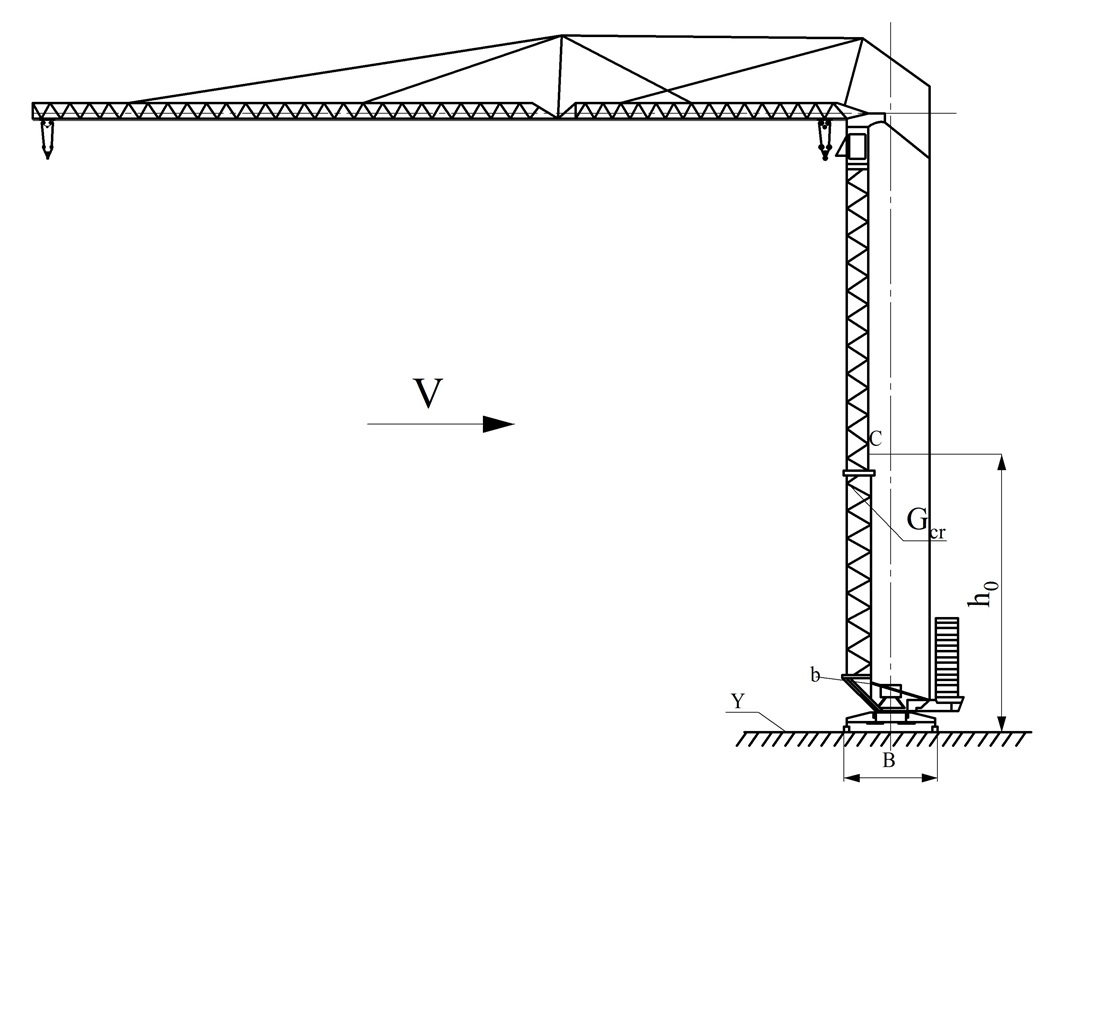
The results include the analytical model of velocity head built to describe dynamic loads on the boom, tower, and crane load depending on their position. Aerodynamic coefficients for lattice structures have been determined by taking into account a change in the Reynolds number when the flow front passes.
It is shown that the loss of stability is due to the nonlinear interaction of the velocity head with pendulum oscillations of the load and the resistance of the lattice. The maximum overturning moment (up to 451 kNm at a flow velocity of 33 m/s) occurs when the flow velocity vector coincides with the movement of the cargo. Special features of the results involve modification of the classical formula of aerodynamic pressure by integrating the quadratic set of relative velocities. This, in contrast to static approaches, makes it possible to analytically describe the nonlinear amplification of the overturning moment due to the kinetic energy of the swinging cargo under conditions of unsteady flow.
The scope of and conditions for practical implementation of the results include engineering and supervisory organizations. The model could be integrated into automated design systems for developing emergency protection algorithms at facilities with an elevated risk of extreme wind loads
References
- Hebiba, A. M., Bouferguene, A., Moon, S., Han, S. (2022). Wind-Wise Automated Stability Analysis for Selection of Tower Crane and Location. Journal of Construction Engineering and Management, 148 (11). https://doi.org/10.1061/(asce)co.1943-7862.0002377
- Tomasi, I., Solazzi, L. (2025). Dynamic Analysis of an Offshore Knuckle-Boom Crane Under Different Load Applications Laws. Applied Sciences, 15 (14), 8100. https://doi.org/10.3390/app15148100
- Ke, C., Long, H., Jiang, J. (2024). Study on the Anti-Progressive Collapse Behavior of Steel Frame Structures under Close-Range Blast Loading. Buildings, 14 (5), 1387. https://doi.org/10.3390/buildings14051387
- Ramos, H., Pickering, E., AlMahri, S., Krishnan, K., Oyebanji, J., Guan, Z. et al. (2023). Experimental evaluation of hybrid lattice structures subjected to blast loading. Additive Manufacturing, 76, 103751. https://doi.org/10.1016/j.addma.2023.103751
- Augustyn, M., Barski, M., Chwał, M., Stawiarski, A. (2023). Experimental and Numerical Estimation of the Aerodynamic Forces Induced by the Wind Acting on a Fast-Erecting Crane. Applied Sciences, 13 (19), 10826. https://doi.org/10.3390/app131910826
- Liu, Q., Zhang, R., Sun, S., Zhang, J. (2024). Aerodynamic Load Variation and Wind-Induced Vibration Analysis of Tower Cranes Under Full Wind Angles. The International Journal of Acoustics and Vibration, 29 (2), 101–115. https://doi.org/10.20855/ijav.2024.29.22016
- Horbatiuk, Ye. V., Volianiuk, V. O., Terentiev, O. O., Sviderskyi, A. T. (2021). Proektuvannia metalokonstruktsiy budivelnykh mashyn. Kyiv: KNUBA, 276. Available at: https://elib.knuba.edu.ua/library/DocumentDescription?docid=KvKNUBA.BibRecord.229775
- Slyusar, V. (2022). Evaluation of reliability indicators of tower cranes. Kompleksni kompozytni konstruktsiyi budivel ta sporud v umovakh voiennoho stanu (CSCS-2022): zb. nauk. pr. za materialamy XIV Mizhnar. nauk.-tekhn. konf. Poltava, 111–112. Available at: http://lib.kart.edu.ua/bitstream/123456789/24205/1/Berestianskaya.pdf#page=111
- CEN - EN 13001-2. Crane safety - General design - Part 2: Load actions. European Committee for Standardization. Available at: https://standards.globalspec.com/std/14373127/en-13001-2
- Zhang, Q., Mei, B., Wang, K., Hu, X., Yang, H., Xu, Y. et al. (2026). Wind-Induced Dynamic Performance and Fatigue Life of a Flat-Jib Tower Crane Across Various Operating Conditions. Buildings, 16 (4), 741. https://doi.org/10.3390/buildings16040741
- Li, Q., Fan, W., Huang, M., Jin, H., Zhang, J., Ma, J. (2023). Machine Learning-Based Prediction of Dynamic Responses of a Tower Crane under Strong Coastal Winds. Journal of Marine Science and Engineering, 11 (4), 803. https://doi.org/10.3390/jmse11040803
- Kang, H., Gao, J., Wang, S., Zhou, K., Huang, C. (2024). Research on Stability of Tower Crane based on ANSYS Software. Frontiers in Computing and Intelligent Systems, 8 (3), 74–79. https://doi.org/10.54097/dfa06z68
- Kobets, A. S., Dyrda, V. I., Kozub, Yu. H., Raksha, S. V., Ovcharenko, Yu. M. (2014). Pidiomno-transportni mashyny. Starobilsk, 217. Available at: https://elib.knuba.edu.ua/library/DocumentDescription?docid=KvKNUBA.BibRecord.210047
Downloads
Published
How to Cite
Issue
Section
License
Copyright (c) 2026 Ievgenii Gorbatyuk, Oleg Bulavka, Oleksandr Terentiev, Vitalii Borodynia, Volodymyr Sliusar

This work is licensed under a Creative Commons Attribution 4.0 International License.
The consolidation and conditions for the transfer of copyright (identification of authorship) is carried out in the License Agreement. In particular, the authors reserve the right to the authorship of their manuscript and transfer the first publication of this work to the journal under the terms of the Creative Commons CC BY license. At the same time, they have the right to conclude on their own additional agreements concerning the non-exclusive distribution of the work in the form in which it was published by this journal, but provided that the link to the first publication of the article in this journal is preserved.
A license agreement is a document in which the author warrants that he/she owns all copyright for the work (manuscript, article, etc.).
The authors, signing the License Agreement with TECHNOLOGY CENTER PC, have all rights to the further use of their work, provided that they link to our edition in which the work was published.
According to the terms of the License Agreement, the Publisher TECHNOLOGY CENTER PC does not take away your copyrights and receives permission from the authors to use and dissemination of the publication through the world's scientific resources (own electronic resources, scientometric databases, repositories, libraries, etc.).
In the absence of a signed License Agreement or in the absence of this agreement of identifiers allowing to identify the identity of the author, the editors have no right to work with the manuscript.
It is important to remember that there is another type of agreement between authors and publishers – when copyright is transferred from the authors to the publisher. In this case, the authors lose ownership of their work and may not use it in any way.








