Construction of mathematical models of heat exchange in electronic devices with semi-through foreign elements
DOI:
https://doi.org/10.15587/1729-4061.2026.357609Keywords:
temperature field, thermal conductivity of the material, thermal resistance of structures, heat transfer, semi-through foreign elementsAbstract
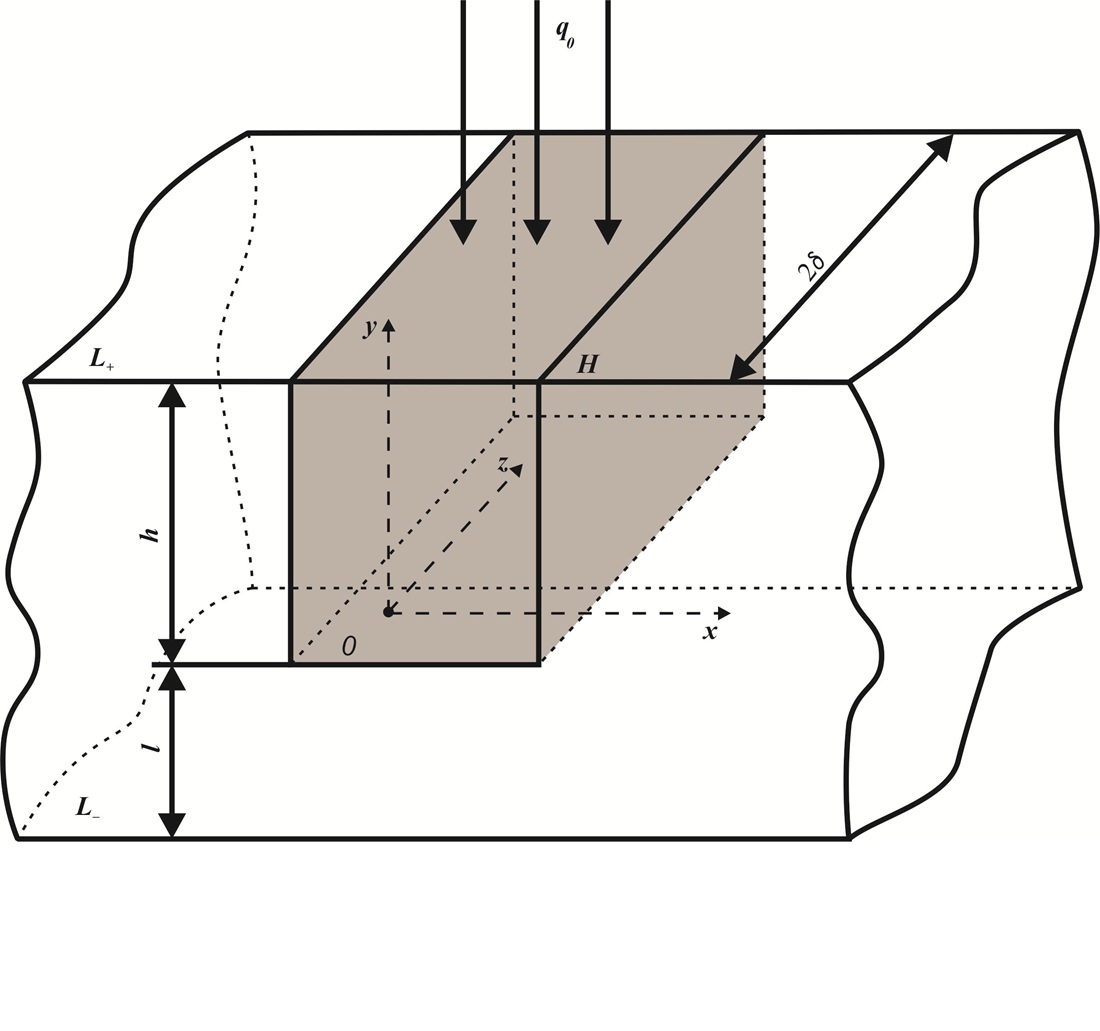
This study investigates heat exchange processes in isotropic spatial environments with foreign semi-through elements subjected to external and internal thermal loads.
Significant temperature gradients arise as a result of the thermal load. To establish and analyze temperature regimes for effective operation of electronic devices, mathematical models for determining temperature fields have been constructed.
Based on the formulated boundary value problems of thermal conductivity, their analytical and numerical solutions have been defined. Using these solutions, numerical calculations of the temperature distribution in spatial coordinates for given geometric and thermophysical parameters have been performed.
For an effective description of the thermal conductivity coefficient for inhomogeneous spatial media, asymmetric unit functions were used. A technique for segment-constant approximation of temperature as a function of spatial coordinates on the surfaces of foreign elements has been introduced. As a result, second-order differential equations with partial derivatives and discontinuous and singular coefficients have been derived.
The numerical results reflect temperature distribution in the media in spatial coordinates for the given geometric and thermophysical parameters. The number of partitions of the intervals (0; h), (–H; H), (0; R) was chosen to be equal to 9. That has made it possible to obtain numerical values of temperature with an accuracy of 10–6. The constructed mathematical models of heat transfer make it possible to analyze spatial isotropic media with foreign through-going elements in terms of their thermal stability
References
- Zhuravchak, L. M., Zabrodska, N. V. (2025). Solving inverse problem of the potential theory by the cascade algorithm and the near-boundary element method. Mathematical Modeling and Computing, 12 (4), 1243–1253. https://doi.org/10.23939/mmc2025.04.1243
- Bartwal, N., Shahane, S., Roy, S., Vanka, S. P. (2023). Simulation of heat conduction in complex domains of multi-material composites using a meshless method. Applied Mathematics and Computation, 457, 128208. https://doi.org/10.1016/j.amc.2023.128208
- Łach, Ł., Svyetlichnyy, D. (2025). Advances in Numerical Modeling for Heat Transfer and Thermal Management: A Review of Computational Approaches and Environmental Impacts. Energies, 18 (5), 1302. https://doi.org/10.3390/en18051302
- Channouf, S., Benhamou, J., Jami, M. (2024). Investigating convective and conductive heat transfer in square and circular heated bodies: A novel approach using coupled Runge-Kutta and lattice Boltzmann method. Thermal Science and Engineering Progress, 49, 102441. https://doi.org/10.1016/j.tsep.2024.102441
- Bi, D., Jiang, M., Chen, H., Liu, S., Liu, Y. (2020). Effects of thermal conductivity on the thermal contact resistance between non-conforming rough surfaces: An experimental and modeling study. Applied Thermal Engineering, 171, 115037. https://doi.org/10.1016/j.applthermaleng.2020.115037
- Shen, F., Li, Y.-H., Güler, M. A., Wu, H.-D., Shen, W.-W., Ke, L.-L. (2025). A high-efficiency prediction method for thermal contact resistance of rough surfaces. International Communications in Heat and Mass Transfer, 167, 109325. https://doi.org/10.1016/j.icheatmasstransfer.2025.109325
- Jiang, G., Chen, W., Chen, J., Yang, W. (2026). Experimental Investigation of Thermal Contact Resistance at Flat/Curved Surface Interfaces Under Various Temperature, Pressure, and Surface Roughness Levels. Technologies, 14 (1), 41. https://doi.org/10.3390/technologies14010041
- Chumak, K. А., Martynyak, R. М. (2018). Effective Thermal Contact Resistance of Regularly Textured Bodies in the Presence of Intercontact Heat-Conducting Media and the Phenomenon of Thermal Rectification. Journal of Mathematical Sciences, 236 (2), 160–171. https://doi.org/10.1007/s10958-018-4103-7
- Silva, D. (2022). Modeling the Transient Response of Thermal Circuits. Applied Sciences, 12 (24), 12555. https://doi.org/10.3390/app122412555
- Chandra, S., Chowdhury, S. S., Roy, K. (2025). 2D-ThermAl: Physics-Informed Framework for Thermal Analysis of Circuits using Generative AI. IEEE Transactions on Computer-Aided Design of Integrated Circuits and Systems. https://doi.org/10.1109/tcad.2025.3642715
- Padmanabhan, N. (2024). A Transient Thermal Model for Power Electronics Systems. SoutheastCon 2024, 1294–1299. https://doi.org/10.1109/southeastcon52093.2024.10500091
- Zorzetto, M., Torchio, R., Lucchini, F., Massei, S., Robol, L., Dughiero, F. (2024). Reduced Order Modeling for Thermal Simulations of Electric Components With Surface-to-Surface Radiation. IEEE Access, 12, 178117–178126. https://doi.org/10.1109/access.2024.3507367
- Havrysh, V., Kochan, V. (2023). Mathematical Models to Determine Temperature Fields in Heterogeneous Elements of Digital Devices with Thermal Sensitivity Taken into Account. 2023 IEEE 12th International Conference on Intelligent Data Acquisition and Advanced Computing Systems: Technology and Applications (IDAACS), 983–991. https://doi.org/10.1109/idaacs58523.2023.10348875
- Havrysh, V., Kolyasa, L. (2026). Mathematical modeling and analysis of heat transfer in structures with foreign elements. Naukovyi Visnyk Natsionalnoho Hirnychoho Universytetu, 1, 34–42. https://doi.org/10.33271/nvngu/2026-1/034
Downloads
Published
How to Cite
Issue
Section
License
Copyright (c) 2026 Vasyl Havrysh, Svitlana Yatsyshyn, Lubov Kolyasa, Mykhailo Stepaniak, Andrii Kapustianskyi

This work is licensed under a Creative Commons Attribution 4.0 International License.
The consolidation and conditions for the transfer of copyright (identification of authorship) is carried out in the License Agreement. In particular, the authors reserve the right to the authorship of their manuscript and transfer the first publication of this work to the journal under the terms of the Creative Commons CC BY license. At the same time, they have the right to conclude on their own additional agreements concerning the non-exclusive distribution of the work in the form in which it was published by this journal, but provided that the link to the first publication of the article in this journal is preserved.
A license agreement is a document in which the author warrants that he/she owns all copyright for the work (manuscript, article, etc.).
The authors, signing the License Agreement with TECHNOLOGY CENTER PC, have all rights to the further use of their work, provided that they link to our edition in which the work was published.
According to the terms of the License Agreement, the Publisher TECHNOLOGY CENTER PC does not take away your copyrights and receives permission from the authors to use and dissemination of the publication through the world's scientific resources (own electronic resources, scientometric databases, repositories, libraries, etc.).
In the absence of a signed License Agreement or in the absence of this agreement of identifiers allowing to identify the identity of the author, the editors have no right to work with the manuscript.
It is important to remember that there is another type of agreement between authors and publishers – when copyright is transferred from the authors to the publisher. In this case, the authors lose ownership of their work and may not use it in any way.








