Determining dispersion characteristics of rectangular waveguide with narrow impedance walls
DOI:
https://doi.org/10.15587/1729-4061.2026.359146Keywords:
propagation constant, boundary conditions, surface waves, dispersion characteristics, surface impedance, filters of harmonicsAbstract
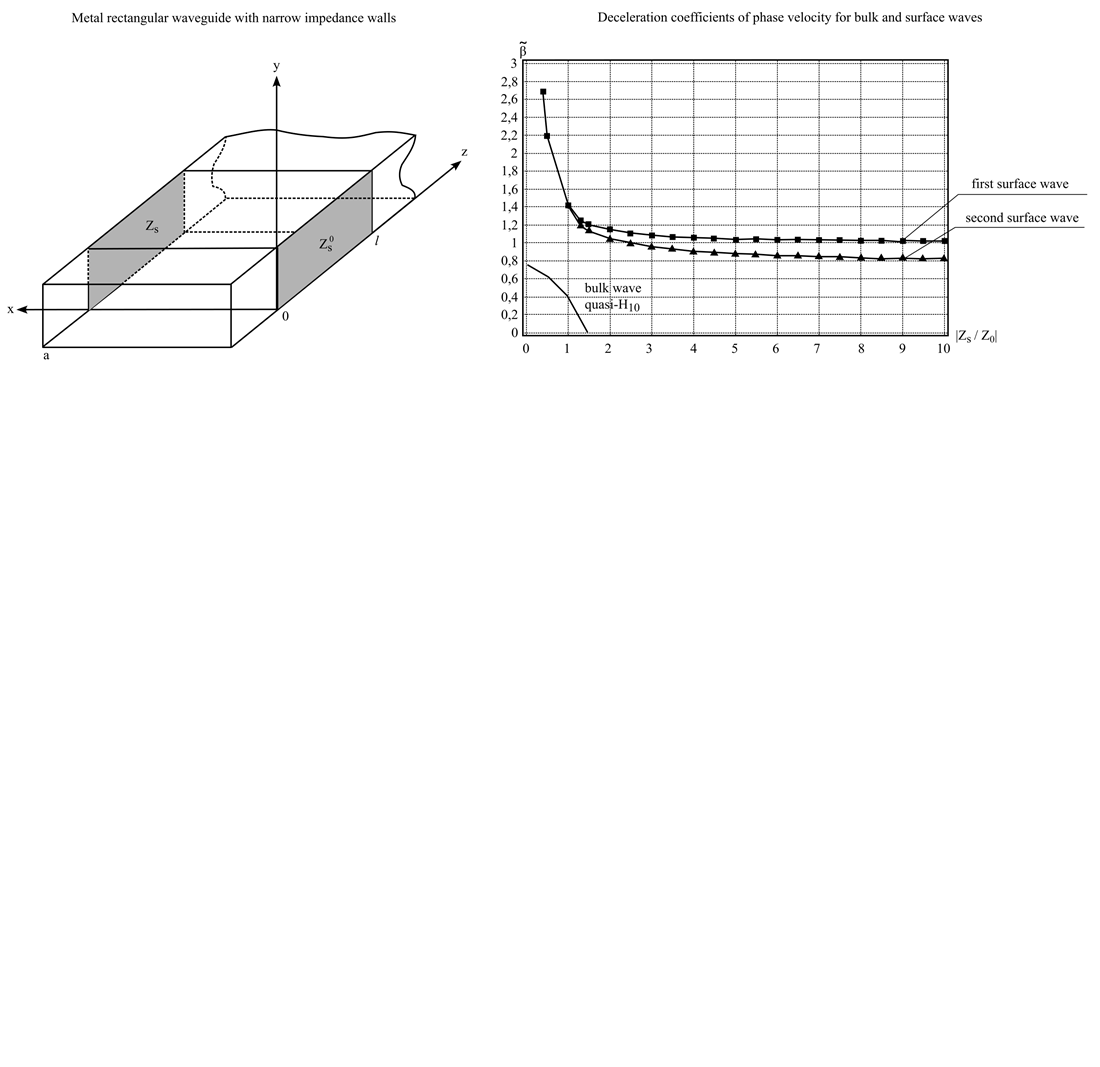
This study explores a rectangular metal waveguide with narrow impedance walls, described by equivalent impedance-type boundary conditions. The task addressed is to build an effective mathematical model for analyzing waveguides with non-ideally conducting and irregular boundary surfaces, by determining their dispersion characteristics and wave propagation constants.
An approach based on the Fourier method and Leontovych impedance boundary conditions has been proposed. This has made it possible to avoid the complications associated with the vector statement of the problem and obtain transcendental equations for determining the propagation constants of bulk and surface waves. The dispersion equation was analytically solved and the eigenwave parameters were calculated in a wide range of surface impedance values.
The analytical results made it possible to verify correctness of the approach from a physical point of view; they could facilitate the optimization of parameters for the basic structure to the requirements of a specific microwave device. This is due to the use of an impedance boundary condition model, which adequately takes into account the influence of losses and reactive properties of the surface on electromagnetic fields and wave propagation processes in the waveguide.
In practice, the proposed approach could be used for the analysis and design of complex periodic microwave structures, in particular, filters, directional couplers, as well as power distribution elements between phased array antenna elements. Through the generalization of research results in the form of normalization of the impedance and spectral characteristics of the basic waveguide structure, the obtained characteristics could be used to design microwave devices in the range from decimeter to millimeter wavelengths
References
- Gowrish, B., Mansour, R. R. (2020). A Novel Bandwidth Reconfigurable Waveguide Filter for Aerospace Applications. IEEE Microwave and Wireless Components Letters, 30 (6), 577–580. https://doi.org/10.1109/lmwc.2020.2989283
- Yuferev, S. V. (2009). Surface Impedance Boundary Conditions. CRC Press. https://doi.org/10.1201/9781315219929
- Guha, R., Wang, X., Tang, X., Varshney, A. K., Ghosh, S. K., Datta, S. K. et al. (2021). Metamaterial assisted microwave tubes: a review. Journal of Electromagnetic Waves and Applications, 36 (9), 1189–1211. https://doi.org/10.1080/09205071.2021.2016499
- Gaucher, S., Guiffaut, C., Bui, N., Reineix, A., Cessenat, O. (2023). Angle-Dependent Face-Centered SIBC Model of Metamaterial in Conformal FDTD Methods. IEEE Transactions on Antennas and Propagation, 71 (9), 7438–7446. https://doi.org/10.1109/tap.2023.3297330
- Larson, M. G., Bengzon, F. (2013). The Finite Element Method: Theory, Implementation, and Applications. Texts in Computational Science and Engineering. Springer Berlin Heidelberg. https://doi.org/10.1007/978-3-642-33287-6
- Beilina, L., Ruas, V. (2022). On the Maxwell-wave equation coupling problem and its explicit finite-element solution. Applications of Mathematics, 68 (1), 75–98. https://doi.org/10.21136/am.2022.0210-21
- Jiang, H., Córcoles, J., Ruiz-Cruz, J. A. (2025). Fusing Leontovich Boundary Conditions and Scalar 2-D FEM to Compute Lid and Lateral Wall Losses in H-Plane Waveguide Devices. IEEE Microwave and Wireless Technology Letters, 35(6), 764–767. https://doi.org/10.1109/lmwt.2025.3557266
- Hinojosa, J., Máximo-Gutiérrez, C., Alvarez-Melcon, A. (2023). Design of Evanescent Mode Band-Pass Filters Based on Groove Gap Waveguide Technology. https://doi.org/10.2139/ssrn.4332500
- Marini, S., Rueda, A. S., Soto, P., Nieves, E. G., Boria, V. E. (2026). Design of Low-Pass Corrugated Filters Based on Half-Mode Groove Gap Waveguide Technology. Electronics, 15 (1), 234. https://doi.org/10.3390/electronics15010234
- Zhou, K., Wu, K. (2023). Substrate Integrated Waveguide Multiband Bandpass Filters and Multiplexers: Current Status and Future Outlook. IEEE Journal of Microwaves, 3 (1), 466–483. https://doi.org/10.1109/jmw.2022.3227131
- Shen, Y., Zhang, T., Luo, L., Zhu, H., Chen, L. (2025). 4 × 4 Wideband Slot Antenna Array Fed by TE440 Mode Based on Groove Gap Waveguide. Electronics, 14 (4), 813. https://doi.org/10.3390/electronics14040813
- Zaghdani, A., Hasnaoui, A., Sayari, S. (2024). Analysis of aWeak Galerkin Mixed Formulation for Maxwell’s Equations. Kragujevac Journal of Mathematics, 50 (3), 387. https://doi.org/10.46793/kgjmat2603.387z
- Abdikalikova, G. (2025). Solvability of the Boundary Value Problem for a System of Parabolic Equations. Mathematical Methods in the Applied Sciences, 49 (5), 4328–4339. https://doi.org/10.1002/mma.70348
- Shusharin, M. M., Svetkin, M. I., Bogolyubov, A. N., Erokhin, A. I. (2021). Mathematical Modeling of Infinite Waveguides with Inhomogeneous Losses. 2021 Photonics & Electromagnetics Research Symposium (PIERS), 92–97. https://doi.org/10.1109/piers53385.2021.9694768
- Osipov, A. V. (2021). A Semi-Analytical Solution of the Impedance-Wedge Problem. 2021 International Conference on Electromagnetics in Advanced Applications (ICEAA), 193. https://doi.org/10.1109/iceaa52647.2021.9539554
- Zhang, R. (2021). Numerical methods for scattering problems in periodic waveguides. Numerische Mathematik, 148 (4), 959–996. https://doi.org/10.1007/s00211-021-01229-0
- Divakov, D. V., Tyutyunnik, A. A. (2022). Symbolic Investigation of the Spectral Characteristics of Guided Modes in Smoothly Irregular Waveguides. Programming and Computer Software, 48 (2), 80–89. https://doi.org/10.1134/s0361768822020049
- Heinlein, A., Klawonn, A., Lanser, M., Weber, J. (2021). Combining machine learning and domain decomposition methods for the solution of partial differential equations—A review. GAMM-Mitteilungen, 44 (1). https://doi.org/10.1002/gamm.202100001
- Anaya, S. G., Moura, H. G., Teodoro, E. B., Miranda, R. F. d., Muñoz, D. M. (2025). A comprehensive digital waveguide formulation using the impedance method for acoustic simulation. Mechanical Systems and Signal Processing, 224, 112047. https://doi.org/10.1016/j.ymssp.2024.112047
- Arab, H., Wang, D., Wu, K., Dufour, S. (2022). A Full-Wave Discontinuous Galerkin Time-Domain Finite Element Method for Electromagnetic Field Mode Analysis. IEEE Access, 10, 125243–125253. https://doi.org/10.1109/access.2022.3222359
- Wang, P., Shi, Y., Ban, Z. G., Zhu, S. C., Yang, Q., Li, L. (2020). Penalty Factor Threshold and Time Step Bound Estimations for Discontinuous Galerkin Time-Domain Method Based on Helmholtz Equation. IEEE Transactions on Antennas and Propagation, 68 (11), 7494–7506. https://doi.org/10.1109/tap.2020.2998585
- Feng, H., Chen, C., Wang, Y.-D., Wang, Y.-Y., Chen, H., Yin, W.-Y., Zhan, Q. (2025). A Superconvergent Discontinuous Galerkin Method Alleviating Numerical Dispersion in High-Frequency Wave Modeling. IEEE Transactions on Microwave Theory and Techniques, 73 (11), 8573–8584. https://doi.org/10.1109/tmtt.2025.3591719
- Franklin, J. (2025). Green’s Functions for Neumann Boundary Conditions. Mathematics, 13 (21), 3399. https://doi.org/10.3390/math13213399
- Abdullin, R., Narudinov, R. (2021). Propagation Constant in Tapered Segment of Slotted Rectangular Waveguide. 2021 29th Telecommunications Forum (TELFOR), 1–4. https://doi.org/10.1109/telfor52709.2021.9653384
- Huéscar de la Cruz, A. M., Gómez Molina, C., Quesada Pereira, F. D., Álvarez Melcón, A., Boria Esbert, V. E. (2024). Efficient Integral Equation Analysis of 3-D Rectangular Waveguide Microwave Circuits by Using Green’s Functions Accelerated With the Ewald Method. IEEE Transactions on Microwave Theory and Techniques, 72 (10), 5709–5720. https://doi.org/10.1109/tmtt.2024.3388193
Downloads
Published
How to Cite
Issue
Section
License
Copyright (c) 2026 Ludmila Logacheva, Tetiana Bugrova, Mikhail Chornoborodov, Sergii Morshchavka, Natalia Chornoborodova

This work is licensed under a Creative Commons Attribution 4.0 International License.
The consolidation and conditions for the transfer of copyright (identification of authorship) is carried out in the License Agreement. In particular, the authors reserve the right to the authorship of their manuscript and transfer the first publication of this work to the journal under the terms of the Creative Commons CC BY license. At the same time, they have the right to conclude on their own additional agreements concerning the non-exclusive distribution of the work in the form in which it was published by this journal, but provided that the link to the first publication of the article in this journal is preserved.
A license agreement is a document in which the author warrants that he/she owns all copyright for the work (manuscript, article, etc.).
The authors, signing the License Agreement with TECHNOLOGY CENTER PC, have all rights to the further use of their work, provided that they link to our edition in which the work was published.
According to the terms of the License Agreement, the Publisher TECHNOLOGY CENTER PC does not take away your copyrights and receives permission from the authors to use and dissemination of the publication through the world's scientific resources (own electronic resources, scientometric databases, repositories, libraries, etc.).
In the absence of a signed License Agreement or in the absence of this agreement of identifiers allowing to identify the identity of the author, the editors have no right to work with the manuscript.
It is important to remember that there is another type of agreement between authors and publishers – when copyright is transferred from the authors to the publisher. In this case, the authors lose ownership of their work and may not use it in any way.








