Identification of the influence of bend angle in an l-shaped channel on incompressible viscous flow
DOI:
https://doi.org/10.15587/1729-4061.2026.361507Keywords:
Viscous flow, L-shaped channel, incompressible Navier-Stokes equations, finite element methodAbstract
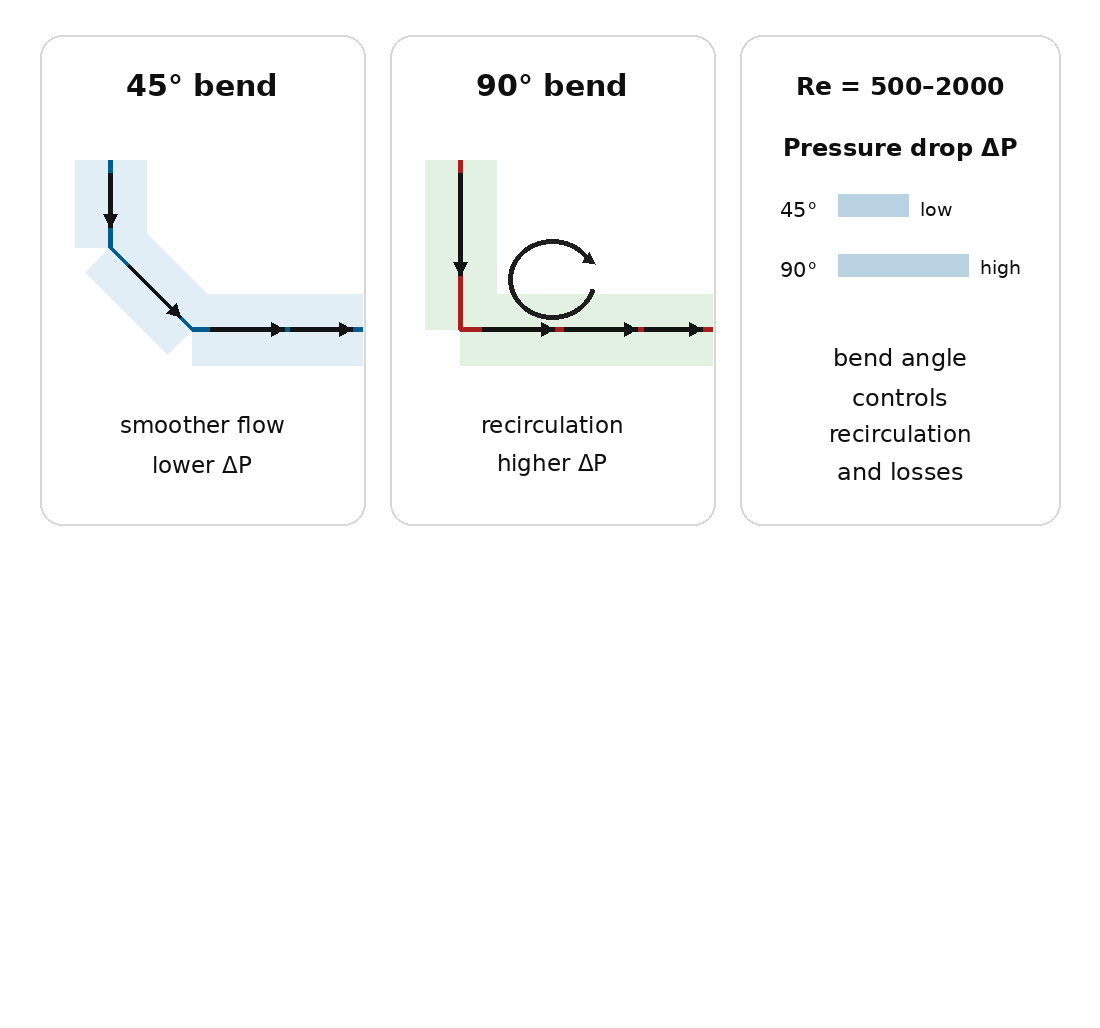
The object of this study is steady two-dimensional incompressible viscous flow in L-shaped channels with different bend angles. The problem to be solved is to determine how the bend angle affects the flow pattern and hydraulic losses. Two geometries are compared: channels with 45° and 90° bends. The computations are carried out for Re = 500, 1000, and 2000. The flow is described by the stationary Navier-Stokes equations, which are solved by the finite element method. Newton's method is used to solve the nonlinear system. The comparison is performed under the same boundary conditions and computational parameters.
The results are analyzed using velocity and pressure fields, stream-function distributions, pressure drop, loss coefficient, and Euler number. The calculations show that the 90° bend causes a stronger change in the flow after the corner than the 45° bend. In the 90° channel, the direction of motion changes more sharply. Therefore, the velocity field downstream of the bend is more distorted, the gradients are higher, and recirculation zones become more visible as Re increases. In the 45° channel, the turn is smoother, so the velocity and pressure fields change more regularly.
The integral characteristics confirm this result. For all Re considered, the 90° bend gives a larger pressure drop than the 45° bend. The loss coefficient and Euler number vary with Re, but the 90° geometry remains less favorable. This is explained by stronger rearrangement of the flow caused by the sharper turn. The influence of the bend angle is shown both by field plots and by pressure-loss indicators. The results may be used in design of ducts, cooling channels, and pipelines when pressure losses in curved parts should be reduced
References
- Glowinski, R. (1984). Numerical Methods for Nonlinear Variational Problems. Springer Berlin Heidelberg. https://doi.org/10.1007/978-3-662-12613-4
- Olshanskii, M. A. (2002). A low order Galerkin finite element method for the Navier–Stokes equations of steady incompressible flow: a stabilization issue and iterative methods. Computer Methods in Applied Mechanics and Engineering, 191 (47-48), 5515–5536. https://doi.org/10.1016/s0045-7825(02)00513-3
- Varun Kumar, R., Nagaraja, K. V., Kovács, E., Shah, N. A., Chung, J., Prasannakumara, B. C. (2023). Accelerating finite element modeling of heat sinks with parallel processing using FEniCSx. Case Studies in Thermal Engineering, 44, 102865. https://doi.org/10.1016/j.csite.2023.102865
- Larson, M. G., Bengzon, F. (2013). The Finite Element Method: Theory, Implementation, and Applications. Springer Berlin Heidelberg. https://doi.org/10.1007/978-3-642-33287-6
- Zienkiewicz, O. C., Taylor, R. L., Zhu, J. Z. (2013). The Finite Element Method: Its Basis and Fundamentals. Oxford: Butterworth-Heinemann. https://doi.org/10.1016/c2009-0-24909-9
- Bilal, F. S., Sedrez, T. A., Shirazi, S. A. (2021). Experimental and CFD investigations of 45 and 90 degrees bends and various elbow curvature radii effects on solid particle erosion. Wear, 476, 203646. https://doi.org/10.1016/j.wear.2021.203646
- Ben Haroual, B., Albagnac, J., Brancher, P., Cazin, S., Boldo, D., Thibert, E., Mathis, R. (2025). Experimental investigation of Dean-vortices oscillation downstream of a 90° Bend. Experimental Thermal and Fluid Science, 163, 111402. https://doi.org/10.1016/j.expthermflusci.2024.111402
- Heskestad, G. (1971). Two-Dimensional Miter-Bend Flow. Journal of Basic Engineering, 93 (3), 433–443. https://doi.org/10.1115/1.3425271
- Yamashita, H., Izumi, R., Kushida, G., Mizuno, T. (1986). Fluid Flow and Heat Transfer in a Two-dimensional Miter-bend : 1st Report, Experiments and Analyses. Bulletin of JSME, 29 (258), 4164–4169. https://doi.org/10.1299/jsme1958.29.4164
- Xiong, R., Chung, J. N. (2008). Effects of miter bend on pressure drop and flow structure in micro-fluidic channels. International Journal of Heat and Mass Transfer, 51 (11-12), 2914–2924. https://doi.org/10.1016/j.ijheatmasstransfer.2007.09.018
- Al-Tameemi, W. T. M., Ricco, P. (2018). Pressure-Loss Coefficient of 90 deg Sharp-Angled Miter Elbows. Journal of Fluids Engineering, 140 (6). https://doi.org/10.1115/1.4038986
- Villegas-León, J. J. (2025). Head losses and experimental loss coefficient in 45° and 90° elbow of pvc small-diameter pipes for single-phase flow and moderate reynolds numbers. Journal of Southwest Jiaotong University, 3. https://doi.org/10.35741/issn.0258-2724.60.3.5
- Varun Kumar, R., Nagaraja, K. V. (2023). Steady solver for incompressible Navier-Stokes equation with automated adaptive mesh refinement using FEniCS. Materials Today: Proceedings. https://doi.org/10.1016/j.matpr.2023.04.425
- Temirbekov, A., Baigereyev, D., Temirbekov, N., Urmashev, B., Amantayeva, A. (2021). Parallel CUDA implementation of a numerical algorithm for solving the Navier-Stokes equations using the pressure uniqueness condition. International Conference on Analysis and Applied Mathematics (Icaam 2020), 2325, 20063. https://doi.org/10.1063/5.0041039
- Temirbekov, A., Altybay, A., Temirbekovа, L., Kasenov, S. (2022). Development of parallel implementation for the Navier-Stokes equation in doubly connected areas using the fictitious domain method. Eastern-European Journal of Enterprise Technologies, 2 (4 (116)), 38–46. https://doi.org/10.15587/1729-4061.2022.254261
- Temirbekov, A., Zhaksylykova, Z., Malgazhdarov, Y., Kasenov, S. (2022). Application of the Fictitious Domain Method for Navier-Stokes Equations. Computers, Materials & Continua, 73 (1), 2035–2055. https://doi.org/10.32604/cmc.2022.027830
- Baitulenov, Z., Olshanskii, M., Temirbekov, A., Temirbekov, N., Kasenov, S. (2026). A Modified Brinkman Penalization Fictitious Domain Method for the Unsteady Navier‐Stokes Equations. Numerical Methods for Partial Differential Equations, 42 (3). https://doi.org/10.1002/num.70089
- Temirbekov, N., Khakimzyanov, G., Kerimakyn, A. (2026). Application of the Curvilinear Coordinate Method for the Numerical Solution of the Navier–Stokes Equations in Domains with Complex Boundaries. Computation, 14 (3), 58. https://doi.org/10.3390/computation14030058
- Çengel, Y., Cimbala, J. (2017). Fluid Mechanics: Fundamentals and Applications. New York: McGraw-Hill Higher Education, 1024.
- Galdi, G. P. (2011). An Introduction to the Mathematical Theory of the Navier-Stokes Equations. Springer Monographs in Mathematics. Springer New York. https://doi.org/10.1007/978-0-387-09620-9
- Automated Solution of Differential Equations by the Finite Element Method (2012). Lecture Notes in Computational Science and Engineering. Springer Berlin Heidelberg. https://doi.org/10.1007/978-3-642-23099-8
- Langtangen, H. P., Mardal, K.-A. (2016). Introduction to Numerical Methods for Variational Problems. Available at: http://hplgit.github.io/fem-book/doc/web/
- Alnæs, M. S., Blechta, J., Hake, J. et al. (2015) The FEniCS Project Version 1.5. Archive of Numerical Software, 3 (100), 23. https://doi.org/10.11588/ans.2015.100.20553
- Langtangen, H. P., Logg, A. (2016). Solving PDEs in Python. Springer International Publishing. https://doi.org/10.1007/978-3-319-52462-7
- Kumar, V., Chandan, K., Nagaraja, K. V., Reddy, M. V. (2022). Heat Conduction with Krylov Subspace Method Using FEniCSx. Energies, 15 (21), 8077. https://doi.org/10.3390/en15218077
- Geuzaine, C., Remacle, J.-F. (2009). Gmsh: A 3‐D finite element mesh generator with built‐in pre‐ and post‐processing facilities. International Journal for Numerical Methods in Engineering, 79 (11), 1309–1331. https://doi.org/10.1002/nme.2579
- Baigereyev, D., Omariyeva, D., Temirbekov, N., Yergaliyev, Y., Boranbek, K. (2022). Numerical Method for a Filtration Model Involving a Nonlinear Partial Integro-Differential Equation. Mathematics, 10 (8), 1319. https://doi.org/10.3390/math10081319
Downloads
Published
How to Cite
Issue
Section
License
Copyright (c) 2026 Almas Temirbekov, Zhadra Zhaksylykova, Bekdaulet Khudaibergen, Nurlan Temirbekov

This work is licensed under a Creative Commons Attribution 4.0 International License.
The consolidation and conditions for the transfer of copyright (identification of authorship) is carried out in the License Agreement. In particular, the authors reserve the right to the authorship of their manuscript and transfer the first publication of this work to the journal under the terms of the Creative Commons CC BY license. At the same time, they have the right to conclude on their own additional agreements concerning the non-exclusive distribution of the work in the form in which it was published by this journal, but provided that the link to the first publication of the article in this journal is preserved.
A license agreement is a document in which the author warrants that he/she owns all copyright for the work (manuscript, article, etc.).
The authors, signing the License Agreement with TECHNOLOGY CENTER PC, have all rights to the further use of their work, provided that they link to our edition in which the work was published.
According to the terms of the License Agreement, the Publisher TECHNOLOGY CENTER PC does not take away your copyrights and receives permission from the authors to use and dissemination of the publication through the world's scientific resources (own electronic resources, scientometric databases, repositories, libraries, etc.).
In the absence of a signed License Agreement or in the absence of this agreement of identifiers allowing to identify the identity of the author, the editors have no right to work with the manuscript.
It is important to remember that there is another type of agreement between authors and publishers – when copyright is transferred from the authors to the publisher. In this case, the authors lose ownership of their work and may not use it in any way.








