Devising a multi-criterion approach to forming a portfolio of territorial community projects on the basis of public participation
DOI:
https://doi.org/10.15587/1729-4061.2026.365568Keywords:
set of initiatives, situational structuring, Kruskal-Wallis criterion, rank correlation, AHP methodAbstract
This study investigates the process of forming and optimizing the structure of the public participation project portfolio (public budget) of a territorial community given the multi-vector nature of residents’ requests and limited resource provision. The results aim to solve the task of ensuring the overall quality and balance in the formation of participatory budgets. This is achieved through the automated selection of innovative and social initiatives that correspond to the specificity and level of their funding.
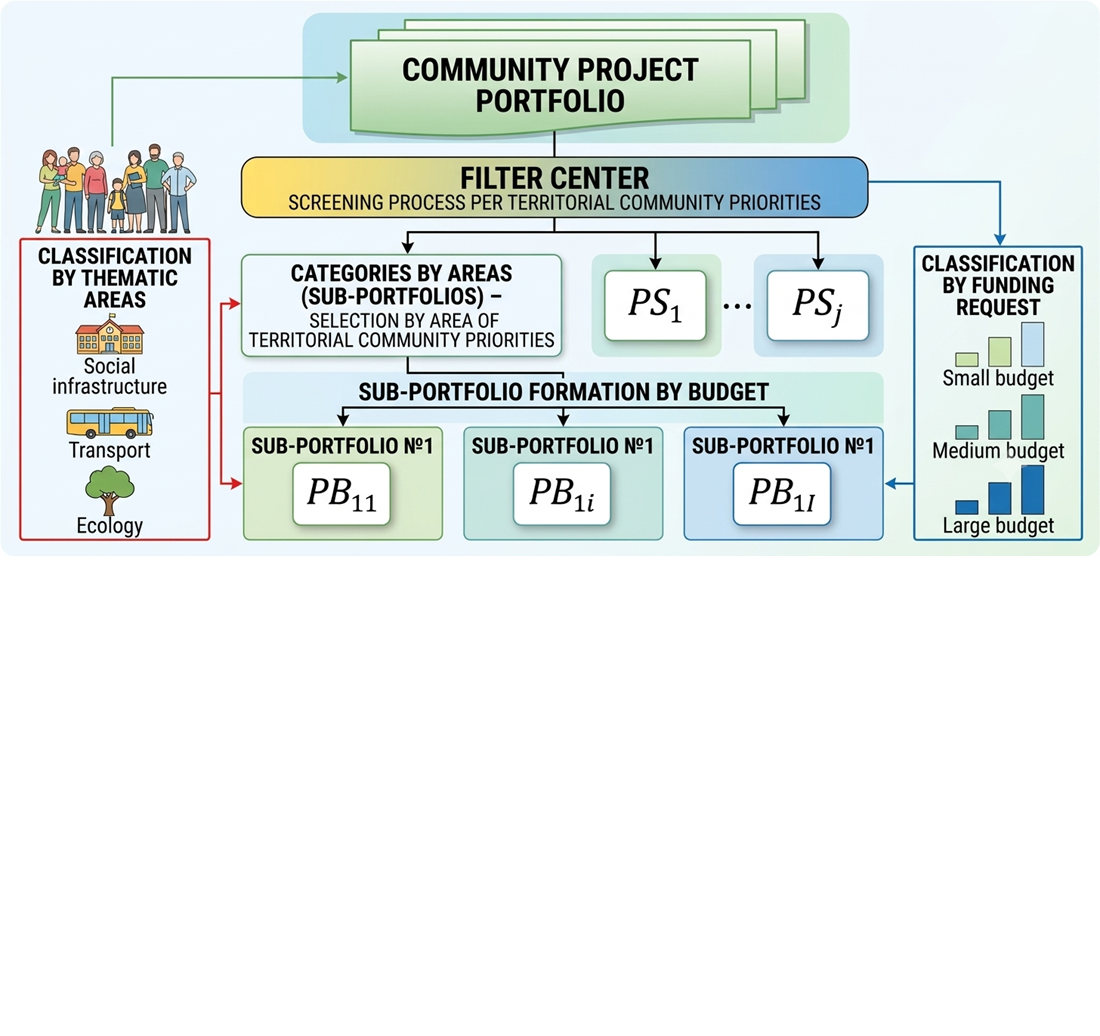
A method of situational structuring of the public participation project portfolio by categories of thematic areas as sub-portfolios has been devised. Compared to conventional approaches, which are usually based on only one criterion of direct rating voting, the proposed approach is based on multi-criteria selection and situational adaptation of the portfolio architecture. The approach algorithm uses a combination of evaluation of the results of mathematical modeling using non-parametric statistics and the AHP method. This is explained by the fact that the multi-criteria structuring method allows for a better integrated result compared to traditional approaches.
The approach was tested on the basis of a set of real projects in three thematic areas. According to the test results, it was found that the integrated indicator of the socio-strategic effect of the portfolio using the cross-matrix model is 21% higher than when using the conventional rating selection. The efficiency of budget use increased by 11%.
Such results indicate the possibility of effective application of the designed toolset in practice for automating and eliminating subjective factor in the distribution of large arrays of participatory budget funds by local governments
References
- Arancibia-Carvajal, S., Petit-Laurent, F., Troncoso, M. P., Vargas-Vargas, M. (2022). Proposal of a Multi-Criteria Model for the Evaluation of Territorial Development Plans: An Application in Chile’s Lagging Areas. International Journal of Environmental Research and Public Health, 19 (18), 11312. https://doi.org/10.3390/ijerph191811312
- Barbati, M., Figueira, J. R., Greco, S., Ishizaka, A., Panaro, S. (2023). A multiple criteria methodology for priority based portfolio selection. Socio-Economic Planning Sciences, 88, 101595. https://doi.org/10.1016/j.seps.2023.101595
- Steyvers, K., Haesevoets, T., Roets, A., Verschuere, B., Wauters, B., Berkvens, L. et al. (2026). Between legitimacy and favorability – comparing perspectives of democratic stakeholders in local participatory arrangements. International Journal of Public Sector Management, 1–22. https://doi.org/10.1108/ijpsm-10-2025-0458
- Mavrotas, G., Makryvelios, E. (2023). R&D project portfolio selection using the Iterative Trichotomic Approach in order to study how subjectivity of the weights is reflected in the selected projects of the final portfolio. Operational Research, 23 (3). https://doi.org/10.1007/s12351-023-00785-7
- Gallozzi, T., Micangeli, F., Bricca, D., Groppi, D., Astiaso Garcia, D. (2026). Multi Criteria Decision Making for Distributed Renewable Energy Systems: A Review of Methods, Criteria Selection and Weighting Techniques. https://doi.org/10.20944/preprints202604.1661.v1
- Santolamazza, V., Grossi, G., Mattei, G. (2025). The seesaw experience of participatory budgeting: the role of the institutional entrepreneur. International Journal of Public Sector Management, 1–20. https://doi.org/10.1108/ijpsm-10-2024-0328
- Smaniotto Costa, C., García-Esparza, J. A., Kimic, K. (2024). Participatory Budgeting and Placemaking: Concepts, Methods, and Practices. Urban Planning, 9. https://doi.org/10.17645/up.7162
- Umoh, A. A., Ohenhen, P. E., Chidolue, O., Ngozichukwu, B., Fafure, A. F., Ibekwe, K. I. (2024). Incorporating energy efficiency in urban planning: A review of policies and best practices. Engineering Science & Technology Journal, 5 (1), 83–98. https://doi.org/10.51594/estj.v5i1.729
- Rosy Rochmatullah, M., Nur Probohudono, A., Rahmawati, R., Wijayanti Daniar Paramita, R., Badriyah, N. (2023). Local government competitiveness analysis using the perspective of organizational excellence: Evidence from Indonesia. Problems and Perspectives in Management, 21 (2), 356–370. https://doi.org/10.21511/ppm.21(2).2023.35
- Aljabri, B., Aburas, H. M., Alkahtani, M., Almalki, A., Alharthy, A. (2024). Methodological approaches in prioritizing municipal projects: A case study of the municipality of the holy capital (Makkah). Journal of Infrastructure Policy and Development, 8 (15), 9664. https://doi.org/10.24294/jipd9664
- Esposito, G., Terlizzi, A., Guarino, M., Crutzen, N. (2023). Interpreting digital governance at the municipal level: Evidence from smart city projects in Belgium. International Review of Administrative Sciences, 90 (2), 301–317. https://doi.org/10.1177/00208523231167538
- Rezende, D. A., Almeida, G. G. F., Fumagalli, L. A. W. (2024). Strategic Digital City: Multiple Projects for Sustainable Urban Management. Sustainability, 16 (13), 5450. https://doi.org/10.3390/su16135450
- Qiu, B., Dou, Y., Chen, Z. (2024). Optimizing Multi-Stage Project Portfolio Selection Considering Integrating Lifecycle and Interactions. Systems, 12 (10), 414. https://doi.org/10.3390/systems12100414
- Omweri, F. S. (2024). A systematic literature review of e-government implementation in developing countries: Examining urban-rural disparities, institutional capacity, and socio-cultural factors in the context of local governance and progress towards SDG 16.6. International Journal of Research and Innovation in Social Science, 8 (8), 1173–1199. https://doi.org/10.47772/ijriss.2024.808088
- Kaiser, Z. R. M. A. (2024). Smart governance for smart cities and nations. Journal of Economy and Technology, 2, 216–234. https://doi.org/10.1016/j.ject.2024.07.003
- Gasco-Hernandez, M., Nasi, G., Cucciniello, M., Hiedemann, A. M. (2022). The role of organizational capacity to foster digital transformation in local governments: The case of three European smart cities. Urban Governance, 2 (2), 236–246. https://doi.org/10.1016/j.ugj.2022.09.005
- Li, Z., Wu, F., Zhang, F. (2021). A multi-scalar view of urban financialization: urban development and local government bonds in China. Regional Studies, 56 (8), 1282–1294. https://doi.org/10.1080/00343404.2021.1998419
Downloads
Published
How to Cite
Issue
Section
License
Copyright (c) 2026 Tatiana Vorkut, Vitalii Kharuta, Anna Kharchenko, Yurii Lushchai, Yuliia Bozhok, Yuliia Artemchuk

This work is licensed under a Creative Commons Attribution 4.0 International License.
The consolidation and conditions for the transfer of copyright (identification of authorship) is carried out in the License Agreement. In particular, the authors reserve the right to the authorship of their manuscript and transfer the first publication of this work to the journal under the terms of the Creative Commons CC BY license. At the same time, they have the right to conclude on their own additional agreements concerning the non-exclusive distribution of the work in the form in which it was published by this journal, but provided that the link to the first publication of the article in this journal is preserved.
A license agreement is a document in which the author warrants that he/she owns all copyright for the work (manuscript, article, etc.).
The authors, signing the License Agreement with TECHNOLOGY CENTER PC, have all rights to the further use of their work, provided that they link to our edition in which the work was published.
According to the terms of the License Agreement, the Publisher TECHNOLOGY CENTER PC does not take away your copyrights and receives permission from the authors to use and dissemination of the publication through the world's scientific resources (own electronic resources, scientometric databases, repositories, libraries, etc.).
In the absence of a signed License Agreement or in the absence of this agreement of identifiers allowing to identify the identity of the author, the editors have no right to work with the manuscript.
It is important to remember that there is another type of agreement between authors and publishers – when copyright is transferred from the authors to the publisher. In this case, the authors lose ownership of their work and may not use it in any way.








