Determining the quality of minced meat products manufactured with the use of the food additive "Laminaria+NPFe3O4"
DOI:
https://doi.org/10.15587/1729-4061.2026.365616Keywords:
"Laminaria NPFe3O4" food additive, minced meat products, quality assessment, food supply for the defense forcesAbstract
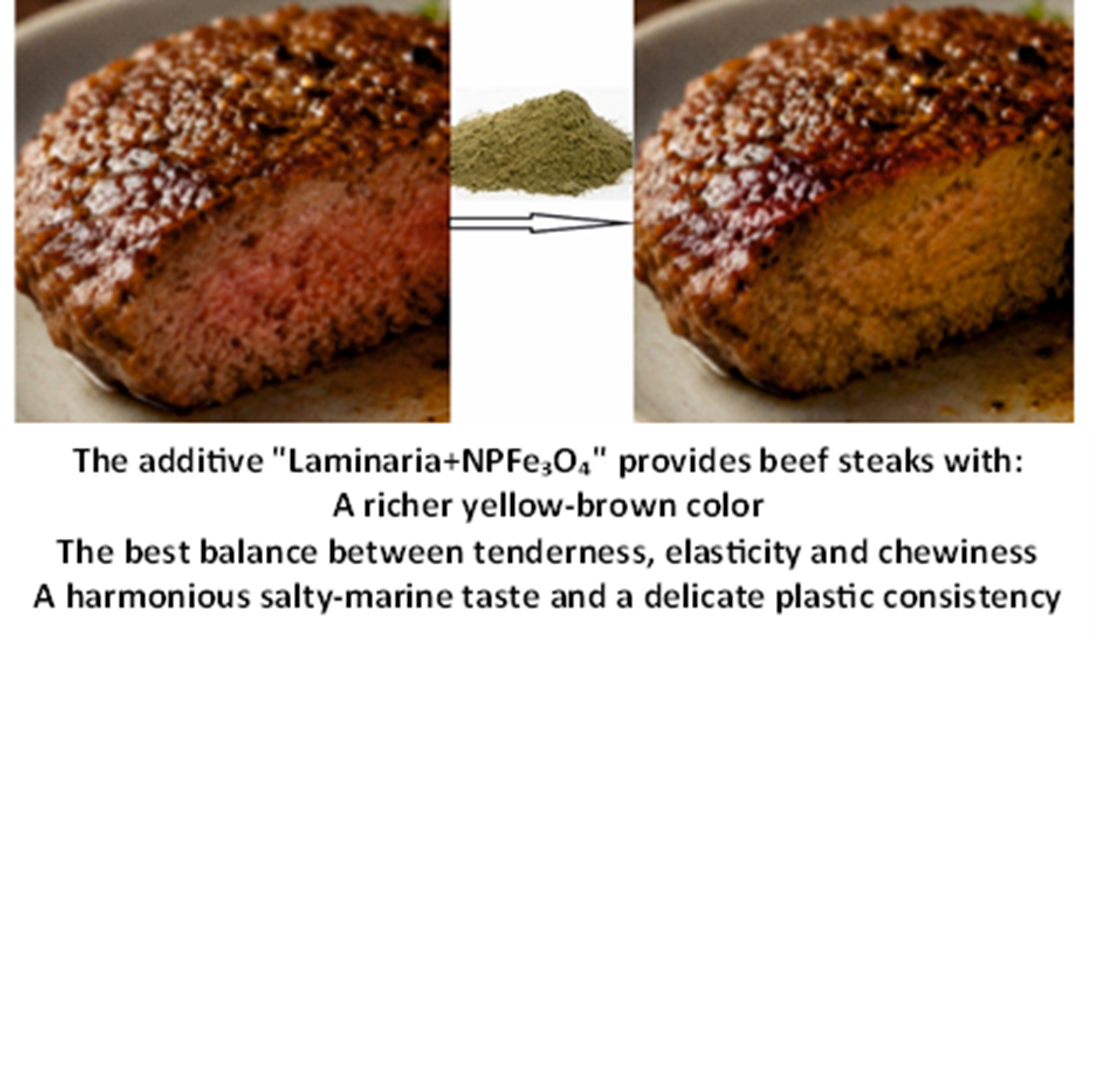
This study investigates the quality of minced meat products (beef steaks) fortified with a nanostructured food additive of the combined composition “Laminaria + NPFe3O4”. The task addressed is to stabilize the polyphase structure and improve the consumer properties of minced meat products. It was found that introducing the additive in the amount of 0.1–0.3% improves the taste, aroma, and consistency of steaks, contributes to the formation of a more saturated and natural color, as well as increases the hardness, plasticity, elasticity, and chewiness of the products. With the introduction of the “Laminaria + NPFe3O4” food additive, the brightness of the products decreased by 1.02–1.06 times, and the b* and H* indicators increased by 1.16–1.42 and 1.08–1.43 times, respectively. The optimal concentration of the additive was determined to be 0.2%.
The regularities in the influence of the nanostructured food additive of the combined composition "Laminaria + NPFe3O4", which combines components of brown algae Laminaria sp. and nanoparticles of iron oxide NPFe3O4, on the properties of beef steaks (on the transformation of pigments, the formation of textural characteristics, and sensory profile) have been established. The synergistic nature of the action of the additive components, which provides a comprehensive effect on the quality characteristics of minced meat products, has been shown, and its rational concentration at the level of 0.2% of the mass of the recipe mixture has been justified.
The scope of practical application of the results includes the technology of manufacturing minced meat products. The expected effects of the implementation of the NFACC "Laminaria + NPFe3O4" are the improvement of organoleptic and textural characteristics of products and the expansion of the range of functional meat products with increased biological value
References
- Tsykhanovska, I., Stabnikova, O., Yevlash, V., Gubsky, S. (2025). Wild Edible Brown Algae Laminaria and Iron Oxide Nanoparticles as a Combined Food Additive. Wild Edible Plants, 294–320. https://doi.org/10.1201/9781003486794-11
- Jiménez-Colmenero, F., Carballo, J., Cofrades, S. (2001). Healthier meat and meat products: their role as functional foods. Meat Science, 59 (1), 5–13. https://doi.org/10.1016/s0309-1740(01)00053-5
- Peñalver, R., Lorenzo, J. M., Ros, G., Amarowicz, R., Pateiro, M., Nieto, G. (2020). Seaweeds as a Functional Ingredient for a Healthy Diet. Marine Drugs, 18 (6), 301. https://doi.org/10.3390/md18060301
- Siladji, C., Djordjevic, V., Milijasevic, J. B., Heinz, V., Terjung, N., Sun, W., Tomasevic, I. (2024). Micro- and Macroalgae in Meat Products. Foods, 13 (6), 826. https://doi.org/10.3390/foods13060826
- Kumari, A., Chauhan, A. K. (2021). Iron nanoparticles as a promising compound for food fortification in iron deficiency anemia: a review. Journal of Food Science and Technology, 59 (9), 3319–3335. https://doi.org/10.1007/s13197-021-05184-4
- Ameta, S. K., Rai, A. K., Hiran, D., Ameta, R., Ameta, S. C. (2020). Use of Nanomaterials in Food Science. Biogenic Nano-Particles and Their Use in Agro-Ecosystems, 457–488. https://doi.org/10.1007/978-981-15-2985-6_24
- Perez‐Santaescolastica, C., Goemaere, O., Hanskens, J., Lorenzo, J. M., Fraeye, I. (2019). Effect of stabiliser classes (animal proteins, vegetable proteins, starches, hydrocolloids and dietary fibre) on the physicochemical properties of a model lean meat product. International Journal of Food Science & Technology, 55 (3), 970–977. https://doi.org/10.1111/ijfs.14354
- Tsykhanovska, I., Skurikhina, L., Evlash, V., Pavlotska, L. (2019). Influence of food additive “Magnetofood” on physical and chemical parameters, functional properties of model minced meat systems. Food Science and Technology, 13 (2). https://doi.org/10.15673/fst.v13i2.1389
- Tsykhanovska, I., Stabnikova, O., Dorohovich, V., Lytvyn, O., Hetman, P. (2025). Meat cutlets with iron oxide nanoparticles and alga Laminaria japonica. Ukrainian Food Journal, 14 (2), 238–258. https://doi.org/10.24263/2304-974x-2025-14-2-5
- Tsykhanovska, I., Stabnikova, O., Oliinyk, S., Lazarieva, T., Gubsky, S. (2024). Сombined food additive based on iron oxide nanoparticles and кombu in a rye-wheat bread technology. Ukrainian Food Journal, 13 (3), 576–596. https://doi.org/10.24263/2304-974x-2024-13-3-10
- McClements, D. J. (2020). Nanotechnology Approaches for Improving the Healthiness and Sustainability of the Modern Food Supply. ACS Omega, 5 (46), 29623–29630. https://doi.org/10.1021/acsomega.0c04050
- Mustafa, F., Andreescu, S. (2020). Nanotechnology-based approaches for food sensing and packaging applications. RSC Advances, 10 (33), 19309–19336. https://doi.org/10.1039/d0ra01084g
- Yao, H., Liu, W., Lin, L., Lu, Y., Gan, J.-H., Liu, Y. et al. (2021). Micro-nano particle formation and transformation mechanisms of broth in meat braised processing. Food Chemistry, 342, 128383. https://doi.org/10.1016/j.foodchem.2020.128383
- Liu, S., Yu, B., Wang, S., Shen, Y., Cong, H. (2020). Preparation, surface functionalization and application of Fe3O4 magnetic nanoparticles. Advances in Colloid and Interface Science, 281, 102165. https://doi.org/10.1016/j.cis.2020.102165
- Zhang, J.-Q., Chen, C., Fu, X., Liu, R.-H. (2020). A study on the Fe3O4@Fructus mori L. polysaccharide particles with enhanced antioxidant activity and bioavailability. Food & Function, 11 (3), 2268–2278. https://doi.org/10.1039/c9fo03047f
- dos Santos, P. P., Andrade, L. D. A., Flôres, S. H., Rios, A. D. O. (2018). Nanoencapsulation of carotenoids: a focus on different delivery systems and evaluation parameters. Journal of Food Science and Technology, 55 (10), 3851–3860. https://doi.org/10.1007/s13197-018-3316-6
- Wang, L., Huang, X., Wang, C., Tian, X., Chang, X., Ren, Y., Yu, S. (2021). Applications of surface functionalized Fe3O4 NPs-based detection methods in food safety. Food Chemistry, 342, 128343. https://doi.org/10.1016/j.foodchem.2020.128343
- Cofrades, S., López-López, I., Solas, M. T., Bravo, L., Jiménez-Colmenero, F. (2008). Influence of different types and proportions of added edible seaweeds on characteristics of low-salt gel/emulsion meat systems. Meat Science, 79 (4), 767–776. https://doi.org/10.1016/j.meatsci.2007.11.010
- Cofrades, S., Benedí, J., Garcimartin, A., Sánchez-Muniz, F. J., Jimenez-Colmenero, F. (2017). A comprehensive approach to formulation of seaweed-enriched meat products: From technological development to assessment of healthy properties. Food Research International, 99, 1084–1094. https://doi.org/10.1016/j.foodres.2016.06.029
- Agregán, R., Munekata, P. E., Domínguez, R., Carballo, J., Franco, D., Lorenzo, J. M. (2017). Proximate composition, phenolic content and in vitro antioxidant activity of aqueous extracts of the seaweeds Ascophyllum nodosum, Bifurcaria bifurcata and Fucus vesiculosus. Effect of addition of the extracts on the oxidative stability of canola oil under accelerated storage conditions. Food Research International, 99, 986–994. https://doi.org/10.1016/j.foodres.2016.11.009
- Tibbetts, S. M., Milley, J. E., Lall, S. P. (2016). Nutritional quality of some wild and cultivated seaweeds: Nutrient composition, total phenolic content and in vitro digestibility. Journal of Applied Phycology, 28 (6), 3575–3585. https://doi.org/10.1007/s10811-016-0863-y
- Kryzhova, Y., Antonuk, M., Stabnikov, V., Stabnikova, O. (2021). Stability of selenium and iodine in the functional meat products prepared with seaweeds under different cooking procedures. Ukrainian Food Journal, 10 (1), 136–144. https://doi.org/10.24263/2304-974x-2021-10-1-12
- Grabež, V., Devle, H., Kidane, A., Mydland, L. T., Øverland, M., Ottestad, S. et al. (2023). Sugar Kelp (Saccharina latissima) Seaweed Added to a Growing-Finishing Lamb Diet Has a Positive Effect on Quality Traits and on Mineral Content of Meat. Foods, 12 (11), 2131. https://doi.org/10.3390/foods12112131
- Grabež, V., Coll-Brasas, E., Fulladosa, E., Hallenstvedt, E., Håseth, T., Øverland, M. et al. (2022). Seaweed Inclusion in Finishing Lamb Diet Promotes Changes in Micronutrient Content and Flavour-Related Compounds of Raw Meat and Dry-Cured Leg (Fenalår). Foods, 11 (7), 1043. https://doi.org/10.3390/foods11071043
- Gomez-Zavaglia, A., Prieto Lage, M. A., Jimenez-Lopez, C., Mejuto, J. C., Simal-Gandara, J. (2019). The Potential of Seaweeds as a Source of Functional Ingredients of Prebiotic and Antioxidant Value. Antioxidants, 8 (9), 406. https://doi.org/10.3390/antiox8090406
- Gunathilake, T., Akanbi, T. O., Suleria, H. A. R., Nalder, T. D., Francis, D. S., Barrow, C. J. (2022). Seaweed Phenolics as Natural Antioxidants, Aquafeed Additives, Veterinary Treatments and Cross-Linkers for Microencapsulation. Marine Drugs, 20 (7), 445. https://doi.org/10.3390/md20070445
- Rajapakse, N., Kim, S.-K. (2011). Nutritional and Digestive Health Benefits of Seaweed. Marine Medicinal Foods - Implications and Applications, Macro and Microalgae, 17–28. https://doi.org/10.1016/b978-0-12-387669-0.00002-8
- Auer, J., Kim, A., Heupl, S., Mihnea, M., Öström, Å., Niimi, J., Langton, M. (2025). Consumer preferences of plant-based minced meat analogs: Linking physico-chemical properties, structural features, and sensory attributes. Food Structure, 46, 100492. https://doi.org/10.1016/j.foostr.2025.100492
- Prasol, I., Golembovskaya, N., Slobodyanyuk, N., Ochkolyas, E. (2017). Sensory analysis of semi-finished minced fish products by the flavour profile method. Scientific Messenger of LNU of Veterinary Medicine and Biotechnologies. Series «Food Technologies», 19 (80), 83–87. https://doi.org/10.15421/nvlvet8017
- Luo, M. R. (2015). CIELAB. Encyclopedia of Color Science and Technology, 1–7. https://doi.org/10.1007/978-3-642-27851-8_11-1
- Faustman, C., Suman, S. P., Ramanathan, R. (2023). The eating quality of meat: I Color. Lawrie’s Meat Science, 363–392. https://doi.org/10.1016/b978-0-323-85408-5.00023-6
- Suman, S. P., Nair, M. N., Joseph, P., Hunt, M. C. (2016). Factors influencing internal color of cooked meats. Meat Science, 120, 133–144. https://doi.org/10.1016/j.meatsci.2016.04.006
- Godschalk-Broers, L., Sala, G., Scholten, E. (2022). Meat Analogues: Relating Structure to Texture and Sensory Perception. Foods, 11 (15), 2227. https://doi.org/10.3390/foods11152227
- Bakhsh, A., Lee, S.-J., Lee, E.-Y., Sabikun, N., Hwang, Y.-H., Joo, S.-T. (2021). A Novel Approach for Tuning the Physicochemical, Textural, and Sensory Characteristics of Plant-Based Meat Analogs with Different Levels of Methylcellulose Concentration. Foods, 10 (3), 560. https://doi.org/10.3390/foods10030560
- Tsykhanovska, I. T., Lazarieva, T., Alexandrov, O., Riabchykov, M., Koval, A., Bryzytska, O. (2026). Physico-Chemical Study on the Mechanism of Interaction Between Divalent and Trivalent Iron Double Oxide Nanoparticles With Fibrillar Protein-Gelatin. Chemistry & Chemical Technology, 20 (1), 37–52. https://doi.org/10.23939/chcht20.01.037
Downloads
Published
How to Cite
Issue
Section
License
Copyright (c) 2026 Iryna Tsykhanovska, Lidiіa Tovma, Oleh Lytvyn, Alexandr Alexandrov, Tetiana Lazarieva, Viktoriia Yevlash, Oleh Lushchenko, Ihor Morozov, Sergiy Kaplun, Vasyl Vakuliuk

This work is licensed under a Creative Commons Attribution 4.0 International License.
The consolidation and conditions for the transfer of copyright (identification of authorship) is carried out in the License Agreement. In particular, the authors reserve the right to the authorship of their manuscript and transfer the first publication of this work to the journal under the terms of the Creative Commons CC BY license. At the same time, they have the right to conclude on their own additional agreements concerning the non-exclusive distribution of the work in the form in which it was published by this journal, but provided that the link to the first publication of the article in this journal is preserved.
A license agreement is a document in which the author warrants that he/she owns all copyright for the work (manuscript, article, etc.).
The authors, signing the License Agreement with TECHNOLOGY CENTER PC, have all rights to the further use of their work, provided that they link to our edition in which the work was published.
According to the terms of the License Agreement, the Publisher TECHNOLOGY CENTER PC does not take away your copyrights and receives permission from the authors to use and dissemination of the publication through the world's scientific resources (own electronic resources, scientometric databases, repositories, libraries, etc.).
In the absence of a signed License Agreement or in the absence of this agreement of identifiers allowing to identify the identity of the author, the editors have no right to work with the manuscript.
It is important to remember that there is another type of agreement between authors and publishers – when copyright is transferred from the authors to the publisher. In this case, the authors lose ownership of their work and may not use it in any way.








