Визначення якості м’ясних січених виробів, виготовлених з використанням харчової добавки «Laminaria+NPFe3O4»
DOI:
https://doi.org/10.15587/1729-4061.2026.365616Ключові слова:
харчова добавка «Laminaria NPFe₃O₄», м’ясні січені вироби, оцінювання якості, продовольче забезпечення сил оборониАнотація
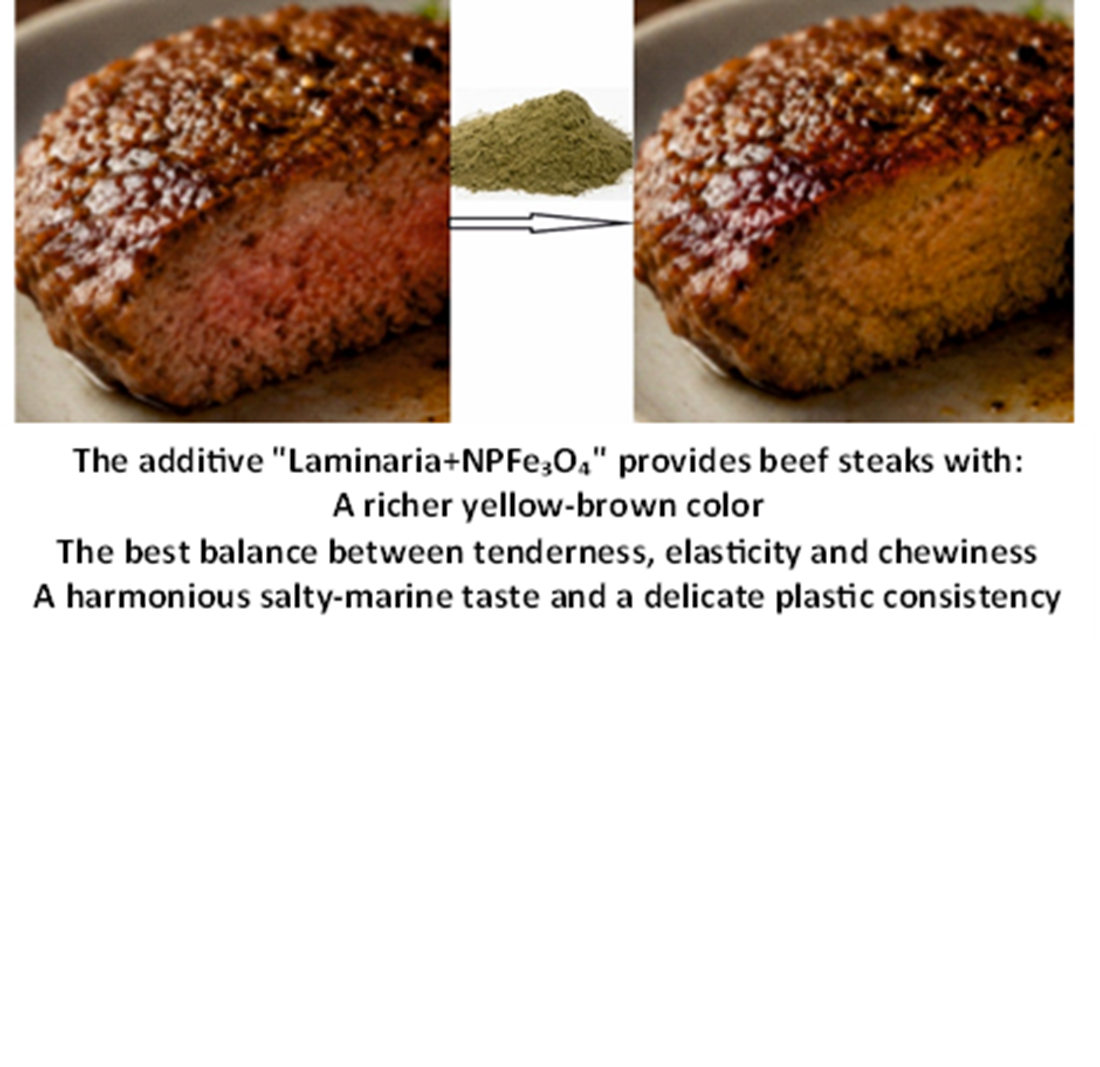
Об’єкт дослідження – якість м’ясних січених виробів (яловичих біфштексів), збагачених наноструктурованою харчовою добавкою комбінованого складу «Laminaria+NPFe₃O₄». Проблема, що вирішувалася, – стабілізація поліфазної структури та покращення споживних властивостей м’ясних січених виробів. Встановлено, що внесення добавки у кількості 0,1–0,3 % покращує смак, аромат і консистенцію біфштексів, сприяє формуванню більш насиченого та природного забарвлення, а також підвищує твердість, пружність, еластичність і жувальну здатність виробів. За додавання харчової добавки «Laminaria+NPFe₃O₄» світлота виробів зменшувалася у 1,02–1,06 раза, а показники b* та H* зростали відповідно у 1,16–1,42 та 1,08–1,43 раза. Оптимальною концентрацією добавки визначено 0,2 %.
Встановлені закономірності впливу наноструктурованої харчової добавки комбінованого складу «Laminaria+NPFe₃O₄», що поєднує компоненти бурої водорості Laminaria sp. та наночастинки оксиду заліза Fe₃O₄, на властивості яловичих біфштексів (на трансформацію пігментів, формування текстурних характеристик і сенсорного профілю). Показано синергічний характер дії компонентів добавки, який забезпечує комплексний вплив на якісні характеристики м’ясних січених виробів, та обґрунтовано її раціональну концентрацію на рівні 0,2 % від маси рецептурної суміші.
Сфера практичного застосування результатів дослідження – у технології виробництва м’ясних січених виробів. Очікувані ефекти від впровадження НХДКС «Laminaria+NPFe₃O₄» – покращення органолептичних і текстурних характеристик продукції та розширення асортименту функціональних м’ясних продуктів підвищеної біологічної цінності
Посилання
- Tsykhanovska, I., Stabnikova, O., Yevlash, V., Gubsky, S. (2025). Wild Edible Brown Algae Laminaria and Iron Oxide Nanoparticles as a Combined Food Additive. Wild Edible Plants, 294–320. https://doi.org/10.1201/9781003486794-11
- Jiménez-Colmenero, F., Carballo, J., Cofrades, S. (2001). Healthier meat and meat products: their role as functional foods. Meat Science, 59 (1), 5–13. https://doi.org/10.1016/s0309-1740(01)00053-5
- Peñalver, R., Lorenzo, J. M., Ros, G., Amarowicz, R., Pateiro, M., Nieto, G. (2020). Seaweeds as a Functional Ingredient for a Healthy Diet. Marine Drugs, 18 (6), 301. https://doi.org/10.3390/md18060301
- Siladji, C., Djordjevic, V., Milijasevic, J. B., Heinz, V., Terjung, N., Sun, W., Tomasevic, I. (2024). Micro- and Macroalgae in Meat Products. Foods, 13 (6), 826. https://doi.org/10.3390/foods13060826
- Kumari, A., Chauhan, A. K. (2021). Iron nanoparticles as a promising compound for food fortification in iron deficiency anemia: a review. Journal of Food Science and Technology, 59 (9), 3319–3335. https://doi.org/10.1007/s13197-021-05184-4
- Ameta, S. K., Rai, A. K., Hiran, D., Ameta, R., Ameta, S. C. (2020). Use of Nanomaterials in Food Science. Biogenic Nano-Particles and Their Use in Agro-Ecosystems, 457–488. https://doi.org/10.1007/978-981-15-2985-6_24
- Perez‐Santaescolastica, C., Goemaere, O., Hanskens, J., Lorenzo, J. M., Fraeye, I. (2019). Effect of stabiliser classes (animal proteins, vegetable proteins, starches, hydrocolloids and dietary fibre) on the physicochemical properties of a model lean meat product. International Journal of Food Science & Technology, 55 (3), 970–977. https://doi.org/10.1111/ijfs.14354
- Tsykhanovska, I., Skurikhina, L., Evlash, V., Pavlotska, L. (2019). Influence of food additive “Magnetofood” on physical and chemical parameters, functional properties of model minced meat systems. Food Science and Technology, 13 (2). https://doi.org/10.15673/fst.v13i2.1389
- Tsykhanovska, I., Stabnikova, O., Dorohovich, V., Lytvyn, O., Hetman, P. (2025). Meat cutlets with iron oxide nanoparticles and alga Laminaria japonica. Ukrainian Food Journal, 14 (2), 238–258. https://doi.org/10.24263/2304-974x-2025-14-2-5
- Tsykhanovska, I., Stabnikova, O., Oliinyk, S., Lazarieva, T., Gubsky, S. (2024). Сombined food additive based on iron oxide nanoparticles and кombu in a rye-wheat bread technology. Ukrainian Food Journal, 13 (3), 576–596. https://doi.org/10.24263/2304-974x-2024-13-3-10
- McClements, D. J. (2020). Nanotechnology Approaches for Improving the Healthiness and Sustainability of the Modern Food Supply. ACS Omega, 5 (46), 29623–29630. https://doi.org/10.1021/acsomega.0c04050
- Mustafa, F., Andreescu, S. (2020). Nanotechnology-based approaches for food sensing and packaging applications. RSC Advances, 10 (33), 19309–19336. https://doi.org/10.1039/d0ra01084g
- Yao, H., Liu, W., Lin, L., Lu, Y., Gan, J.-H., Liu, Y. et al. (2021). Micro-nano particle formation and transformation mechanisms of broth in meat braised processing. Food Chemistry, 342, 128383. https://doi.org/10.1016/j.foodchem.2020.128383
- Liu, S., Yu, B., Wang, S., Shen, Y., Cong, H. (2020). Preparation, surface functionalization and application of Fe3O4 magnetic nanoparticles. Advances in Colloid and Interface Science, 281, 102165. https://doi.org/10.1016/j.cis.2020.102165
- Zhang, J.-Q., Chen, C., Fu, X., Liu, R.-H. (2020). A study on the Fe3O4@Fructus mori L. polysaccharide particles with enhanced antioxidant activity and bioavailability. Food & Function, 11 (3), 2268–2278. https://doi.org/10.1039/c9fo03047f
- dos Santos, P. P., Andrade, L. D. A., Flôres, S. H., Rios, A. D. O. (2018). Nanoencapsulation of carotenoids: a focus on different delivery systems and evaluation parameters. Journal of Food Science and Technology, 55 (10), 3851–3860. https://doi.org/10.1007/s13197-018-3316-6
- Wang, L., Huang, X., Wang, C., Tian, X., Chang, X., Ren, Y., Yu, S. (2021). Applications of surface functionalized Fe3O4 NPs-based detection methods in food safety. Food Chemistry, 342, 128343. https://doi.org/10.1016/j.foodchem.2020.128343
- Cofrades, S., López-López, I., Solas, M. T., Bravo, L., Jiménez-Colmenero, F. (2008). Influence of different types and proportions of added edible seaweeds on characteristics of low-salt gel/emulsion meat systems. Meat Science, 79 (4), 767–776. https://doi.org/10.1016/j.meatsci.2007.11.010
- Cofrades, S., Benedí, J., Garcimartin, A., Sánchez-Muniz, F. J., Jimenez-Colmenero, F. (2017). A comprehensive approach to formulation of seaweed-enriched meat products: From technological development to assessment of healthy properties. Food Research International, 99, 1084–1094. https://doi.org/10.1016/j.foodres.2016.06.029
- Agregán, R., Munekata, P. E., Domínguez, R., Carballo, J., Franco, D., Lorenzo, J. M. (2017). Proximate composition, phenolic content and in vitro antioxidant activity of aqueous extracts of the seaweeds Ascophyllum nodosum, Bifurcaria bifurcata and Fucus vesiculosus. Effect of addition of the extracts on the oxidative stability of canola oil under accelerated storage conditions. Food Research International, 99, 986–994. https://doi.org/10.1016/j.foodres.2016.11.009
- Tibbetts, S. M., Milley, J. E., Lall, S. P. (2016). Nutritional quality of some wild and cultivated seaweeds: Nutrient composition, total phenolic content and in vitro digestibility. Journal of Applied Phycology, 28 (6), 3575–3585. https://doi.org/10.1007/s10811-016-0863-y
- Kryzhova, Y., Antonuk, M., Stabnikov, V., Stabnikova, O. (2021). Stability of selenium and iodine in the functional meat products prepared with seaweeds under different cooking procedures. Ukrainian Food Journal, 10 (1), 136–144. https://doi.org/10.24263/2304-974x-2021-10-1-12
- Grabež, V., Devle, H., Kidane, A., Mydland, L. T., Øverland, M., Ottestad, S. et al. (2023). Sugar Kelp (Saccharina latissima) Seaweed Added to a Growing-Finishing Lamb Diet Has a Positive Effect on Quality Traits and on Mineral Content of Meat. Foods, 12 (11), 2131. https://doi.org/10.3390/foods12112131
- Grabež, V., Coll-Brasas, E., Fulladosa, E., Hallenstvedt, E., Håseth, T., Øverland, M. et al. (2022). Seaweed Inclusion in Finishing Lamb Diet Promotes Changes in Micronutrient Content and Flavour-Related Compounds of Raw Meat and Dry-Cured Leg (Fenalår). Foods, 11 (7), 1043. https://doi.org/10.3390/foods11071043
- Gomez-Zavaglia, A., Prieto Lage, M. A., Jimenez-Lopez, C., Mejuto, J. C., Simal-Gandara, J. (2019). The Potential of Seaweeds as a Source of Functional Ingredients of Prebiotic and Antioxidant Value. Antioxidants, 8 (9), 406. https://doi.org/10.3390/antiox8090406
- Gunathilake, T., Akanbi, T. O., Suleria, H. A. R., Nalder, T. D., Francis, D. S., Barrow, C. J. (2022). Seaweed Phenolics as Natural Antioxidants, Aquafeed Additives, Veterinary Treatments and Cross-Linkers for Microencapsulation. Marine Drugs, 20 (7), 445. https://doi.org/10.3390/md20070445
- Rajapakse, N., Kim, S.-K. (2011). Nutritional and Digestive Health Benefits of Seaweed. Marine Medicinal Foods - Implications and Applications, Macro and Microalgae, 17–28. https://doi.org/10.1016/b978-0-12-387669-0.00002-8
- Auer, J., Kim, A., Heupl, S., Mihnea, M., Öström, Å., Niimi, J., Langton, M. (2025). Consumer preferences of plant-based minced meat analogs: Linking physico-chemical properties, structural features, and sensory attributes. Food Structure, 46, 100492. https://doi.org/10.1016/j.foostr.2025.100492
- Prasol, I., Golembovskaya, N., Slobodyanyuk, N., Ochkolyas, E. (2017). Sensory analysis of semi-finished minced fish products by the flavour profile method. Scientific Messenger of LNU of Veterinary Medicine and Biotechnologies. Series «Food Technologies», 19 (80), 83–87. https://doi.org/10.15421/nvlvet8017
- Luo, M. R. (2015). CIELAB. Encyclopedia of Color Science and Technology, 1–7. https://doi.org/10.1007/978-3-642-27851-8_11-1
- Faustman, C., Suman, S. P., Ramanathan, R. (2023). The eating quality of meat: I Color. Lawrie’s Meat Science, 363–392. https://doi.org/10.1016/b978-0-323-85408-5.00023-6
- Suman, S. P., Nair, M. N., Joseph, P., Hunt, M. C. (2016). Factors influencing internal color of cooked meats. Meat Science, 120, 133–144. https://doi.org/10.1016/j.meatsci.2016.04.006
- Godschalk-Broers, L., Sala, G., Scholten, E. (2022). Meat Analogues: Relating Structure to Texture and Sensory Perception. Foods, 11 (15), 2227. https://doi.org/10.3390/foods11152227
- Bakhsh, A., Lee, S.-J., Lee, E.-Y., Sabikun, N., Hwang, Y.-H., Joo, S.-T. (2021). A Novel Approach for Tuning the Physicochemical, Textural, and Sensory Characteristics of Plant-Based Meat Analogs with Different Levels of Methylcellulose Concentration. Foods, 10 (3), 560. https://doi.org/10.3390/foods10030560
- Tsykhanovska, I. T., Lazarieva, T., Alexandrov, O., Riabchykov, M., Koval, A., Bryzytska, O. (2026). Physico-Chemical Study on the Mechanism of Interaction Between Divalent and Trivalent Iron Double Oxide Nanoparticles With Fibrillar Protein-Gelatin. Chemistry & Chemical Technology, 20 (1), 37–52. https://doi.org/10.23939/chcht20.01.037
##submission.downloads##
Опубліковано
Як цитувати
Номер
Розділ
Ліцензія
Авторське право (c) 2026 Iryna Tsykhanovska, Lidiіa Tovma, Oleh Lytvyn, Alexandr Alexandrov, Tetiana Lazarieva, Viktoriia Yevlash, Oleh Lushchenko, Ihor Morozov, Sergiy Kaplun, Vasyl Vakuliuk

Ця робота ліцензується відповідно до Creative Commons Attribution 4.0 International License.
Закріплення та умови передачі авторських прав (ідентифікація авторства) здійснюється у Ліцензійному договорі. Зокрема, автори залишають за собою право на авторство свого рукопису та передають журналу право першої публікації цієї роботи на умовах ліцензії Creative Commons CC BY. При цьому вони мають право укладати самостійно додаткові угоди, що стосуються неексклюзивного поширення роботи у тому вигляді, в якому вона була опублікована цим журналом, але за умови збереження посилання на першу публікацію статті в цьому журналі.
Ліцензійний договір – це документ, в якому автор гарантує, що володіє усіма авторськими правами на твір (рукопис, статтю, тощо).
Автори, підписуючи Ліцензійний договір з ПП «ТЕХНОЛОГІЧНИЙ ЦЕНТР», мають усі права на подальше використання свого твору за умови посилання на наше видання, в якому твір опублікований. Відповідно до умов Ліцензійного договору, Видавець ПП «ТЕХНОЛОГІЧНИЙ ЦЕНТР» не забирає ваші авторські права та отримує від авторів дозвіл на використання та розповсюдження публікації через світові наукові ресурси (власні електронні ресурси, наукометричні бази даних, репозитарії, бібліотеки тощо).
За відсутності підписаного Ліцензійного договору або за відсутністю вказаних в цьому договорі ідентифікаторів, що дають змогу ідентифікувати особу автора, редакція не має права працювати з рукописом.
Важливо пам’ятати, що існує і інший тип угоди між авторами та видавцями – коли авторські права передаються від авторів до видавця. В такому разі автори втрачають права власності на свій твір та не можуть його використовувати в будь-який спосіб.