Development of coarse corn flour technology for baking functional bread
DOI:
https://doi.org/10.15587/1729-4061.2026.365661Keywords:
corn flour, coarse flour, water absorption capacity, proteins, acidity, doughAbstract
The object of the study is coarse corn flour for baking bread in the Republic of Kazakhstan. The problem to be solved is following. When using bakery products made from premium wheat flour and other varieties that contain gluten, it is possible to say that there is no health and functional direction, only the value of its nutritional value and maintaining its satiety. A promising area is the development of special types of bakery and cereal products made from coarse corn flour containing nutritious and biologically active substances: dietary fibers, fats, carbohydrates, vitamins, enzymes, micro- and macronutrients and functional proteins.
As a result of the study, "Kazakhstanska" corn varieties with coarse grinding were studied and a comparative analysis with a control sample of wheat flour of water absorption capacity, in which coarse corn and the control sample showed the same result of 55.6%, with a combined change slightly.
It was found that in corn flour, of all the protein fractions, the water-soluble one accounts for only 11.63% of the total amount of protein. The protein part is made up of prolamins (20.17%) and glutelins (29.20%), which are soluble in alcohol and in an alkaline solution. Corn flour contains more insoluble protein than wheat flour – 2,367 and 1,044, respectively.
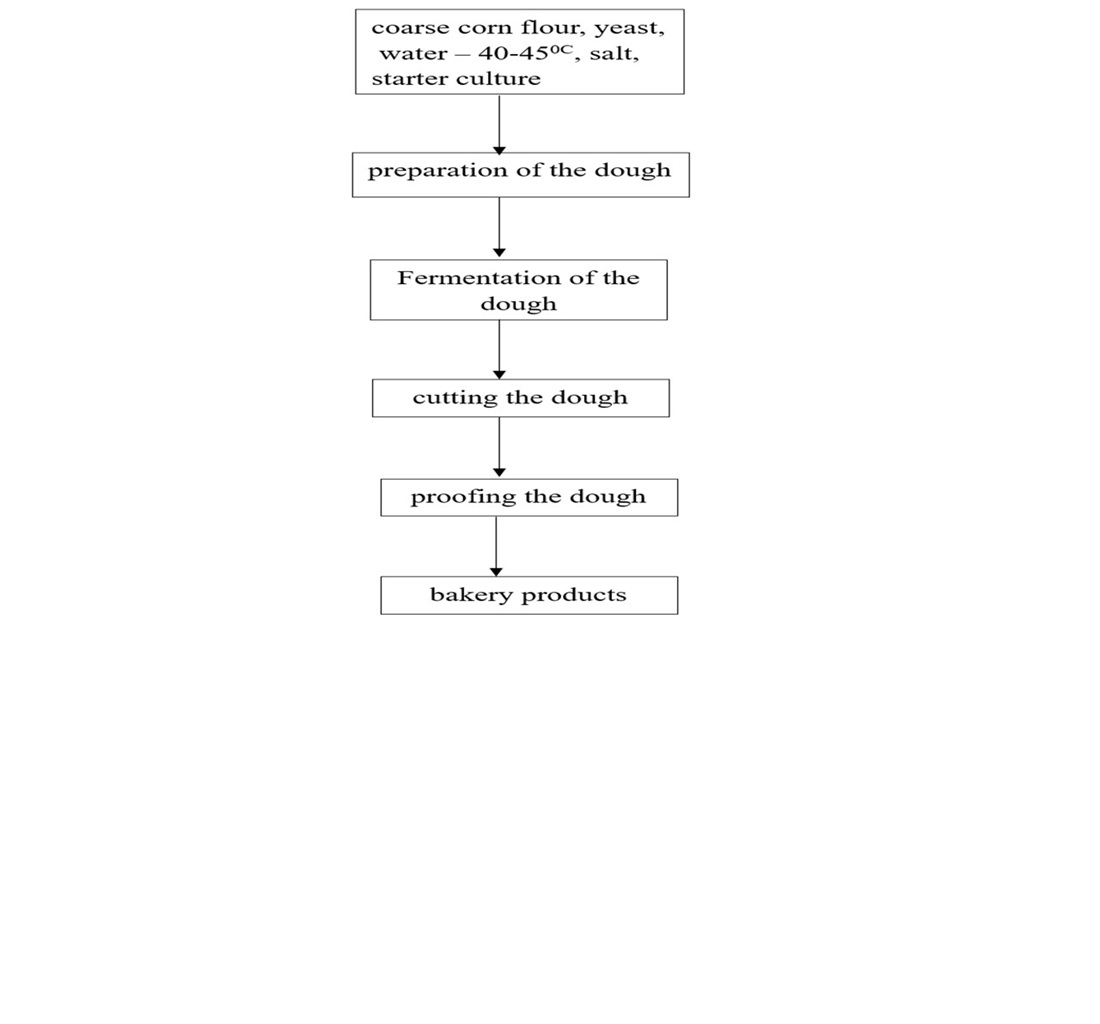
Corn bread made from coarse flour without admixture of wheat flour, prepared by the baking method, meets the requirements of consumers in taste and aroma, and due to this, the formulation technology has been developed. Considering this, the developed recipe technology is tailored specifically to the "Kazakhstanska" variety, which will allow the production of bread products from coarse corn flour for functional and dietary nutrition
References
- Aidarova, A. B., Abdikhalyk, S. M. (2022). Formation of demand, consumption of bread and bakery products in the Republic of Kazakhstan. Problems of AgriMarket, 1, 113–119. https://doi.org/10.46666/2022-1.2708-9991.13
- Mashanova, N. S., Tokmakhanbet, G. B. (2021). Improvement of gluten-free bread production technology. The Journal of Almaty Technological University, 1, 11–16. https://doi.org/10.48184/2304-568x-2021-1-11-16
- Alpaslan, M., Hayta, M. (2006). The effects of flaxseed, soy and corn flours on the textural and sensory properties of a bakery product. Journal of Food Quality, 29 (6), 617–627. https://doi.org/10.1111/j.1745-4557.2006.00099.x
- Niță, S., Niță, L., Imbrea, F., Hînda, I. A., Bătrîna, Ș., Botoș, L. (2024). Study of quantitative and qualitative indicators in wheat. Sci. Papers Ser. A Agron., 67, 581–586. Available at: https://www.agronomyjournal.usamv.ro/pdf/2024/issue_1/Art73.pdf
- Shynkaruk, L., Lykhochvor, V. (2021). Influence of fertilization and foliar feeding on maize grain qualitative indicators. Ukrainian Journal of Ecology, 11 (6), 113–116. Available at: https://www.ujecology.com/articles/influence-of-fertilization-and-foliar-feeding-on-maize-grain-qualitative-indicators.pdf
- Gül, H., Özer, M. S., Dizlek, H. (2009). Improvement of the wheat and corn bran bread quality by using glucose oxidase and hexose oxidase. Journal of Food Quality, 32 (2), 209–223. https://doi.org/10.1111/j.1745-4557.2009.00246.x
- Seyyedcheraghi, K. (2018). The effect of the using corn flour level and additive type on quality of corn bread. Middle East Journal of Science, 4 (2), 81–98. https://doi.org/10.23884/mejs.2018.4.2.04
- Huang, S. D. (1999). Wheat products: 2. Breads, cakes, cookies, pastries and dumplings. Asian foods: Science and technology, 71–109. Available at: https://books.google.kz/books?hl=ru&lr=&id=H0hZDwAAQBAJ&oi=fnd&pg=PA71&dq=8.%
- Sharma, G. M., Khuda, S. E., Pereira, M., Slate, A., Jackson, L. S., Pardo, C. et al. (2013). Development of an Incurred Cornbread Model for Gluten Detection by Immunoassays. Journal of Agricultural and Food Chemistry, 61 (49), 12146–12154. https://doi.org/10.1021/jf404072x
- Panfil, P., Dorica, B. O. T. Ă. U., Sorin, C., Emilian, M., Ersilia, A., Iosif, G. (2014). Biochemical characterization of flour obtained from germinated cereals (wheat, barley and oat). Romanian Biotechnological Letters, 19 (5), 9772–9777. Available at: https://www.researchgate.net/profile/Sorin-Ciulca/publication/288121308
- Curic, D., Novotni, D., Bauman, I., Kricka, T., Dugum, J. (2009). Optimization of extrusion cooking of cornmeal as raw material for bakery products. Journal of Food Process Engineering, 32 (2), 294–317. https://doi.org/10.1111/j.1745-4530.2007.00217.x
- Mailybayeva, E., Imanbayev, A., Yessirkep, G., Mussayeva, S., Shingissov, A. (2022). Developing a procedure for controlling the rheological properties of dough during its kneading based on a parametric model. Eastern-European Journal of Enterprise Technologies, 3 (11 (117)), 31–38. https://doi.org/10.15587/1729-4061.2022.257323
- Lavers, A., Kalmykova, Y., Rosado, L., Oliveira, F., Laurenti, R. (2017). Selecting representative products for quantifying environmental impacts of consumption in urban areas. Journal of Cleaner Production, 162, 34–44. https://doi.org/10.1016/j.jclepro.2017.06.030
- Ezekiel, R., Singh, N. (2011). Use of Potato Flour in Bread and Flat Bread. Flour and Breads and Their Fortification in Health and Disease Prevention, 247–259. https://doi.org/10.1016/b978-0-12-380886-8.10023-6
- Moreno-Rivas, S. C., Medina-Rodríguez, C. L., Torres-Chávez, P. I., Ramírez-Wong, B., Platt-Lucero, L. C. (2014). Changes in the Solubility of Corn Proteins through Interaction with the Arabinoxylans in Extruded Nixtamalized Corn Flour Treated with Xylanase. Plant Foods for Human Nutrition, 69 (2), 148–154. https://doi.org/10.1007/s11130-014-0411-3
- Schober, T. J., Bean, S. R., Boyle, D. L. (2007). Gluten-Free Sorghum Bread Improved by Sourdough Fermentation: Biochemical, Rheological, and Microstructural Background. Journal of Agricultural and Food Chemistry, 55 (13), 5137–5146. https://doi.org/10.1021/jf0704155
- Tariverdi, S., Gharekhani, M. (2025). Effect of Sourdough Made With Lactobacillus amylovorus and Lactobacillus brevis Starters on the Quality Characteristics of Gluten‐Free Bread Based on Corn Flour. Journal of Food Processing and Preservation, 2025 (1). https://doi.org/10.1155/jfpp/6662199
Downloads
Published
How to Cite
Issue
Section
License
Copyright (c) 2026 Alimzhan Imanbayev, Zeinep Nurseitova, Khojiakbar Abdurahimov, Gulnoza Djakhangirova, Azim Malikov

This work is licensed under a Creative Commons Attribution 4.0 International License.
The consolidation and conditions for the transfer of copyright (identification of authorship) is carried out in the License Agreement. In particular, the authors reserve the right to the authorship of their manuscript and transfer the first publication of this work to the journal under the terms of the Creative Commons CC BY license. At the same time, they have the right to conclude on their own additional agreements concerning the non-exclusive distribution of the work in the form in which it was published by this journal, but provided that the link to the first publication of the article in this journal is preserved.
A license agreement is a document in which the author warrants that he/she owns all copyright for the work (manuscript, article, etc.).
The authors, signing the License Agreement with TECHNOLOGY CENTER PC, have all rights to the further use of their work, provided that they link to our edition in which the work was published.
According to the terms of the License Agreement, the Publisher TECHNOLOGY CENTER PC does not take away your copyrights and receives permission from the authors to use and dissemination of the publication through the world's scientific resources (own electronic resources, scientometric databases, repositories, libraries, etc.).
In the absence of a signed License Agreement or in the absence of this agreement of identifiers allowing to identify the identity of the author, the editors have no right to work with the manuscript.
It is important to remember that there is another type of agreement between authors and publishers – when copyright is transferred from the authors to the publisher. In this case, the authors lose ownership of their work and may not use it in any way.








